Ever such Rumours as APS-C, Low Density, Low MP sensors?...

I'm really not convinced that pixel size has as much to do with image noise as some say it does. Over the years as sensor resolution has continued to rise, high ISO noise has also gone down.

I actually suspect that the high ISO capabilities of current full frame cameras have as much to do with the processor as any aspect of the sensor. There are also many things that can be improved irrespective of pixel size, maybe Canon saves their best designs, materials and components for high end models. They cripple other things commonly enough, why not specifically produce worse low light on low end models?
Lower resolution means you can do more processing per image. If it is mostly processing power making the difference then a 40MP camera with the same processor as the 1Dx should have the same ISO quality at half the burst speed. I'm looking forward to seeing the results from Canon's first big MP full frame.
 
Upvote 0
9VIII said:
I'm really not convinced that pixel size has as much to do with image noise as some say it does. Over the years as sensor resolution has continued to rise, high ISO noise has also gone down.

I actually suspect that the high ISO capabilities of current full frame cameras have as much to do with the processor as any aspect of the sensor. There are also many things that can be improved irrespective of pixel size, maybe Canon saves their best designs, materials and components for high end models. They cripple other things commonly enough, why not specifically produce worse low light on low end models?
Lower resolution means you can do more processing per image. If it is mostly processing power making the difference then a 40MP camera with the same processor as the 1Dx should have the same ISO quality at half the burst speed. I'm looking forward to seeing the results from Canon's first big MP full frame.

The readout rate is only going to affect read noise levels. Slower frequency components will introduce less noise of their own into the signal. If you look into astrophotography CCD cameras, they have very low readout rates, often reading fewer megapixels per second than there are in-total in the sensor. This, along with cooling by TEC, aims to reduce read noise (both dark current by reducing temperature, and high frequency noise by reducing readout rate (i.e. using slower frequency ADC units and the like.))

Read noise only affects the shadows, however. Overall noise is the result of the randomness with which photons strike photodiodes and free an electron. Photon shot noise, the primary source of high ISO noise, follows a Poisson distribution. The only link this has with the electronics of the sensor is via quantum efficiency. Increase Q.E., and you increase the ratio of incident photons to an increase in charge by one electron. Beyond that, photon shot noise is not an electrical phenomena, it is a physical and natural phenomena. Q.E. is already relatively high in sensors...most have around 50% give or take 5% or so. To reduce high ISO noise (at any ISO) by a factor of two, one must double Q.E. That means we can only half high ISO noise once (at best), but that would require 100% Q.E. (and not even astro cams with low frequency readout (i.e. 0.3 frames per second) and three-stage water-cooled TEC with a 70°C delta-T can achieve that!)

That leaves only one other option for reducing noise at high ISO: pixel size. Photon shot noise is the result of the randomness with which photons strike pixels. An increase in pixel size is effectively the same thing as an analog averaging algorithm...larger area, more incident photons per pixel, less total variation across pixels. There is absolutely no question that larger pixels result in less noise (especially at high ISO, where read noise is already a minimal contribution of total noise, far, far less than it is at lower ISO...for example, the 1D X has 2.2e- read noise at ISO 3200, but 38.2e- at ISO 100! The 5D III has 3.1e- at ISO 3200, and 33.1e- at ISO 100. Read noise is a negligible amount at high ISO.

However, contrast the charge saturation point of larger pixels of FF with the smaller pixels of APS-C, and there is a very clear benefit to FF sensors. The 1D X has 3069e- and 10.5 stops DR at ISO 3200. The 5D III has 2179e- and 9.5 stops DR at ISO 3200, where as the 7D has 1067e- and 8.5 stops DR at ISO 3200. The 7D has 2.9e- read noise at ISO 3200, approximately the same negligible amount as the 1D X and 5D III. The 1D X has a three-fold noise advantage AND a two-stops dynamic range advantage at the same ISO, and that is all thanks to the larger physical photodiode area. The 5D III has a clear two-fold noise advantage over the 7D.

The logical next step is to say the 70D has better pixels. The 70D has better pixels at LOW ISO (a good thing, certainly for Canon) thanks to a higher FWC (26726e- vs. 20187e-), however it's smaller pixel area than the 7D still results in a lower saturation point at higher ISO. The 70D gets a mere 999e- charge saturation at ISO 3200. It has a slight 0.2 stop DR advantage thanks to ever so slightly less read noise, but that difference is within the margin of error of Canon's metering sensor.

When it comes to high ISO image quality, there is absolutely no substitute for total photodiode area. One either increases pixel size, or one could, as I mentioned before, possibly layer photodiodes in each pixel. Three times the photodiodes in depth, and one could potentially double the sensitivity of APS-C pixels. Combined with BSI, and one could make APS-C pixels pretty small and still have the IQ be acceptable, even quite good. But, one could also always employ the same technology in FF sensor pixels...so APS-C will never have the IQ advantage. Except in the case of very reach-limited scenarios...no amount of pixel processing can really overcome the benefit of 4x more pixels. ;)
 
Upvote 0
Don Haines said:
Sporgon said:
I half wonder if Canon would have the courage to use a lower mp in the up coming 7DII in order to increase high ISO performance and shooting speed. If the new camera does turn out to be a 'budget' pro action camera the high ISO performance would be useful for indoor sports.

I've owned both the 650D and 1100D alongside my FF bodies, and IMO the lower mp camera gave better overall 'IQ'. in fact the 1100D can produce alarmingly good IQ. I say 'alarming' because the 1100D cost about £250 and the FF £2500.

I see that the new 1200D uses the ubiquitous 18mp sensor. A pity IMO, but then I guess the vast majority of customers for that camera would disagree; the more mp the better.

So are we seeing Canon steering the customer towards 'high mp = consumer, low mp = pro' ?( Bearing in mind 'low' is still actually high resolution).If so the new 'pro' grade 7DII might be lower mp.
I kind of doubt it. One of the big reasons for the 7d is to get more pixels on target.... If the pixel size becomes that of a FF sensor (or larger), that advantage disappears and with it a significant portion of the buying public.

I shoot birds, usually in good light, and need all the pixels on target I can get. If the 7D2 had the same size pixels (8 megapixels) as the 5D3, there would be no debate as to getting A or B or possibly both... It would be 5D3 all the way.

I don't really agree because the crop sensors overwhelming advantage is its cheaper price rather than more pixels on target. The crop is disproportionately cheaper, most probably because the manufactures keep FF expensive. So for many it wouldn't be 5DIII all the way because they would not be able to afford one.

I'm not disputing the case for more pixels on target; it's just that that can be an additional benefit along with the cheaper system.

I wasn't referring to an 8 mp camera either, more in the region of 14-16, which in my opinion is high resolution anyway. You'd have to have around a 40 mp FF to match even that. My thinking was high ISO and speed, something where the new 7DII will have to excel over the likes of the 70D. BUt it's main 'advantage' is going to be the 'high end' ergonomics, which was my original point, but you will have to pay 50% more than the 70D for it.

I still maintain the 7DII will come in slightly under the RRP of the 6D, so it may well be more expensive than the 'budget' FF at inception.
 
Upvote 0
Sporgon said:
Don Haines said:
Sporgon said:
I half wonder if Canon would have the courage to use a lower mp in the up coming 7DII in order to increase high ISO performance and shooting speed. If the new camera does turn out to be a 'budget' pro action camera the high ISO performance would be useful for indoor sports.

I've owned both the 650D and 1100D alongside my FF bodies, and IMO the lower mp camera gave better overall 'IQ'. in fact the 1100D can produce alarmingly good IQ. I say 'alarming' because the 1100D cost about £250 and the FF £2500.

I see that the new 1200D uses the ubiquitous 18mp sensor. A pity IMO, but then I guess the vast majority of customers for that camera would disagree; the more mp the better.

So are we seeing Canon steering the customer towards 'high mp = consumer, low mp = pro' ?( Bearing in mind 'low' is still actually high resolution).If so the new 'pro' grade 7DII might be lower mp.
I kind of doubt it. One of the big reasons for the 7d is to get more pixels on target.... If the pixel size becomes that of a FF sensor (or larger), that advantage disappears and with it a significant portion of the buying public.

I shoot birds, usually in good light, and need all the pixels on target I can get. If the 7D2 had the same size pixels (8 megapixels) as the 5D3, there would be no debate as to getting A or B or possibly both... It would be 5D3 all the way.

I don't really agree because the crop sensors overwhelming advantage is its cheaper price rather than more pixels on target. The crop is disproportionately cheaper, most probably because the manufactures keep FF expensive. So for many it wouldn't be 5DIII all the way because they would not be able to afford one.

I'm not disputing the case for more pixels on target; it's just that that can be an additional benefit along with the cheaper system.

I wasn't referring to an 8 mp camera either, more in the region of 14-16, which in my opinion is high resolution anyway. You'd have to have around a 40 mp FF to match even that. My thinking was high ISO and speed, something where the new 7DII will have to excel over the likes of the 70D. BUt it's main 'advantage' is going to be the 'high end' ergonomics, which was my original point, but you will have to pay 50% more than the 70D for it.

I still maintain the 7DII will come in slightly under the RRP of the 6D, so it may well be more expensive than the 'budget' FF at inception.
I did say " one of the advantages" :)

I agree that price is the big one, and based on the T3i being the big seller for Canon, it looks like the buying public agrees with you too.
 
Upvote 0
Don Haines said:
Sporgon said:
Don Haines said:
Sporgon said:
I half wonder if Canon would have the courage to use a lower mp in the up coming 7DII in order to increase high ISO performance and shooting speed. If the new camera does turn out to be a 'budget' pro action camera the high ISO performance would be useful for indoor sports.

I've owned both the 650D and 1100D alongside my FF bodies, and IMO the lower mp camera gave better overall 'IQ'. in fact the 1100D can produce alarmingly good IQ. I say 'alarming' because the 1100D cost about £250 and the FF £2500.

I see that the new 1200D uses the ubiquitous 18mp sensor. A pity IMO, but then I guess the vast majority of customers for that camera would disagree; the more mp the better.

So are we seeing Canon steering the customer towards 'high mp = consumer, low mp = pro' ?( Bearing in mind 'low' is still actually high resolution).If so the new 'pro' grade 7DII might be lower mp.
I kind of doubt it. One of the big reasons for the 7d is to get more pixels on target.... If the pixel size becomes that of a FF sensor (or larger), that advantage disappears and with it a significant portion of the buying public.

I shoot birds, usually in good light, and need all the pixels on target I can get. If the 7D2 had the same size pixels (8 megapixels) as the 5D3, there would be no debate as to getting A or B or possibly both... It would be 5D3 all the way.

I don't really agree because the crop sensors overwhelming advantage is its cheaper price rather than more pixels on target. The crop is disproportionately cheaper, most probably because the manufactures keep FF expensive. So for many it wouldn't be 5DIII all the way because they would not be able to afford one.

I'm not disputing the case for more pixels on target; it's just that that can be an additional benefit along with the cheaper system.

I wasn't referring to an 8 mp camera either, more in the region of 14-16, which in my opinion is high resolution anyway. You'd have to have around a 40 mp FF to match even that. My thinking was high ISO and speed, something where the new 7DII will have to excel over the likes of the 70D. BUt it's main 'advantage' is going to be the 'high end' ergonomics, which was my original point, but you will have to pay 50% more than the 70D for it.

I still maintain the 7DII will come in slightly under the RRP of the 6D, so it may well be more expensive than the 'budget' FF at inception.
I did say " one of the advantages" :)

Yes you did ! :)

In reality I'm sure the odds are stacked against the 7DII being a lower mp camera; Canon will probably use it to introduce a 22 mp one, or something like that. But I'm not sure it will be better for it.
 
Upvote 0
Khufu said:
Has it ever been rumored for their to be prototypes in testing of what would essentially be a physical 1.6x crop of a FF sensor, allowing the ISO capabilities of the 6D/5D3 in, say, an EOS M or xxD body?

I'd love me an EOS M with 6-9 megapixels of low light goodness!

Thoughts?

Would this be stupid-expensive to develop? I can imagine the right advertising campaign could sell the concept of fewer pixels for low light, arty, shallow DoF shooting with the 22mm f/2 with results that're still 2-4x larger than necessary for Facebook ;)

I don't think it will happen, and is not really necessary either. What you are proposing is basically downsampling a 18 MP sensor by a factor of 2. With good software you are essentially binning 2 pixels into one, and thus reducing noise. It's perhaps not as effective as a hardware 9 MP sensor, but it sure will not be a quantum leap better. The lower DR of the smaller pixels still exists though, but you were asking about low light.
 
Upvote 0
Khufu said:
Has it ever been rumored for their to be prototypes in testing of what would essentially be a physical 1.6x crop of a FF sensor, allowing the ISO capabilities of the 6D/5D3 in, say, an EOS M or xxD body?

I'd love me an EOS M with 6-9 megapixels of low light goodness!

Thoughts?

Would this be stupid-expensive to develop? I can imagine the right advertising campaign could sell the concept of fewer pixels for low light, arty, shallow DoF shooting with the 22mm f/2 with results that're still 2-4x larger than necessary for Facebook ;)

Your post shows a fundamental misunderstanding of how cameras work.

There is no difference between low light performance when adding more pixels in the range of pixels that DSLR's typically have. The issue with more pixels = more noise is only relevant to ultra compact sensors, like smartphones.

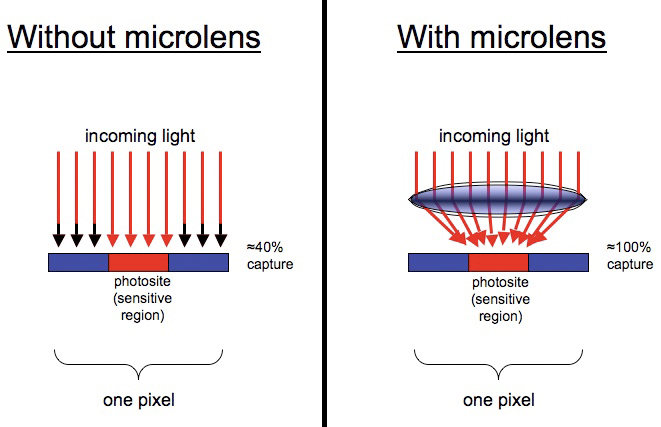
There USED to be an issue with more pixels adding more noise BEFORE micro lenses were invented.

microlens.jpg


Let's just do the math.

According to DXO Mark's sensor tests. The Canon 70D which has 40.4 megapixels which are binned into 20.2 mp in files and has ISO performance that is equal at 2.5 times it's ISO rating compared to the 5D Mark III, which has 22.3 megapixels. The 5DIII has around 5 times less pixel density than the 70D.

So ISO 1000 on the 70D = same noise as ISO 2500 on the 5D Mark III.

The 70D has a sensor area that is 1/2.5 times that of the 5D Mark III. Wait a second... isn't that the exact difference between the 70D and the 5D Mark III's ISO? Yes it is!

Because the sensor is 2.5 times smaller the GAIN on the smaller sensor has to be 2.5 times higher for a given illumination to get the same exposure. Meaning if you cropped the 5D Mark III's sensor to APS-C ISO 2500 would now be called ISO 1000, even though the sensor gain is identical.

With current sensor technology there is no meaningful difference between the noise sensitivity of larger pixels to smaller pixels in DSLRs. That's why Canon can go from an 18 megapixel sensor in the 60D to a 40.4 megapixel sensor and actually improve noise performance in the 70D. That's why the 36 megapixel D800 and the 22.3 megapixel 5D3 have the same noise performance.

The reason why full frames are better than APS-C sensors is aperture and sharpness.

An APS-C camera has the exact same depth of field at equivalent focal lengths to a full frame camera when the APS-C camera is at f/1.75 and the full frame is at f/2.8. Or when the APS-C is at f/2.5 and the full frame is at f/4.0.

That's why the Sigma 18-35mm f/1.8 on crop gives you the same look as a 24-70mm f/2.8 lens on full frame.

What this means is that if you put an f/1.4 lens on a full frame you are shooting at f/0.85 on crop, and there are very few f/0.85 lenses. That's why full frame is better in low light, because on crop you are shooting at way lower equivalent aperture and the lenses available for full frame tend to have faster apertures.

Even though you can design faster lenses for crop than you can for full frame (f/0.85 40mm lenses for example exist for crop but not full frame) full frame is better than crop because it is much easier to design a lens with a given equivalent aperture and equivalent focal length for full frame. A f/1.2 50mm lens on crop will look much worse than a 85mm f/2 lens on full frame. The net result is that you have better availability of faster lenses, and at equivalent settings full frame typically has at least twice the resolution and way less aberrations.

For example if you compare a 70-200mm f/2.8 IS II on a 70D @ 70mm f/2.8 vs a 70-200mm f/4.0 IS L on a 5D Mark III @112mm f/4.5, the lens on the full frame has 3.3 TIMES the spacial resolution and detail.
 
Upvote 0
Radiating said:
Khufu said:
Has it ever been rumored for their to be prototypes in testing of what would essentially be a physical 1.6x crop of a FF sensor, allowing the ISO capabilities of the 6D/5D3 in, say, an EOS M or xxD body?

I'd love me an EOS M with 6-9 megapixels of low light goodness!

Thoughts?

Would this be stupid-expensive to develop? I can imagine the right advertising campaign could sell the concept of fewer pixels for low light, arty, shallow DoF shooting with the 22mm f/2 with results that're still 2-4x larger than necessary for Facebook ;)

Your post shows a fundamental misunderstanding of how cameras work.

There is no difference between low light performance when adding more pixels in the range of pixels that DSLR's typically have. The issue with more pixels = more noise is only relevant to ultra compact sensors, like smartphones.

There USED to be an issue with more pixels adding more noise BEFORE micro lenses were invented.

microlens.jpg


Let's just do the math.

According to DXO Mark's sensor tests. The Canon 70D which has 40.4 megapixels which are binned into 20.2 mp in files and has ISO performance that is equal at 2.5 times it's ISO rating compared to the 5D Mark III, which has 22.3 megapixels. The 5DIII has around 5 times less pixel density than the 70D.

So ISO 1000 on the 70D = same noise as ISO 2500 on the 5D Mark III.

The 70D has a sensor area that is 1/2.5 times that of the 5D Mark III. Wait a second... isn't that the exact difference between the 70D and the 5D Mark III's ISO? Yes it is!

Because the sensor is 2.5 times smaller the GAIN on the smaller sensor has to be 2.5 times higher for a given illumination to get the same exposure. Meaning if you cropped the 5D Mark III's sensor to APS-C ISO 2500 would now be called ISO 1000, even though the sensor gain is identical.

With current sensor technology there is no meaningful difference between the noise sensitivity of larger pixels to smaller pixels in DSLRs. That's why Canon can go from an 18 megapixel sensor in the 60D to a 40.4 megapixel sensor and actually improve noise performance in the 70D. That's why the 36 megapixel D800 and the 22.3 megapixel 5D3 have the same noise performance.

The reason why full frames are better than APS-C sensors is aperture and sharpness.

An APS-C camera has the exact same depth of field at equivalent focal lengths to a full frame camera when the APS-C camera is at f/1.75 and the full frame is at f/2.8. Or when the APS-C is at f/2.5 and the full frame is at f/4.0.

That's why the Sigma 18-35mm f/1.8 on crop gives you the same look as a 24-70mm f/2.8 lens on full frame.

What this means is that if you put an f/1.4 lens on a full frame you are shooting at f/0.85 on crop, and there are very few f/0.85 lenses. That's why full frame is better in low light, because on crop you are shooting at way lower equivalent aperture and the lenses available for full frame tend to have faster apertures.

Even though you can design faster lenses for crop than you can for full frame (f/0.85 40mm lenses for example exist for crop but not full frame) full frame is better than crop because it is much easier to design a lens with a given equivalent aperture and equivalent focal length for full frame. A f/1.2 50mm lens on crop will look much worse than a 85mm f/2 lens on full frame. The net result is that you have better availability of faster lenses, and at equivalent settings full frame typically has at least twice the resolution and way less aberrations.

For example if you compare a 70-200mm f/2.8 IS II on a 70D @ 70mm f/2.8 vs a 70-200mm f/4.0 IS L on a 5D Mark III @112mm f/4.5, the lens on the full frame has 3.3 TIMES the spacial resolution and detail.

Ok, may be I have to read your post again, but I don't understand how a lower pixel density would not allow for larger microlenses and more light capturing ability for a single photodiode. I admit that there may be a lesser gain than it used to, but I can't see it being no gain at all.
 
Upvote 0
Radiating said:
Khufu said:
Has it ever been rumored for their to be prototypes in testing of what would essentially be a physical 1.6x crop of a FF sensor, allowing the ISO capabilities of the 6D/5D3 in, say, an EOS M or xxD body?

I'd love me an EOS M with 6-9 megapixels of low light goodness!

Thoughts?

Would this be stupid-expensive to develop? I can imagine the right advertising campaign could sell the concept of fewer pixels for low light, arty, shallow DoF shooting with the 22mm f/2 with results that're still 2-4x larger than necessary for Facebook ;)

Your post shows a fundamental misunderstanding of how cameras work.

There is no difference between low light performance when adding more pixels in the range of pixels that DSLR's typically have. The issue with more pixels = more noise is only relevant to ultra compact sensors, like smartphones.

There USED to be an issue with more pixels adding more noise BEFORE micro lenses were invented.

microlens.jpg


Let's just do the math.

According to DXO Mark's sensor tests. The Canon 70D which has 40.4 megapixels which are binned into 20.2 mp in files and has ISO performance that is equal at 2.5 times it's ISO rating compared to the 5D Mark III, which has 22.3 megapixels. The 5DIII has around 5 times less pixel density than the 70D.

So ISO 1000 on the 70D = same noise as ISO 2500 on the 5D Mark III.

The 70D has a sensor area that is 1/2.5 times that of the 5D Mark III. Wait a second... isn't that the exact difference between the 70D and the 5D Mark III's ISO? Yes it is!

Because the sensor is 2.5 times smaller the GAIN on the smaller sensor has to be 2.5 times higher for a given illumination to get the same exposure. Meaning if you cropped the 5D Mark III's sensor to APS-C ISO 2500 would now be called ISO 1000, even though the sensor gain is identical.

With current sensor technology there is no meaningful difference between the noise sensitivity of larger pixels to smaller pixels in DSLRs. That's why Canon can go from an 18 megapixel sensor in the 60D to a 40.4 megapixel sensor and actually improve noise performance in the 70D. That's why the 36 megapixel D800 and the 22.3 megapixel 5D3 have the same noise performance.

The reason why full frames are better than APS-C sensors is aperture and sharpness.

An APS-C camera has the exact same depth of field at equivalent focal lengths to a full frame camera when the APS-C camera is at f/1.75 and the full frame is at f/2.8. Or when the APS-C is at f/2.5 and the full frame is at f/4.0.

That's why the Sigma 18-35mm f/1.8 on crop gives you the same look as a 24-70mm f/2.8 lens on full frame.

What this means is that if you put an f/1.4 lens on a full frame you are shooting at f/0.85 on crop, and there are very few f/0.85 lenses. That's why full frame is better in low light, because on crop you are shooting at way lower equivalent aperture and the lenses available for full frame tend to have faster apertures.

Even though you can design faster lenses for crop than you can for full frame (f/0.85 40mm lenses for example exist for crop but not full frame) full frame is better than crop because it is much easier to design a lens with a given equivalent aperture and equivalent focal length for full frame. A f/1.2 50mm lens on crop will look much worse than a 85mm f/2 lens on full frame. The net result is that you have better availability of faster lenses, and at equivalent settings full frame typically has at least twice the resolution and way less aberrations.

For example if you compare a 70-200mm f/2.8 IS II on a 70D @ 70mm f/2.8 vs a 70-200mm f/4.0 IS L on a 5D Mark III @112mm f/4.5, the lens on the full frame has 3.3 TIMES the spacial resolution and detail.

Your talking equivalence. In a sense, your right, when it comes to aperture equivalence vs. total sensor area, an f/4 400mm lens used on a 70D is effectively equivalent to an f/8 800mm lens used on a 5D III. That does, however, assume that you actually use cameras that way. I'd like to present a real-world scenario that demonstrates why this isn't actually necessarily the case.

First off, smaller pixels don't "add" noise. That's a misnomer. Noise is present in the image signal, it is a NATURAL phenomena derived from the physical nature of light. Smaller pixels divide up an image signal into smaller parts, thus the intrinsic noise in the discretized result is higher. That REQUIRES more gain. Equivalently, that may not be an issue, however again...in a real-world situation, things can be and are frequently not equivalent.

Second, microlenses are used on ALL sensors nowadays. The advantage of microlenses is not solely given to APS-C sensors, therefor there is no advantage at all. Microlenses only serve to increase the incident light on the photodiode. That does not change the photodiodes capacity. I'd also point out that even with microlenses today, we aren't even close to 100% capture. Even with double layered microlenses, both above and below the CFA, there isn't 100% capture. Microlens power, something difficult to control but critical, is usually wrong for the given photodiode pitch. The photodiode is also not level with the readout wiring, the wiring creates a literal "well", deep inside of which the photodiode sits. Microlenses direct more light into the photowell, however with smaller pixels, a greater percentage of that light is lost as incident strikes on the wiring wall itself. Some even reflects back out of the photowell. An area of research right now in CIS manufacture is the production of more accurately curved microlenses that focus more light onto the photodiode itself. Other avenues of research, such as lightpiping, fills the photowells with a high-K refracting substance that picks up where the photodiodes leave off, channeling more light onto the photodiode. However in NONE of these cases is light capture ~100%. You still have losses.

Third, the 70D is not a 40.4mp sensor. It is a 20.2mp sensor. Plain and simple. When you bin, you bin, there isn't 40 million much smaller pixels...there are 20 million slightly smaller pixels. The charge of both halves of a DPAF pixels are read out and combined ON THE SENSOR. There is effectively ZERO difference between that and having one full sized pixel. The 70D is a 20.2mp sensor, always has been a 20.2mp sensor, always will be a 20.2mp sensor. The 32 million pixels (80%) that are used for DPAF are only read out individually for AF purposes. Gain will be twice as high, noise will be twice as high (at least), but this kind of readout does not produce images. It is only used for AF. It is an invisible factor that never affects IQ. From a photography standpoint, the 70D is a 20.2mp camera with a 26726e- FWC. Plain and simple.

Finally, there is aperture in-equivalence. In absolutely no way are the smaller pixels of a sensor like the 70D equivalent to the larger pixels of a 5D III when you consider identical aperture at identical framing. Let me take my wildlife photography as an example. I LOVE blurry backgrounds! For blurry backgrounds, I use the fastest aperture I can get away with. I spent $13000 on a 600mm f/4 lens to help me get blurrier backgrounds (and to get more reach once I moved to FF.) I currently use a 7D. It's a great camera, it has served me well for over two years now. But it's just not cutting it when it comes to helping me achieve all of my goals. So I'll be switching up to a 5D III soon.

Now, here are the facts of how the 5D III will affect my shooting. First, it will lose the reach advantage...and the FPS advantage. At least, theoretically. I can always attach a TC or get closer to my subject...getting closer is not much of a problem especially with wildlife, and when it is, the TC will do quite fine (I've never needed to use a TC with my wildlife photography...in fact I always feel I should be able to get closer, but the 7D crop factor is the limiting factor here). I do not need to stop down, the entire point is to reduce the depth of field, so aperture equivalence (ironically) doesn't apply here...instead of stopping down from f/4 to f/8, I simply leave the aperture at f/4. As for the FPS difference, the 7D has an inherent AF jitter...so it loses about 2-3 fps anyway, so there is really no difference there (the edge might even lean in the 5D III's favor.) That leaves all the other differences. The 7D has a smaller sensor, so I have to be back farther to frame, meaning less boke. It has smaller pixels, so more noise (because of higher gain). It has fewer pixels.

The 5D III has the advantage in every respect. Its larger FoV allows me to get closer, which is exactly what I want. Once I'm closer, I frame the subject the same way. That means I'm not only using larger pixels (so less gain), but putting MORE of those larger pixels on my subject! There is no way around it here. Even in my previously reach-limited scenario, with a 600mm lens, reach is not nearly the issue it used to be at 400mm (a subject area difference of 2.25x relative to the frame, so if the difference between a 7D/70D and 5D III is 2.5x, moving to the longer lens left me with a mere potential 0.25x reach loss...however given the 7D's AA filter, we can call it even.)

The simple fact of the matter is that, while a FF sensor at f/8 gathers roughly the same total light as an APS-C sensor at f/4.5, that isn't how people shoot. We aren't even forced to shoot like that by any real-world conditions most of the time. The crop-sensor advantage really only presents in literal reach-limited scenarios, where you are photographing small birds at a distance, and cannot get closer. The 70D or 7D would then have the advantage...you could use a 400mm f/5.6 lens on a cropped sensor, or an 800mm f/8 lens on a FF sensor...and you would then indeed finally experience the one case where equivalence directly applies. Outside of that...it's all just theory, theory that otherwise indicates that the FF sensor will always have the advantage at the same or faster aperture than the APS-C sensor is used at (i.e. 5D III + 600/4 vs. 70D + 400/5.6...5D III wins hands down every time no contest; beyond that, my 600mm f/4 with a 1.4x TC is 840mm f/5.6, so even when I am limited by reach, once I add the TC I am still not at an "equivalent" aperture...I'm at the same aperture, so the 5D III + 840mm lens STILL wins, hands down, every time, no contest).

I'd also offer that photographer skill plays a significant role in combating the direct application of equivalence. Even as a bird photographer, the more you hone your skill, the less you will actually NEED a physical reach advantage. Professional bird photographers are much more skilled at getting close enough to frame fully with a FF camera without using a teleconverter than your average novice with a 7D and 400mm lens. Spend five years or more photographing small birds on a regular basis, and you'll ultimately find that you end up having too much reach, and actually need the FF sensor to give you back some FoV. (This is basically where I am now...I'm able to get far closer to the small birds in my back yard than I used to, and I certainly need less reach with the wildlife, and the 7D with my 600mm lens is actually more of a problem than not.)

The theory is sound, but there is more to equivalence than simply always reducing camera equipment to equal use cases. The real-world case is that use cases are NOT equal, therefor lending the advantage to FF.

 
Upvote 0
jrista said:
Second, microlenses are used on ALL sensors nowadays. The advantage of microlenses is not solely given to APS-C sensors, therefor there is no advantage at all.

That's not the point. The point is that with microlenses in place there is little difference between a sensor with 18m physical pixels (60D) and one with 40m physical pixels (70D). The light is directed toward one pixel or another, so pixel size does not have a significant impact on total image noise.

Microlenses only serve to increase the incident light on the photodiode. That does not change the photodiodes capacity.

True. But that's about DR, not image noise. People...like the guy who started this thread...honestly think if Canon gave them an 8 MP sensor with modern circuitry that it would be some kind of super high ISO performer. It wouldn't do any better then a 70D on noise, though it should have better DR.

I'd also point out that even with microlenses today, we aren't even close to 100% capture.

Source? Also: if it's not 100%, it seems to at least be sufficient to make pixel density irrelevant (again, 70D vs. 60D, or any modern high density sensor with microlenses vs. a lower density sensor before microlenses.)

Third, the 70D is not a 40.4mp sensor. It is a 20.2mp sensor.

I would say at the hardware level you guys are talking about, it is a 40.4 MP sensor. The pixels are physically separated and basically half the normal size.

But who cares? Feel free to compare other sensors. Direct observations do not support the idea that a lower density sensor would automatically yield superior high ISO. And if this were the case, someone would be doing it.

Outside of that...it's all just theory, theory that otherwise indicates that the FF sensor will always have the advantage at the same or faster aperture than the APS-C sensor is used at

Unless you happen to want more DoF and not less ;)
 
Upvote 0
dtaylor said:
jrista said:
Second, microlenses are used on ALL sensors nowadays. The advantage of microlenses is not solely given to APS-C sensors, therefor there is no advantage at all.

That's not the point. The point is that with microlenses in place there is little difference between a sensor with 18m physical pixels (60D) and one with 40m physical pixels (70D). The light is directed toward one pixel or another, so pixel size does not have a significant impact on total image noise.

The 7D does not have 40 million physical pixels. It has 20.2 million physical pixels, who's photodiodes are split in half. There is a BIG difference there!! HUGE DIFFERENCE. From a light gathering standpoint, the 70D has 20.2mp, vs. the 60D 18mp. That is only a 2.2mp difference, not a 22.4mp difference. Please don't exaggerate this, because your being exceptionally misleading about how the 70D sensor is designed. It is NOT 40.4 million pixels...it's 20.2 million pixels. PIXELS. Not independently read or binnable photodiodes, but pixels. There is ALWAYS two photodiodes binned and read per output pixel when it comes to doing an image read (image read, in contrast to an AF read, which is entirely different and not valid in the context of discussing IQ.)

dtaylor said:
Microlenses only serve to increase the incident light on the photodiode. That does not change the photodiodes capacity.

True. But that's about DR, not image noise. People...like the guy who started this thread...honestly think if Canon gave them an 8 MP sensor with modern circuitry that it would be some kind of super high ISO performer. It wouldn't do any better then a 70D on noise, though it should have better DR.

Sorry, but wrong. The more light on you get to the photodiode, the more charge you are going to accumulate in less time. That means you can get away with a lower gain for each ISO setting. That is SPECIFICALLY about noise, not DR. I mean image signal noise. Read noise is an entirely different beast, and does not really apply here.

dtaylor said:
I'd also point out that even with microlenses today, we aren't even close to 100% capture.

Source? Also: if it's not 100%, it seems to at least be sufficient to make pixel density irrelevant (again, 70D vs. 60D, or any modern high density sensor with microlenses vs. a lower density sensor before microlenses.)

The source would be dozens of patents. Go read ImageSensorsWorld or find where Chipworks breaks down sensors, then dig up the patents mentioned. You'll learn a lot about Q.E. and total light percentage incident on the photodiode. And that's really what matters here, the light incident on the photodiode itself. A "pixel" is more than just a photodiode...but only the photodiode is actually sensitive to light.

Here is one link: http://image-sensors-world.blogspot.com/2014/02/sharp-explains-ishccd-improvements.html

This is Sharps improved microlens (and it also talks about deep photodiodes, however this is for an IR camera, so the deeper photodiode doesn't apply the same way to visible light photography.) Sony, Samsung, and others also have similar patents for improved mirolenses, although I think Sharp's is a bit more advanced as it's newer (although there is still going to be off-axis light incident on the microlens that is still going to be lost, hence the reason Sony employs a double-layered microlens design, and I believe Canon may ultimately employ a double-layer approach in the future for their compact cameras as well.)

Even with improved microlenses, your still not getting 100% focus nor 100% conversion. The silicon of the photodiode itself has a specific Q.E. These days, at room temperature, about the highest Q.E. your going to get is about 65%, and most sensors are between 40-55% Q.E. So, assuming you did somehow accurately focus 100% of the light incident on the microlens directly onto the photodiode (a logical fallacy, it is impossible to get 100% efficiency out of ANYTHING), your still going to be losing 40-60% of that light simply because not every photon that strikes the photodiode is going to actually free an electron. Some are simply absorbed and converted into heat, and a small amount will even reflect off the photodiode itself.

Advancements in nano-scale silicon manufacture have given rise to things like nano-spikes and black silicon. Both of these work to produce a gradient transition between the well and the photodiode. Somewhat like a nanocoating works on a lens...by eliminating any abrupt transitions in index of refraction, you dramatically reduce the chance of a photon reflecting in the first place. Such advancements, if they make their way into still photography sensors, might increase Q.E. into the 70% range or so at room temperatures.

dtaylor said:
Third, the 70D is not a 40.4mp sensor. It is a 20.2mp sensor.

I would say at the hardware level you guys are talking about, it is a 40.4 MP sensor. The pixels are physically separated and basically half the normal size.

No, the photodiodes are split in half, but every pixel has two binned photodiodes. As I already said above, the pixels are what matter, because when you bin the charge in both photodiodes, the outcome is identical to having one single photodiode per pixel.

dtaylor said:
But who cares? Feel free to compare other sensors. Direct observations do not support the idea that a lower density sensor would automatically yield superior high ISO. And if this were the case, someone would be doing it.

Density is a matter of perspective here. You don't seem to have read the rest of my answer about wildlife photography. Assuming identical framing and identical aperture, the 5D III is technically a DENSER sensor than the 7D or 70D. With identical framing and aperture, you end up with MORE pixels on your subject...AND those pixels are bigger. This does not contradict equivalence, as a matter of fact it is entirely in line with it. The only difference is that equivalence assumes the aperture is stopped down and the ISO is increased in order to reach equilibrium.

My point is that in real live, we don't always do that. As a matter of fact, in real life, I would RARELY do that. In real life, the chances that I would be using a longer focal length with a faster aperture is very real, and highly probable, in which case no APS-C camera could ever possibly compare to any FF camera. Pixel size doesn't even matter here...all that matters is total sensor area, really. For any given aperture, at identical framing, the larger sensor is gathering more light in total.

dtaylor said:
Outside of that...it's all just theory, theory that otherwise indicates that the FF sensor will always have the advantage at the same or faster aperture than the APS-C sensor is used at

Unless you happen to want more DoF and not less ;)

If you want more DOF, you can always have more DOF. But again, the FF camera is better, because you have more options there. You can have much thinner DOF with FF than with APS-C at any given focal length, without requiring more complicated retrofocal designs that eat away at IQ to get those ultra wide focal lengths and still have nice boke.

As I said, the one single use case where cropped sensor is better is when you are literally reach-limited. You cannot get closer, you only have one focal length. In that case, smaller pixels are better. Don't get me wrong, here. I've argued that use case a lot! I'm usually on your side, because that advantage for cropped sensors isn't given enough credit. (People mostly only credit APS-C with being cheaper.) For a lot of people, especially people who ARE on a budget, the reach advantage of a high performance cropped sensor camera like the 7D (or 7D II, as the case may be) is well and truly valuable. I most certainly don't deny the value of having a cropped sensor. It is valueable, and it can allow a LOT of aspiring bird and wildlife photographers the option to frame tightly without having to get closer than their skill may allow. That was and is my argument for getting the 7D in the first place.

I just have to point out that in every other circumstance, where you are not reach limited, FF sensors will do better. Bigger pixels, more pixels, and the ability to get more total light AND more pixels on your subject. You are basically trying to use the theory of equivalence for the exact opposite of what it actually says, which is that for any given quantity of light, a FF sensor is gathering more light in total...not the other way around.

Pixels on subject is really at the heart of the matter here. With a 5D III, I always have the option (although maybe not necessarily the ability in fringe cases) to get more pixels on my subject, and because the 5D III pixels are bigger...well, there is just no contest. No APS-C sensor could ever compare. Even assuming I did stop down...all that serves to do is reduce the IQ of the 5D III to the level of an APS-C sensor...it does nothing to lift the IQ of the APS-C sensor up.
 
Upvote 0
This is a simplified version of events...
1) A given lens gathers an amount of light (x) through it's image circle.
2) Diffuse light (a) is cropped away at the aperture
3) Then the camera body crops from circular image into a rectangular image thereby losing light(b).

Light reaching the sensor = (x-a-b)

Canon APS-C bodies, by virtue of their smaller sensor design crop away 61% of the light from a full frame lens, which the full frame sensor wouldn't have.
 
Upvote 0
StudentOfLight said:
This is a simplified version of events...
1) A given lens gathers an amount of light (x) through it's image circle.
2) Diffuse light (a) is cropped away at the aperture
3) Then the camera body crops from circular image into a rectangular image thereby losing light(b).

Light reaching the sensor = (x-a-b)

Canon APS-C bodies, by virtue of their smaller sensor design crop away 61% of the light from a full frame lens, which the full frame sensor wouldn't have.
And then...

A 5Mp sensor has 1/5000000 of the available light per pixel,
A 10Mp sensor provides 1/10000000 of the light per pixel (that is half the former's)
A 20Mp, 1/20000000... and so on.

Now tell me how this won't make a 5Mp APS-C sensor better in low light than a 20Mp APS-C sensor . The key idea from the start of the discussion, which seems hard to accept for some, is to compare APS-C sensors between themselves. There was never anyone objecting to the fact that FF sensors receive more light.
 
Upvote 0
IMG_0001 said:
...The key idea from the start of the discussion...

is

Khufu said:
Has it ever been rumored for their to be prototypes in testing of what would essentially be a physical 1.6x crop of a FF sensor, allowing the ISO capabilities of the 6D/5D3 in, say, an EOS M or xxD body?

I'd love me an EOS M with 6-9 megapixels of low light goodness!

Thoughts?

Would this be stupid-expensive to develop? I can imagine the right advertising campaign could sell the concept of fewer pixels for low light, arty, shallow DoF shooting with the 22mm f/2 with results that're still 2-4x larger than necessary for Facebook ;)

I wasn't quoting with my reply, I was replying to the OP. Perhaps I should have quoted him in the first place, sorry for the misunderstanding.
 
Upvote 0
StudentOfLight said:
IMG_0001 said:
...The key idea from the start of the discussion...

is

Khufu said:
Has it ever been rumored for their to be prototypes in testing of what would essentially be a physical 1.6x crop of a FF sensor, allowing the ISO capabilities of the 6D/5D3 in, say, an EOS M or xxD body?

I'd love me an EOS M with 6-9 megapixels of low light goodness!

Thoughts?

Would this be stupid-expensive to develop? I can imagine the right advertising campaign could sell the concept of fewer pixels for low light, arty, shallow DoF shooting with the 22mm f/2 with results that're still 2-4x larger than necessary for Facebook ;)

I wasn't quoting with my reply, I was replying to the OP. Perhaps I should have quoted him in the first place, sorry for the misunderstanding.

Ok, but I still read in the original post that the guy (girl or whatever) wants to know about a compact APS-C body, with improved low-light capability through lower pixel density (APS-C sized sensor with the pixel density of a FF sensor).

I agree it would not provide as good an IQ or low-light performance as a FF because the absolute number of pixels would be lower and the total amount of light on the sensor is lower. However, the per pixel noise would be reduced by the simple fact that larger pixels get a greater part of the incoming light, providing a higher signal, and lower relative noise.

I then still think you oversimplified by saying :

StudentOfLight said:
This is a simplified version of events...
1) A given lens gathers an amount of light (x) through it's image circle.
2) Diffuse light (a) is cropped away at the aperture
3) Then the camera body crops from circular image into a rectangular image thereby losing light(b).

Light reaching the sensor = (x-a-b)

Canon APS-C bodies, by virtue of their smaller sensor design crop away 61% of the light from a full frame lens, which the full frame sensor wouldn't have.

Because you did not consider the fact that larger pixel act at the sensor level just like larger aperture acts at the lens level. The photodiode is part of the optical path.
 
Upvote 0