Everything We’ve Been Told About The Canon EOS R7 Mark II

TBH, once you start going up in iso or narrower in aperture, the 17mpx of the R5/RFii resolves detail as well as the 32Mpx of the R7 because of noise and diffraction, although the R7 does put more pixels on the target. To get the best out of the R7, you need an f/4 lens or wider. Having said that, I have got good images from the R7 with the RF 800/11 in decent light.
Yes, that is the tradeoff - more pixels, but when you start cranking the ISO, the noise creeps in. NR generally cuts down resolution and fine detail, though some of these newer NR schemes seem to do pretty good, as long as your computer has the horsepower to use it.

It'd be nice to have an R7 II with another full stop of lower noise, that is, ISO 6400 looking like ISO 3200 on today's body. Not sure that such a dramatic improvement is possible, at least not in RAW noise. There is only so much light available.

This does illustrate the problem with long, slow lenses. 800 at f/11 is just not bright enough outside of very bright skies or full sun. So photographing warblers in the dark forest becomes much more difficult. Ditto the f/7.1 of the 100-500. Not quite as bad, but it is decidedly darker than I'd like.

But size matters, as does price. I used to have a 500 f/4L II, and while it was a stellar lens, it was not a walkabout lens by any stretch. It sat in the safe most of the time I owned it.
 
Upvote 0
Yes, that is the tradeoff - more pixels, but when you start cranking the ISO, the noise creeps in. NR generally cuts down resolution and fine detail, though some of these newer NR schemes seem to do pretty good, as long as your computer has the horsepower to use it.

It'd be nice to have an R7 II with another full stop of lower noise, that is, ISO 6400 looking like ISO 3200 on today's body. Not sure that such a dramatic improvement is possible, at least not in RAW noise. There is only so much light available.

This does illustrate the problem with long, slow lenses. 800 at f/11 is just not bright enough outside of very bright skies or full sun. So photographing warblers in the dark forest becomes much more difficult. Ditto the f/7.1 of the 100-500. Not quite as bad, but it is decidedly darker than I'd like.

But size matters, as does price. I used to have a 500 f/4L II, and while it was a stellar lens, it was not a walkabout lens by any stretch. It sat in the safe most of the time I owned it.
The best telephoto lens is the one light enough for you to carry so you have it with you.
 
  • Like
Reactions: 2 users
Upvote 0
Who's the audience for the R7 ?
Birders ?
Anyone else ?
Options.

It's like having a 1.6 teleconverter with negligible (or no) loss in image quality.

I earn a living photographing portraits (personal and corporate), sailing, and product photography.

For the sailing, the benefit is likely obvious, more 'reach' for when subjects are further away and I want more pixels on subject. When I'm trying to get 'close', I have a 100-500, or a 420-700 (when the 1.4x is attached). The 420-700mm range is narrow and to make the most of the 1.4, I need to be filling the frame. Pulled back images are notably softer with the 1.4x. However, with the proposed R7ii, I'll have a 160-800, lightweight lens with phenomenal zoom range, and decent pixels on subject. I'm not worried about diffraction at f7.1. From experience, the images will still be better than less pixels on subject.

But I'm most excited for studio work. My 35mm becomes a 56mm, my 85 a 136.

Outside the studio, my little 14-35 becomes a decent travel/walk-around lens at 22-56.
 
  • Like
Reactions: 2 users
Upvote 0
Options.

It's like having a 1.6 teleconverter with negligible (or no) loss in image quality.

I earn a living photographing portraits (personal and corporate), sailing, and product photography.

For the sailing, the benefit is likely obvious, more 'reach' for when subjects are further away and I want more pixels on subject. When I'm trying to get 'close', I have a 100-500, or a 420-700 (when the 1.4x is attached). The 420-700mm range is narrow and to make the most of the 1.4, I need to be filling the frame. Pulled back images are notably softer with the 1.4x. However, with the proposed R7ii, I'll have a 160-800, lightweight lens with phenomenal zoom range, and decent pixels on subject. I'm not worried about diffraction at f7.1. From experience, the images will still be better than less pixels on subject.

But I'm most excited for studio work. My 35mm becomes a 56mm, my 85 a 136.

Outside the studio, my little 14-35 becomes a decent travel/walk-around lens at 22-56.
In terms of field of view APS-C narrows it relative to FF by 1.6x. In terms of acting like a teleconverter for resolution or reach for the R7, it is only 1.4x relative to the R5/R5ii but nearly 2x relative to the R1 because of the difference in number of Mpx. An 88 Mpx FF sensor would have the same resolution/reach as a 32 Mpx APS-C.
 
  • Like
Reactions: 1 user
Upvote 0
TBH, once you start going up in iso or narrower in aperture, the 17mpx of the R5/RFii resolves detail as well as the 32Mpx of the R7 because of noise and diffraction, although the R7 does put more pixels on the target. To get the best out of the R7, you need an f/4 lens or wider. Having said that, I have got good images from the R7 with the RF 800/11 in decent light.

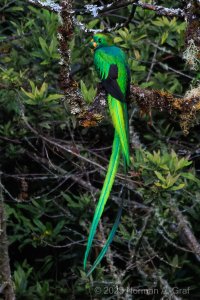
I, too, have had success using the R7 with the RF 800 f/11, even in poor light. Here's a photo of a Resplendent Quetzal taken at 6AM in the cloud forest of Costa Rica at a distance of ~250', handheld. Not going to win any contests, but I was happy to get this image of the bird. No one else in the crowd even noticed it was eating an avocado.
Although I haven't been using my R7 that much lately, I am looking forward to seeing what Canon has to offer both in terms of an R7MkII (which I might then buy) and super telephoto lenses (in which case I may not need it).

Quetzal.JPG
 
  • Like
Reactions: 4 users
Upvote 0
I, too, have had success using the R7 with the RF 800 f/11, even in poor light. Here's a photo of a Resplendent Quetzal taken at 6AM in the cloud forest of Costa Rica at a distance of ~250', handheld. Not going to win any contests, but I was happy to get this image of the bird. No one else in the crowd even noticed it was eating an avocado.
Although I haven't been using my R7 that much lately, I am looking forward to seeing what Canon has to offer both in terms of an R7MkII (which I might then buy) and super telephoto lenses (in which case I may not need it).

View attachment 226192
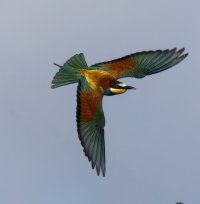
My avatar was taken at about 200' (60m) with the RF 800/11 on the R7, 1/2500s, iso 800. We had an extremely rare visit of a family of Beeeaters to Norfolk so the birders gathered at that distance, the closest we could get. Beeeaters are high up on my list of favourites, if not at the top.

3R3A7266-DxO_Beeeater_flying-ls-1-ss_Avatar.jpg
 
  • Like
Reactions: 3 users
Upvote 0
My avatar was taken at about 200' (60m) with the RF 800/11 on the R7, 1/2500s, iso 800. We had an extremely rare visit of a family of Beeeaters to Norfolk so the birders gathered at that distance, the closest we could get. Beeeaters are high up on my list of favourites, if not at the top.

View attachment 226193
Ah yes, the European Bee-eater. I've only seen it in Zimbabwe. Nice in-flight photo.
 
Upvote 0
In terms of field of view, it will be equivalent to 112-320 on FF. But, in terms of of depth of field (and bokeh) and signal noise over the image, it's equivalent to f/4.5 on FF. There's no free ride, it would need to be f/1.8 on APS-C to give the same depth of field and light gathering over the whole image to equal an f/2.8 on FF.

Many are willing to deal with the noise to not have to buy a lens that costs more than the rest of their frequently used kit combined. This is especially the case if it means the difference between positive and negative cash flow.

The 70-200/2.8 they already have weighs half as much and cost nothing they haven't already spent. AI noise reduction is getting very good. Of course AI NR can also be used to improve lower noise images from a FF sensor and a longer, larger, and heavier lens.
 
Upvote 0
I love where the joystick and wheel is on the R7. I rarely used where it was on older cameras. Where it is on the R7 is exactly where my thumb sits so perfect location! I don't understand why so many didn't learn by using it to see its in the perfect spot.

I'm glad your thumb is long enough to reach it. Not everyone's is.
 
Upvote 0
Please, full-frame users, let us R7 users keep the ergonomics we're used to! The thumbwheel by the viewfinder is perfect placement. I use it to set f/stop, and the main dial on the top for shutter speed. I use the ISO button to set that.

If you prefer the ergonomics of your full-frame model, then use yours in crop mode.

If they want to add another dial down where you guys are used to, fine - just don't take away what we're used to - and then you'd have the full three dials everyone complained was missing from the original R7.

All I want by way of an improvement is a back-side-illuminated sensor to improve low-light sensitivity.

And if they take out the mechanical shutter, they'd better let us still have full dynamic range and something to automatically cover the sensor when the camera is turned off so we can change lenses safely.

And don't make the body bigger and heavier to feel more like a full-frame. (See above.) APS-C is a bigger market than full-frame for a reason - and lighter weight and smaller size is a major part of it. I suspect that they're taking so long to release the R7 II because of a tug-of-war between those in the company who appreciate APS-C and those who see it as just a teleconverter for lenses that don't take one.

I come from forty years in the 35mm SLR world - my Canon FT-QL was similar in size to the R7. No one complained it was "too small" back then. Don't complain now.

Many of us use both FF and APS-C cameras. Cropping FF cameras with lower pixel densities do not get results as good as using an APS-C body with higher pixel density when more reach is needed and the cost of lenses past 200mm f/2.8 affect the direction of cash flow.

My standard setup much of the time is a FF + 24-70/2.8 and APS-C + 70-200/2.8. I shoot with both, often switching from one to the other and back in less than one minute. At other times I use two FF bodies with the same lenses when I'm shooting in situations that don't need the extra reach, or with two FF bodies and various primes when f/2.8 isn't fast enough or when I don't need the versatility of the zoom focal lengths.

It helps immensely that all three of these bodies have the same controls in the same places.
 
  • Like
Reactions: 1 users
Upvote 0
So use your R5/II in crop mode and leave our camera alone! I wouldn't mind if they added a dial where you want one, but don't take away the one R7 owners are used to.

Leave the top tier APS-C body alone! Let it match the top tier FF bodies!

If you want that goofy one-off abomination, ask them to put it on the R10 Mark II.
 
  • Like
Reactions: 1 user
Upvote 0
Many of us use both FF and APS-C cameras. Cropping FF cameras with lower pixel densities do not get results as good as using an APS-C body with higher pixel density when more reach is needed and the cost of lenses past 200mm f/2.8 affect the direction of cash flow.

My standard setup much of the time is a FF + 24-70/2.8 and APS-C + 70-200/2.8. I shoot with both, often switching from one to the other and back in less than one minute. At other times I use two FF bodies with the same lenses when I'm shooting in situations that don't need the extra reach, or with two FF bodies and various primes when f/2.8 isn't fast enough or when I don't need the versatility of the zoom focal lengths.

It helps immensely that all three of these bodies have the same controls in the same places.
Which bodies are you using? I really like on the R5/R5ii being able to switch from C1-C2-C3-A Programmed mode by assigning the Mode button to the M-Fn button. It takes just a fraction of a second with the shutter finger and better than having to turn the Mode dial knob on the top of earlier bodies and the R7.
 
Upvote 0
Which bodies are you using? I really like on the R5/R5ii being able to switch from C1-C2-C3-A Programmed mode by assigning the Mode button to the M-Fn button. It takes just a fraction of a second with the shutter finger and better than having to turn the Mode dial knob on the top of earlier bodies and the R7.

I'm still in DSLR land. 5D Mark IV, 7D Mark II, and 5D Mark III. 54K, 212K, and 86K shutter actuations, respectively. I use the FF bodies for most shoots other than field sports (mostly at night) and daytime outdoor music festivals. But the field sports really run up the shutter count on the 7D Mark II with the 70-200/2.8 on it.
 
Upvote 0
Nikon D500 was effectively a D5 with a crop sensor and no built in grip. Both were the flagship for their respective sensor size. The D500 was about 2.5x less expensive. An R7 2 with R5 2 features won’t cost more th
It will be a question of where Canon sees the center of the market. With inflation that $1,800 turns into almost $2500 plus tariffs, so around $2,800. That would have buyers if the feature set were what you want. but the list is much shorter than with the price of the current R7. If they go that high with the R7 II, they will need an xxD price range camera also for the wider market that is a bit more camera than the R10, or the R10 will have to go up market, too. Time will tell.
 
Upvote 0
Nonsense. The Nikon D500 was effectively a D5 with a crop sensor and no built in grip. Both were the flagship for their respective sensor size. The D500 was about 2.5x less expensive. An R7 2 with R5 2 features won’t cost more than the R6 2. The old Canon 7 series was about $1800. Add in inflation.
I think a better comparison is the Nikon D500 with the D850 (both of which I used extensively, and both arguably the best in their class over all makes). The APS-C was originally $2000 and the FF $3000.
 
  • Like
Reactions: 1 users
Upvote 0
I think a better comparison is the Nikon D500 with the D850 (both of which I used extensively, and both arguably the best in their class over all makes). The APS-C was originally $2000 and the FF $3000.
And that would put it about where I suggested above, which is consistent with the OP's $1800 plus inflation (although he forgot about tariffs). It will be interesting to see if Canon goes as far as a stacked sensor, which would be essential if they are really going to skip the mechanical shutter. On a cost basis, I wonder if a good mechanical shutter is about the same as the differential between a standard sensor and a stacked one. The R7 shutter works well, but definitely less gently that the one in the 5DS, so not as sophisticated.
 
Last edited:
Upvote 0
Birding is a massive hobby. Over 35% of the USA is actively into birding. Most obviously are just doing feeders, planting native plants, listening or using binos but when you have a pool of over 100million people that gives you a lot of people buying cameras.
That 35% number seems insanely high. Where are you getting that data from?
 
  • Like
Reactions: 1 users
Upvote 0