FF mirrorless mount -- go thin or go with EF?

What should Canon's lens mount strategy be for FF mirroless?


  • Total voters
    75
  • Poll closed .
9VIII said:
My opinion is that they should stick to the EF mount at first, and if they release a new mount it should be larger and able to accommodate 50mm sensors in the future.

So if the bottom-eats-the-top progression we see with cell phones continues, in 20 years, Canon can only remain profitable if they offer medium format products?

- A
 
Upvote 0
I want the mount to be (as it is with Sony and other mirrorless cameras) the length that allows for the attachments of adapters that will allow as wide a range of lenses to be attached as possible (not that it's obviously in Canon's interest to do so). At the very least it should be compatible with EF-S lenses - it seems silly that I can use my Canon EF-S 10-18mm on my Sony a7rII in crop mode but can't on any current Canon body.
 
Upvote 0
sdsr said:
I want the mount to be (as it is with Sony and other mirrorless cameras) the length that allows for the attachments of adapters that will allow as wide a range of lenses to be attached as possible (not that it's obviously in Canon's interest to do so). At the very least it should be compatible with EF-S lenses - it seems silly that I can use my Canon EF-S 10-18mm on my Sony a7rII in crop mode but can't on any current Canon body.

That clearly is not what you actually meant, obviously you can use it on any Canon crop camera and you don't need to put it in crop mode!

But, you can also use in on any Canon M body, again no crop mode selection needed.
 
Upvote 0
No need to nitpick. It is 100% clear, that sdsr was referring to the fact, that no current canon camera with FF sensor has a crop mode to allow use of APS-C lenses. Whereas every Nikon and Sony FF camera (DSLR and Mirrorless) does have a crop mode.

Personally I do not miss the feature at all - i only use lenses that will cover the entire imaging circle of the camera sensor. But i can see, that 1. some people would want a crop mode and 2. that it is technically feasible and that 3. Canon has decided against it as far as DSLRs are concerned.

Future Canon mirrorless FF cameras open up the possibility again. We shall see, what Canon is going to offer ... Once they do get around to offering anything at all. ;)
 
Upvote 0
Mt Spokane Photography said:
brad-man said:
Mt Spokane Photography said:
The issue with short flange distances is that it becomes more difficult to build wide angle lenses that will cover full frame. The sharper angle of the light rays striking the sensor causes more light fall off which must be compensated for by boosting the ISO of the outer photosites.

I think its a bad solution, its workable, but a compromise in quality.

Couldn't DO be used to mitigate that problem? It's my understanding that enhanced bending of light is what they do.


I've yet to see any wide angle DO lenses, they seem most useful for telephoto. Perhaps there is not much market for $7,000 16mm lenses?

Let's not exaggerate. There's a lot less glass in a 16mm for an APSC than a 400mm for FF. Shouldn't cost more than $2100 :P
 
Upvote 0
ahsanford said:
9VIII said:
My opinion is that they should stick to the EF mount at first, and if they release a new mount it should be larger and able to accommodate 50mm sensors in the future.

So if the bottom-eats-the-top progression we see with cell phones continues, in 20 years, Canon can only remain profitable if they offer medium format products?

- A

Maybe? Is that a bad thing?
I should mention here, the current EF mount should already be able to use larger sensors. It can almost take the 645D sensor, measuring the inside diameter it looks like it would be just a few millimeters short, and there's plenty of room around the electronic contacts to take a sensor that tall.
I just think sensor size can still be leveraged as an advantage over other systems, and something like a digital IMAX frame is pretty much an inevitability, it's just a matter of "when". So if the current mount is already competitive with other digital medium-format then a new mount should be future-proof, whether that be a few years or decades before large digital sensors really take off.
 
Upvote 0
AvTvM said:
No need to nitpick. It is 100% clear, that sdsr was referring to the fact, that no current canon camera with FF sensor has a crop mode to allow use of APS-C lenses. Whereas every Nikon and Sony FF camera (DSLR and Mirrorless) does have a crop mode.

Personally I do not miss the feature at all - i only use lenses that will cover the entire imaging circle of the camera sensor. But i can see, that 1. some people would want a crop mode and 2. that it is technically feasible and that 3. Canon has decided against it as far as DSLRs are concerned.

Oh, it's a perfectly reasonable nitpick - my proofreading failures are what they are. Anyway, what I meant to write was how you read it. I didn't think I would find the feature useful either but have come to appreciate it for this reason - I don't often shoot very wide but have three very inexpensive and very good wide aps-c lenses (the Canon 10-18, the Rokinon 8mm 2.8 fisheye and Rokinon 12mm f2) and don't feel much like buying their much more expensive ff equivalents. They work very well on FF in crop mode (the Canon even goes 1mm wider than it does on Canon, thanks to the different crop factor).
 
Upvote 0
Mt Spokane Photography said:
The issue with short flange distances is that it becomes more difficult to build wide angle lenses that will cover full frame. The sharper angle of the light rays striking the sensor causes more light fall off which must be compensated for by boosting the ISO of the outer photosites.

I think its a bad solution, its workable, but a compromise in quality.

To tie into this I wonder whether there might be even more of a problem if we finally see some kind of multi layer sensor tech similar to Sigma's finally come to market for the big companies. You look at say the Sigma DP0 with its massive 20mm equivalent lens and that tells me that even on APSC light angles are a significant issue having to pass though three layers. It could well be that the Sony FE lens line-up simply is not compatible with a sensor such as this with there big light drop-off at the boarders.

One thing to consider as well is whether the shorter flange distance is even really much of a size saver on FF. I can see why Leica for example went with it on the SL simply because its the only way there M-mount lenses would be adaptable but just look at the size/length of there native lenses. I would argue that when you move up to FF the bigger size saver of going mirrorless isn't reduced flange distance its actually being able to remove the larger prism and AF sensor. Look at this...

http://camerasize.com/compact/#380.345,579.394,ha,t

The overhead view with the lenses really isn't too different besides the larger Canon grip that's not directly connected to the camera being an SLR. Its the front on view where the Sony is smaller. Release a 6D like camera with no mirror and an EVF plus maybe a slightly smaller grip and you could get very close to the A7.
 
Upvote 0
Behemoth Leica SL1 with behemoth variable aperture kit zooms is laughable and thanks to behemoth Leica prices not relevant to real people.

Relevant to me is the size difference between e.g. mirrorless Canon EOS-M with 22/2.0 versus canon rebel SL1 with EF-S 24/2.8 attached. Its the smallest canon mirrorslapper with the smallest long flange distance canon lens - and yet it is uncomfortably bulky and will not fit into a coat jacket on a city walk or into a LowePro Dashpoint 20 bag neatly attached to a backpack strap when out and about in the mountains.

Or in FF territory the difference in size and weight between a Sony A7R II with SonyZeiss 55/1.8 versus a Canon 5DSR or Nikon D810 with Sigma Art 50/1.4 attached. The mirrorless setup offers excellent image quality in a smallish, light package, the other in a big, fat and heavy package.

Mirrorless done right with reasonably short flange distance offers significant, real and eminently useful size and bulk advantages over mirrorslappers or like the ill-fated, boxy Pentax K-01 - with long flange distance. At least for those 90-99% of situations, occasions and image scenes, that do not require use of EF 600/4 or tilt-shift lens or 11-24 monsters are not needed.
 
Upvote 0
EF!! For the same reasons I voted for a FF mirrorless being around the size of a 6D in ahansford's companion poll - although I could see FF mirrorless cameras with an EF mount coming in a range for sizes from something similar to an SL1 up to 1Dx size.

I won't repeat my reasons but they are in the other thread: http://www.canonrumors.com/forum/index.php?topic=28231.0
 
Upvote 0
AvTvM said:
Behemoth Leica SL1 with behemoth variable aperture kit zooms is laughable and thanks to behemoth Leica prices not relevant to real people.

The "variable aperture kit zoom" on the Leica is both faster and longer range than the Sony/Zeiss 24-70mm F/4, the size of the SL overall is I would guess partly a response to the naturally large lenses when aiming for high specs/performance.

Relevant to me is the size difference between e.g. mirrorless Canon EOS-M with 22/2.0 versus canon rebel SL1 with EF-S 24/2.8 attached. Its the smallest canon mirrorslapper with the smallest long flange distance canon lens - and yet it is uncomfortably bulky and will not fit into a coat jacket on a city walk or into a LowePro Dashpoint 20 bag neatly attached to a backpack strap when out and about in the mountains.

Definitely a good example of the advantages of small flange mirrorless, the EOS M being APSC has smaller lenses and targets a market that desires more limited handling and no viewfinder.

Or in FF territory the difference in size and weight between a Sony A7R II with SonyZeiss 55/1.8 versus a Canon 5DSR or Nikon D810 with Sigma Art 50/1.4 attached. The mirrorless setup offers excellent image quality in a smallish, light package, the other in a big, fat and heavy package.

Mirrorless done right with reasonably short flange distance offers significant, real and eminently useful size and bulk advantages over mirrorslappers or like the ill-fated, boxy Pentax K-01 - with long flange distance. At least for those 90-99% of situations, occasions and image scenes, that do not require use of EF 600/4 or tilt-shift lens or 11-24 monsters are not needed.

The Pentax K-01 shows you that the EOS M style small flange mirrorless design is much better suited for that kind of camera but my point is that I think FF changes this significantly. FF means larger lenses with a larger grip and it means users who generally desire more advanced handling and a viewfinder.

Your example with the Song 55mm F/1.8 isn't ideal of course because the Sigma is 2/3rds of a stop faster, the same way comparing the Canon 50mm F/1.8 to the Sony wouldn't be a fair comparison due to the higher performance of the latter. As far as cameras like the D810 or 5D mk3(neither the smallest FF DSLRs) my point was that the flange distance isn't really what makes them larger. Rather its a combination of the large grip, space for more controls AND the large prism and AF sensor.

The reality is that with a FF camera there are going to be very few lens options that will make it slim enough for a short flange distance to be exploited and indeed the short flange distance seems to result in many lenses actually being longer anyway killing any advantage. The more significant size savings with FF mirrorless would be removing the larger prism and AF sensor to make the camera shorter and potentially decreasing the size of the grip/battery.

If you wanted to make something closer to a FF EOS M then yes a new small flange mount would work better but really is there a market for that? nobody seems to think so thus far. If Canon went that route I would say you would be talking more of a fringe product with maybe only a handful of lenses, slower primes and a very short/slow kit zoom.
 
Upvote 0
moreorless said:
... but my point is that I think FF changes this significantly. FF means larger lenses with a larger grip and it means users who generally desire more advanced handling and a viewfinder.
...
Rather its a combination of the large grip, space for more controls AND the large prism and AF sensor.
...
The reality is that with a FF camera there are going to be very few lens options that will make it slim enough for a short flange distance to be exploited and indeed the short flange distance seems to result in many lenses actually being longer anyway killing any advantage. The more significant size savings with FF mirrorless would be removing the larger prism and AF sensor to make the camera shorter and potentially decreasing the size of the grip/battery.

Of course I would only consider a FF-sensored MILC with built-in EVF and with a full set of control points. Can easily be done in a body sized like Sony A7 (1st Gen), if chunkier grip is absolutely required, then size of A7 Mk. II bodies. As far as control points go, the Sony A7 has enough for my taste and even the Canon EOS M3 has pretty much everything I want in hardware control elements ... front-wheel, rear-wheel, back-AF button, plus all required additional [user-assignable] buttons. AF-selector joystick would be unnecessary, if Canon finally re-implements the most intuitive and easiest method ever of telling a camera where you want it to autofocus: improved Eye Control AF v2.0 -> AF will focus [and track] whatever subject/object you're looking at in the viewfinder. As far as I am concerned, Canon can also call it "virtual touchscreen AF" or "iMagic-AF" or whatever ... as long as they bring it back! ;)

In terms of FF lenses to exploit a FF MILC size/weight advantage I already see a good number in the current EF lineup:
* EF 24(2.8 IS
* 28/2 IS
* 35/2.0 IS
* 40 / 2.8 STM
* 50/ 1.8 STM
* 85/1.8
* 100/2.0
the latter 2 do need an update, but even with IS and some IQ improvements they should not be larger/heavier than current versions.
It should also be possible to add a reasonably smallish landscape UWA ... say EF 15mm/4.0 IS

That would be a pretty neat COMPACT existing lens park for a Canon FF MILC with adapter.

Of course things would then get even better, smaller and more compact, once the same focal lengths come as native, short flange-back mount with new optical formula. Especially the 3 wide-angles could be pretty much pancake size. Further size/weight savings would be possible with a "pure AF" lens series, without focus ring and manual focus gear, cost savings applied to full weathersealing (easier without focus ring), great IQ, and lower price [in essence a FF version of the current EF-M lenses minus manual focus stuff in them]. 8)

 
Upvote 0
You can have a thin body and use EF glass at the same time.
Put the sensor on the bottom (looking up) and a fixed mirror at 45 degrees facing the lens mount.

For added points make the sensor be able to move up and down, this way you can change the flange distance, yes I know that is not likely to happen.
 
Upvote 0
kphoto99 said:
You can have a thin body and use EF glass at the same time.
Put the sensor on the bottom (looking up) and a fixed mirror at 45 degrees facing the lens mount.
For added points make the sensor be able to move up and down, this way you can change the flange distance, yes I know that is not likely to happen.

hehe! nice idea! 8)
However, with an FF sensor at the bottom, resulting camera body would also not be really thin ... 24mm + space around it and LCD in back etc. = closer to DSLR body than to Sony A7 from factor.
Plus a mirror in the lightpath ... rather than incoming photons hitting that sensor straight in the face. :)
 
Upvote 0
AvTvM said:
moreorless said:
... but my point is that I think FF changes this significantly. FF means larger lenses with a larger grip and it means users who generally desire more advanced handling and a viewfinder.
...
Rather its a combination of the large grip, space for more controls AND the large prism and AF sensor.
...
The reality is that with a FF camera there are going to be very few lens options that will make it slim enough for a short flange distance to be exploited and indeed the short flange distance seems to result in many lenses actually being longer anyway killing any advantage. The more significant size savings with FF mirrorless would be removing the larger prism and AF sensor to make the camera shorter and potentially decreasing the size of the grip/battery.

Of course I would only consider a FF-sensored MILC with built-in EVF and with a full set of control points. Can easily be done in a body sized like Sony A7 (1st Gen), if chunkier grip is absolutely required, then size of A7 Mk. II bodies. As far as control points go, the Sony A7 has enough for my taste and even the Canon EOS M3 has pretty much everything I want in hardware control elements ... front-wheel, rear-wheel, back-AF button, plus all required additional [user-assignable] buttons. AF-selector joystick would be unnecessary, if Canon finally re-implements the most intuitive and easiest method ever of telling a camera where you want it to autofocus: improved Eye Control AF v2.0 -> AF will focus [and track] whatever subject/object you're looking at in the viewfinder. As far as I am concerned, Canon can also call it "virtual touchscreen AF" or "iMagic-AF" or whatever ... as long as they bring it back! ;)

In terms of FF lenses to exploit a FF MILC size/weight advantage I already see a good number in the current EF lineup:
* EF 24(2.8 IS
* 28/2 IS
* 35/2.0 IS
* 40 / 2.8 STM
* 50/ 1.8 STM
* 85/1.8
* 100/2.0
the latter 2 do need an update, but even with IS and some IQ improvements they should not be larger/heavier than current versions.
It should also be possible to add a reasonably smallish landscape UWA ... say EF 15mm/4.0 IS

That would be a pretty neat COMPACT existing lens park for a Canon FF MILC with adapter.

Of course things would then get even better, smaller and more compact, once the same focal lengths come as native, short flange-back mount with new optical formula. Especially the 3 wide-angles could be pretty much pancake size. Further size/weight savings would be possible with a "pure AF" lens series, without focus ring and manual focus gear, cost savings applied to full weathersealing (easier without focus ring), great IQ, and lower price [in essence a FF version of the current EF-M lenses minus manual focus stuff in them]. 8)

If you look at the difference between a Sony A7 body though and say the Canon 6D its not really the depth of the mount that's the big issue, its the height of the camera...

http://camerasize.com/compact/#380.345,579.394,ha,t

The big FF prism and the shoulders raised up either side of it at what adds most to the dimensions and weight, remove those and decrease the size of the grip and you have something quite close to an A7 when lenses are included. The size of the grip could also be reduced regardless of the mount the camera uses.

You mention a 15mm F/4 lens, well personally I would disagree that such a lens on a mirrorless FF system would be compact, look at the voigtlander 15mm F/5.6 mk 3 that's been designed for digital use. Much longer than the previous lenses designed for film and that's still an M mount lens as well so add on the length of an adapter plus autofocus and a stop faster. The reality is that the hype of ultra small wide FF mirroress lesnes for FF has turned out to be a myth.
 
Upvote 0
moreorless said:
One thing to consider as well is whether the shorter flange distance is even really much of a size saver on FF. I can see why Leica for example went with it on the SL simply because its the only way there M-mount lenses would be adaptable but just look at the size/length of there native lenses. I would argue that when you move up to FF the bigger size saver of going mirrorless isn't reduced flange distance its actually being able to remove the larger prism and AF sensor. Look at this...

http://camerasize.com/compact/#380.345,579.394,ha,t

The overhead view with the lenses really isn't too different besides the larger Canon grip that's not directly connected to the camera being an SLR. Its the front on view where the Sony is smaller. Release a 6D like camera with no mirror and an EVF plus maybe a slightly smaller grip and you could get very close to the A7.

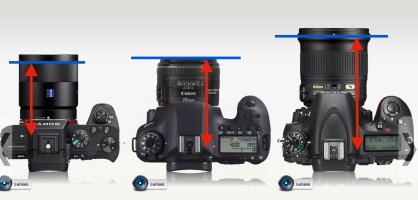
There's still advantages to draw from a shorter flange distance, and the Sony 28mm f2 is a good example of that. Yes, all right, it's software corrected. But it's one full stop brighter than the Canon 28mm IS USM and yet the overall lens + flange distance remains smaller, and it's dramatically smaller than the Nikon 28mm f1.8G. The following picture uses the Sony 55 and Nikon 24mm as stand in since the 28mm lenses aren't in Camerasize's database, with a blue line to roughly show where the 28mm lenses would end.

Remember that to measure overall thickness you shouldn't look at the back of a body but at the focal plane mark. The A7 series bodies, particularly the II version, are quite thick behind the sensor.
 

Attachments

  • Screen Shot 2015-11-12 at 10.50.20.jpg
    Screen Shot 2015-11-12 at 10.50.20.jpg
    368.8 KB · Views: 199
Upvote 0
It is evident, that mirrorless FF camera with short-flange distance lenses for the most commonly used focal length range can be designed with considerably less overall bulk compared to mirrorflippers with large flange-back lenses.

Part of the "thickness" of the Sony A7 Mk. II series behind the sensor plane is owed to the IBIS mechanism, that needs some "wiggling room". Also, the A7 series (I and II) comes with articulated LCD screen which also takes a bit more depth than the fixed LCDs found on all Canon and Nikon FF DSLRs [except Nikon D750].

A Sony A7R II "reduced to 5D III feature set" = fixed LCD, no IBIS - could be a bit smaller than A7 Mk. I series. It would be still way more compact than any DSLR even if a decent-sized handgrip was added for better grip and to hold a "grown-up" battery - sizewise like Canon LP-E6N or corresponding Nikon / Sony DSLR-batteries - with 14+ Whrs capacity ... even in a power-hungry MILC that should provide for 500+ shots per charge.
 
Upvote 0
I'd have voted for EF. But it seems clear from all these discussions that there are broadly two camps - those who want small, light cameras and lenses, and those who want to retain the current ergonomics. It would seem reasonable to imagine there will be small bodies and larger ones, indeed I see no other way to satisfy the majority of photographers.

For me, the smaller body can have whatever mount they like. As for a larger mirrorless body (if that technology does, as most seem to agree, eventually supplant mirrors) - well, if it came sooner rather than later, EF all the way. If it's another 5 or 10 years, then I could come to terms with a new mount.

Either way, it sounds like what we have now, the same roles but different players - two mounts (one for big/'serious' lenses, one for smaller, lighter/cheaper ones) just as we have EF and EF-S; smaller bodies and larger ones, and perhaps even the larger one only taking one type of lens, whilst the smaller body taking both kinds. Mirrorless starts looking a lot less disruptive than some have contended, when put that way.

But this is of course all supposition, as I'm neither an engineer nor a businessman.
 
Upvote 0