How to differentiate crop vs. FF

ecka said:
ashmadux said:
Crop vs. Full frame.

As a 6d owner - my first full frame- im very unimpressed at its low iso quality. There is no 3d-ish POP that i have seen in so many 5d2/5d3 images over the years - image quality that i could easily see was not reproducible on my crop cameras.

To these ultra pixel peeping eyes, the 6d is only slightly better at dynamic range than my t2i. High Iso handling is generally FANTASTIC, which is why i figure the low iso takes an image quality hit. Low light photography is a whole other ball game compared to my crop bodies.

So while i enjoy my 6d, its nowhere close to the full frame experience i thought it would be. Still dreaming of a 5d3 and non-ancient AF. :(

Really? From what I've seen, 5D2-3 and 6D images side by side look almost identical :).

All else being equal, the 6D images are slightly better, because they have less banding noise in the shadows. Of course, that usually isn't obvious until you boost them by a couple of stops.


neuroanatomist said:
If one has seen and admired a '3D-ish POP' in 5DII/III images taken by others over the years, but doesn't see that quality in one's own 6D images, I suppose "it's the camera" is one possible explanation. It's certainly a more palatable one than the far more likely and rational reason for the discrepancy.

There are three likely reasons: the lens, the lighting, and differences in post-processing choices. The camera shouldn't matter much at all, except insofar as it affects the choice of lens....
 
Upvote 0
Jackson_Bill said:
neuroanatomist said:
True, but the 2.56x greater area of the FF sensor will gather more total light. Comparing noise at the pixel level isn't the same as comparing noise at the image level.

There's shot noise, which is clearly related to the size of the pixel and I thought that the signal processing to convert the analog to digital was done on a pixel-by-pixel basis, which would make the read noise related to the pixel photon count, too. Is that so? If so, what else would make the image level noise different? In other words, how does the total amount of light collected by the sensor come into the noise calculation?

SNR = sqrt(photon count)
 
Upvote 0
Jackson_Bill said:
neuroanatomist said:
Jackson_Bill said:
I don't agree with this "amount of light" argument. Consider a full frame sensor and an APS-C size sensor with pixels the same size as a full frame taking photos with the same lens at the same f-stop and the same distance from the subject. The signal to noise ratio for each pixel in the APS-C sensor will be the same as the S:N ratio as the corresponding pixels in an APS-C sized area of the ff.
True, but the 2.56x greater area of the FF sensor will gather more total light. Comparing noise at the pixel level isn't the same as comparing noise at the image level.
You lost me on the image level noise, Neuro. It seems that an APS-C sized crop of the FF image and the APS-C image in this case would be identical. The number of photons hitting each pixel is the same and assuming the downstream operations are identical, what's the difference?
Yes, if a FF pixel and a crop pixel are the same physical size (and technology) the individual pixels will be identical in terms of signal and noise.

If both images were shot with the exact same lens, the same settings, and the same distance, the central 40 percent of the FF pixels would be exactly the same as the crop pixels.

In real life, with your equal size pixel scenario, we would try to frame the two pictures the same, so that means either a 1.6X longer lens on the FF camera, or walking closer until the image filled the screen the same. Either way you look at it, that gives you 2.56 times as many pixels of equal quality on the target, so when you "normalize" the FF picture for the same number of pixels as the crop image, you end up with better quality pixels on the FF image. You are choosing between more pixels of the same quality, or the same amount of pixels but of better quality. There is no way for crop to win in that scenario.

In the real world, with the cameras Canon makes now, FF wins the IQ contest in all but one scenario... and that scenario is when you are focal length limited, can't move any closer, have a GREAT lens, and good lighting. Under those conditions (happens a lot with small birds) the quality of your crop pixels is fairly close to your FF pixels, but you have more crop pixels on target so you end up with a better image from the crop camera. Everywhere else, FF wins.

NOTE that I have left cost out of the factors.... cost will change the point where you become focal length limited, affect lens quality, and may even eliminate FF altogether. If you have $3000 and want to take pictures of distant chickadees, a 7D2 and a Tamron 150-600 is your best bet. If you have $25,000, a 1DX, a 600F4, and a 1.4X or 2X teleconverter will be the best.
 
Upvote 0
Don Haines said:
In the real world, with the cameras Canon makes now, FF wins the IQ contest in all but one scenario... and that scenario is when you are focal length limited, can't move any closer, have a GREAT lens, and good lighting. Under those conditions (happens a lot with small birds) the quality of your crop pixels is fairly close to your FF pixels, but you have more crop pixels on target so you end up with a better image from the crop camera. Everywhere else, FF wins.

No, there's another one - when you're magnification (as in macro) limited.
 
Upvote 0
Lee Jay said:
Don Haines said:
In the real world, with the cameras Canon makes now, FF wins the IQ contest in all but one scenario... and that scenario is when you are focal length limited, can't move any closer, have a GREAT lens, and good lighting. Under those conditions (happens a lot with small birds) the quality of your crop pixels is fairly close to your FF pixels, but you have more crop pixels on target so you end up with a better image from the crop camera. Everywhere else, FF wins.

No, there's another one - when you're magnification (as in macro) limited.

Good point!
 
Upvote 0
Don Haines said:
Lee Jay said:
Don Haines said:
In the real world, with the cameras Canon makes now, FF wins the IQ contest in all but one scenario... and that scenario is when you are focal length limited, can't move any closer, have a GREAT lens, and good lighting. Under those conditions (happens a lot with small birds) the quality of your crop pixels is fairly close to your FF pixels, but you have more crop pixels on target so you end up with a better image from the crop camera. Everywhere else, FF wins.

No, there's another one - when you're magnification (as in macro) limited.

Good point!

Only my and Pit123's crops in this thread don't actually illustrate that to be a crop camera 'advantage' either, certainly not one to base a buying decision on, price, AF fps maybe, but IQ advantage, not so much.

http://www.canonrumors.com/forum/index.php?topic=23224.msg453442#msg453442
http://www.canonrumors.com/forum/index.php?topic=23224.msg453961#msg453961
 
Upvote 0
Jackson_Bill said:
Lee Jay said:
SNR = sqrt(photon count)

True, but I believe that's photon count per pixel. I'm trying to understand how the the total photon count on the sensor matters.

If you only look at one pixel, the per-pixel photon count would be all that matters. If you look at a whole image, the whole image photon count is what matters.
 
Upvote 0
privatebydesign said:
Don Haines said:
Lee Jay said:
Don Haines said:
In the real world, with the cameras Canon makes now, FF wins the IQ contest in all but one scenario... and that scenario is when you are focal length limited, can't move any closer, have a GREAT lens, and good lighting. Under those conditions (happens a lot with small birds) the quality of your crop pixels is fairly close to your FF pixels, but you have more crop pixels on target so you end up with a better image from the crop camera. Everywhere else, FF wins.

No, there's another one - when you're magnification (as in macro) limited.

Good point!

Only my and Pit123's crops in this thread don't actually illustrate that to be a crop camera 'advantage' either, certainly not one to base a buying decision on, price, AF fps maybe, but IQ advantage, not so much.

http://www.canonrumors.com/forum/index.php?topic=23224.msg453442#msg453442
http://www.canonrumors.com/forum/index.php?topic=23224.msg453961#msg453961
To get that crop reach advantage, you need a GREAT lens. A lens like the 100-400 or the Tamron 150-600 is not sharp enough. My tests between a 5D2 and a 60D using those two lenses showed minimal differences in resolving power of distant objects between crop and FF. Using a 100L, crop definitely resolved distance objects better than FF, but it most certainly was not twice as good... maybe 20 or 30 percent better. (no scientific measurements taken, the percentage is a guess)

I am told, no personal experience, that the second generation "Big Whites" will act the same... but however you slice it, to get that crop reach advantage, you need some of the sharpest glass that Canon makes.
 
Upvote 0
Don Haines said:
privatebydesign said:
Don Haines said:
Lee Jay said:
Don Haines said:
In the real world, with the cameras Canon makes now, FF wins the IQ contest in all but one scenario... and that scenario is when you are focal length limited, can't move any closer, have a GREAT lens, and good lighting. Under those conditions (happens a lot with small birds) the quality of your crop pixels is fairly close to your FF pixels, but you have more crop pixels on target so you end up with a better image from the crop camera. Everywhere else, FF wins.

No, there's another one - when you're magnification (as in macro) limited.

Good point!

Only my and Pit123's crops in this thread don't actually illustrate that to be a crop camera 'advantage' either, certainly not one to base a buying decision on, price, AF fps maybe, but IQ advantage, not so much.

http://www.canonrumors.com/forum/index.php?topic=23224.msg453442#msg453442
http://www.canonrumors.com/forum/index.php?topic=23224.msg453961#msg453961
To get that crop reach advantage, you need a GREAT lens. A lens like the 100-400 or the Tamron 150-600 is not sharp enough. My tests between a 5D2 and a 60D using those two lenses showed minimal differences in resolving power of distant objects between crop and FF. Using a 100L, crop definitely resolved distance objects better than FF, but it most certainly was not twice as good... maybe 20 or 30 percent better. (no scientific measurements taken, the percentage is a guess)

I am told, no personal experience, that the second generation "Big Whites" will act the same... but however you slice it, to get that crop reach advantage, you need some of the sharpest glass that Canon makes.

I understand what you are saying Don, but my example crops fly in the face of that.

I used the best techniques possible to maximise the difference including using a Canon 300mm f2.8 IS @ f5.6 (nobody ever argued that isn't a great lens and without a TC gives little, if anything, to the MkII's), I did this to give the crop camera the biggest advantage its small pixels will ever have, it certainly isn't close to a real world situation, and the differences are just not there to any meaningful degree.

As an aside, I have tested my 50 f1.4 against my 100L Macro at f5.6, and the 50 is 'sharper', TDP iso charts agree with my findings.
 
Upvote 0
Don Haines said:
To get that crop reach advantage, you need a GREAT lens. A lens like the 100-400 or the Tamron 150-600 is not sharp enough.

Not true.

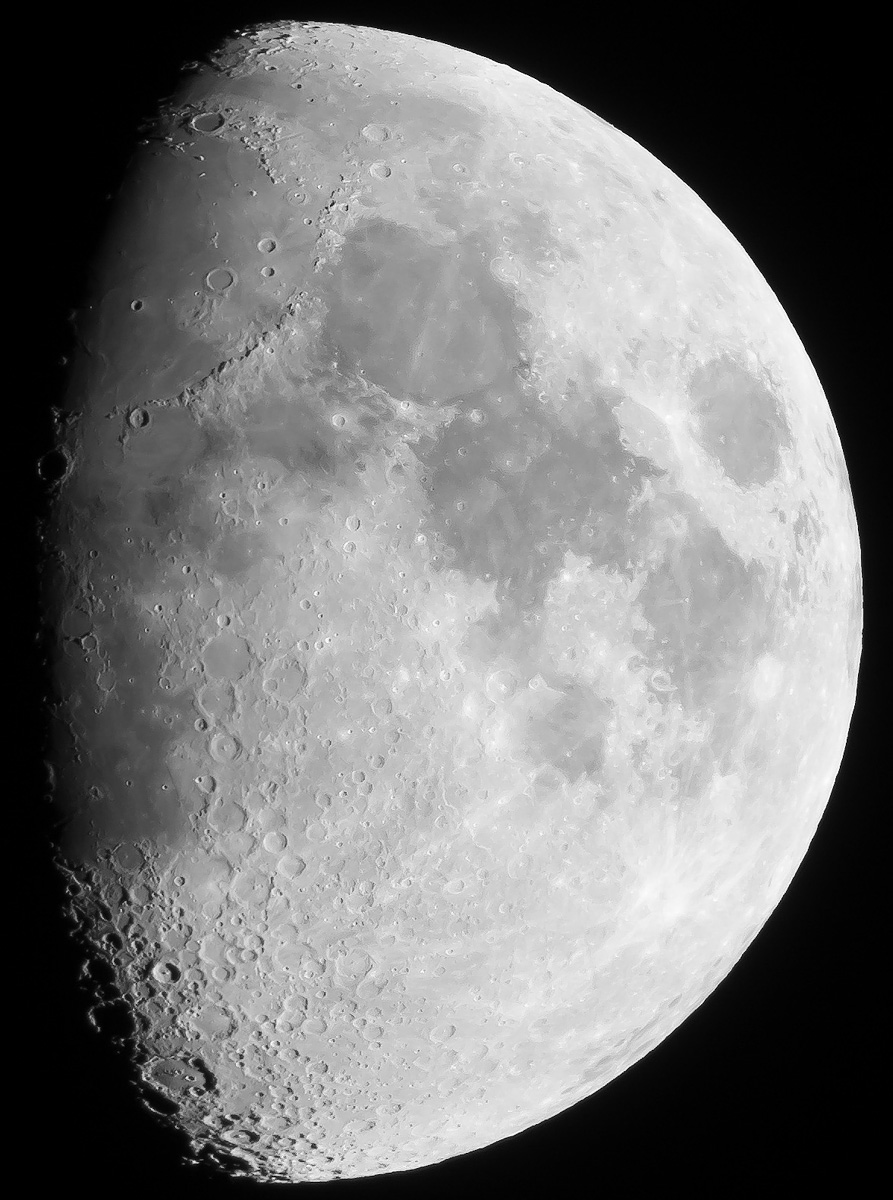
I'll challenge anyone to go out with a 1DX or 5DII or III and get a moon shot like this one with a 100-400L.

T2i__3574%20edited.jpg
 
Upvote 0
Jackson_Bill said:
Lee Jay said:
Jackson_Bill said:
Lee Jay said:
SNR = sqrt(photon count)

True, but I believe that's photon count per pixel. I'm trying to understand how the the total photon count on the sensor matters.

If you only look at one pixel, the per-pixel photon count would be all that matters. If you look at a whole image, the whole image photon count is what matters.

I don't think so. You've probably seen this before
http://theory.uchicago.edu/~ejm/pix/20d/tests/noise/

For the shot noise, its only a function of the number of photons captured by a pixel.

The shot noise for that pixel.

Its the physics of why the crop (smaller pixels) shot noise can never be as low as the FF.

Shot noise is also called "photon counting noise".

If you have a larger sensor with the same pixel count, the shot noise per pixel is lower.

If you have a larger sensor with the same sized pixels, the shot noise for each pixel is the same, but you have many more pixels.

You can use software (noise reduction and downsampling) to trade all that extra resolution for much lower noise in the overall image with the same sharpness (resolution), and in fact that's what you end up doing when you compare the two images at the same final size.

All those photons that are collected by all those extra pixels count in the total signal (sharpness) to noise (noise) of the final overall image, and that's the reason that a larger sensor out-performs a smaller sensor in low-light despite having the same sized pixels. It's also why cropping 1.4x (linear) is like increasing ISO by 1 stop, and cropping 2x (linear) is like increasing ISO by 2 stops (as far as noise is concerned) - the same as a teleconverter requires for the same shutter speed.
 
Upvote 0
Lee Jay said:
Don Haines said:
To get that crop reach advantage, you need a GREAT lens. A lens like the 100-400 or the Tamron 150-600 is not sharp enough.

Not true.

I'll challenge anyone to go out with a 1DX or 5DII or III and get a moon shot like this one with a 100-400L.

T2i__3574%20edited.jpg

Hand held.

http://www.canonrumors.com/forum/index.php?topic=435.msg120132#msg120132
And here,
http://photography-on-the.net/forum/showthread.php?p=10014826
 
Upvote 0
Lee Jay said:
Don Haines said:
To get that crop reach advantage, you need a GREAT lens. A lens like the 100-400 or the Tamron 150-600 is not sharp enough.

Not true.

I'll challenge anyone to go out with a 1DX or 5DII or III and get a moon shot like this one with a 100-400L.

Nice image, well processed; but not sure I see the point.

It was shot with a 100-400L + 1.4x TC - so you could not even capture that image on a crop camera with the 100-400L alone.

Phil.
 
Upvote 0
privatebydesign said:
Lee Jay said:
Don Haines said:
To get that crop reach advantage, you need a GREAT lens. A lens like the 100-400 or the Tamron 150-600 is not sharp enough.

Not true.

I'll challenge anyone to go out with a 1DX or 5DII or III and get a moon shot like this one with a 100-400L.

T2i__3574%20edited.jpg

Hand held.

http://www.canonrumors.com/forum/index.php?topic=435.msg120132#msg120132
And here,
http://photography-on-the.net/forum/showthread.php?p=10014826

As I said...not even close.
 
Upvote 0
philmoz said:
Lee Jay said:
Don Haines said:
To get that crop reach advantage, you need a GREAT lens. A lens like the 100-400 or the Tamron 150-600 is not sharp enough.

Not true.

I'll challenge anyone to go out with a 1DX or 5DII or III and get a moon shot like this one with a 100-400L.

Nice image, well processed; but not sure I see the point.

It was shot with a 100-400L + 1.4x TC - so you could not even capture that image on a crop camera with the 100-400L alone.

Phil.

And what's the purpose of a TC? Answer: To compensate for the sensor under sampling the lens. A 1.4x TC can be thought of as shrinking the pixels by 1.4x or as doubling the pixel count, rather than doing anything optically. They are equivalent, and in both cases if the lens isn't resolving the detail, the extra pixels or extra magnification won't help. But it does help as you just said yourself. And you are right.
 
Upvote 0
Lee Jay said:
privatebydesign said:
Lee Jay said:
Don Haines said:
To get that crop reach advantage, you need a GREAT lens. A lens like the 100-400 or the Tamron 150-600 is not sharp enough.

Not true.

I'll challenge anyone to go out with a 1DX or 5DII or III and get a moon shot like this one with a 100-400L.

T2i__3574%20edited.jpg

Hand held.

http://www.canonrumors.com/forum/index.php?topic=435.msg120132#msg120132
And here,
http://photography-on-the.net/forum/showthread.php?p=10014826

As I said...not even close.

Oh, I missed the bit where you didn't mention the TC, that was naughty of you. There are loads more FF images out there with 5D MkII/III's with TC's that are every bit as good as yours, I was just looking for 100-400's.
 
Upvote 0
Lee Jay said:
philmoz said:
Lee Jay said:
Don Haines said:
To get that crop reach advantage, you need a GREAT lens. A lens like the 100-400 or the Tamron 150-600 is not sharp enough.

Not true.

I'll challenge anyone to go out with a 1DX or 5DII or III and get a moon shot like this one with a 100-400L.

Nice image, well processed; but not sure I see the point.

It was shot with a 100-400L + 1.4x TC - so you could not even capture that image on a crop camera with the 100-400L alone.

Phil.

And what's the purpose of a TC? Answer: To compensate for the sensor under sampling the lens. A 1.4x TC can be thought of as shrinking the pixels by 1.4x or as doubling the pixel count, rather than doing anything optically. They are equivalent, and in both cases if the lens isn't resolving the detail, the extra pixels or extra magnification won't help. But it does help as you just said yourself. And you are right.

???
 
Upvote 0
privatebydesign said:
Lee Jay said:
privatebydesign said:
Lee Jay said:
Don Haines said:
To get that crop reach advantage, you need a GREAT lens. A lens like the 100-400 or the Tamron 150-600 is not sharp enough.

Not true.

I'll challenge anyone to go out with a 1DX or 5DII or III and get a moon shot like this one with a 100-400L.

T2i__3574%20edited.jpg

Hand held.

http://www.canonrumors.com/forum/index.php?topic=435.msg120132#msg120132
And here,
http://photography-on-the.net/forum/showthread.php?p=10014826

As I said...not even close.

Oh, I missed the bit where you didn't mention the TC, that was naughty of you. There are loads more FF images out there with 5D MkII/III's with TC's that are every bit as good as yours, I was just looking for 100-400's.

Why? That shows that the bare lens was sharp enough to be dramatically out resolving the sensor, which itself had pixels 1.6x smaller than those in the 1DX. Oh, and this was a 2x TC and this shot was slightly better than the same shot taken with just a 1.4x. That's like a 72MP 1.6 crop sensor or a 184MP full frame sensor. And that's on a 16 year old zoom lens.
 
Upvote 0
Jackson_Bill said:
Lee Jay said:
You can use software (noise reduction and downsampling) to trade all that extra resolution for much lower noise in the overall image with the same sharpness (resolution), and in fact that's what you end up doing when you compare the two images at the same final size.
That's something else again. This discussion was related to the discussion regarding the intensity and total quantity of light and whether how that was affected (if at all) by the size of the sensor [before post processing].

Yeah...and you can't do what I said unless you have all that extra light captured in all those extra pixels.

Lee Jay said:
All those photons that are collected by all those extra pixels count in the total signal (sharpness) to noise (noise) of the final overall image, and that's the reason that a larger sensor out-performs a smaller sensor in low-light despite having the same sized pixels.
No, those extra pixels don't count (again, before post processing).

Yes, they do.

One assumption that we always make is that quantization noise is negligible. That means, you can't see the individual pixels. If you can, that's another whole problem.

Since you can't see the individual pixels, your eye is essentially averaging some small number of pixels together. The averaging works like this - the noise goes down with the square root of the number of pixels averaged. Average 4 pixels, you cut the noise in half. Average 9, you cut the noise by a factor of three.

This works out the same as the decrease in shot noise from all that extra light - SnR goes with the square root of the number of photons collected.

In reality, all larger pixels do is block average. It turns out that block averaging is about the worst performing method of noise reduction there is. Even the most basic noise reduction is better, and modern advanced method are enormously better. So, smaller pixels that are block averaging less combined with modern noise reduction software will out-perform larger pixels since the larger pixel are doing the dumbest kind of noise reduction there is.
 
Upvote 0