I'm going squirrely trying to improve these photos (help)?

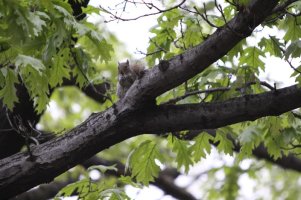
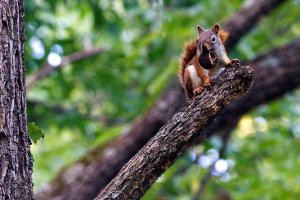
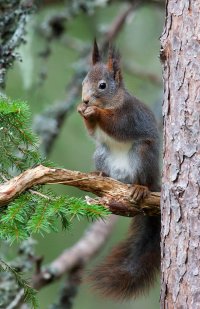
I took the following two photos yesterday. The lighting wasn't very good and I couldn't get as close to the subject as I wanted. I like the fact that I was able to capture the squirrel eating in it's natural habitat, so I'm looking for some tips on how I can improve the look of the photos. Any advice would be greatly appreciated.

IMG_0649_sRGB.jpg


IMG_0648_sRGB.jpg
 
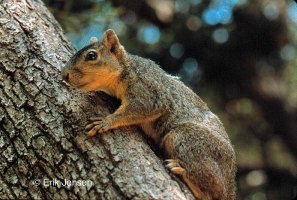
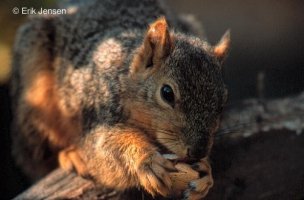
Did you use the 70-200mm for these shots? I can't find the information in the jpgs you have posted. Can you please provide lens and aperture information? I believe the background looks somewhat busy. Perhaps you can use a wider aperture? I have shot both samples you see below at an aperture of f2.8.

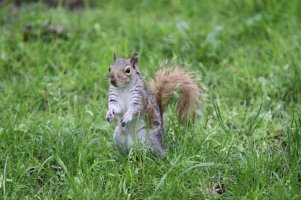
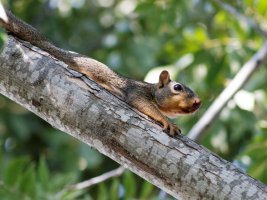
I have shot these squirrels in New York (I wouldn't exactly say that qualifies as a natural habitat). There has been no post-processing in the attached shots.
 

Attachments

  • IMG_4368_copy.JPG
    IMG_4368_copy.JPG
    69.5 KB · Views: 1,375
  • IMG_4403_copy.JPG
    IMG_4403_copy.JPG
    479.9 KB · Views: 1,367
Upvote 0
Maybe I'll head back out in the woods today and try a wider aperature f/4.0 as you suggested. I was hoping to salvage these shots though.

Photo 1
Body: Canon 7D
Lens: 70-200 f/4.0 IS
Shutter speed: 1/25 sec
Aperature: f/7.1
Focal length: 200mm
ISO: 400

Photo 2
Body: Canon 7D
Lens: 70-200 f/4.0 IS
Shutter speed: 1/30 sec
Aperature: f/7.1
Focal length: 200mm
ISO: 400
 
Upvote 0
AmbientLight said:
You have used surprisingly low shutter speeds. I was shooting around 1/1000 of a second so as to avoid motion blur.
Yeah, generally speaking, when I am shooting wildlife, I am putting the lens on the fastest aperture possible, because I am both trying to isolate the subject and avoid motion blur. That same shot at f/4 would still have the tree and squirrel in focus, but the background would be much more diffuse. The green area would be completely blurred, and even the limb behind him would be much more blurred. That would isolate the squirrel more where he now blends with the limb a little. And your shutter speeds would be more like 1/100th of a second, which would save you from getting blurred shots if he moved.

The big thing is background choice. I know this is damn near impossible with something that moves so much like squirrels, but if you were 3-4 steps right and crouched a little, there would be more green which would isolate the squirrel more and make him stand out
 
Upvote 0
HeavenHell said:
Maybe I'll head back out in the woods today and try a wider aperature f/4.0 as you suggested. I was hoping to salvage these shots though.

Photo 1
Body: Canon 7D
Lens: 70-200 f/4.0 IS
Shutter speed: 1/25 sec
Aperature: f/7.1
Focal length: 200mm
ISO: 400

Photo 2
Body: Canon 7D
Lens: 70-200 f/4.0 IS
Shutter speed: 1/30 sec
Aperature: f/7.1
Focal length: 200mm
ISO: 400

Instead of f/4 I would suggest to go with something like f/5.6. A bit stopped down but not so much as f/7.1 as to make the background non-blurred (if that is a word).

For the current photos, why do not you try to crop around the squirrel a little tighter and use blurring in post processing for the background (using layer and layer mask).

For squirrels I always find my 70-300 lens to be handy to get close (of course cropping from your lens at 200mm will probably give better results than my third party lens).

I cropped the following pretty severely and reached this resultant photo.


Squirrel by alo-chhaya, on Flickr
 
Upvote 0
Shooting squirrels, like photographing all wildlife in their element, requires patience, experimentation and anticipation. I would take readings with practice shots of the settings before I try to get that perfect squirrel shot. Because they move so quickly it is important to both track them and have a proper speed (certainly above 200 if possible) to freeze the action and avoid camera shake.

In the shade that potentially means some compromise with a higher ISO and shallow DOF making focusing critical. Ergo the practice and testing. The shots are nice already and you should practice being more cagy and patient in getting closer to those critters for really outstanding work.
 
Upvote 0
IMO the background isn't the issue. It's more of the composition. All I look at is that twig sticking up in front of the squirrel. I'd play around with composition/ cropping to try to get a more unique perspective.

Here is a quick 1 min crop & clone (the cloning is messy, just to give you the idea):

This crop gets rid of the ugly (distracting) white bokeh light coming through the trees in the top left. It also moves the squirrel into a better composition.
 

Attachments

  • edit.jpg
    edit.jpg
    81.8 KB · Views: 1,084
Upvote 0
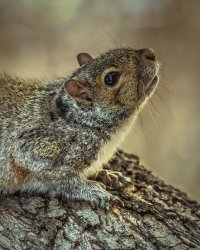
I don't usually post pictures, but when I do, they are of squirrels. Here's one solution to busy backgrounds: 500mm+1.4x. I think I went overboard with clarity on this one but it is what it is...

(Info: Cropped to 5x4 + rotated, 7D, f7.1, 1/160, ISO800, hand-held)
 

Attachments

  • img_0812.jpg
    img_0812.jpg
    438.6 KB · Views: 1,036
Upvote 0
straub said:
I don't usually post pictures, but when I do, they are of squirrels. Here's one solution to busy backgrounds: 500mm+1.4x. I think I went overboard with clarity on this one but it is what it is...

(Info: Cropped to 5x4 + rotated, 7D, f7.1, 1/160, ISO800, hand-held)

Oh that is a cool shot! I love how the squirrel's fur pattern blends so well into the bark. Darwin at work there.
 
Upvote 0
pdirestajr said:
IMO the background isn't the issue. It's more of the composition. All I look at is that twig sticking up in front of the squirrel. I'd play around with composition/ cropping to try to get a more unique perspective.

Here is a quick 1 min crop & clone (the cloning is messy, just to give you the idea):

This crop gets rid of the ugly (distracting) white bokeh light coming through the trees in the top left. It also moves the squirrel into a better composition.

Thats exactly how I would have cropped it too. Leading lines form the branch also helps.
 
Upvote 0
Composition is very important in how the overall image looks, sharp or not, and while it is preferred to frame for the end product from the beginning you do have a bit of 'canvass' to work with in the higher mp bodies out there. Do not be afraid to crop into the image, that is one of the benefits of digital photography, but you want to make sure you are capturing the sharpest image you can if that is your objective so you can maintain sharpness in the crops.

For example my normal wildlife lens is in for its yearly service (70-300mm-L) and for the past several days I have been playing with the super cheap 70-300 III kit lens from a friend. Not very sharp at all in comparison, but stopping down the lens to its sharpest (f/8-f/11) and then purposely choosing a ISO setting that starts to every so lightly show grain can give a crispness to the image. That will give you the sharpness you may need to perform some PP composition and frame the subject for the least distracting background/surrounding.

(ISO 640 probably showing a tiny bit too much grain with this lens.. and if the branches in the right side of the frame were not so distracting it would have been better to have the squirrel further to the left of a slightly larger perspective.)
 

Attachments

  • 011_DxO_BC.jpg
    011_DxO_BC.jpg
    1.5 MB · Views: 838
Upvote 0