Improving composition - photography skills

Status
Not open for further replies.
Dear All,

Pardon me for interrupting the flood of tech - equipment type posts. I would like to ask those of you who are seasoned photographers a question about PICTURES (not cameras) for a change.

I am an amateur photographer (as a hobby) for about 14 months now. I started out right at the bottom coming from simple p&s pics at a birthday party - and I'm trying to improve my skills.

Can you suggest some tips on how to advance my composition skills ?
 
Can't give specific advice without having seen any of your photos, so here are some basic rules that helped me when I was learning:

  • Get closer: don't try to "get it all in."
  • Simplify: if it's not a part of your composition, then what's it doing in your photo? ;)
  • Two-thirds rule: here's a simple explanation; you can find plenty of info online or in books.
    http://en.wikipedia.org/wiki/Rule_of_thirds
  • Read books/articles that target the types of photography (landscapes, portraits, macro, etc.) you're interested in.
 
Upvote 0
koolman said:
Pardon me for interrupting the flood of tech - equipment type posts....Can you suggest some tips on how to advance my composition skills ?

Well, we all know that the best way to improve your photos is to buy better gear... :P

Seriously, the tips from DJL329 are good ones...get close and the rule-of-thirds.

I find it helps to scan all around the frame before taking the shot, often you'll notice something there you want to avoid (trash, a tree branch).

There are some online sites with good (and free) tutorials, such as DPS. If there are classes inyour local area, that's another option.

One more tip: practice, practice, practice. Take your camera with you, take lots of pics. Be brutal when you edit - keep only the best, then try to identify the trends in what makes you think the ones you kept are the best, and incorporate those learnings before you take the shots.

Happy shooting!
 
Upvote 0
Experiment with your pictures. Take good but boring looking pics and simply re-crop them in all kind of ways. I learned a lot about composition by simply cutting away wildly at my pics. Once you see what works in post processing you'll be able to imagine it while actually lining up your shot as well. (At least that's how it worked for me) And yeah the rule-of-thirds is likely the most important thing to know and understand.
 
Upvote 0
One of my favorite books is Stephen Shore's "The Nature of Photographs." It's not about composition. Which is good because I don't believe composition can be taught.

Instead he delves into the four basic constraints/characteristics of photographs: Flatness, Frame, Time and Focus and offers examples from great photographers (including himself) to illustrate each of these. There isn't much text, but it is worth reading over and over again and really thinking about.

If you want to be challenged, I can't think of a better place to start.

Other than that, I would suggest starting with a good history of photography (I prefer Naomi Rosenblum's "World History of Photography" to Beaumont Newhall's classic "The History of Photography" but that just my personal preference.) You might also want to pick up copies of John Szarkowski's "Looking at Photographs" and "The Photographers Eye."

These will provide a good introduction and from there you can start exploring individual photographers.

Remember though, pictures are about seeing, not about composition. Composition is only a tool to help convey your meaning. Still, knowing a little about the rules can help you know when to break them.
 
Upvote 0
koolman said:
Dear All,

Pardon me for interrupting the flood of tech - equipment type posts. I would like to ask those of you who are seasoned photographers a question about PICTURES (not cameras) for a change.

I am an amateur photographer (as a hobby) for about 14 months now. I started out right at the bottom coming from simple p&s pics at a birthday party - and I'm trying to improve my skills.

Can you suggest some tips on how to advance my composition skills ?

"The Photographers Eye" by Michael Freeman.
 
Upvote 0
unfocused said:
One of my favorite books is Stephen Shore's "The Nature of Photographs." It's not about composition. Which is good because I don't believe composition can be taught.

Instead he delves into the four basic constraints/characteristics of photographs: Flatness, Frame, Time and Focus and offers examples from great photographers (including himself) to illustrate each of these. There isn't much text, but it is worth reading over and over again and really thinking about.

If you want to be challenged, I can't think of a better place to start.

Other than that, I would suggest starting with a good history of photography (I prefer Naomi Rosenblum's "World History of Photography" to Beaumont Newhall's classic "The History of Photography" but that just my personal preference.) You might also want to pick up copies of John Szarkowski's "Looking at Photographs" and "The Photographers Eye."

These will provide a good introduction and from there you can start exploring individual photographers.

Remember though, pictures are about seeing, not about composition. Composition is only a tool to help convey your meaning. Still, knowing a little about the rules can help you know when to break them.

good post. Rule of thirds is the basic concept everyone will say, but it isn't an end to all concept. Also remember to look at the colors, interesting ways to frame your subject within other objects in the shot, lines/shapes leading in-n-out of your frame to draw the eye to certain points in the picture, and use focus to your advantage. Blurring out parts of background clutter, and could also use focus to draw the eye to a certain point will help too. There's a lot to think about, and no one way to compose a shot. Experience and really studying your shots to see what works for you and what doesn't is the only way to really improve.
 
Upvote 0
koolman said:
Can you suggest some tips on how to advance my composition skills ?

I posted a book before, I can add a few tips (without repositing a mini tutorial) I'm not a seasoned photographer, but I'll fire away anyway --

for family pictures (e.g. birthday parties), I've found dealing with backgrounds to be one of the key challenges. I don't know about you, but my residence while well kept is not a photo studio, and sometimes where I will be shooting, it's just a mess.

Neuroanatomist's tip to scan the frame is a good one. I'd go a step further and suggest that you need to move around and position yourself so that you have a good background. This also includes considering a high or low camera position.

Telephoto lenses (or the long end of a normal zoom) give you tighter control of the background. Wider shots really force you to look at the frame carefully because they really pull in a lot of background.
 
Upvote 0
Thanks for starting the thread, a much more humane topic...
But, neuro is right (as almost always)- in this world of ubiquitous high-end or near high-end gear I saw my photos always lacking pop, sense, message, etc UNTIL I found what Good Gear can do to them: a fast prime lens for instance makes you think about composition more, the price of it makes you jump out of bed in twilight to chase the time, add manual focus and LifeView and you are doing already better than 90%, and take it to a place noone has been before (not geographically but in you surrounding space eg shooting at flowers from low to sky, like an ant) and you start searching for Yourself in the world of light...
So, follow neuro and look through fast and sharp glass - the rest is readable and seeable on the net.
 
Upvote 0
elflord said:
for family pictures (e.g. birthday parties), I've found dealing with backgrounds to be one of the key challenges. I don't know about you, but my residence while well kept is not a photo studio, and sometimes where I will be shooting, it's just a mess.

I know what you mean...in a house with two toddlers, unless I set up my background support and muslin backdrops, chances are there will be some clutter in the background. Fortunately, shooting with a fast lens (especially on FF) can turn a cluttered background into a pleasing, multi-colored blur.
 
Upvote 0
te4o said:
Thanks for starting the thread, a much more humane topic...
But, neuro is right (as almost always)- in this world of ubiquitous high-end or near high-end gear I saw my photos always lacking pop, sense, message, etc UNTIL I found what Good Gear can do to them: a fast prime lens for instance makes you think about composition more, the price of it makes you jump out of bed in twilight to chase the time, add manual focus and LifeView and you are doing already better than 90%, and take it to a place noone has been before (not geographically but in you surrounding space eg shooting at flowers from low to sky, like an ant) and you start searching for Yourself in the world of light...
So, follow neuro and look through fast and sharp glass - the rest is readable and seeable on the net.

Yes, a fast prime is a great tool (especially for learning exposure), however (for those who may not have "gotten" it) neuroanatomist was being sarcastic when he said "Well, we all know that the best way to improve your photos is to buy better gear." Learning how to take good pictures is more important than the hardware you're using. :)
 
Upvote 0
koolman said:
Dear All,

Pardon me for interrupting the flood of tech - equipment type posts. I would like to ask those of you who are seasoned photographers a question about PICTURES (not cameras) for a change.

I am an amateur photographer (as a hobby) for about 14 months now. I started out right at the bottom coming from simple p&s pics at a birthday party - and I'm trying to improve my skills.

Can you suggest some tips on how to advance my composition skills ?

Educate yourself on what makes a photograph successful.

There are hundreds of good photography books published in
just the last 20 years about the basics of photography,
including composition and other related topics.

Study the photographs in books and magazines that feature
a lot of photos and try to imitate the ones that you like.

The camera shops in your area will offer seminars on photography
as will photography schools. See about attending one of them.

Join a photography club and take advantage of the experience
and knowledge of other members. If you attend a few meetings
you'll find someone who will go out and spend the day with you
shooting photos and help you improve your photography.

There are several excellent websites that provide a forum for
members to submit their photos for critical evaluations, such as
www.fredmiranda.com. www.flickr.com is another great website.
You can search by photo type, like portraits, landscape or action,
by equipment used, or by subject, such as children, birthdays,
soccer, etc. You'll find lots of photos, good and not so good, to
study. Some of them will have comments that you may find useful.

It's already been said, but probably the most important aspect to
improving your photography is practice, practice, practice.

Personally, the method I use to improve my photography is to
envision an image that I want to create and then just work on that
one image until I get something that I'm happy with. Sometimes I'll
work on improving a photo I've already shot that I know I can do
better, or try to "imitate" a photo that I love that was shot by
someone else or add a twist to it.

Almost all the photos that I love were shot by someone else, which
motivates me to be a better photographer through education and practice.
 
Upvote 0
If you're into books, I recently read "The Art of Photography" by Bruce Barnbaum, which I thought was excellent. He tries to explain what makes a good photograph work. This book was very popular and many libraries would have a copy by now.

The Rule of Thirds is a good, safe way to go and works well. But as you start studying photography, you also start to realise that many of the most of the famous photos don't apply this rule (Quite a lot actually put the subject smack bang in the centre or have horizons straight through the middle!). Instead, it is more about getting the key elements in the photo to balance and work well with each other. I'll give some thought to this and see if I can come up with a simple way to describe what I mean.

On the lighter side, for some compositional tips, try: -

http://theonlinephotographer.blogspot.com/2006/06/great-photographers-on-internet.html

http://theonlinephotographer.typepad.com/the_online_photographer/2009/11/great-photographers-on-the-internet-part-ii.html
 
Upvote 0
Firstly thank you all for the references and tips. will need time to digest the materials mentioned here.

Let me share 2 specific challenges I face with my photos:

1) Exposure - with digital - even a slight brightness often "kills" the colors by "blowing them out". When I shoot outdoors (I live in a very sunny country) I find it very hard to set exposure - as "normal" exposure often is much to bright and colorless, if I start to underexpose - I get dark spots in the frame? Any tips on outdoor shots in bright light ?

2) Portraits. Everyone talks about using a small f/stop >=2.8 to produce background blur (bokeh) and give the shot a nice affect. However I find - that f stops 2.8 and smaller - can easily produce blurry shots as the smallest movement of the subject (not to mention a group shot where people are not all the same distance from you) causes blur. I found that nothing ruins a nice portrait more then a blurry kind of picture (unless this was intended for some artistic purpose)
What is the best F/stop for portraits ? What about if you use a flash ?
 
Upvote 0
koolman said:
2) Portraits. Everyone talks about using a small f/stop >=2.8 to produce background blur (bokeh) and give the shot a nice affect. However I find - that f stops 2.8 and smaller - can easily produce blurry shots as the smallest movement of the subject (not to mention a group shot where people are not all the same distance from you) causes blur. I found that nothing ruins a nice portrait more then a blurry kind of picture (unless this was intended for some artistic purpose)
What is the best F/stop for portraits ? What about if you use a flash ?

2.8 and smaller, open up the aperture, allowing a faster shutter, thereby allowing you to freeze your subjects better, so in this case, it's a win/win, since you get more softer backgrounds anyway. The 2 downsides (minor) are that some lenses will be sharper 1-2 stops slower, and if you are up very close, the depth of field will be so shallow that unless your subjects are in one plane, some will be blurred.

Perhaps you are referring to OOF (out of focus) and not (motion) blur caused by someone moving front to back and falling outside the depth of field... ?

To get max background blur, open up as much as you can knowing your lens will still be sharp. In the end there are many factors to consider but for this scenario, open up the aperture and work from there. Know your lens!
 
Upvote 0
koolman said:
1) Exposure - with digital - even a slight brightness often "kills" the colors by "blowing them out". When I shoot outdoors (I live in a very sunny country) I find it very hard to set exposure - as "normal" exposure often is much to bright and colorless, if I start to underexpose - I get dark spots in the frame? Any tips on outdoor shots in bright light ?

First off, if you aren't doing so already, I recommend shooting in RAW. Unlike JPG, where adjusting exposure in post processing can impact image quality, with a RAW image you have a lot more latitude to adjust exposure, white balance, etc.

What body are you using? Some bodies have a tendency to over- or under-expose by 1/3 or 1/2 stop.

Are you using evaluative metering? You could try experimenting with other metering modes.

When you review images on your LCD, do you use the histogram? I find that that combined with exposure compensation can handle most situations.

koolman said:
2) Portraits. Everyone talks about using a small f/stop >=2.8 to produce background blur (bokeh) and give the shot a nice affect. However I find - that f stops 2.8 and smaller - can easily produce blurry shots as the smallest movement of the subject (not to mention a group shot where people are not all the same distance from you) causes blur. I found that nothing ruins a nice portrait more then a blurry kind of picture (unless this was intended for some artistic purpose)
What is the best F/stop for portraits ? What about if you use a flash ?

Not sure what you mean by f/2.8 causing blurry shots due to subject motion - those two aren't directly related (although indirectly, a wider aperture usually means a faster shutter speed, which should reduce the effect of subject motion).

In terms of shutter speed, generally 1/60 s is sufficient to stop subject motion for a person 'holding still' for a photo. If you need to shoot slower (1/30 s, etc.) to get enough light, take several shots to increase the chances of getting one without motion blur.

If you're using a flash, the same rules apply unless most of your light is coming from the flash. If there's a fair bit of ambient light, a slow shutter speed means enough light on the subject for motion to become evident. If you increase the shutter speed (max is 1/200 s to 1/300 s, depending on your camera, and assuming you don't use high-speed sync), you will freeze motion, but then almost all the light will be from the flash - that can be good if you're bouncing it off a white ceiling for more flattering light, but not for direct light (but then, I avoid direct flash except as fill light for outdoor portraits).

The issue with a wider aperture is the trade off with depth of field. If the aperture is too wide, the DoF can be so thin that you cannot get the entire subject in focus, and that's especially true for group shots. But that's not movement, that's DoF.

There really isn't a 'best f/stop for portraits' - the goal is to use the aperture you need to get the subject in focus and separated from the background. If your DoF is thinner than the subject, at least get the eye(s) in focus. Three factors affect DoF - aperture, subject distance, and focal length. So, with a given focal length - say, 50mm - if you're close enough to nearly fill the frame with one subject's head and torso, f/1.8 might be too wide an aperture, but with the same lens far enough away for a small group shot, f/1.8 may be ok. The other factor is distance from subject to background - if there is already some spatial separation between subject and background, it's easier to blur that background out.

There are online DoF calculators (e.g. DoF Master), and there are smartphone apps that do the same thing. After a while, you will develop the experience to know which aperture to select depending on your subject(s), lens, and distance.

Here are three examples to illustrate the point. The first is at 85mm f/1.8, shot very close to the subject, with only one eye in focus (which is what I wanted - eye, nose, and rose in focus). The second is at 70mm f/2.8 but from further away, and both subjects are in focus. Third is 105mm f/4, very close to the subject, showing that even with f/4 you can get a thin DoF (eye is in focus, ear is not). In all three cases, the background is out of focus, even though in the first image, that background is the couch that her head is resting on - just a few inches behind the subject's eye and rose which are the focal points.
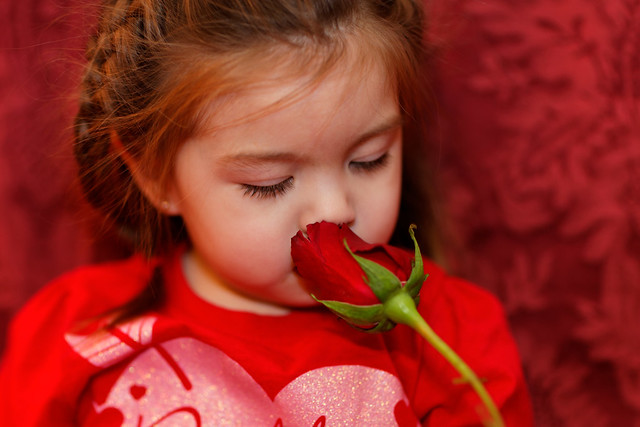

EOS 5D Mark II, EF 85mm f/1.2L II USM @ 1/60 s, f/1.8, ISO 400


EOS 5D Mark II, EF 70-200mm f/2.8L IS II USM @ 70mm, 1/250 s, f/2.8, ISO 100


EOS 5D Mark II, EF 24-105mm f/4L IS USM @ 105mm, 1/160 s, f/4, ISO 100

 
Upvote 0
koolman said:
Firstly thank you all for the references and tips. will need time to digest the materials mentioned here.

Let me share 2 specific challenges I face with my photos:

1) Exposure - with digital - even a slight brightness often "kills" the colors by "blowing them out". When I shoot outdoors (I live in a very sunny country) I find it very hard to set exposure - as "normal" exposure often is much to bright and colorless, if I start to underexpose - I get dark spots in the frame? Any tips on outdoor shots in bright light ?

"Understanding Exposure" by Bryan Peterson discusses metering in some depth. The first step if you are taking pictures of a scene with really bright highlights is to make sure that you are metering the primary subject and how to meter when photographing challenging scenes.

A quick summary: the way Peterson likes to do it is put the camera on manual and fill most of the frame with whatever he wants to use as his point of reference and manually set the exposure, then recompose. Alternatively one can use AE lock combined with shutter/aperture priority.

2) Portraits. Everyone talks about using a small f/stop >=2.8 to produce background blur (bokeh) and give the shot a nice affect. However I find - that f stops 2.8 and smaller - can easily produce blurry shots as the smallest movement of the subject (not to mention a group shot where people are not all the same distance from you) causes blur. I found that nothing ruins a nice portrait more then a blurry kind of picture (unless this was intended for some artistic purpose)
What is the best F/stop for portraits ? What about if you use a flash ?

The best F stop depends -- depth of field varies with subject distance. If you're close to minimum focus distance, you could need a much narrower aperture than f/2.8 to avoid "foreground blur". If you're taking a full body portrait with a 50mm lens on a crop, subject movement will not throw them out of focus (assuming you focused correctly). See online depth of field calculators.

For portraits, there is no one best F stop, but if you go with a narrow aperture, you will need a more cooperative background.

Flash can be used as necessary to provide enough light. Ideally, you choose the F stop based on depth of field preference. As you've probably observed already, for group shots you often need more depth of field, especially if the subjects aren't conveniently lined up in the plane of focus. A flash really helps for these because then you don't need to stretch the aperture to get enough light, instead you can close it to get enough depth of field.
 
Upvote 0
Bright light in itself shouldn't be a problem. The problem usually relates to having both dark and bright things in the photo. To fix this, just be wary of situations where there is a lot of shade and a lot of brightness in the one photo. Try to get everything in a similar level of brightness. Taking photos on cloudy days, or placing your subject under a tree or under a shadow often helps.

Usually it is the sky around the middle of the day that causes the most problems. If this is your situation, just minimise the amount of sky in the photo. Most photographers like taking photos in the early morning and late afternoon when the sky isn't so bright. Shooting with your back to the sun (or your shadow pointing towards the subject) can also help.

You could also use a flash to raise the level of brightness of your subject to match the brightness of the sky.

If the problem is that the colours appear unsaturated, try using a lens hood and / or a polarizer filter. This helps reduce flare and glare and keeps colours vivid.
 
Upvote 0
Status
Not open for further replies.