
Is Full Frame sharper than APS-C? My answer here

Status
Not open for further replies.
Despite all the acrimony in this thread, there is some interesting stuff. I would not dispute that that a FF is better than an APS-C with a 1.6xshorter focal length lens so that the whole picture area has the same field of view. I am interested in photography at super telephoto distance where crop factor is thought to be important. So, I decided to do a rough and ready test of FF vs APS-C doing my favourite hobby, taking photos of birds with a 300mm f/2.8 II +2xTC III. Accordingly, I took my ancient 7D and my new 5DIII and did the Old Grey Heron Test (parodying http://en.wikipedia.org/wiki/The_Old_Grey_Whistle_Test). The heron did his bit, stayed in one place long enough so I could switch bodies. The 7D was at iso 400 and the 5DIII at 640. Consistent with my other recent experience, the IQ of the 5DIII makes up for the crop factor loss of 1.5 fold as the two centre crops were quite similar. The 7D was noisier, as expected. I usually use it at iso 320 or less. At great length extremes, the 7D does have an advantage but otherwise the FF is just as good for bird photography with the same lenses, and the closer you get to the target, the better it should be. It will be interesting to see when the 7D II comes out with more modern technology if it can overtake the 5DIII in the telephoto range,
 

Attachments
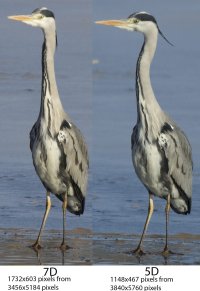
  • GreyHeronTest copy.jpg
    GreyHeronTest copy.jpg
    608.1 KB · Views: 1,445
Upvote 0
AlanF said:
Consistent with my other recent experience, the IQ of the 5DIII makes up for the crop factor loss of 1.5 fold as the two centre crops were quite similar. The 7D was noisier, as expected. I usually use it at iso 320 or less. At great length extremes, the 7D does have an advantage but otherwise the FF is just as good for bird photography with the same lenses, and the closer you get to the target, the better it should be. It will be interesting to see when the 7D II comes out with more modern technology if it can overtake the 5DIII in the telephoto range,

^^ This is why I don't use my 7D anymore... Add to that the case of the 600/4, where the FF 1D X will autofocus with a 2x TC for 1200mm focal length, compared to the 7D which needs f/5.6 for phase AF and therefore is limited to the 1.4x TC and a FF-equivalent of 1344mm - an effective 'crop factor benefit' of only 1.12x.
 
Upvote 0
AprilForever said:
TrumpetPower! said:
Sporgon said:
From my understanding of your posts it seems to me that you think the pixels you see on your screen are the same ones on your sensor.

Eh, you might be the one with a bit of confusion as to what a pixel is.

When you're looking at a 100% crop of an image, the pixels on your monitor are a (close to) perfect representation of the pixels on the sensor, just magnified a Brazilian times. There are caveats, of course, insofar as there are different color gamuts and luminance mapping and what-not, but those have no practical bearing on the discussion.

Also the actual size of the image projected onto the sensor is creating another confusion here. Yes it's true to say the recorded image as it falls on the sensor is larger on a larger sensor, but the ability to record it accurately comes down to lenses and pixel efficiency, so having a ( slightly ) larger light image on the sensor does not necessarily mean it has been recorded more accurately.

As with so many others, you're significantly overstating the importance of the megapickles.

Can a smaller format system produce sharper images than a larger format system? Yes, but not by merely matching the (in the case of digital) total pixel count of the larger format. You need at least the same number of megapickles to make up for the quantization advantage of the larger format, but you then need even more (resolution, optics quality, whatever) to make up for the surface area advantage of the larger format.

And this is where film is such a useful example to bring into the mix. Let's say you developed some fantastic new film that was so much better than the film currently being used in 120 film that it made a 135 camera produce images as good as those from 645. Great news! But the very next thing that's going to happen is that said film is going to get packaged into a 120 roll...and now the 645 images are going to be just as much better. Indeed, the 645 images with the new film are going to be as good as 4x5 images with the old film...but, again, the large format shooters are going to be all over the new film, and the 4x5 images are going to be as good as 8x10, and the 8x10 images are going to be better than original reality.

That's the exact same thing we see with digital formats, except that the expense of scaling up film formats is much gentler than the expense of scaling up new digital formats.

So please, by all means. Support enhanced image quality in smaller formats. But what makes you think those same enhancements aren't on their way to the larger formats as well?

Cheers,

b&

To quote a great luminary: "Don't underestimate the power of the megapickle." (Darth Vader, when discussing the 7D vs the 1D4 with the Emperor)

A few extra megapixels goes a long long way...

Hmmm, I'm lost. The 1D4 has much better IQ than the 7D. Or was that a joke? If so, good one!
 
Upvote 0
That Gray Heron test confirms my own experience. I own both a 7D and a 5D Mark iii. I find that the Mark iii produces consistently sharper photos, in part because of its superior autofocus (much superior!) and also because of its noise handling ability. I routinely shoot at ISO 320 with my 7D and at 640 with the 5D Mark iii. The vastly superior technology of the Mark iii more than compensates for the need to crop.
 
Upvote 0
Really great article, Plamen. It proves all the sane stuff in this thread: FF beats out crop when each sensor covers the same field with different focal length lenses etc but crop and FF are quite similar when they have the same pixel density and are with the same high quality lens.
 
Upvote 0
Please label the axes of the graph. I can guess at some but not all. What is the y-axis (S/N?)? What are the numerical values? What are the units - Is it Lin or log? What is the colour key?
 
Upvote 0
kanonpokajanen said:
Plamen, would it be possible to make a graph that not only accounts for the 8% MP differential, but also adjusts for the aperture to sensor size ratio?
I am not sure what that means. The graphs that I have there are in equivalent f-stops, which means the same ratio (same "pupil" a.k.a "physical aperture" size). For example 50/2 vs 80/3.2. Since the FL is proportional to the sensor size, you can think that with equivalent shots, the ratio of linear sensor size vs. the f-stop number (but not physical aperture!) stays the same. In the example above,
  • Crop: FL=50mm, f/2, crop sensor width=22.5, physical aperture=25mm
  • Full frame: FL=80, f/3.2, sensor width=36mm, physical aperture=25mm
So FL/(f-stop) is the same, (sensor width)/(f-stop) remains the same but (sensor width)/(physical aperture) is not.
Or maybe you mean an interactive graph of some sort? Icannot do such things.
 
Upvote 0
AlanF said:
It will be interesting to see when the 7D II comes out with more modern technology if it can overtake the 5DIII in the telephoto range,

I am also curious as to how a newer 7Dii would compare... I'd bet it would be VERY close...

What you have shown us is that BOTH cameras take nice pictures.
 
Upvote 0
Agreed about both taking very good pictures. The 7D under the right conditions performs just as well as its expensive brother. On the other hand, much of the advantage of crop in giving extra reach is illusory. I did some iso12233 chart tests at 100 iso with the 100-400mm L on both bodies as it is a very popular but not very sharp lens - its defects according to Plamen's analysis should show up more on the crop. At closer distances where the closely spaced lines on the chart are easily resolved, the 5D III gave clearer, more contrasty images. At long distances where the lines were at the limits of resolution, they were marginally better resolved by the 7D but IQ was much poorer from poorer contrast and so again the resultant overall image was not better.

The good news for the bird photography 7D owner is that you have camera that can equal the best (at lower iso).
The good news for the bird photography 5D III or 1DX owner is that you are not really disadvantaged by not having the crop factor (but both owners probably don't need me to tell you that).
 
Upvote 0
Put me down in the heron test in the camp of "full framed cropped 5d3 equals or exceeds 7d for bird photography". My test was similar to the herons except I used kingfishers in extreme range. The 5d3 images yielded better detail when cropped to equal framing. My settings for birds in flight are usually shutter 1250-1600, f 7.1 to 10 and ISo on automatic. With the 7d Letting the iso go above 320 in autoiso has its own issues.

So for me a ff has more sharpness than crop given the same lens and distance to target.
 
Upvote 0
Once Canon releases a high mp FF body, there would be mo much need for crop cameras in term of IQ, but croppers could achieve higher fps for less $$ for those who need them.

I think that Canon should implement a crop mode in their future FF bodies to lower the size of the RAW files (but no need to take EF-S lenses), and keep the sRAW and mRAW options for those who do not want large (non cropped) RAWs. The Nikon compressed RAW format is another option.
 
Upvote 0
Mikael Risedal said:
It means that the sensor in D800 at APS mode = 15,3Mp has better pixels signal =they have a greater efficiency than the 7D.

If you are talking about Quantum Efficiency - it depends on the sensor technology, not on the number of the pixels. In my analysis, I am not taking the noise factor into account. Then, if you crop the D800 to APC size, you are just getting a cropped sensor, something like the 50D but with 1.5 crop factor.
 
Upvote 0
I've read bits and pieces of this thread and I read a little of the math and whatnot, not much that I've understood, but what about the crucial question...print?

You have a small subject 50 yards away (you can't get closer) and a 300mm 2.8 lens attatched to that 7D/5dMkII manually prefocused.
Now, that small subject will not fill the frame of either camera...you must crop to create an equal field of view and make a 30x30" print.

Which of those cameras is going to cough out the better print?
 
Upvote 0
Status
Not open for further replies.