Is my copy soft or that's the average for the Canon EF 70-300 f/4-5.6 IS USM?

Status
Not open for further replies.
I have access to two copies of this lens and can confirm that in this case the TDP resolution crops give a true representation. At 200 to 300 mil, wider than f8 it is a soft focus lens. The op has shot at 270mm @ f6.3 so I would expect it to be soft. The lens has to be used between f8 & f11 at that focal length, and even then the mid frame is soft.

The 70-300 L on the other hand is a gem.

Regarding the price, here in the UK I think the non L is rather expensive for it's overall performance, but at sporting venues such as horse trials where every second member of the public has a dslr, I see hundreds of them !
 
Upvote 0
neuroanatomist said:
LetTheRightLensIn said:
It's hardly that bad to say you don't want to shoot with it at 300mm. It's pretty sharp there even if the large scale contrast is a bit duller there.

Maybe you can say you want to shoot with it at 300mm. I can confidently say that I certainly don't. I've tried two copies of it, one in a shop, one borrowed from a colleague. My experience reflects the performance of the lens on the TDP test chart, here's the 70-300 non-L at 300mm, followed by the 70-300L for comparison. Maybe you think it's 'pretty sharp' but I call it a mushy mess at 300mm.

Wow, that's some difference!
Ok, so that's the quality one can expect from this lens? It's not just my copy? And are Canon filters really that crappy? They're quite expensive and I thought they were designed to be put on L lenses, what's the point in producing a $2000 optical marvel and sell with it an overpriced crappy filter? So, B+W MRC it is.
On top of all that my copy front focuses (example attached, focus set on eyes), should I fix that with micro focusing adjustments or send body and lens to Canon?
I'll definitely get rid of it when I buy the new one, but I'm waiting to see what they're doing with the new 100-400L, hoping they'll announce it soon. I guess then the choice will be between 100-400L, 70-300L and 28-300L.
 

Attachments

  • IMG_1189.jpg
    IMG_1189.jpg
    512.4 KB · Views: 767
Upvote 0
banana joe said:
for comparison. Maybe you think it's 'pretty sharp' but I call it a mushy mess at 300mm.
, but I'm waiting to see what they're doing with the new 100-400L, hoping they'll announce it soon. I guess then the choice will be between 100-400L, 70-300L and 28-300L.


People have been waiting for a new 100-400L for some 7 years, probably more. That's a lot of lost images.

The new lens, if it ever comes out is going to run $3K, and the price of the old version will rise as a result.

Its pretty difficult to go wrong with one, but for a crop, the 100-300L is a excellent choice too.

As to the 70-300mm IS, it struggles at 300mm, but is ok at shorter focal lengths. It was a huge upgrade when I bought my 70-200mm f/4 IS to replace it several years ago.
 
Upvote 0
neuroanatomist said:
LetTheRightLensIn said:
It's hardly that bad to say you don't want to shoot with it at 300mm. It's pretty sharp there even if the large scale contrast is a bit duller there.

Maybe you can say you want to shoot with it at 300mm. I can confidently say that I certainly don't. I've tried two copies of it, one in a shop, one borrowed from a colleague. My experience reflects the performance of the lens on the TDP test chart, here's the 70-300 non-L at 300mm, followed by the 70-300L for comparison. Maybe you think it's 'pretty sharp' but I call it a mushy mess at 300mm.

My experience is NOTHING remotely like the TDP disaster for either the non-L or L. TDP either had hideous copies of each or used a target right near MFD or messed the tests up totally. My experience doesn't remotely match their Tamron 70-300VC results either while I'm at it. In fact, an awful lot of my experiences don't match TDP. Photozone results are overall a lot closer to my own experiences and tests (not quite the same either, but between copy variation and test margins of error, to be expected I guess) than TDP for the most part.

On FF it probably becomes mushy mess at the edges, but on APS-C a solid copy isn't pretty sharp if a bit lacking in large scale contrast. It was at least a sharp as my old 100-300L, although the 100-300L had far richer color and large-scale contrast at 300mm. My 70-300L had both richer color, large-scale contrast and sharpness.

Don't forget that when the 70-300 IS first came out it was referred to by some as a so-called "hidden L".
 
Upvote 0
Sporgon said:
I have access to two copies of this lens and can confirm that in this case the TDP resolution crops give a true representation. At 200 to 300 mil, wider than f8 it is a soft focus lens. The op has shot at 270mm @ f6.3 so I would expect it to be soft. The lens has to be used between f8 & f11 at that focal length, and even then the mid frame is soft.

Well I can confirm as can my friend that TDP's results do NOT give a true representation. It also tested quite well, I believe, at DxO (not that I trust them for lens tests) and one other site.

Perhaps there is extreme copy variation with this lens then? (Do beware focus precision though as the non-L 70-300 is prone to need very different MFA at each focal length along the way and is prone to miss at the longer end in any case under a number of scenarios which can make it seem softer than it really is. In the end the focus precision, or lack thereof, started bugging me, since I kept having to recheck to make sure it wasn't a little hazy due to miss to make sure I didn't need to reshoot since it missed just often enough to be something of a pain.)

TDP looks like they dropped it, kicked it, dropped it again, focused at MFD and then slightly defocused and then posted results.

The 70-300 L on the other hand is a gem.

Well the 70-300L certainly is better. It's the best one of these mini-70/300 or so range slow lenses ever made.
Even here TDP has a horrible copy or messed the test IMO. AS their 70-300L did a lot worse compared to the 70-200 f/4 IS than I found with my copies or than photozone found or than most bloggers found.

70-300L has much more precise AF, faster AF, non-rotating front, a tiny bit better IS, at the least a bit sharper across the board and sometimes much more noticeably so (much much so at the edges on FF across the board, the non-L is more of a strong performer on APS-C, beyond APS-C image circle it starts getting dicey unlike the L zooms), much stronger contrast and richer colors above 200mm, much better built. It is larger and a LOT heavier though.
 
Upvote 0
LetTheRightLensIn said:
Well I can confirm as can my friend that TDP's results do NOT give a true representation. It also tested quite well, I believe, at DxO (not that I trust them for lens tests) and one other site.

Perhaps there is extreme copy variation with this lens then? (Do beware focus precision though as the non-L 70-300 is prone to need very different MFA at each focal length along the way and is prone to miss at the longer end in any case under a number of scenarios which can make it seem softer than it really is. In the end the focus precision, or lack thereof, started bugging me, since I kept having to recheck to make sure it wasn't a little hazy due to miss to make sure I didn't need to reshoot since it missed just often enough to be something of a pain.)

TDP looks like they dropped it, kicked it, dropped it again, focused at MFD and then slightly defocused and then posted results.

AS their 70-300L did a lot worse compared to the 70-200 f/4 IS than I found with my copies or than photozone found or than most bloggers found.

I agree with you on TDP's resolution crops of the 70-300 L - but not at 300mm. I do find that they have not done justice, or perhaps the lens has not done justice to the L version at 70 -100mm where like you say it is shown to be clearly inferior to the 70-200 f4 IS and even the 24-105, yet I have not come across anyone who believes their 70-300 L is inferior to those other lenses when they actually own them. TDP resolution crops also show the new 24-70 L IS to have an inferior performance to the 24-105, which IMO is misleading.

Like yourself I find that photozone gives a view that is more close to my experiences with the various lenses I have owned and used. Photozone use MTF software to analyse the blur on the edges of the black squares whereas with TDP we are simply viewing it. You would think that would be the best way as after all it is about viewing the image. To overcome the effect of the AA filter TDP sharpen to the equivalent of '1' in the Canon picture style settings. Now I am not sure how effective this is as from my experience sometimes one lens may appear sharper than another with no sharpening applied, but after a little sharpening of both the other lens then is clearly sharper. I presume the information is there for the sharpening to work, but I really don't now.

One thing I do know though is that whoever said ' the 70-300 IS non L is the hidden L series lens' should give me some of what he'd been smoking. I need it.
 
Upvote 0
banana joe said:
privatebydesign said:
Without the EXIF data it is impossible to say, but there is nothing sharp in your image, if you had a good fast shutter speed, the vehicle was stationary, no crappy filter, it isn't a huge crop, etc then I'd say you have a soft lens, but to test that you need to put it in a tripod and do some controlled exposures in both manual and auto focus. It does not look like a micro AF issue as nothing is sharp, not meaning you don't need to do micro AF, but that the issue you have is masking any additional micro AF issue.

Here is how I test my lenses for sharpness and element misalignment. This series showed me extreme misalignment at 35mm with a 16-35, even at this size you can see the image right paper is more blurred than center and left.

And a little sharpen and rework on your elephant shot too.

You're right, I didn't give enough information.

Shot with Canon EOS 7D

EFIX data:
f/6,3
1/1000 sec
ISO 800
275mm

The vehicle was stationary, it's almost not cropped at all and I had on the Canon protection filter.
So, if my copy is soft, will Canon fix it under warranty?

What software and tool did you use to retouch my photo? I like what you did, except for some artifacts in the sky.

Thank you all for your responses!

As others have now said, the filter is not good and is costing you sharpness and contrast, I once had a Canon CPL, it was the worst filter I ever bought!

That will be your biggest improvement, after that shutter speed could be hurting you, at 275mm on the 7D you should be looking at 1/500 absolute minimum for pixel sharp images, 1/1000 as a minimum if you are a little excited, flustered or just drunk coffee! IS will help a bit, but I find light lenses to not get anywhere near as much sharpness improvement from IS as heavier lenses, maybe sprung to unsprung mass differentials play a part, maybe it is more difficult to jog a heavier lens, I don't know, just an observation I have made. Even at distance my 100 macro IS is not as effective as my 300 f2.8 even though the 100 has newer generation system.

After that it is probably just the lens, try some tests at home with no filter on a tripod with live view manual focusing, obviously just looking at the differing responses here and the different test results linked to there is some sample variation out there, but if you are not happy and it is a recent purchase send it back.

As for the post processing, I did it in ACR via Bridge, which is exactly the same as Lightroom, auto setting for exposure and contrast, your metering overexposed the scene because the elephants are dark and overwhelmed the Evaluative Metering (or Center Weighted or Spot, the only metering mode that would have nailed this image is Average Metering) simple grad filter for sky, vignette to draw attention to the subject and thats it, very simple and basic. My copy didn't get artifacts so I suspect it was the forum algorithm doing a bit of compression that introduced it.

 
Upvote 0
banana joe said:
privatebydesign said:
Without the EXIF data it is impossible to say, but there is nothing sharp in your image, if you had a good fast shutter speed, the vehicle was stationary, no crappy filter, it isn't a huge crop, etc then I'd say you have a soft lens, but to test that you need to put it in a tripod and do some controlled exposures in both manual and auto focus. It does not look like a micro AF issue as nothing is sharp, not meaning you don't need to do micro AF, but that the issue you have is masking any additional micro AF issue.

Here is how I test my lenses for sharpness and element misalignment. This series showed me extreme misalignment at 35mm with a 16-35, even at this size you can see the image right paper is more blurred than center and left.

And a little sharpen and rework on your elephant shot too.

You're right, I didn't give enough information.

Shot with Canon EOS 7D

EFIX data:
f/6,3
1/1000 sec
ISO 800
275mm

The vehicle was stationary, it's almost not cropped at all and I had on the Canon protection filter.
So, if my copy is soft, will Canon fix it under warranty?

What software and tool did you use to retouch my photo? I like what you did, except for some artifacts in the sky.

Thank you all for your responses!

First step, go out and test without a filter! Canon filters are apparently not that great
 
Upvote 0
banana joe said:
neuroanatomist said:
LetTheRightLensIn said:
It's hardly that bad to say you don't want to shoot with it at 300mm. It's pretty sharp there even if the large scale contrast is a bit duller there.

Maybe you can say you want to shoot with it at 300mm. I can confidently say that I certainly don't. I've tried two copies of it, one in a shop, one borrowed from a colleague. My experience reflects the performance of the lens on the TDP test chart, here's the 70-300 non-L at 300mm, followed by the 70-300L for comparison. Maybe you think it's 'pretty sharp' but I call it a mushy mess at 300mm.

Wow, that's some difference!
Ok, so that's the quality one can expect from this lens? It's not just my copy? And are Canon filters really that crappy? They're quite expensive and I thought they were designed to be put on L lenses, what's the point in producing a $2000 optical marvel and sell with it an overpriced crappy filter? So, B+W MRC it is.
On top of all that my copy front focuses (example attached, focus set on eyes), should I fix that with micro focusing adjustments or send body and lens to Canon?
I'll definitely get rid of it when I buy the new one, but I'm waiting to see what they're doing with the new 100-400L, hoping they'll announce it soon. I guess then the choice will be between 100-400L, 70-300L and 28-300L.

Well, first give the lens a proper test without the filter. Some people report that a filter can also affect focusing accuracy. As pointed out, it looks like your lens is performing not as good as it could, irrespective of the TDP tests, which may simply be due to wrong focus.
It has to be said though that in hot places heat seriously affects visual quality over distance, so that may have impacted your images as well.
 
Upvote 0
privatebydesign said:
Without the EXIF data it is impossible to say, but there is nothing sharp in your image, if you had a good fast shutter speed, the vehicle was stationary, no crappy filter, it isn't a huge crop, etc then I'd say you have a soft lens, but to test that you need to put it in a tripod and do some controlled exposures in both manual and auto focus. It does not look like a micro AF issue as nothing is sharp, not meaning you don't need to do micro AF, but that the issue you have is masking any additional micro AF issue.

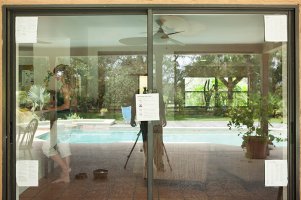
Here is how I test my lenses for sharpness and element misalignment. This series showed me extreme misalignment at 35mm with a 16-35, even at this size you can see the image right paper is more blurred than center and left.

Alas, this test is not done too well. From your image it looks like you are not standing perpendicular to your target.
First, the top of the entrance is not parallel to the frame (slanting down towards the right), and the tiles on the floor at the bottom are running upwards towards the right. These two lines converge somewhere on the right, which should not happen with two parallel lines, thus it's not perpendicular.
Second, your reflection should be in the middle of the window (at the black bar) if you stand perpendicular to the window. It is not. Both points show you are off to the left, and the focal plane of the lens will not be the same for your right and left samples. Your test alas is flawed.
 
Upvote 0
photonius said:
Alas, this test is not done too well. From your image it looks like you are not standing perpendicular to your target.
First, the top of the entrance is not parallel to the frame (slanting down towards the right), and the tiles on the floor at the bottom are running upwards towards the right. These two lines converge somewhere on the right, which should not happen with two parallel lines, thus it's not perpendicular.
Second, your reflection should be in the middle of the window (at the black bar) if you stand perpendicular to the window. It is not. Both points show you are off to the left, and the focal plane of the lens will not be the same for your right and left samples. Your test alas is flawed.

Wow, I post a quick picture to illustrate a concept! However if the center is focused then both sides should fall off evenly, even if the camera is not squared to the doors. A typical response from a person who thinks about doing something, rather than have some experience of actually doing it.

But the huge assumption you make is that this is part of the test, not an illustration. Here is one from the actual test.
 

Attachments

  • 1.jpg
    1.jpg
    150.9 KB · Views: 589
Upvote 0
privatebydesign said:
banana joe said:
privatebydesign said:
Without the EXIF data it is impossible to say, but there is nothing sharp in your image, if you had a good fast shutter speed, the vehicle was stationary, no crappy filter, it isn't a huge crop, etc then I'd say you have a soft lens, but to test that you need to put it in a tripod and do some controlled exposures in both manual and auto focus. It does not look like a micro AF issue as nothing is sharp, not meaning you don't need to do micro AF, but that the issue you have is masking any additional micro AF issue.

Here is how I test my lenses for sharpness and element misalignment. This series showed me extreme misalignment at 35mm with a 16-35, even at this size you can see the image right paper is more blurred than center and left.

And a little sharpen and rework on your elephant shot too.

You're right, I didn't give enough information.

Shot with Canon EOS 7D

EFIX data:
f/6,3
1/1000 sec
ISO 800
275mm

The vehicle was stationary, it's almost not cropped at all and I had on the Canon protection filter.
So, if my copy is soft, will Canon fix it under warranty?

What software and tool did you use to retouch my photo? I like what you did, except for some artifacts in the sky.

Thank you all for your responses!

As others have now said, the filter is not good and is costing you sharpness and contrast, I once had a Canon CPL, it was the worst filter I ever bought!

That will be your biggest improvement, after that shutter speed could be hurting you, at 275mm on the 7D you should be looking at 1/500 absolute minimum for pixel sharp images, 1/1000 as a minimum if you are a little excited, flustered or just drunk coffee! IS will help a bit, but I find light lenses to not get anywhere near as much sharpness improvement from IS as heavier lenses, maybe sprung to unsprung mass differentials play a part, maybe it is more difficult to jog a heavier lens, I don't know, just an observation I have made. Even at distance my 100 macro IS is not as effective as my 300 f2.8 even though the 100 has newer generation system.

After that it is probably just the lens, try some tests at home with no filter on a tripod with live view manual focusing, obviously just looking at the differing responses here and the different test results linked to there is some sample variation out there, but if you are not happy and it is a recent purchase send it back.

As for the post processing, I did it in ACR via Bridge, which is exactly the same as Lightroom, auto setting for exposure and contrast, your metering overexposed the scene because the elephants are dark and overwhelmed the Evaluative Metering (or Center Weighted or Spot, the only metering mode that would have nailed this image is Average Metering) simple grad filter for sky, vignette to draw attention to the subject and thats it, very simple and basic. My copy didn't get artifacts so I suspect it was the forum algorithm doing a bit of compression that introduced it.
Ok, I'll ditch the filter an do some tests!

I got pretty unlucky with light there, so if I wanted to stop down and get some more sharpness, I had either to get to ISO 1600 and deal with a lot of noise, or get to 1/500s and deal with camera shake, instead I just hoped that the lens could do a decent job half stop up... I guess that's what happens when you don't have time to properly test your equipment prior to using it!

Anyway, I feel like this lens doesn't deserve too much thought, I'll try to sell it and replace it as soon as possible (come on Canon, announce the new 100-400L already!).
I think I did manage to get some decent pictures, but they would have been undoubtedly better with a proper lens (at least IQ-wise), sometimes equipment does count! Speaking of equipment, those B+W MRC filters are quite expensive, but I guess there's a good reason!

Thank you all very much, you gave me very useful information!
 

Attachments

  • _MG_7542.jpg
    _MG_7542.jpg
    781.8 KB · Views: 446
  • _MG_9727.jpg
    _MG_9727.jpg
    518.2 KB · Views: 439
  • IMG_0601.jpg
    IMG_0601.jpg
    857.8 KB · Views: 436
Upvote 0
privatebydesign said:
photonius said:
Alas, this test is not done too well. From your image it looks like you are not standing perpendicular to your target.
First, the top of the entrance is not parallel to the frame (slanting down towards the right), and the tiles on the floor at the bottom are running upwards towards the right. These two lines converge somewhere on the right, which should not happen with two parallel lines, thus it's not perpendicular.
Second, your reflection should be in the middle of the window (at the black bar) if you stand perpendicular to the window. It is not. Both points show you are off to the left, and the focal plane of the lens will not be the same for your right and left samples. Your test alas is flawed.

Wow, I post a quick picture to illustrate a concept! However if the center is focused then both sides should fall off evenly, even if the camera is not squared to the doors. A typical response from a person who thinks about doing something, rather than have some experience of actually doing it.

But the huge assumption you make is that this is part of the test, not an illustration. Here is one from the actual test.

Well, how is a reader supposed to know that the sample - since you give it as an example how soft the lens is on the right side - was not part of the test. And with the limited resolution it was impossible to tell where the focus was. So, it wasn't really a "huge" assumption I made.
Anyway, the new sample is nicely lined up, how it should be done. Still at the resolution provided, one can't tell that the right side is less sharp, it sure looks more even that your first sample, but that's anyway not relevant for the thread here. The more important point is that if the OP tests his lens that the test should be done perpendicular.
 
Upvote 0
Sporgon said:
Very briefly and talking FF: it should be very good across the frame when stopped down a little from 70 to about 120.

From 200 to 300 it should sharp in the very centre stopped down 2. But the mid frame will be soft. Don't even look in the corners.

It's overall performance is much more suited to crop sensors.

I agree with most (maybe all!) of this.

But, the non-L 70-300 seems to perform best on a full frame @300mm if the center is your primary concern. If you believe the TDP charts. Otherwise, it's better on a crop.

http://www.the-digital-picture.com/Reviews/ISO-12233-Sample-Crops.aspx?Lens=358&Camera=453&Sample=0&FLI=4&API=3&LensComp=358&CameraComp=736&SampleComp=0&FLIComp=4&APIComp=3

FWIW, I have found the non-L 70-300 to perform better - particularly @300mm - on the Sl-1 than it does on the 60D.

I too am really wondering about the accuracy of the TDP charts as to the L version of the 70-300. If you do a comparison of the L version to the non-L verson in the center @300mm, the difference is noticeable but not huge. Of course, across the frame, there is no comparison - even at f/8:

http://www.the-digital-picture.com/Reviews/ISO-12233-Sample-Crops.aspx?Lens=358&Camera=453&Sample=0&FLI=4&API=3&LensComp=738&CameraComp=453&SampleComp=0&FLIComp=4&APIComp=3

And at f/11, (I know, I know, who uses f/11 on these lenses...) the L and the non-L appear equally sharp in the center on full frame:

http://www.the-digital-picture.com/Reviews/ISO-12233-Sample-Crops.aspx?Lens=358&Camera=453&Sample=0&FLI=4&API=4&LensComp=738&CameraComp=453&SampleComp=0&FLIComp=4&APIComp=4

If you are using the non-L 70-300, you just need to know its limitations to get the best bang out of it. But it is possible to get sharp images from it all the way to 300mm.
 
Upvote 0
Status
Not open for further replies.