
You are using an out of date browser. It may not display this or other websites correctly.
You should upgrade or use an alternative browser.
You should upgrade or use an alternative browser.
Mushrooms And Fungi Of Any Kind
- Thread starter Maximilian
- Start date


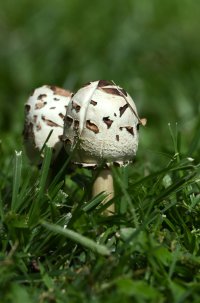
No idea about the specific mushroom, but the overwhelming majority of mushrooms fall into the category of ‘edible but not tasty and will probably cause some GI discomfort’. A small number of mushrooms are in the ‘edible and tasty’ category, and an even smaller number are in the ‘deadly if ingested’ category.This is the first time I've seen this mushroom. They're very pretty with their white stripes. Are they edible?
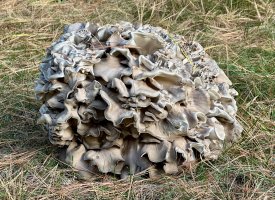
The hen-of-the-woods falls into the large edible but not tasty group.

Upvote
0

I don't think the edibility is known but judging by some other features they should be in section Xanthodermatei. It means they should be +/- mildly to moderate toxic (as all others from that section of the genus). In the literature you may find that "some people can eat" specifically A. xanthodermus. I don't think it's about the person who eats it. I had an experience in Bulgaria when one of my colleagues came with a jar of marinated A. xanthodermus. She was insisting that "many people" of that place are collecting the mushrooms without ill effects. We (5-6 people) tried it and nothing happen (symptoms are coming rather fast with that kind of toxins). I think it's a case of where you are collecting such a mushrooms!This is the first time I've seen this mushroom. They're very pretty with their white stripes. Are they edible?
The bottom line: I wouldn't eat Agaricus of that section even in survival mode (huh - especially in that mode!)!!!!
And BTW that mushrooms were with metallic taste. No reason to collect them even if you know they are not toxic!
Upvote
0
"A small number of mushrooms are in the ‘edible and tasty’ category, and an even smaller number are in the ‘deadly if ingested’ category."No idea about the specific mushroom, but the overwhelming majority of mushrooms fall into the category of ‘edible but not tasty and will probably cause some GI discomfort’. A small number of mushrooms are in the ‘edible and tasty’ category, and an even smaller number are in the ‘deadly if ingested’ category.
The hen-of-the-woods falls into the large edible but not tasty group.
View attachment 227204
I agree with that but what is "tasty" for some is kind of "mediocre" or "not tasty" for others!
In most cases it actually deepens on how you prepare it: you don't make chicken, pork, beef e.t.c the same way, no?
Grifola frondosa (aka "hen-of-the-woods") has a flavor similar of some Amanitas (yes! there are edible Amanitas like the most known A. rubescens and even the highly prized A. cesarea) and some other mushrooms (like Leucopaxillus giganteus that is by far more meaty!) with the similar flavor. You may like or dislike it but it's just a different flavor!
I could be an exception but for example I don't like the flavor of any Truffles! Or may be I just haven't tried some prepared by a good chef?!
And a case from Sweden: I went out to look for Boletus edulis but instead found +/- 2 pounds of Cantharellis cibarius. Met a family with two small children and when they saw my basked they were like "where did you find these? We are looking for these!!!"
I gave them my C. cibarius because I'm not realy fan of it.
For my big surprize they gave me their collection of B. edulis!!! I asked few times "are you sure?!!!" but they were so happy with the Cantharelle!
It was more Boletus than I was expecting to find and lately gave half to a friend!
Upvote
0

Because I can't resist going off topic, does anyone know the evolutionary advantages of various properties of mushrooms?"A small number of mushrooms are in the ‘edible and tasty’ category, and an even smaller number are in the ‘deadly if ingested’ category."
I agree with that but what is "tasty" for some is kind of "mediocre" or "not tasty" for others!
In most cases it actually deepens on how you prepare it: you don't make chicken, pork, beef e.t.c the same way, no?
Grifola frondosa (aka "hen-of-the-woods") has a flavor similar of some Amanitas (yes! there are edible Amanitas like the most known A. rubescens and even the highly prized A. cesarea) and some other mushrooms (like Leucopaxillus giganteus that is by far more meaty!) with the similar flavor. You may like or dislike it but it's just a different flavor!
I could be an exception but for example I don't like the flavor of any Truffles! Or may be I just haven't tried some prepared by a good chef?!
And a case from Sweden: I went out to look for Boletus edulis but instead found +/- 2 pounds of Cantharellis cibarius. Met a family with two small children and when they saw my basked they were like "where did you find these? We are looking for these!!!"
I gave them my C. cibarius because I'm not realy fan of it.
For my big surprize they gave me their collection of B. edulis!!! I asked few times "are you sure?!!!" but they were so happy with the Cantharelle!
It was more Boletus than I was expecting to find and lately gave half to a friend!
Upvote
0
Sorry for the late answer but for an answer to your question one can write a book...Because I can't resist going off topic, does anyone know the evolutionary advantages of various properties of mushrooms?
What exactly "properties"?
If you mean the toxicity of some species: what is toxic to the humans is not toxic for some animals (and opposite!). The Dead Cap (Amanita phalloides) is highly toxic (up to deadly) for us but for example squirrels (and many others!) enjoy them, same for many other toxic mushrooms that I know. And I'm giving an example with only the mammals (insects, slugs - they use to eat toxic mushrooms for breakfast!). They don't need us to spread their spores!
Some other properties (here for simplicity I will sample just what Oyster mushrooms can do...).
1. Ability to degrade the lignin from the lignocellulose is giving them food source - easily consuming the cellulose (and that is sugar! - yes, the paper that we use is form of sugar!).
2. Powerful enzymatic system that is able to break many other molecules - food source.
3. Did you know they have a micro-structures that can capture nematodes (tiny worms) and utilize them for a food?
And there are so many other features like an antibiotics production, symbiotic properties e.t.c. all of them correlated with the ability to survive and evolve.
Other features are just a byproduct of their metabolism - like the anti-cancer properties of some fungi that we can use but can't explain what advantage that fungi have from it.
Upvote
0
Thank you! It's enough to make me interested in finding a book!Sorry for the late answer but for an answer to your question one can write a book...
What exactly "properties"?
If you mean the toxicity of some species: what is toxic to the humans is not toxic for some animals (and opposite!). The Dead Cap (Amanita phalloides) is highly toxic (up to deadly) for us but for example squirrels (and many others!) enjoy them, same for many other toxic mushrooms that I know. And I'm giving an example with only the mammals (insects, slugs - they use to eat toxic mushrooms for breakfast!). They don't need us to spread their spores!
Some other properties (here for simplicity I will sample just what Oyster mushrooms can do...).
1. Ability to degrade the lignin from the lignocellulose is giving them food source - easily consuming the cellulose (and that is sugar! - yes, the paper that we use is form of sugar!).
2. Powerful enzymatic system that is able to break many other molecules - food source.
3. Did you know they have a micro-structures that can capture nematodes (tiny worms) and utilize them for a food?
And there are so many other features like an antibiotics production, symbiotic properties e.t.c. all of them correlated with the ability to survive and evolve.
Other features are just a byproduct of their metabolism - like the anti-cancer properties of some fungi that we can use but can't explain what advantage that fungi have from it.
Upvote
0

R5m2 + RF 100L
stack of 80 frames
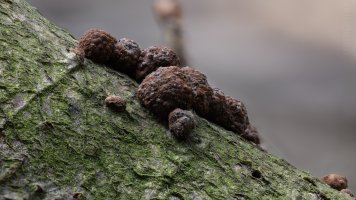
R5m2 + Laowa 25mm macro
stack of 21 frames
of this tremella https://www.canonrumors.com/forum/threads/mushrooms-and-fungi-of-any-kind.40761/post-1033480
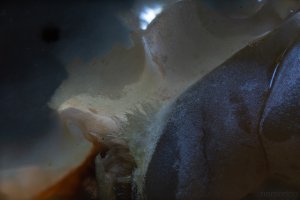
stack of 80 frames
R5m2 + Laowa 25mm macro
stack of 21 frames
of this tremella https://www.canonrumors.com/forum/threads/mushrooms-and-fungi-of-any-kind.40761/post-1033480
Upvote
0
It looks like low magnification/resolution photo (that has to be done with microscope for better results). I need for the mushroom below better resolution and by far more magnification to get at least to a genus ID. Cant use the microscopes in the lab - we use them for human cells and contamination with fungal spores could be disaster!I really like the abstract aspect of the last one. Well done, Nemorino.
So far just a Lepiota sensu lato: it means possible Lepiota/Leucocoprinus/Leucoagaricus - by your choice
 ! My first suspect was Lepiota besseyi but there are so many macro differences!

Upvote
0

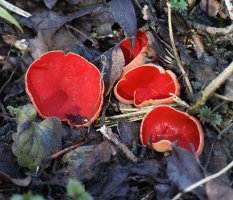
Indeed, they are edible and many people enjoy them (I never had the luck to find enough in order to try them)! Concerning the color - you shouldn't protest because they make colorful photosI don't usually see interesting mushrooms but these are colourful, Scarlet Elf Cups. They are supposedly edible, despite their colour.
View attachment 228001
 ! Toxicity is not connected to the color...
Upvote
0
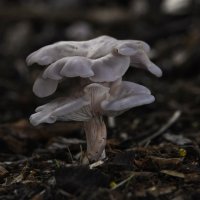
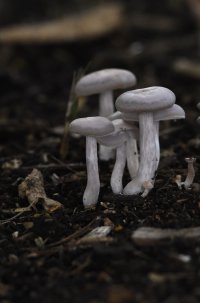
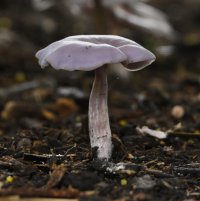
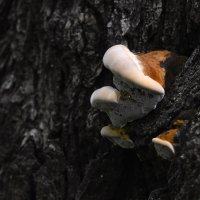
Well, I'm posting this on this topic only because from first glance I was thinking "fungus" ! Particularly some kind of Jelly fungus.
Actually a sap from old trunk of Araucaria sp.! How that old trunk can produce a sap I don't know but it's a sap (I had a hard time to clean my fingers).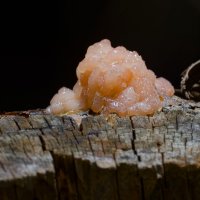
! Particularly some kind of Jelly fungus.Actually a sap from old trunk of Araucaria sp.! How that old trunk can produce a sap I don't know but it's a sap (I had a hard time to clean my fingers
).
Upvote
0

(I had a hard time to clean my fingers
I can imagine how sticky it was But really an interesting finding. And well shot!Well, I'm posting this on this topic only because from first glance I was thinking "fungus"
Actually a sap from old trunk of Araucaria sp.! How that old trunk can produce a sap I don't know but it's a sap

Remembers me, that I still have a whole folder of fungi from a wood walk in autumn, still not processed

Upvote
0
Similar threads
D
- Replies
- 32
- Views
- 4K


- Replies
- 14
- Views
- 3K
