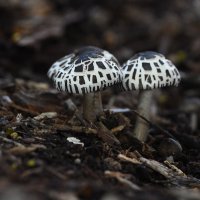
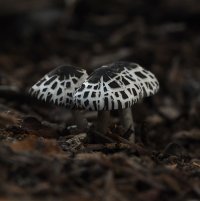
Mushrooms And Fungi Of Any Kind

The center column definitely is something I hadn't thought about but is obvious now that you told me. Thanks!
I was using Feisol 3441 back in the time and it is good (that time I was taking photos of fungi only and I never used a central column!) until one hike when I drop it on a stone and the "spider" cracked! After that I got a Feisol "Tournament" - lighter and as stable as the 3441, actually on hard ground as stable as the RRS that I'm using now(!!!) but I started using it for birds (with the Nikon 200-500!) and after ~2 years one of the legs disconnected from the spider (!!!). I use to have my camera attached to the tripod and I carry it on my shoulder (ready for all surprises...). After applying Gorilla glue it was OK but for a peace of mind I finally acquired the RRS and it's as stable as the "Tournament"(even more!) even on unstable ground. I never ever use a central column! What I did realized is that even with the RRS (and it has much ticker legs!) if it's not at (+/-) horizontal (both dimensions!) you get vibrations (nicely measurable - I mean you can see it and measure the difference!)*. Conclusions: don't use a central column, and try to avoid a tilted tripod!!!
* = many times the tilt of the lens is compensating the tilt of the tripod (and it depends on the weight of the front element, angle e.t.c.). But you shouldn't relay on these "compensations" because in the field they are "x"?
And finally (I really got tired after that much typing!) few photos!
It was like it will rain any moment there (overclouded with some sun occasionally protruding behind of thin clouds...).
DSC_3366.jpgDSC_3367.jpg
 
  • Like
Reactions: 3 users
Upvote 0
The center column definitely is something I hadn't thought about but is obvious now that you told me. Thanks!
I found a site that does tripod and head tests: The Center Column: “The Center Column is dedicated to providing quantitative data on tripod stability.”

See: https://thecentercolumn.com/
 
  • Like
Reactions: 1 user
Upvote 0
Do you have any trouble with your tripod vibration?
Depends on the situation: I use a small travel tripod which is not the most stable. As You see in the "making of" pictures, I removed the center column to get closer to the floor. If I have the camera at the end of a fully extended macro rail vibration is of cause a problem. But I use the remote control and allways a delayed shutter of two seconds. And the Laowa lens is much smaller then the Canon MPE 65.

Now two stacks made with a MT 24 flash

R5m2 + RF100L
135 frames close to mfd
flash135.jpg

and 35 frames
Pilz 35 flash.jpg
 
  • Like
  • Wow
Reactions: 4 users
Upvote 0
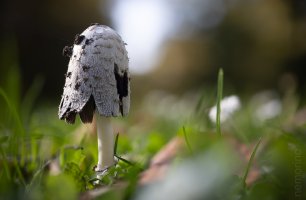
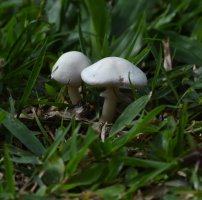
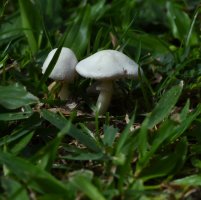
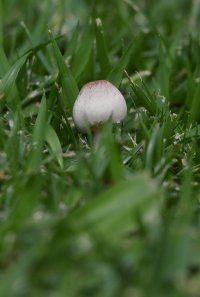
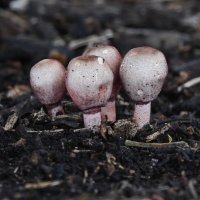
Nothing interesting from the birds today. After the last rains as expected there were some mushrooms growing: for the first one (two photos) I would expect Agaricus comptus. Slightly yellow bruising on the very base of the stem. Otherwise not bruising at all. After that Agaricus comptuloides with that purplish fibrils on the cap. Both are reported from Hawaii. For the last one I don't know: my first reaction was Leucoagaricus meleagris but it differs by many macroscopic features... All photos with 500mm prime (+/- 3 meters from the object).
These are for people who are interested of mushrooms, nothing from photo point of view...

DSC_6131.jpgDSC_6138.jpgDSC_6143.jpgDSC_6160.jpg
 
  • Like
Reactions: 3 users
Upvote 0
Nothing interesting from the birds today. After the last rains as expected there were some mushrooms growing: for the first one (two photos) I would expect Agaricus comptus. Slightly yellow bruising on the very base of the stem. Otherwise not bruising at all. After that Agaricus comptuloides with that purplish fibrils on the cap. Both are reported from Hawaii. For the last one I don't know: my first reaction was Leucoagaricus meleagris but it differs by many macroscopic features... All photos with 500mm prime (+/- 3 meters from the object).
These are for people who are interested of mushrooms, nothing from photo point of view...

View attachment 227129View attachment 227130View attachment 227131View attachment 227132
I found it interesting from a technical point of view as I would not have guessed 500mm. Which lens and what f number?
 
Upvote 0
I found it interesting from a technical point of view as I would not have guessed 500mm. Which lens and what f number?
When I'm out for birds (and I'm out for birds 99.99% of the time :)) it's always Nikon 500mm PF. The "f" should be 8-11(?). The rare exceptions are the cases when I expect bigger birds (like Tropic Birds) from closer distances. In that cases I usually use Nikon 200-500mm. For insects 200-500 is better because the smaller MFD but I usually don't go out with insects in my mind. In other words I rarely use 200-500 and only time to time a macro lens.
I forgot: ~month ago I used old 17-50mm, f 2.8 lens to take a photo of the students in the Lab :) !
 
Last edited:
  • Like
Reactions: 1 user
Upvote 0
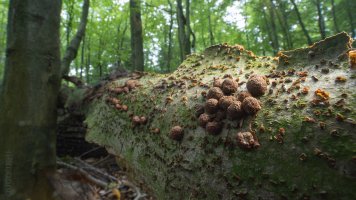
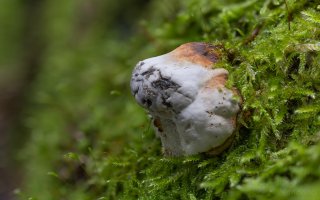
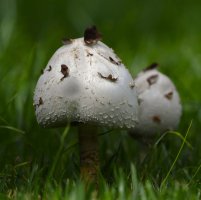
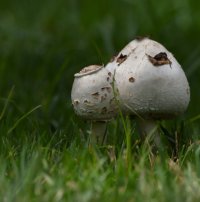
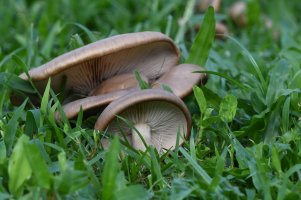
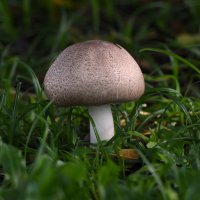
And these are from today. For the first one I have no idea: what it did resembles to me from at a firs glance was the Pleurotus eryngii from Europe - what I mean is the color and the impressed-fibrillate cap... Nothing else: it makes almost perfect ring in the grass (there is NO grass that will accommodate this mushroom on Hawaii! And P. eringii rarely does a ring - it grows solitary!) and very different attachment of the gills to the stem (+ several other differences!). Went to the Wikipedia to check at least the color of the cap (just for curiosity!) and was blown out by the images there: practically everything is artificially grown mushrooms and what is most disturbing some are arranged to look as growing in the nature!!! The photo in Wikipedia (some total ignorant from Poland!!!) is perfect example: P. eringii (aka King Oyster mushroom) in the nature is:
1. Parasitic on Eyingium campestre (it's a species complex with others growing on different Umbiliferae!). Not around the trees!
2. The wild mushrooms have in proportions by far bigger cap than stems (look at my photo: the closer and on focus fruit-body is about the right proportions !!! You can't say it's the same mushroom in comparison with the artificially grown!!!
After that just Agaricus subrufescens. I wish they were 6-8 of the same size: stuffed and on the side with baked baby potatoes and caramelized baby onions + fresh greens they would make an excellent dinner for two!

DSC_6514.jpgDSC_6625.jpg
 
  • Like
Reactions: 2 users
Upvote 0
And these are from today. For the first one I have no idea: what it did resembles to me from at a firs glance was the Pleurotus eryngii from Europe - what I mean is the color and the impressed-fibrillate cap... Nothing else: it makes almost perfect ring in the grass (there is NO grass that will accommodate this mushroom on Hawaii! And P. eringii rarely does a ring - it grows solitary!) and very different attachment of the gills to the stem (+ several other differences!). Went to the Wikipedia to check at least the color of the cap (just for curiosity!) and was blown out by the images there: practically everything is artificially grown mushrooms and what is most disturbing some are arranged to look as growing in the nature!!! The photo in Wikipedia (some total ignorant from Poland!!!) is perfect example: P. eringii (aka King Oyster mushroom) in the nature is:
1. Parasitic on Eyingium campestre (it's a species complex with others growing on different Umbiliferae!). Not around the trees!
2. The wild mushrooms have in proportions by far bigger cap than stems (look at my photo: the closer and on focus fruit-body is about the right proportions !!! You can't say it's the same mushroom in comparison with the artificially grown!!!
After that just Agaricus subrufescens. I wish they were 6-8 of the same size: stuffed and on the side with baked baby potatoes and caramelized baby onions + fresh greens they would make an excellent dinner for two!

View attachment 227184View attachment 227185
Wikipedia was a nice idea, but when anyone can edit, it's becmore likely to be misleading (unintentionally or not). At least on these forums when there are disagreements, someone with an open mind can read the argument and understand it better that these articles presented with the false expectation that nobody wants to challenge it.
 
  • Like
Reactions: 1 user
Upvote 0
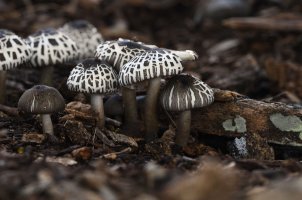
After the rains (and more are coming!) a mushroom that I haven't seen for several dry years: Agaricus rotalis! After that something that I don't know. It's ~3.5-4cm tall...

DSC_6664.jpgDSC_6673.jpgDSC_6761.jpgDSC_6681.jpg
 
  • Like
  • Love
Reactions: 4 users
Upvote 0