No New 50mm Lens Coming in 2017 [CR2]

ahsanford said:
geekpower said:
actually, the quality of the bokeh has little to do with the 1/3 stop wider aperture, and even less do to with magic; it's all about the spherical aberration, which turns out is actually science:

http://toothwalker.org/optics/spherical.html

we can talk about SA being a "defect" of the lens because it makes the image softer, overall, but it is qualitatively different than what a simple blur in post can do, as it becomes gradually more pronounced at the edges, which helps to pull attention to the subject. perhaps a more advanced post process could do something similar, but a simple one certainly can't. in addition, if the photographer decides to intentionally front or back focus, it can make the bokeh look different, so there is a lot of room for creativity.

Point taken -- the weird love of the f/1.2L is more than just a fraction of a stop. Its nutty spherical plane of focus is somewhat unique: some folks describe how it renders as 'magical' while others just call it soft.

It would appear that there are two camps with 50 primes -- give me magic or give me sharpness. The former spoons with their 50L at night while the latter straps enormous pickle jars to their rigs (Sigma Art, Zeiss Otus) to get razor sharp images.

I'm in a clear minority compared to those two groups. I care less about bokeh and best possible sharpness. I want a lens that is 90% as good as the best lens is optically, but only half as big. I love love love the 35mm f/2 IS USM and just want something similar (I'll take f/1.4 if it's not enormous) at the 50mm focal length.

- A

Well I wish they could make one with 90% of both, a very smooth bokeh and very sharp on the subject, I know it's near impossible and if not then very expensive, which means I can't afford it, but I want it to be there in the case I can afford it.
 
Upvote 0
meywd said:
Well I wish they could make one with 90% of both, a very smooth bokeh and very sharp on the subject, I know it's near impossible and if not then very expensive, which means I can't afford it, but I want it to be there in the case I can afford it.

I can't speak to bokeh quality as that seems a bit subjective, but I believe the mere existence of the 35 f/2 IS USM vs. the 35L II or 35 Art implies you can get sharp + (relatively) fast + small, so I think there's hope for 50mm lenses as well.

The $64,000 questions have always been with the non-L EF 50mm f/1.4 refresh to a EF 50mm f/nooneknows IS USM: what is 'nooneknows' and how big will it be?

- A
 
Upvote 0
ahsanford said:
geekpower said:
actually, the quality of the bokeh has little to do with the 1/3 stop wider aperture, and even less do to with magic; it's all about the spherical aberration, which turns out is actually science:

http://toothwalker.org/optics/spherical.html

we can talk about SA being a "defect" of the lens because it makes the image softer, overall, but it is qualitatively different than what a simple blur in post can do, as it becomes gradually more pronounced at the edges, which helps to pull attention to the subject. perhaps a more advanced post process could do something similar, but a simple one certainly can't. in addition, if the photographer decides to intentionally front or back focus, it can make the bokeh look different, so there is a lot of room for creativity.

Point taken -- the weird love of the f/1.2L is more than just a fraction of a stop. Its nutty spherical plane of focus is somewhat unique: some folks describe how it renders as 'magical' while others just call it soft.

It would appear that there are two camps with 50 primes -- give me magic or give me sharpness. The former spoons with their 50L at night while the latter straps enormous pickle jars to their rigs (Sigma Art, Zeiss Otus) to get razor sharp images.

I'm in a clear minority compared to those two groups. I care less about bokeh and best possible sharpness. I want a lens that is 90% as good as the best lens is optically, but only half as big. I love love love the 35mm f/2 IS USM and just want something similar (I'll take f/1.4 if it's not enormous) at the 50mm focal length.

- A

How do you feel about the bokeh quality (seems to be decent at best) and the weird ghosting effects?

I like the lens also, even though i bought it to be a 'crop 50mm'.
 
Upvote 0
ashmadux said:
How do you feel about the bokeh quality (seems to be decent at best) and the weird ghosting effects?

I like the lens also, even though i bought it to be a 'crop 50mm'.

As I said, bokeh is subjective to judge, but it seems fine to me for a wider f/2 lens. I haven't seen any weird flare with the 35mm f/2 IS USM. I've actually been fairly pleased with it.

Others have tested this more aggressively than I have and come to a similar conclusion:

http://www.lenstip.com/365.9-Lens_review-Canon_EF_35_mm_f_2_IS_USM_Ghosting_and_flares.html

And from TDP:

"The [35mm f/2] IS lens design has 3 additional lens elements (10/8 vs. 7/5) over the previous non-IS design, but remarkably shows the same or less flare than the previous lens. Which is very little - flare is very well controlled by this lens. The f/2 non-IS shows slightly more flare than the f/2 IS at very narrow apertures - f/11 and narrower. The 35 L and its larger glass show modestly more flare than the two f/2 lenses at narrow apertures."

- A
 
Upvote 0
It might not show but I want that 50mm IS even more than Ahsanford. Yes.

The deal is, in film, people LOVE shallow depth, especially when not TOO shallow (85mm1.2like) but more 50mm1.8 shallow on S35 (aps-c). It's the sweet spot for film and most hollywood kings have the 50mm f/1.8-2.8 as their favourite and the one to shoot an entire film on.

It's the close up on subject look, coupled with diffused background that separates the subject yet gives attention to background details and layers, atmosphere. And you can go back and close down to 5.6 and get a very dreamy full body shot with slight background separation.

I still shoot video and films on Canon DSLRs (yes - it's the colours and inability to afford a new sony every couple of month and a new 4K editing rig and film school money for learning colouri.. sorry, correcting footage)

When you're in the video business you shoot a lot of high end cameras because rental is a thing, much less so in photography. But still my very owned personal gear is Canon APS-C cameras and Canon glass.

It's sharp enough for 720p television (maximum spec) and web (where all my work goes) and even projects in theatres magically. No need to change. And the point is, I've always shot the Canon 50mm 1.4, just because the 1.8 II didn't have a focus ring. And the 1.4 gave identical image both at 1.8. Never use lower than 1.8-2 so 1.4 and 1.2 is of no concern. The 1.4 Canon was cheap and well made and gave me hollywood grade footage coupled with a Canon camera's Jpeg engine colour rendition. I then bought the 50mm STM when it came out as a backup at 120$, and it now replaced my 1.4! Just a better lens. Sharper too and has a smoother focus ring (Fly by wire but no where near as bad as Sonys do it, it's linear). The build quality is too steep but I bough another copy, juse because! Both together still cheaper than the 1.4 and each is superior. This says it all about the current 1.4. IT NEEDS replacement.

Guess what's the biggest shooting problem that I have now shooting on set? Stability.

You just CANNOT shoot 50mm video handheld. So you need a rig, and it transforms a rebel/80d+Niftyfifty look into a monster cinema shooter look! Plus they all work 10-20% out of the times badly in stability. While optical stabilization is numerical and always dead on (owning the 35mm IS, that is)

I just can't imagine how easy it would make my life if Canon created a 50mm IS. So many creative shots ruined by the need to add post stabilization and so many great frames went uncaptured because it can't be done without a rig I don't have on me...

This need for that lens made me think seriously about jumping to Sony due to their 50mm 1.8 OSS (plus IBIS). But the colours and bodies and heating and all that noise turn me off. They just don't make Canon-like video. Just go see youtube videos/films shot on both. My client like the images I give and I am not compromising that.

Now that Canon is not giving a 50mm soon, worst news I've heard all month, I have two options: looks for a third party alternative, or get a Sony/pana camera with IBIS.

The former appeals better to me for all the reasons above. What do you guys think of that Tamron 45mm VC? What are the other options?

(BTW for 6D/5D/1D shooters reading this: s35 50mm f/1.8 looks like 85mm f/2.8 on your 5D, that's the look I mean)
 
Upvote 0
BTW the EOS M5 has (5axis stabilization -electronic) in video mode. If that works well, it's my ticket out. Will sell my newly acquired 80D and get that body + adapter.

I have to ask, most people here are photogs, what is your sooo urgent need for an IS 50mil?

I have some russian m42 glass and the 135mm prime works great in photography, you just pump up that dial called shutter speed.

Can't think of anythng other than lowlight still subject shooting with a 50, like in a meuseum or some sort...

We video shooters however, normally, starve for it. So what's the so urgent need??
 
Upvote 0
Josh Denver said:
BTW the EOS M5 has (5axis stabilization -electronic) in video mode. If that works well, it's my ticket out. Will sell my newly acquired 80D and get that body + adapter.

I have to ask, most people here are photogs, what is your sooo urgent need for an IS 50mil?

I have some russian m42 glass and the 135mm prime works great in photography, you just pump up that dial called shutter speed.

Can't think of anythng other than lowlight still subject shooting with a 50, like in a meuseum or some sort...

We video shooters however, normally, starve for it. So what's the so urgent need??
I read somewhere, that body image stabilization (IBIS) works well with wide-angle lenses, and not very well with tele lenses.

The 80mm (50mm APS-C) viewing angle should benefit most from an optical image stabilizer, and the Tamron 45mm VC is the only option at this time.

Yes, dark places like museums, would be the priority use for a 50mm IS.
 
Upvote 0
ajfotofilmagem said:
I read somewhere, that body image stabilization (IBIS) works well with wide-angle lenses, and not very well with tele lenses.

penny drops!.. of course it does!

With a WA the camera has to wobble an awful lot to move the image at all, with a telephoto hardly any movement results in image shift. Any accelerometer in the camera will be limited (noise & resolution), and that limit will show up at the "long" end of the lens range first.
 
Upvote 0
rfdesigner said:
ajfotofilmagem said:
I read somewhere, that body image stabilization (IBIS) works well with wide-angle lenses, and not very well with tele lenses.
penny drops!.. of course it does!

With a WA the camera has to wobble an awful lot to move the image at all, with a telephoto hardly any movement results in image shift. Any accelerometer in the camera will be limited (noise & resolution), and that limit will show up at the "long" end of the lens range first.
Obviously I compared stabilization in the lens, versus stabilization in the body, both with the same viewing angle.

In this scenario, IBIS is competitive with wide-angle lenses.
On the other hand, with tele lenses, IBIS is ineffective COMPARING WITH STABILIZER ON THE LENS.
 
Upvote 0
Keep im mind the EOS M5 while technically has IBIS (in body image stabilization), because it has stabilization, well, in body, it is not what other IBIS from Panasonic and Sony. In the EOS M5 the camera takes a bigger resolution than 1080p, and corrects for motion by moving the frame electronically, while the others actually move the sensor to compensate with motion, so it works for photo mode, while the m5 needs a supersampled resololution thus only video mode.

Electronis IS has been VERY BAD at some cameras and VERY GOOD at others. From the M3, it's in the very good category. I hope the M5 does it well.

So my only option for a stabilized 50 prime for my SLRs is the Tamron 45mm VC? Bummer.

It'd be interesting to see how it would work with VC + M5 IBIS though.

BTW the M5 makes a never-before-heard claim, which is 5 axis electronic IBIS. How is that even a physical possibility? Doesn't sensor motion need to work for 5 axis? Are they doinh some overly clever software manipulations? Over-wording from marketing department?
 
Upvote 0
Josh Denver said:
...BTW the M5 makes a never-before-heard claim, which is 5 axis electronic IBIS. How is that even a physical possibility? Doesn't sensor motion need to work for 5 axis? Are they doinh some overly clever software manipulations? Over-wording from marketing department?
I have a Panasonic AG-AC8 video camera with 5-axis optical + electronic stabilizer. This means that MOTION SENSORS capture motion in 5 different directions.

Direction 1:
Vertical rotation on the central axis of the camera (when the front moves up, the back moves down) that corrects itself through the displacement in the lens.

Direction 2: Vertical movement without turning (both the front and the back move to the same side) that is corrected through the displacement in the lens.

Direction 3:
Horizontal rotation in the central axis of the camera (when the front moves to the left, the back moves to the right) that corrects itself through the displacement in the lens.

Direction 4: Horizontal movement without turning (both the front and the back move to the same side) that is corrected by the displacement in the lens.

Direction 5: Horizon's tilt movement, which will be leveled electronically through a small digital zoom.

In a lens without OPTICAL STABILIZER, directional corrections 1, 2, 3, 4 would have to be made electronically, with reduced efficiency.
 
Upvote 0
Josh Denver said:
BTW the M5 makes a never-before-heard claim, which is 5 axis electronic IBIS. How is that even a physical possibility? Doesn't sensor motion need to work for 5 axis? Are they doinh some overly clever software manipulations? Over-wording from marketing department?

I think it's likely 'overwording'. But...it may be true, in a convoluted way (i.e., technically true as written, but practically false). Here's what the press release states:

[quote author=Canon USA]
The Canon EOS M5 also features Combination IS with in-camera 5-axis image stabilization, while capturing video, a first in the Canon EOS series. With a compatible lens attachediv, Combination IS leverages optical IS and in-camera digital IS to help create tremendously smooth videos. The DIGIC 7 Image Processor makes the 5-axis IS possible even with lenses that do not contain IS, because the in-camera image stabilization functions independently to help reduce camera shake when shooting videos.

ivMaximum image stabilization is achieved when using either the EF-M 18–150mm f/3.5–6.3 IS STM or the EF-M 15–45mm f/3.5–6.3 IS STM with the lens firmware update.
[/quote]

To simplify ajfotofilmagem's statement, the 5 axes are pitch, yaw, roll, and translational movements in X and Y. Sensor movement IS can correct all five. Lens IS can correct four – all except roll (however, most lens IS systems only correct pitch and yaw, which are the major sources of motion at non-closeup distances; Canon's Hybrid IS corrects X/Y translation, too). Electronic IS can generally correct three – roll and X/Y translation. The part I bolded above likely isn't possible.

However, real electronic 5-axis IS might be possible in the future, based on dual-pixel architecture. Given that a DP RAW file allows limited forward/backward adjustment, it's theoretically possible to correct pitch and/or yaw by post-hoc moving focus forward on one half of the frame and back in the other. Since current DP architecture has all the pixels split in the same direction, it would currently only be possible to correct pitch or yaw, not both (you'd need mixed orientation of dual pixels, or quad-pixels, for both).

The M5 doesn't have DP-RAW for stills, and for the 5DIV with Digic 6+ you need the processing power of a real computer for microadjusting focus. But possibly Digic 7 can do it on the fly for video resolution. So if you put that string of ifs together with the fact that if you shoot video with the camera in portrait orientation (I know, why?!?), pitch becomes yaw (at least relative to the Canon logo, even if not in real space), then the M5 has 5-axis electronic stabilization (even though it can only do four axes at any one time).

64687937.jpg
 
Upvote 0
ajfotofilmagem said:
On the other hand, with tele lenses, IBIS is ineffective COMPARING WITH STABILIZER ON THE LENS.

Not at all. 1) IBIS is "always on" in-lens stabilization is not and needs time to "settle" which will ruin some pictures if it does not have the time to do so. 2) IBIS can now combine with in-lens stabilization giving the best of two worlds. 3) IBIS "upgrades" the IS of all your lenses for every generation. The best IBIS systems now clearly out-perform Canon's older in-body (2 stop) system.

Some people used to claim that it was "impossible" or "difficult" to see through a non-stabilized viewfinder on a big white. However, after Canon introduced its "sports-mode" without a stabilized viewfinder this spurious claim has finally subsided.

The reason for having this settings is due to another weakness of the in-lens stabilization - you risk "fighting" against the stabilization system when framing your shot. This is also the official Canon reason for introducing this setting which makes sure IS only kicks in when you press the shutter fully.

Canon - I want IBIS NOW!!!!!!!
 
Upvote 0
Josh Denver said:
I have to ask, most people here are photogs, what is your sooo urgent need for an IS 50mil?

I have some russian m42 glass and the 135mm prime works great in photography, you just pump up that dial called shutter speed.

Can't think of anything other than lowlight still subject shooting with a 50, like in a meuseum or some sort...

We video shooters however, normally, starve for it. So what's the so urgent need??

Video is shot @ 1/24s or faster (AFAIK the common speed is 1/48), with at most 4K (= ~8MP).

Why do you think video shooters would strive for IS at 1/48 at 8MP, but stills photographers shooting 1/60 with >20MP would not, at the same focal length?

And, mind you, stills cameras are shot handheld much more often than video.
 
Upvote 0
I continue to take wonderful pictures with my no-fail 50 1.4.

It has worked for me so well that I use my beloved 70-200 only a few times a year- though im looking to change that.

The AF on mine is dead on after it was first serviced some years back. It took 5 copies to find a good one, but man, its been a treasure ever since. The green fringing in particular is very noticeable, and sometimes is way more difficult to take otu in post then it looks, however purple fringing is a non issue.

Updated lenses are great too, however I'm mildly disappointed withe the cheesy bokeh and ghosting of the 35mm f2IS. It works great for behind the scenes stuff, but nothing comes close to the accuracy of my 5d3 + 50mm 1.4 combo. Actually, the closest was my t2i+70-200.

Ah well, happy shooting :)
 
Upvote 0
ashmadux said:
I continue to take wonderful pictures with my no-fail 50 1.4.

My Canon 50 f/1.4 nails focus (eventually -- it hunts quite a bit) but I only use it at f/2.8 or narrower for most use as I don't find the wider aperture shots all that appealing. The bokeh is all right I guess, but images seem cloudy and 'off' when I shoot on the wide open end, especially in higher contrast scenes (backlit skies, street lights in the background at night, etc.). Occasionally, the light is good and even and I net some strong keepers, but it's more the exception to the rule.

I can't say it any more plainly -- we need a 24/28/35 IS refresh for the 50 f/1.4. I'm not married to f/1.4 or even IS with this 50mm f/nooneknows IS USM, but it must have a new optical design + USM + internal focusing for me.

- A
 
Upvote 0
ahsanford said:
ashmadux said:
I continue to take wonderful pictures with my no-fail 50 1.4.
My Canon 50 f/1.4 nails focus (eventually -- it hunts quite a bit) but I only use it at f/2.8 or narrower for most use as I don't find the wider aperture shots all that appealing. The bokeh is all right I guess, but images seem cloudy and 'off' when I shoot on the wide open end, especially in higher contrast scenes (backlit skies, street lights in the background at night, etc.). Occasionally, the light is good and even and I net some strong keepers, but it's more the exception to the rule.

I can't say it any more plainly -- we need a 24/28/35 IS refresh for the 50 f/1.4. I'm not married to f/1.4 or even IS with this 50mm f/nooneknows IS USM, but it must have a new optical design + USM + internal focusing for me.
My experience with the Canon 50mm F1.4 was like this: Great quality at F2.8 and just reasonable at F1.8. Simply unacceptable contrast in F1.4.

Now with Sigma 50 Art, I am always delighted with the image quality, even wide open.
 
Upvote 0
ajfotofilmagem said:
Now with Sigma 50 Art, I am always delighted with the image quality, even wide open.

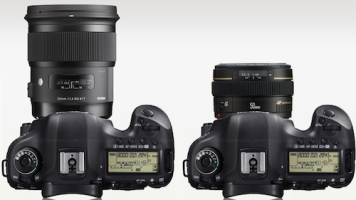
The optics are stellar, yes, but it's the size of a standard zoom and has AF inconsistency issues.

I just want something in the form factor of the one on the right with 90% of the IQ of the one on the left -- with reliable/fast/consistent first party AF.

- A

P.S. Didn't mean to judge -- the Sigma Art is a wonderful instrument. I just value compact size and AF speed/accuracy/consistency more than best-best-best IQ. For instance, I chose the 35mm f/2 IS USM over the Sigma 35 Art for the exact same reason. In your hands, however, the Art may very well be the best choice.
 

Attachments

  • Screen Shot 2017-01-10 at 8.44.38 AM.png
    Screen Shot 2017-01-10 at 8.44.38 AM.png
    166.8 KB · Views: 547
Upvote 0
My interest has been peaked with the news that Canon is looking into an f1.0 design :O With the latest Canon technology that could be amazing! I would be interested if we knew any more about the time frame though. No availability in 2017 sucks, but I would hope it was 2018 not later... I'd love a 50mm, but since I don't NEED one I'm not sure what to do in the mean while.
 
Upvote 0