Official release of Nikon D850

Mike,
6D, 5D III and 6D II QoF test results are very close, just so we both understand that 80D and 5D IV test results do stand out quite a bit.
"different sensor tech" - because of on sensor ADC and who knows what else Canon improved in 80D and 5D IV sensor.

not really in a position to argue the point. all I know is that on 5D IV my lenses deliver higher QoF results than on my 6D body. same lens, same distance, same calibration target, same version of FoCal, same or similar lighting conditions...All of them, no exception.. Make what you want from this.

Mikehit said:
It would also be interesting to know how you define 'different sensor tech' given that the 6D2 is not the same sensor tech as previous models despite what people said at the time of its release.
 
Upvote 0
right. 5D IV is a higher resolution sensor than 6D (30Mp vs 20Mp) or 6d II, yet it produced higher QoF results.

according to your theory, 6D QoF numbers should be higher yet they are not.

AlanF said:
+1
The point about measuring IQ from Reikan FoCal is borne out in practice. FoCal does indeed measure Quality of Focus in terms of edge sharpness, that is acutance, and acutance appears higher on lower mpx sensors. I routinely calibrate the same lenses on both a 5DSR and a 5DIV (and before that a 5DIII) and the lower resolution sensor gives a higher QoF despite being truly trounced in resolution tests.
 
Upvote 0
SecureGSM said:
Mike,
6D, 5D III and 6D II QoF test results are very close, just so we both understand that 80D and 5D IV test results do stand out quite a bit.
"different sensor tech" - because of on sensor ADC and who knows what else Canon improved in 80D and 5D IV sensor.

not really in a position to argue the point. all I know is that on 5D IV my lenses deliver higher QoF results than on my 6D body. same lens, same distance, same calibration target, same version of FoCal, same or similar lighting conditions...All of them, no exception.. Make what you want from this.

Your previous statements were quite categorical about which camera has higher pixel sharpness and how higher density sensors give lower pixel level sharpness and reference to sensor technology. But your quote above suggests you cannot define what 'same technology' means and lets us 'make of that what you can' based not on objective measurements but subjective review of an image.
On top of this your numbers comparing FF and APS-C are only helpful if you crop a FF image to the same FOV as a APS-C - which is a limited situation

So this does make me wonder what practical value your numbers have and anyone looking at them without really understanding may draw the wrong conclusion.

Please do not think I am trashing what you are saying but as a world-weary scientist I am trying to reconcile what you are saying. My other expensive sin is hi-fi and if that is packed full of pseudo-science as much as quality science and I have seen all manner of measurements that claim new insights.
 
Upvote 0
SecureGSM said:
If you were to upscale any image you would lose sharpness/contrast/details to a certain degree.

what I am saying though is:

if your were to crop the files to an identical pixel size both horizontally and vertically, and print them large, then 80d printed image will be much sharper than the one from 5DsR or D850...

the notion that one can CROP 5DsR files to the size of 80D and then print them large and still be better of, evidently does not hold the water.

If you DOWNSAMPLE 5DsR files instead, then it is a completely different story as you lose nearly 20% at pixel level sharpness BUT make up for the loss due to approx. 45% image size downsampling. I hope it makes sense.

I am looking forward to 80D sensor tech upscaled and implemented in 5DsR II. now, that would be one ultimate High Res / High IQ machine. I hope Canon realised that the sensor tech they used in 80D beats every single available Canon, Sony and Nikon sensor when it comes to pixel level sharpness.

What a lot of useless talk going on here.

This is the fact:
1) you take a picture with a 5DSR and the same one with a 5DIV on a nice summer's day (just to exclude DR etc.).
2) you like the picture and decide to make a print - any print size will do normal, large, very large, extremely large - whatever
3) the 5DSR picture will be sharper than the 5DIV picture - and you will be able to see the difference in your print (except at smaller print sizes)

More pixels count - a lot.

End of story.

The same BTW holds true for on-line publishing.

Everything else - and all the discussion above - is about tech numbers but has nothing to do with photography...

...Just making it clear to those that may be misguided to believe anyone will ever take a sharper picture with a 80D or 5DIV than the same picture taken with a 5DS/R... ;D
 
Upvote 0
https://www.dpreview.com/reviews/image-comparison?attr18=daylight&attr13_0=nikon_d850&attr13_1=canon_eos6d&attr13_2=nikon_d750&attr13_3=nikon_d5&attr15_0=raw&attr15_1=raw&attr15_2=raw&attr15_3=raw&attr16_0=25600&attr16_1=25600&attr16_2=25600&attr16_3=25600&normalization=full&widget=1&x=0.847120473833242&y=0.16149330482305577


DPReview just added the D850 to their comparison tool.
I have to say, it looks worse than the 6D, and the D750, and as far as I can tell the Nikon D5 is still the best low light camera on the market.
Nikon figured out some kind of black magic with the D5 and D500 to give them new levels of low light performance, but somehow that didn't make it into the D850.
 
Upvote 0
MIke, just a couple of observations:

1. I was quite clear that the 2 higher resolution bodies I was referring to are: 5Ds and 850D
yes, the QoF numbers were the lowest for either of them.
I never said that all lower density sensors produce higher QoF results. please read again what I written.
5D IV QoF is higher than 6D. what does this tell you?

2. 80D and 5D IV sensors produced the highest QoF number out of the bunch. both sensors are the new generation of Canon on sensor ADC tech.
3. You may call this an accutance or an edge sharpness.

4. cropping FF sensor to APC-S sensor being a limited situation:
I am not into Wildlife photography but I recall others have discussed cropping 5DsR image vs proper framing on APS-C body in wildlife photography application on this forum before. that would be that limited situation you are referring to.

5. and finally, I would qualify my findings as an empirical results rather than a science.
6. I never claimed that I defined the technology. I have no interest in such a definition. I am interested in outcomes rather than continue a pointless argument about what is the reason behind the results I am getting.

simple takeaway home for me personally:

5D IV and 80D sensor produced images with the highest level of accutance/ edge sharpness/ whatever you would like to call this. now, unless you know how 80D and 5D IV sensors are different, I doubt very much we can reliably explain the reason behind this accutance phenomenon. It could be anything.


Mikehit said:
Your previous statements were quite categorical about which camera has higher pixel sharpness and how higher density sensors give lower pixel level sharpness and reference to sensor technology. But your quote above suggests you cannot define what 'same technology' means and lets us 'make of that what you can' based not on objective measurements but subjective review of an image.
On top of this your numbers comparing FF and APS-C are only helpful if you crop a FF image to the same FOV as a APS-C - which is a limited situation

So this does make me wonder what practical value your numbers have and anyone looking at them without really understanding may draw the wrong conclusion.

Please do not think I am trashing what you are saying but as a world-weary scientist I am trying to reconcile what you are saying. My other expensive sin is hi-fi and if that is packed full of pseudo-science as much as quality science and I have seen all manner of measurements that claim new insights.
 
Upvote 0
SecureGSM said:
MIke, just a couple of observations:

1. I was quite clear that the 2 higher resolution bodies I was referring to are: 5Ds and 850D
yes, the QoF numbers were the lowest for either of them.
I never said that all lower density sensors produce higher QoF results. please read again what I written.
5D IV QoF is higher than 6D. what does this tell you?

What you did say was

High resolution sensors (5Ds, d850) do not offer the best pixel level sharpness. Hence your lens that resolved at around 1800 level on 5D III all that sudden performs sluggishly on 5Ds at pixel level.

which you qualified with

the 80D / 5D IV sensor tech is better than the older tech in 7D II and 5Ds.

which brings tech into the equation, as an explanation of the difference. But you are unable to say what 'better tech' actually means how do you know tech is the reason? You seem to be using bland supposition to explain observations that do not match your numbers. I am not saying tech is not the reason just that it is seemingly impossible to say. This then draws into doubt other claims you make on work that you are obviously putting time into.


SecureGSM said:
4. cropping FF sensor to APC-S sensor being a limited situation:
I am not into Wildlife photography but I recall others have discussed cropping 5DsR image vs proper framing on APS-C body in wildlife photography application on this forum before. that would be that limited situation you are referring to.

Yes. But you cannot make statements in isolation like you did, without qualifying them - which you only did after people questioned the meaning of your results.
So your numbers are meaningless to a landscape photographer who has an 80D and is thinking of upgrading to a FF camera. There was exactly the same discussion when the 6D2 came out and how the sensor was 'poorer' than a 80D - but it seems that not for a landscape photographer it isn't precisely because of this.


SecureGSM said:
5. and finally, I would qualify my findings as an empirical results rather than a science.
6. I never claimed that I defined the technology. I have no interest in such a definition. I am interested in outcomes rather than continue a pointless argument about what is the reason behind the results I am getting.
Reasons are not 'pointless'. Measuring something then not assessing their relevance is creating numbers for the sake of it. Without any understanding of the reasons, your claims of discrepancies being the result of 'different technology' is merely suppositions and mumb-jumbo.
Even the much-discussed DxO say that differences in scores of less than 5 points is probably not noticeable. What level of difference do your results become relevant?

SecureGSM said:
simple takeaway home for me personally:

5D IV and 80D sensor produced images with the highest level of accutance/ edge sharpness/ whatever you would like to call this. now, unless you know how 80D and 5D IV sensors are different, I doubt very much we can reliably explain the reason behind this accutance phenomenon. It could be anything.

I agree. But this is where you need to be careful. You have presented these numbers before, but I have still not seen a demonstration of what they actually mean in the real world. How does 1875 compare to 1800 or 1695?

I would love these numbers to have a real-world relevance to give us another handle on this technology but at the moment I am trying hard to get my head around what that is exactly.
 
Upvote 0
SecureGSM said:
right. 5D IV is a higher resolution sensor than 6D (30Mp vs 20Mp) or 6d II, yet it produced higher QoF results.

according to your theory, 6D QoF numbers should be higher yet they are not.

AlanF said:
+1
The point about measuring IQ from Reikan FoCal is borne out in practice. FoCal does indeed measure Quality of Focus in terms of edge sharpness, that is acutance, and acutance appears higher on lower mpx sensors. I routinely calibrate the same lenses on both a 5DSR and a 5DIV (and before that a 5DIII) and the lower resolution sensor gives a higher QoF despite being truly trounced in resolution tests.

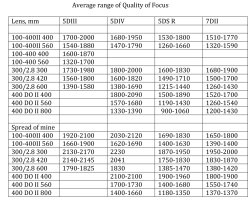
The quote you highlighted in red was for my measurements. Here is a chart I prepared some time ago that has the average spread of measurements published by FoCal on the top and below the spread of my own measurements on different bodies. I haven't tried the 6DII. There are other factors that come such as the strength of the AA-filter and the construction. All things being equal, what I wrote should be correct, but sometimes all things are not equal.

What is important is not to equate Reikan QoF with IQ and resolution.
 

Attachments

  • Focal_QoF_Statistics.jpeg
    Focal_QoF_Statistics.jpeg
    497.2 KB · Views: 146
Upvote 0
if you crop ( not downscale) 5DsR image to the size of 5D IV sensor, the resulting image will be less accute/ edge sharp / whatever that the same produced by 5D IV.
I explained on the previous page that despite 5DsR images are nearly 20% less accute ( edge sharp, or whatever you would like to call this), due to 45% pixel count advantage horisontally and vertically, the downsampled image will be sharper than same of 80D. sharper.


practical implication:

if Canon will upscaled 80D sensor in 5DsR II, you will be able to print even larger as you r image accutance or edge sharpness will be much higher. I hope it makes sense.

Once 5DsR II was released and test RAW images are available from DPR, I will ran the test again to see what QoF number the new sensor produced.

and no, it has nothing to do with photography. nothing at all :)

Sorry, I would rather leave this conversation now until such a time when 5DsR II has materialised and then we can re-visit this conversation and hopefully you would be able to explain how the new 5DsR II sensor beats the crap out of the old 5DsR on accutance / edge sharpness level despite being a higher resolution sensor than 5DsR original.

Maiaibing said:
SecureGSM said:
If you were to upscale any image you would lose sharpness/contrast/details to a certain degree.

what I am saying though is:

if your were to crop the files to an identical pixel size both horizontally and vertically, and print them large, then 80d printed image will be much sharper than the one from 5DsR or D850...

the notion that one can CROP 5DsR files to the size of 80D and then print them large and still be better of, evidently does not hold the water.

If you DOWNSAMPLE 5DsR files instead, then it is a completely different story as you lose nearly 20% at pixel level sharpness BUT make up for the loss due to approx. 45% image size downsampling. I hope it makes sense.

I am looking forward to 80D sensor tech upscaled and implemented in 5DsR II. now, that would be one ultimate High Res / High IQ machine. I hope Canon realised that the sensor tech they used in 80D beats every single available Canon, Sony and Nikon sensor when it comes to pixel level sharpness.

What a lot of useless talk going on here.

This is the fact:
1) you take a picture with a 5DSR and the same one with a 5DIV on a nice summer's day (just to exclude DR etc.).
2) you like the picture and decide to make a print - any print size will do normal, large, very large, extremely large - whatever
3) the 5DSR picture will be sharper than the 5DIV picture - and you will be able to see the difference in your print (except at smaller print sizes)

More pixels count - a lot.

End of story.

The same BTW holds true for on-line publishing.

Everything else - and all the discussion above - is about tech numbers but has nothing to do with photography...

...Just making it clear to those that may be misguided to believe anyone will ever take a sharper picture with a 80D or 5DIV than the same picture taken with a 5DS/R... ;D
 
Upvote 0
according to the table you have provided,
5D IV numbers at least equal or even slightly higher than the same of 5D III.
and 5D IV is a higher resolution body.

AA filter on 5D IV body is much stronger than on the 5D III. you know that. yet is produced higher accutance / edge sharpness number.
I do not recall that I ever referred to the results that I am getting being an IQ level indicator.
I used pixel level sharpness word. you may call this edge sharpness or accutance if you will.

according to the numbers that I was getting 5D IV accutance / edge sharpness was very slightly sharper, nearly identical. 5DsR numbers do stand out though.
Have a great week end everyone.

AlanF said:
SecureGSM said:
right. 5D IV is a higher resolution sensor than 6D (30Mp vs 20Mp) or 6d II, yet it produced higher QoF results.

according to your theory, 6D QoF numbers should be higher yet they are not.

AlanF said:
the lower resolution sensor gives a higher QoF despite being truly trounced in resolution tests.
All things being equal, what I wrote should be correct, but sometimes all things are not equal.

What is important is not to equate Reikan QoF with IQ and resolution.
 
Upvote 0
SecureGSM said:
if you crop ( not downscale) 5DsR image to the size of 5D IV sensor, the resulting image will be less accute/ edge sharp / whatever that the same produced by 5D IV.
I think everyone knows that. This is like taking an image with 7D2 and 5DIV and reproducing them at the same size. I don't need your numbers to tell me that

SecureGSM said:
I explained on the previous page that despite 5DsR images are nearly 20% less accute ( edge sharp, or whatever you would like to call this), due to 45% pixel count advantage horisontally and vertically, the downsampled image will be sharper than same of 80D. sharper.
Again, self-evident

SecureGSM said:
practical implication:

if Canon will upscaled 80D sensor in 5DsR II, you will be able to print even larger as you r image accutance or edge sharpness will be much higher. I hope it makes sense.
Again, self-evident - more pixels in a larger sensor.

I am struggling to see how this idea of 'pixel sharpness' is helping our understanding or explaining what is going on at the sensor.

Are your tests quantifying what we see, or are your tests offering an explanation? To take a (probably poor) analogy, does your speedometer show in an increase in speed because you are going faster, or are you gong faster because your speedometer is creeping up the scale?
 
Upvote 0
did I ever said that I know what is the reason behind this phenomenon?
I said that it could be anything - who knows what changes Canon made in 80D and 5D IV sensor. can you see what I am writing?

I never said 80D is a better camera stop this nonsense please.
I said and I stand my ground that 5D IV and 80D sensor exhibit higher accutance / edge sharpness in one isolated test.
what thats has to do with 6D II. landscape photography or any other camera as a device? I am referring to a single particular metric and you talk about totally unrelated subjects. what is your scientific explanation of this phenomenon then?

I have a good idea: why would you run your own tests over few canon, nikon and sony bodies and come back with an alternative conclusion.

anyway, your logic is flawed. make what you what you will of these numbers. call them what you want but please stop accusing me of claims I never made. all the best.


Mikehit said:
But you are unable to say what 'better tech' actually means how do you know tech is the reason? You seem to be using bland supposition to explain observations that do not match your numbers. I am not saying tech is not the reason just that it is seemingly impossible to say. This then draws into doubt other claims you make on work that you are obviously putting time into.


SecureGSM said:
4. cropping FF sensor to APC-S sensor being a limited situation:
I am not into Wildlife photography but I recall others have discussed cropping 5DsR image vs proper framing on APS-C body in wildlife photography application on this forum before. that would be that limited situation you are referring to.

Yes. But you cannot make statements in isolation like you did, without qualifying them - which you only did after people questioned the meaning of your results.
So your numbers are meaningless to a landscape photographer who has an 80D and is thinking of upgrading to a FF camera. There was exactly the same discussion when the 6D2 came out and how the sensor was 'poorer' than a 80D - but it seems that not for a landscape photographer it isn't precisely because of this.


SecureGSM said:
5. and finally, I would qualify my findings as an empirical results rather than a science.
6. I never claimed that I defined the technology. I have no interest in such a definition. I am interested in outcomes rather than continue a pointless argument about what is the reason behind the results I am getting.
Reasons are not 'pointless'. Measuring something then not assessing their relevance is creating numbers for the sake of it. Without any understanding of the reasons, your claims of discrepancies being the result of 'different technology' is merely suppositions and mumb-jumbo.
Even the much-discussed DxO say that differences in scores of less than 5 points is probably not noticeable. What level of difference do your results become relevant?

SecureGSM said:
simple takeaway home for me personally:

5D IV and 80D sensor produced images with the highest level of accutance/ edge sharpness/ whatever you would like to call this. now, unless you know how 80D and 5D IV sensors are different, I doubt very much we can reliably explain the reason behind this accutance phenomenon. It could be anything.

I agree. But this is where you need to be careful. You have presented these numbers before, but I have still not seen a demonstration of what they actually mean in the real world. How does 1875 compare to 1800 or 1695?

I would love these numbers to have a real-world relevance to give us another handle on this technology but at the moment I am trying hard to get my head around what that is exactly.
 
Upvote 0
do you really have to? sorry. do you read me: my tests are quantifying what we see. did I ever attempted to provide explanation beyond a vague statement: new or better sensor tech on 80D or 5D IV sensors??? no, I have not. so why are you saying that I have?
I do not care what is going on on the sensor level. there is a phenomenon that you cannot explain. but end result is: accutance / edge sharpness on 5D IV and 80D sensor is better than the same on 6D. that affects the outcomes. if it does not affect your outcomes why wasting your time and my time. if it matter not to you what are you arguing here?

Please explain me why 5DsR Qof number is 1650, 6D QoF number is 1800 and 80D number is 1900.

if you cannot explain or produce your numbers, then lets discuss your speedometer theory or weather in Melbourne. and why not?


it is not self evident that

I
Mikehit said:
SecureGSM said:
if you crop ( not downscale) 5DsR image to the size of 5D IV sensor, the resulting image will be less accute/ edge sharp / whatever that the same produced by 5D IV.
I think everyone knows that. This is like taking an image with 7D2 and 5DIV and reproducing them at the same size. I don't need your numbers to tell me that

SecureGSM: How do you know that end result be less acute if you never measured the acutance level? I have. so not that self evident as you say.

SecureGSM said:
I explained on the previous page that despite 5DsR images are nearly 20% less accute ( edge sharp, or whatever you would like to call this), due to 45% pixel count advantage horisontally and vertically, the downsampled image will be sharper than same of 80D. sharper.
Again, self-evident

SecureGSM: again, not self evident. as you would expect the final sharpness advantage in the downscaled image to be larger than 5DsR is offering.

SecureGSM said:
practical implication:

if Canon will upscaled 80D sensor in 5DsR II, you will be able to print even larger as you r image accutance or edge sharpness will be much higher. I hope it makes sense.
Again, self-evident - more pixels in a larger sensor.

I am struggling to see how this idea of 'pixel sharpness' is helping our understanding or explaining what is going on at the sensor.

SecureGSM: it does not. it does not also explain what is going on Mars and Venus

Are your tests quantifying what we see, or are your tests offering an explanation? To take a (probably poor) analogy, does your speedometer show in an increase in speed because you are going faster, or are you going faster because your speedometer is creeping up the scale?

SecureGSM: my speedometer shows the speed and my numbers are a good indication of edge sharpness / image acutance level for number of Canon, Sony and Nikon cameras.
 
Upvote 0
SecureGSM said:
did I ever said that I know what is the reason behind this phenomenon?
I said that it could be anything - who knows what changes Canon made in 80D and 5D IV sensor. can you see what I am writing?

I never said 80D is a better camera stop this nonsense please.
I said and I stand my ground that 5D IV and 80D sensor exhibit higher accutance / edge sharpness in one isolated test.
what thats has to do with 6D II. landscape photography or any other camera as a device? I am referring to a single particular metric and you talk about totally unrelated subjects. what is your scientific explanation of this phenomenon then?

I have a good idea: why would you run your own tests over few canon, nikon and sony bodies and come back with an alternative conclusion.

anyway, your logic is flawed. make what you what you will of these numbers. call them what you want but please stop accusing me of claims I never made. all the best.

Sorry but you did make a claim about the reason behind the differences by taking about sensors having different technology (you brought it up, not me) but if you comment was one of speculation then that was not clear and I may have over-emphasised its relevance.

I never said you said claimed the 80D was a better camera - please show me where I did. You now seem to be accusing of making claims I never made. What I did see what the 80D has higher numbers than other models which means it is clearly 'better' in some regard, because if that is not what it means, what do these numbers show?
And I brought up the 6D2 only as an illustration of how measurements like the ones you have produced can be misleading if the assumptions are not made clear.

As for 'make what I will' of these numbers, that is precisely what I am trying to do. On the same table you have presented APS-C cameras and FF cameras but you are giving us little to no guidance on what they actually mean when applied to photography and defining differences between different models.

What logic of mine do you think is flawed? All I am doing is trying to understand these numbers so if you see a flaw in my logic please explain why it is flawed.

As I said, I really want to understand what is going on here.
 
Upvote 0
SecureGSM said:
do you really have to? sorry. do you read me: my tests are quantifying what we see.

OK. Now that is clear. You previous statements on this thread and previous threads have given me the impression that 'Camera X is better because..' which suggests you are trying to explain what we see.
Do you have any suggestions on what is a meaningful difference? Does camera A have a score of 20 better better than Camera B because there is a genuine difference? Or is it 'measurement noise'?


SecureGSM said:
I do not care what is going on on the sensor level. there is a phenomenon that you cannot explain. but end result is: accutance / edge sharpness on 5D IV and 80D sensor is better than the same on 6D. that affects the outcomes.

yet when I talk about a 'better' camera you say I should not do so. Pedantic? Yes - but it is things like this that can derail a technical discussion (and this is a technical discussion)

SecureGSM said:
if it does not affect your outcomes why wasting your time and my time. if it matter not to you what are you arguing here?
I only know whether or not it affects my outcomes if I understand what the heck it is you think these numbers are showing in terms of photography. And your comment on that is sparse. I guess that is my main issue here


SecureGSM said:
Please explain me why 5DsR Qof number is 1650, 6D QoF number is 1800 and 80D number is 1900.

I don't know. That is what I am asking you - you are producing the numbers so it is reasonable to find out what you think they reflect. You must be measuring these for a reason and have a logic behind them. How do you use them to select a camera? How would you use them to advise a friend on which body to buy?

I am also asking you what is the relevance of those numbers to taking a photo. How does a score of 1800 on the 6D relate to a score of 1650 on the 5DSr? If bigger numbers are 'better' (your word) then are you saying the 6D will show more detail? More sharpness? If not, then what does QoF mean in photography?

How does a score of 1900 on the 80D affect a landscape image when viewed at the same size as a 5DSr that has a score of 1650?
If your numbers should not be used (or you caution against using) to compare APS-C to FF then say so.
 
Upvote 0
Mike,
I will make this really simple for you:

1. 80D sensor exhibits higher image acutance / image sharpness than 6D.
obviously because tech in 80-D sensor is different It is quite obvious.. we know that Canon introduced some changes in sensor design. no matter what they are.
2. difference for your photography if you shoot with long telephoto:

If you crop 5DsR image to achieve the same FOV as with APS-C 80D or 7D II and expect to achieve the same edge sharpness or image acutance, then you better look at the numbers again as it appears that your are better of shooting with 80D uncropped image than with 5DsR image cropped to 80D pixel size. bingo!

p.s. and no, I am not saying that 80D is a better camera :)
 
Upvote 0
SecureGSM said:
If you crop 5DsR image to achieve the same FOV and with APS-C 80D or 7D II and expect to achieve the same edge sharpness or image acutance, then you better look at the numbers again as it appears that your are better of shooting with 80 uncropped image than with 5DsR image cropped to 80D pixel size. bingo!

I get that. You still have not explained what difference in your numbers is relevant to an image - if you are unable to quantify this then fine. Just don't obfuscate.

The comparison above is a conclusion from your numbers - but how well has that been demonstrated? And gain, that only applies when you are focal-length limited which as I have said before is something that your bare numbers do not explain.
 
Upvote 0
I am sure that you used FoCal before and aware what the before and after calibration images look like.
Imagine that your lens was Out of tune before calibration by 8 AFMA points. Now imagine what difference does it make if you were to compare before and after calibration screen

5DsR image at 1:1 magnification will look blurrier than 80D image at 1:1 magnification by approximately the same ammount. It is up to you to decide if this relevant or not.
You can compensate for the loss of image acutance / edge sharpness by using a much sharper lens or image down sampling if it matters to you at all.

Mikehit said:
SecureGSM said:
If you crop 5DsR image to achieve the same FOV and with APS-C 80D or 7D II and expect to achieve the same edge sharpness or image acutance, then you better look at the numbers again as it appears that your are better of shooting with 80 uncropped image than with 5DsR image cropped to 80D pixel size. bingo!

I get that. You still have not explained what difference in your numbers is relevant to an image - if you are unable to quantify this then fine. Just don't obfuscate.

The comparison above is a conclusion from your numbers - but how well has that been demonstrated? And gain, that only applies when you are focal-length limited which as I have said before is something that your bare numbers do not explain.
 
Upvote 0
SecureGSM said:
Mike,
6D, 5D III and 6D II QoF test results are very close, just so we both understand that 80D and 5D IV test results do stand out quite a bit.
"different sensor tech" - because of on sensor ADC and who knows what else Canon improved in 80D and 5D IV sensor.

not really in a position to argue the point. all I know is that on 5D IV my lenses deliver higher QoF results than on my 6D body. same lens, same distance, same calibration target, same version of FoCal, same or similar lighting conditions...All of them, no exception.. Make what you want from this.

Mikehit said:
It would also be interesting to know how you define 'different sensor tech' given that the 6D2 is not the same sensor tech as previous models despite what people said at the time of its release.
Irrelevant.

Do you know how QoF is mathematically defined and determined in FOCAL (not the black box number you obtain as a result)? Do you know how Focal handles the RAW demosaicing (older version used jpgs!!! Now they write: " A
special demosaicing routine is then used which is optimised for FoCal’s analysis of Autofocus
performance, and this image is then analysed." What is that supposed to mean?)?

As long as you can't quantify the influence of the raw converter ALL deductions are pointless. I showed you a link above where it was demonstrated what happens when raw converters are used, even setting sharpening to zero doesn't get rid of the influence of baked in camera company settings. AA filter strength (often varies differently in x- or y-direction) is an other factor.
 
Upvote 0
I listed the spread of repeat runs, and for some of them the differences between the extremes of repeat runs are greater than the difference of mean values between two bodies. You quote single values for QoF. Does this mean that you did just one measurement or is it the mean of repeat measurements? If the latter, what are the standard deviations?

SecureGSM said:
according to the table you have provided,
5D IV numbers at least equal or even slightly higher than the same of 5D III.
and 5D IV is a higher resolution body.

AA filter on 5D IV body is much stronger than on the 5D III. you know that. yet is produced higher accutance / edge sharpness number.
I do not recall that I ever referred to the results that I am getting being an IQ level indicator.
I used pixel level sharpness word. you may call this edge sharpness or accutance if you will.

according to the numbers that I was getting 5D IV accutance / edge sharpness was very slightly sharper, nearly identical. 5DsR numbers do stand out though.
Have a great week end everyone.

AlanF said:
SecureGSM said:
right. 5D IV is a higher resolution sensor than 6D (30Mp vs 20Mp) or 6d II, yet it produced higher QoF results.

according to your theory, 6D QoF numbers should be higher yet they are not.

AlanF said:
the lower resolution sensor gives a higher QoF despite being truly trounced in resolution tests.
All things being equal, what I wrote should be correct, but sometimes all things are not equal.

What is important is not to equate Reikan QoF with IQ and resolution.
 
Upvote 0