Official release of Nikon D850

SecureGSM said:
I am sure that you used FoCal before and aware what the before and after calibration images look like.
Imagine that your lens was Out of tune before calibration by 8 AFMA points. Now imagine what difference does it make if you were to compare before and after calibration screen

5DsR image at 1:1 magnification will look blurrier than 80D image at 1:1 magnification by approximately the same ammount. It is up to you to decide if this relevant or not.
You can compensate for the loss of image acutance / edge sharpness by using a much sharper lens or image down sampling if it matters to you at all.

How do your numbers relate to '8 AFMA points'?
I have not used the Focal but as I understand it, it is relative, not absolute. It plots a curve for a given lens and chooses the best position for that lens - it does not compare between lenses. Two lenses needing +8 means they are both +8 from the best possible sharpness, not that when set to 'ideal' they have the same sharpness.
But I find it hard to picture (no pun meant) how the difference between two sensors is the same as having a mis-focusing lens.

You say a 5DSR will look blurrier at 1:1. Can you demonstrate that?
 
Upvote 0
SecureGSM said:
Mike,
I will make this really simple for you:

1. 80D sensor exhibits higher image acutance / image sharpness than 6D.
obviously because tech in 80-D sensor is different It is quite obvious.. we know that Canon introduced some changes in sensor design. no matter what they are.
2. difference for your photography if you shoot with long telephoto:

If you crop 5DsR image to achieve the same FOV as with APS-C 80D or 7D II and expect to achieve the same edge sharpness or image acutance, then you better look at the numbers again as it appears that your are better of shooting with 80D uncropped image than with 5DsR image cropped to 80D pixel size. bingo!

p.s. and no, I am not saying that 80D is a better camera :)

From a practical perspective, if you're going to shoot low ISO and always use only the crop area, just buy an 80D. The area that you see in the viewfinder or in liveview is actually what you'll get (making focus easier, for example), and for all practical purposes, nobody will be able to tell the pictures apart... and you'll save a ton of money and get flippy screen :D

And no, I'm not saying that an 80D is a better camera either. But if all you care about is the crop area, and don't need high ISOs, it's a much cheaper solution, and there are some advantages.
 
Upvote 0
Mike,
If you have not used the Focal, then perhaps it would be good to familiarise yourself prior to start throwing the weight around. That’s not what a scientist will typically would do.
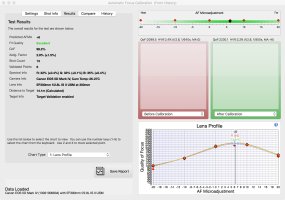
8 AFMA point is only a very approximate number. I you used Focal a lot, you would what it makes to the image. Just an example: if your peak QoF is around 1800, then -20/+20 point AFMA QoF will be in around 1000 points only

I.e. If you detune you Camera by 20 AFMA points, you may expect the QoF value to reduce from 1800 to 1000
From experience, detuning by 8 AFMA points would typically result in QoF decrease of around 15%.

QoF curve typically looks like a parabola with its highest value being positioned on horizontal axis where your AFMA adjustment value is. Step to the left or right by 8 points and you QoF value is came down from the peak value by approx 15%. - for illustrative purposes only.

Hence my example. From 1900 QoF value of 80D down to 1690 value on 5DsR

Yes, I can demonstrate the difference as you requested. You have not looked in the report for have provided you need to look at the QoF Test result pages.

I provided 3 reports in PDF format. Please download 5DsR and 750D reports.

Scroll through pages and locate image of the cropped area that Focal used to analyse RAW file for accutance (crispiness, edge sharpness or whatever...)
You can compare this image with the same you find in 750D report.
Evaluate visually as you do your images at 1:1 magnification for blurriness, sharpness, crispiness, edge sharpness, whatever you would like to call this.

You cannot make this stuff up as you will see with your own eyes that even 750D image was crispier around edges.
I use this word deliberately. I hate buzz words though.

AlanF,

I analysed two files per each given camera.
Very small number, I know. However deviations of result for any given camera is also very small. All results are very close to each other. Please refer to 2x 5DsR report files I have provided.

There is a correlation between edge sharpness, accutance QoF value of Focal software and real world image sharpness or crispiness.

Many forum members relies on Focal to achieve peak focus = peak sharpness for their images.


Mikehit said:
SecureGSM said:
I am sure that you used FoCal before and aware what the before and after calibration images look like.
Imagine that your lens was Out of tune before calibration by 8 AFMA points. Now imagine what difference does it make if you were to compare before and after calibration screen

5DsR image at 1:1 magnification will look blurrier than 80D image at 1:1 magnification by approximately the same ammount. It is up to you to decide if this relevant or not.
You can compensate for the loss of image acutance / edge sharpness by using a much sharper lens or image down sampling if it matters to you at all.

You cannot make this stuff up as you will see with your own eyes that even 750D image was crispier around edges.
I use this word deliberately. I hate buzz words though.

AlanF,

I analysed two files per each given camera.
Very small number, I know. However deviations of result for any given camera is also very small. All results are very close to each other. Please refer to 2x 5DsR report files I have provided.

How do your numbers relate to '8 AFMA points'?
I have not used the Focal but as I understand it, it is relative, not absolute. It plots a curve for a given lens and chooses the best position for that lens - it does not compare between lenses. Two lenses needing +8 means they are both +8 from the best possible sharpness, not that when set to 'ideal' they have the same sharpness.
But I find it hard to picture (no pun meant) how the difference between two sensors is the same as having a mis-focusing lens.

You say a 5DSR will look blurrier at 1:1. Can you demonstrate that?
 
Upvote 0
Are you implying that FoCal demosaicing algorithm is optimized for 5D IV RAW files exclusively and processes 5Ds RAW files incorrectly? Right.
Do you believe your own eyes then?

Please download test RAW 5DsR and 5D IV files, open files in raw editor of your choice, do not apply any processing but crop the the area that Focal analysed. (Black and white round target) Compare side by side at 1:1 magnification level visually. You will notice the difference in edge sharpness, image acutance, crispiness, whatever you pleased. It is that evident.

p.s. to remove Focal RAW demosaicing algorithm from the equation, I have ran QoF analysis on 5DsR and 5D iV jpeg files instead of RAW files.

https://www.dpreview.com/reviews/image-comparison/fullscreen?attr144_0=canon_eos5dmkiv&attr144_1=canon_eos5dsr&attr144_2=canon_eos6dmkii&attr144_3=nikon_d750&attr146_0=100_0&attr146_1=100_0&attr146_2=100_4&attr146_3=100_4&normalization=compare&widget=542&x=0.124786377&y=0.5025702

both files were processed in ACR on MAC.

please find report files attached.

Canon 5DsR QoF value: 2002.4
Canon 5D IV QoF value: 2141.7

compare to 5DsR 1690 vs 5D IV 1865 when RAW files were used.

I do encourage you to look at the crop of the image that FoCal analysed (QoF pages of the report files) and compare them side by side. you can visually see the difference.

again, 5D IV produced more acute, edge sharp, crisp image when viewed at 1:1 magnification.
now that Focal RAW demosaicing algorithm is proven to have no influence on the end result, please explain how 5D IV camera files are consistently more acute, edge sharp, crisp than 5DsR one when viewed at 1:1 resolution?

I cannot explain this as I have no insider knowledge. Why would not you ask Canon? I am sure that they will be able to explain this phenomenon easily.
I merely identified that there is a considerable difference in acutance, image edge sharpness and reported my findings here.


Hflm said:
Irrelevant.

Do you know how QoF is mathematically defined and determined in FOCAL (not the black box number you obtain as a result)? Do you know how Focal handles the RAW demosaicing (older version used jpgs!!! Now they write: " A
special demosaicing routine is then used which is optimised for FoCal’s analysis of Autofocus
performance, and this image is then analysed." What is that supposed to mean?)?

As long as you can't quantify the influence of the raw converter ALL deductions are pointless. I showed you a link above where it was demonstrated what happens when raw converters are used, even setting sharpening to zero doesn't get rid of the influence of baked in camera company settings. AA filter strength (often varies differently in x- or y-direction) is an other factor.
 

Attachments

Upvote 0
SecureGSM said:
Are you implying that FoCal demosaicing algorithm is optimized for 5D IV RAW files exclusively and processes 5Ds RAW files incorrectly? Right.
Do you believe your own eyes then?
We don't know what the demosaicing does to what files, as such debating about things we don't know exactly
is difficult. It is likely, that In-Raw-Sharpening causes differences.

SecureGSM said:
Please download test RAW 5DsR and 5D IV files, open files in raw editor of your choice, do not apply any processing but crop the the area that Focal analysed. (Black and white round target) Compare side by side at 1:1 magnification level visually. You will notice the difference in edge sharpness, image acutance, crispiness, whatever you pleased. It is that evident.

Again, doesn't prove anything, as long as the raw converter is in the equation. We need to be able to compare pixel-level sharpness directly and raw converters are changing the equation, as I demonstrated in the provided link in a previous post.

SecureGSM said:
p.s. to remove Focal RAW demosaicing algorithm from the equation, I have ran QoF analysis on 5DsR and 5D iV jpeg files instead of RAW files.
This is even worse. Even Focal changed their software since with jpgs even more processing gets into the equation. That is known for ages.


SecureGSM said:
Canon 5DsR QoF value: 2002.4
Canon 5D IV QoF value: 2141.7
compare to 5DsR 1690 vs 5D IV 1865 when RAW files were used.
I do encourage you to look at the crop of the image that FoCal analysed (QoF pages of the report files) and compare them side by side. you can visually see the difference.
again, 5D IV produced more acute, edge sharp, crisp image when viewed at 1:1 magnification.
now that Focal RAW demosaicing algorithm is proven to have no influence on the end result, please explain how 5D IV camera files are consistently more acute, edge sharp, crisp than 5DsR one when viewed at 1:1 resolution?
You didn't prove anything. I now get to the impression, you didn't understand the criticism many here provided at all.


SecureGSM said:
I cannot explain this as I have no insider knowledge. Why would not you ask Canon? I am sure that they will be able to explain this phenomenon easily.
I merely identified that there is a considerable difference in acutance, image edge sharpness and reported my findings here.
Based on the program Focal you chose and the metric used as a black-box in that software the results are as they are, which is fine. This is one thing. But the interpretation of the very results is the problem. So far your interpretation seems flawed to me. You get to conclusions
1) without knowing how the QoF metric is defined and measured
2) without quantifying or knowing what type of demosaicing is used and how WB, tone curve and baked in raw values of the manufacturers influence the result (that they do is proven in http://www.strollswithmydog.com/raw-converter-sharpening-with-sliders-at-zero/)
3) Lenses. Are the lenses diffraction limited to f5.6? In that case, the 5dsr has a disadvantage compared to the 5div, as the maximum achievable resolution in the red channel is 38MP due to diffraction, affecting the 5dsr and not the 5div.
 
Upvote 0
what I do not understand really is why I am wasting my time here to explain a simple fact:

no matter what RAW converter I used, 5DsR files exhibit less acutance / edge sharpness than 5D IV files.

This is even worse. Even Focal changed their software since with jpgs even more processing gets into the equation. That is known for ages.

Rubbish.. Focal still use jpeg files for lens calibration by default.. RAW is only optional. They claim that jpeg processing is much prefered. it is faster and you get same accuracy in result. you evidently do not have much experience with FoCal. Check your facts. please.

3) Lenses. Are the lenses diffraction limited to f5.6? In that case, the 5dsr has a disadvantage compared to the 5div, as the maximum achievable resolution in the red channel is 38MP due to diffraction, affecting the 5dsr and not the 5div.

DLA for 5DsR is F6.7

let's look at the numbers:

5DsR:

Red Quality 1810.7
Green Quality 2213.8
Blue Quality 1983.7

now 5D IV:

Red Quality 2059.6
Green Quality 2230.6
Blue Quality 2136.5

oh, wait.. what happened with 5DsR blue channel? is it DLA affected as well?? oh, schweppes..

it turns out that the BLUE channel of 5DsR is also underperforming.

p.s. DLA for Canon 80D is F5.9 and for 5DsR is F6.7. Yet, QoF values of 80D is way better than 5DsR. like chalk and cheese.
 
Upvote 0
SecureGSM said:
Mike,
If you have not used the Focal, then perhaps it would be good to familiarise yourself prior to start throwing the weight around. That’s not what a scientist will typically would do.
........
QoF curve typically looks like a parabola with its highest value being positioned on horizontal axis where your AFMA adjustment value is. Step to the left or right by 8 points and you QoF value is came down from the peak value by approx 15%. - for illustrative purposes only.

Before you start accusing others of not being scientific, consider your own scientific approach and whether it is that of a serious scientist.

Firstly, a QoF fit does not look like a parabola, it looks like the top of a bell-shaped curve. It has to be a type of bell shape as the QoF drops to zero at plus/minus infinity whereas a parabola tends to minus infinity at plus/minus infinity. FoCal probably uses a Gaussian function for data fitting. I've attached a typical QoF plot.

Secondly, it appears that you have just downloaded data from dpr and analysed it by a black-box program whose details you do not know. If that is so, then it is scientifically horrible. You don't know how carefully dpr performed its experiments - they weren't intended for what you are analysing, you don't know how the conditions changed between experiments done at different times. You haven't even done a statistical analysis and yet you draw conclusions between numbers that can be close.
 

Attachments

  • Screenshot 2017-09-30 09.17.25.jpeg
    Screenshot 2017-09-30 09.17.25.jpeg
    566.5 KB · Views: 134
Upvote 0
no, 1650 and 1900 is not even remotely can be called statistically close.

2 5DsR bodies evaluated and 2 80D's. small data but not a statistically close results!

yet QOF values for the same camera model were statistically close: 1650 and 1690 - for 5DsR.

repeatability? yes, that is the word.


now, can I ask you: what happens with all the lens reviewers who evaluate a single copy of the lens and yet considered as a serious researches? oh, this lens beats that lens.. oh, wait i have just received a second copy of the lens and it is not as good.

do you want me to point out the name of the reviewers that being oh so serious scientist evaluating a single copy of the lens? there are few to mention that are regular on this forum and yet. not a single person questioner how reliable the data is.

I simply do not have time to run a serious experiment.
I do not pretend to be a scientist, for starters.
secondly, I have my own Focal Numbers for number of cameras that i have calibrated.

look at at your own table of QoF values for the Christ sake - don't you see that your 5Dsr getting lower QoF values??
thirdly, I called the curve parabola and it is a bell shaped for you. what difference does it make? none. I can call the curve a didgeridoo just for fun :)

btw, in majority of cases, for me the curve looks more like this one:

s6CGIld.png


And lastly, I do not accuse anyone. I pointed attention to a fact and it is up to you to accept or not.
if you do not, it is fine, but would you please stop this never ending biased conversation.

your 5DsR sensor produce wonderfully acute and edge sharp images.


AlanF said:
You haven't even done a statistical analysis and yet you draw conclusions between numbers that can be close.
 
Upvote 0
SecureGSM said:
now, can I ask you: what happens with all the lens reviewers who evaluate a single copy of the lens and yet considered as a serious researches? oh, this lens beats that lens.. oh, wait i have just received a second copy of the lens and it is not as good.

do you want me to point out the name of the reviewers that being oh so serious scientist evaluating a single copy of the lens? there are few to mention that are regular on this forum and yet. not a single person questioner how reliable the data is.

I simply do not have time to run a serious experiment.
I do not pretend to be a scientist, for starters.
secondly, I have my own Focal Numbers for number of cameras that i have calibrated.

look at at your own table of QoF values for the Christ sake - don't you see that your 5Dsr getting lower QoF values??
thirdly, I called the curve parabola and it is a bell shaped for you. what difference does it make? none. I can call the curve a didgeridoo just for fun :)

btw, in majority of cases, for me the curve looks more like this one:

s6CGIld.png


And lastly, I do not accuse anyone. I pointed attention to a fact and it is up to you to accept or not.
if you do not, it is fine, but would you please stop this never ending biased conversation.

your 5DsR sensor produce wonderfully acute and edge sharp images.


AlanF said:
You haven't even done a statistical analysis and yet you draw conclusions between numbers that can be close.

If you read my posts, which I do not expect people to do, I complain incessantly about reviewers who look at just one copy of lens and especially when viewers make comparisons between two lenses based on reviews of one copy of each.

If you truncated the ends off a bell-shaped curve it looks like a parabola. But it isn't one. It makes a big difference to me if you use the wrong equation to fit a curve. But, that is my job - I am a quantitative scientist and I train students to analyse data.
 
Upvote 0
ah, ok. then what I called a parabola is in fact is a bell-shaped curve. what difference does it make.

should we stop calling square "a square" as it is in fact a rectangular with 4 equal sides?

Alan, I appreciate you are being a serious scientist, but what we are looking at is a a very interesting situation that no one previously was looking into. none.

look at the numbers above: it is evident that 5DsR BLUE channel performance is lagging behind.
Green channel seems to perform as good, but BLUE and RED is not so.


AlanF said:
If you truncated the ends off a bell-shaped curve it looks like a parabola. But it isn't one. It makes a big difference to me if you use the wrong equation to fit a curve. But, that is my job - I am a quantitative scientist and I train students to analyse data.
 
Upvote 0
SecureGSM said:
what I do not understand really is why I am wasting my time here to explain a simple fact:

no matter what RAW converter I used, 5DsR files exhibit less acutance / edge sharpness than 5D IV files.

This is even worse. Even Focal changed their software since with jpgs even more processing gets into the equation. That is known for ages.

Rubbish.. Focal still use jpeg files for lens calibration by default.. RAW is only optional. They claim that jpeg processing is much prefered. it is faster and you get same accuracy in result. you evidently do not have much experience with FoCal. Check your facts. please.

3) Lenses. Are the lenses diffraction limited to f5.6? In that case, the 5dsr has a disadvantage compared to the 5div, as the maximum achievable resolution in the red channel is 38MP due to diffraction, affecting the 5dsr and not the 5div.

DLA for 5DsR is F6.7

let's look at the numbers:

5DsR:

Red Quality 1810.7
Green Quality 2213.8
Blue Quality 1983.7

now 5D IV:

Red Quality 2059.6
Green Quality 2230.6
Blue Quality 2136.5

oh, wait.. what happened with 5DsR blue channel? is it DLA affected as well?? oh, schweppes..

it turns out that the BLUE channel of 5DsR is also underperforming.

p.s. DLA for Canon 80D is F5.9 and for 5DsR is F6.7. Yet, QoF values of 80D is way better than 5DsR. like chalk and cheese.
You show here a big deficit in understanding. Jpgs have a lot of processing inside (like sharpening etc.). The Focal manual is even stating that explicitely!! If you deny that fact please educate yourself. If you indeed based your analysis on jpgs all the numbers are for the trash.

Additionally, diffraction is depending on wavelength (Rayleigh criterion). You are only looking at the standard values calculators offer. If you don't believe me look for the luminous landscape article ('Do sensors “outresolve” lenses’ by Rubén Osuna) for a start. Focal does look at the channels separately (see manual), so diffraction can influence the 5dsr at larger wavelengths.

You still stick religiously to QoF, without looking at the details.
 
Upvote 0
do this:

set FoCal to use RAW files for analysis instead of JPEGs and it will take forever for the process to complete. that is what i said. Focal advice is not to set software to use RAW images as it will take much much longer to take photo, retrive the data from the camera, process, then take next shot etc..
it takes infinitely longer. try it once and you will realise what difference does it make.

again, I used RAW files for analysis. read my lips. RAW.
have you looked at the file reports I have attached previously?
it pays to look first and only then start rubbishing someone.
it clear as: RAW files were used.

yes, Focal use channels. did you read my post above with separate red, blue and green values? if yes, why are you telling me this.

you mentioned that diffraction should affect 5DsR RED channel - I see this but also see that BLUE channel even more affected?
how is that sits with your theory?

now. please explain me why 80D is not diffraction affected then? it really should be affected more than 5DsR as it's pixel density is much higher.

your hypothesis is falling apart as there is no logical explanation why 80D sensor RED and BlUE channels should overperform 5DsR sensor by such large margin.


Hflm said:
You show here a big deficit in understanding. Jpgs have a lot of processing inside (like sharpening etc.). The Focal manual is even stating that explicitely!! If you deny that fact please educate yourself. If you indeed based your analysis on jpgs all the numbers are for the trash.

Additionally, diffraction is depending on wavelength (Rayleigh criterion). You are only looking at the standard values calculators offer. If you don't believe me look for the luminous landscape article ('Do sensors “outresolve” lenses’ by Rubén Osuna) for a start. Focal does look at the channels separately (see manual), so diffraction can influence the 5dsr at larger wavelengths.

You still stick religiously to QoF, without looking at the details.
 
Upvote 0
SecureGSM said:
and no, it has nothing to do with photography. nothing at all :)
Maiaibing said:
...Just making it clear to those that may be misguided to believe anyone will ever take a sharper picture with a 80D or 5DIV than the same picture taken with a 5DS/R... ;D
Yup. Just thought it was not quite clear that you understood this and/or some people could misunderstand your posts.
 
Upvote 0
SecureGSM said:
Mike,
If you have not used the Focal, then perhaps it would be good to familiarise yourself prior to start throwing the weight around. That’s not what a scientist will typically would do.
8 AFMA point is only a very approximate number. I you used Focal a lot, you would what it makes to the image. Just an example: if your peak QoF is around 1800, then -20/+20 point AFMA QoF will be in around 1000 points only

I.e. If you detune you Camera by 20 AFMA points, you may expect the QoF value to reduce from 1800 to 1000
From experience, detuning by 8 AFMA points would typically result in QoF decrease of around 15%.

QoF curve typically looks like a parabola with its highest value being positioned on horizontal axis where your AFMA adjustment value is. Step to the left or right by 8 points and you QoF value is came down from the peak value by approx 15%. - for illustrative purposes only.

Hence my example. From 1900 QoF value of 80D down to 1690 value on 5DsR

Yes, I can demonstrate the difference as you requested. You have not looked in the report for have provided you need to look at the QoF Test result pages.

I provided 3 reports in PDF format. Please download 5DsR and 750D reports.

Scroll through pages and locate image of the cropped area that Focal used to analyse RAW file for accutance (crispiness, edge sharpness or whatever...)
You can compare this image with the same you find in 750D report.
Evaluate visually as you do your images at 1:1 magnification for blurriness, sharpness, crispiness, edge sharpness, whatever you would like to call this.

You cannot make this stuff up as you will see with your own eyes that even 750D image was crispier around edges.
I use this word deliberately. I hate buzz words though.

AlanF,

I analysed two files per each given camera.
Very small number, I know. However deviations of result for any given camera is also very small. All results are very close to each other. Please refer to 2x 5DsR report files I have provided.

There is a correlation between edge sharpness, accutance QoF value of Focal software and real world image sharpness or crispiness.

Many forum members relies on Focal to achieve peak focus = peak sharpness for their images.


Mikehit said:
SecureGSM said:
I am sure that you used FoCal before and aware what the before and after calibration images look like.
Imagine that your lens was Out of tune before calibration by 8 AFMA points. Now imagine what difference does it make if you were to compare before and after calibration screen

5DsR image at 1:1 magnification will look blurrier than 80D image at 1:1 magnification by approximately the same ammount. It is up to you to decide if this relevant or not.
You can compensate for the loss of image acutance / edge sharpness by using a much sharper lens or image down sampling if it matters to you at all.

You cannot make this stuff up as you will see with your own eyes that even 750D image was crispier around edges.
I use this word deliberately. I hate buzz words though.

AlanF,

I analysed two files per each given camera.
Very small number, I know. However deviations of result for any given camera is also very small. All results are very close to each other. Please refer to 2x 5DsR report files I have provided.

I am not 'throwing my weight around' I am asking the person who has presented a set of numbers, and who is giving an interpretation of those numbers, how those numbers can be used and the limitation of those numbers.

You say
I.e. If you detune you Camera by 20 AFMA points, you may expect the QoF value to reduce from 1800 to 1000
From experience, detuning by 8 AFMA points would typically result in QoF decrease of around 15%.

So does a shift of 8 AFMA points result in a 15% reduction in QoF, or does it result in a reduction of (taking your 80D vs 5DSR as an example) a reduction of 310 every time in every comparison? This is vital to understand what your numbers mean - are QoF relative or absolute? Are AFMA relative or absolute?

Are you saying that QoF is a direct and qantitatice measure of image sharpness?

These are the scenarios where we would need to consider your numbers:

Take the same picture with two FF cameras: One a Nikon D810 and one a Canon 5Diii: can we compare the numbers between the two, especially considering they will use different lenses with different characteristics that will affect what we get off the sensor? I am not convinced.

Take the same picture with two Canon FF: the 5DIV and the 5DSR. You would take the same picture with the same lens from the same position. You would frame the picture in the same way, even crop it in the same way. No matter what you do, you are downsampling the 5DSR compared to the 5DIV and that would override any 'Pixel level' sharpness.

Take the same picture with APS-C and FF: if the framing is the same then producing the images at the desired size means you are magnifying the APS-C more and I am not sure how that will affect your numbers - and from your comments neither are you

Take the same focal-length-limited picture with APS-C and FF and use the same lens on both cameras. The crop the FF to APS-C FF. This is about the only situations your numbers become a major factor.

I do appreciate your time answering my questions because understanding offers a chance of another bit of information in selecting gear.

 
Upvote 0
SecureGSM said:
do this:

set FoCal to use RAW files for analysis instead of JPEGs and it will take forever for the process to complete. that is what i said. Focal advice is not to set software to use RAW images as it will take much much longer to take photo, retrive the data from the camera, process, then take next shot etc..
it takes infinitely longer. try it once and you will realise what difference does it make.

again, I used RAW files for analysis. read my lips. RAW.
have you looked at the file reports I have attached previously?
it pays to look first and only then start rubbishing someone.
it clear as: RAW files were used.

yes, Focal use channels. did you read my post above with separate red, blue and green values? if yes, why are you telling me this.

you mentioned that diffraction should affect 5DsR RED channel - I see this but also see that BLUE channel even more affected?
how is that sits with your theory?

now. please explain me why 80D is not diffraction affected then? it really should be affected more than 5DsR as it's pixel density is much higher.

your hypothesis is falling apart as there is no logical explanation why 80D sensor RED and BlUE channels should overperform 5DsR sensor by such large margin.


Hflm said:
You show here a big deficit in understanding. Jpgs have a lot of processing inside (like sharpening etc.). The Focal manual is even stating that explicitely!! If you deny that fact please educate yourself. If you indeed based your analysis on jpgs all the numbers are for the trash.

Additionally, diffraction is depending on wavelength (Rayleigh criterion). You are only looking at the standard values calculators offer. If you don't believe me look for the luminous landscape article ('Do sensors “outresolve” lenses’ by Rubén Osuna) for a start. Focal does look at the channels separately (see manual), so diffraction can influence the 5dsr at larger wavelengths.

You still stick religiously to QoF, without looking at the details.
Everything I explained to you is to no avail. I gave you several causes influencing your results. All of this is known and investigated for quite some time from different scientists, sites, blogger. You can't leave your QoF metric despite its flaws and now cherry pick the channels, one of the influencing factors, to prove your point, ignoring e.th. else.
Didn't you think about it at least a little bit?
 
Upvote 0
Everything I explained to you is to no avail - is exactly what I am thinking right now.

you giving me advice related to Focal sotware and you have obviously have no experience with the product.
your RAW vs JPEG FoCal routine wild ideas are broadly misaligned.

you saying that I show here a big deficit in understanding and you have not even looked through the report files attached.

I ask you again: If 5DsR is diffraction affected at F5.6 (it's DLA is only F6.7), how do you explain that 80D sensor performance is not affected. 80D pixel density is higher that the same of 5DsR with DLA F5.9.

if you do not know, just say so: I do not know. don't just point to a resource on internet that does not explain what is really going on here.

regarding channels: you was the one who brought channels argument forward explaining that 5DsR RED channel is diffraction affected. I have merely pointed out that your diffraction affected RED channel hypothesis is not supported in QoF numbers per channel.
Your lack of attention to details is is seriously disappointing. did you even noticed that I mentioned number of times that I have NO slightest clue what is the reason behind 5DsR reduced acutance levels.
I found your diffraction hypothesis to be weak and flawed though as 80D with its' higher pixel density sensor should be even more affected.
Finally, I suggest to wrap this discussion up and call it a day.

lets agree to disagree. I wish you well.

Hflm said:
SecureGSM said:
do this:

set FoCal to use RAW files for analysis instead of JPEGs and it will take forever for the process to complete. that is what i said. Focal advice is not to set software to use RAW images as it will take much much longer to take photo, retrive the data from the camera, process, then take next shot etc..
it takes infinitely longer. try it once and you will realise what difference does it make.

again, I used RAW files for analysis. read my lips. RAW.
have you looked at the file reports I have attached previously?
it pays to look first and only then start rubbishing someone.
it clear as: RAW files were used.

yes, Focal use channels. did you read my post above with separate red, blue and green values? if yes, why are you telling me this.

you mentioned that diffraction should affect 5DsR RED channel - I see this but also see that BLUE channel even more affected?
how is that sits with your theory?

now. please explain me why 80D is not diffraction affected then? it really should be affected more than 5DsR as it's pixel density is much higher.

your hypothesis is falling apart as there is no logical explanation why 80D sensor RED and BlUE channels should overperform 5DsR sensor by such large margin.


Hflm said:
You show here a big deficit in understanding. Jpgs have a lot of processing inside (like sharpening etc.). The Focal manual is even stating that explicitely!! If you deny that fact please educate yourself. If you indeed based your analysis on jpgs all the numbers are for the trash.

Additionally, diffraction is depending on wavelength (Rayleigh criterion). You are only looking at the standard values calculators offer. If you don't believe me look for the luminous landscape article ('Do sensors “outresolve” lenses’ by Rubén Osuna) for a start. Focal does look at the channels separately (see manual), so diffraction can influence the 5dsr at larger wavelengths.

You still stick religiously to QoF, without looking at the details.
Everything I explained to you is to no avail. I gave you several causes influencing your results. All of this is known and investigated for quite some time from different scientists, sites, blogger. You can't leave your QoF metric despite its flaws and now cherry pick the channels, one of the influencing factors, to prove your point, ignoring e.th. else.
Didn't you think about it at least a little bit?
 
Upvote 0
SecureGSM said:
I ask you again: If 5DsR is diffraction affected at F5.6 (it's DLA is only F6.7), how do you explain that 80D sensor performance is not affected. 80D pixel density is higher that the same of 5DsR with DLA F5.9.

Diffraction limitation is a mathematical calculation based on circle of confusion which in turn is an assumption on pixel density. If your tests suggest that the 80D, with a higher pixel density, is not affected whereas the 5DSR is, then is suggests there is something going on (such as processing) in the background. If that is the case then it calls your numbers and your conclusions into question.

Simply saying 'I can't explain it therefore my numbers stand' is avoidance.
 
Upvote 0
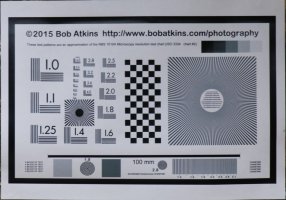
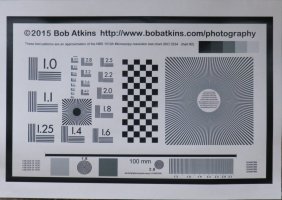
I spent a few hours doing FoCal and resolution measurements on the 5DSR and the M5, which has the same sensor as the 80D. I had to fool FoCal to analyse the M5, which I could do for jpegs but not raw. I used the manual proedure of recording images and feeding them into FoCal. This allowed me to do the measurements at iso640, not base, as that is the most common one for me, and also use the M5. I used a Bob Atkins chart and the 100-400mm II,

1, there were no significant differences in QoF for the 5DSR using jpeg or RAW.
2, the average QoF for the 5DSR was 1864 ± 60, and for the M5 1823 ± 27. The best for the 5DSR was 1977 and for the M5 was 1912. The scatter was because I hand held and refocussed each shot because that is my usual technique.
3, the resolution of the best two (5DSR on top) was very similar. The pixel pitch of the M5 is 3.72 µ , and 4.14 µ for the 5DSR, so you would expect an 11% higher resolution if neither had an AA filter. The lack of AA filter on the 5DSR makes up for its slightly larger pixels.

The attachments below are the output from DxO Optics Pro with PRIME noise reduction and no sharpening. The target was 20m from the camera, and the crops are the actual number of pixels on the sensor (100% crops).

The m5/80D is very good and would scale up nicely to give a 60 mpx FF, preferably with a switchable on/off AA fliter.
 

Attachments

  • 3Q7A9325_DxO_5DS_CR.jpg
    3Q7A9325_DxO_5DS_CR.jpg
    427.9 KB · Views: 161
  • IMG_2304_DxO_M5_CR.jpg
    IMG_2304_DxO_M5_CR.jpg
    602.3 KB · Views: 170
Upvote 0
Jack Douglas said:
So in the same tradition of grumbling that CR generates over what Canon cameras don't have...

Jack

Yup. Canon can't win. It's just really funny how the armchair quarterbacks come out of the woodwork every single time. They think engineering and design can turn on a dime overnight. When Canon issues a competing camera they will whine about that too, calling it crippled. I don't remember reading a single post saying that Nikon, etc. cripples cameras. Maybe I have to go to a Nikon forum for that.
 
Upvote 0
hambergler said:
Jack Douglas said:
So in the same tradition of grumbling that CR generates over what Canon cameras don't have, what's this one lacking?

Jack

Would like a flip screen and GPS but otherwise this thing seems like a dream "no compromise" camera.

Been waiting for the 5d mark iv to drop in price a little before I pull the trigger to replace my 5D3 but I can't help but lust after this one. I would easily drop 5K if I could get this with an EF mount.

The Nikon is intentionally crippled. It doesn't have GPS or a tilt screen, or DPAF. Big compromises. What was Nikon thinking??? ;)
 
Upvote 0