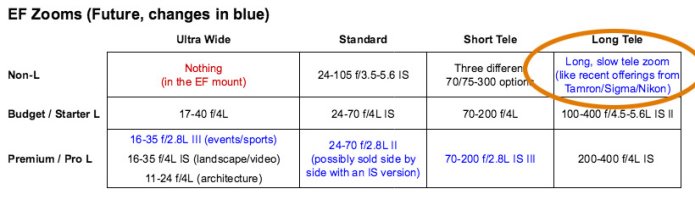
N2itiv said:
neuroanatomist said:
N2itiv said:
No disrespect intended, but you stick to your methods and I'll stick to mine. Lets agree to disagree.
With respect, your 'method' is not consistent with the way optical designs work. But you are certainly welcome to your own beliefs, regardless of their objective validity.
Let me be clarify my statement rather than having everyone read ahs' interpretation of what I said and assuming that's what I meant.
It's easier to correct wide to wide end or long to long end than it is to mix focal length (W to T). My comment, since we were initially discussing a long lens, is that the less FL variation you have in focal length (clarified as either end of the FL scale) the easier it is to correct the way lightwaves need to be bent across that spread. I do understand that a larger front element will add more challenges to my statement, which is only an approximate generalization. My previous post was amended but the board had already moved beyond it.
Your original statement was:
N2itiv said:
My math says the spread from 100-400 ='s 300mm. 300-600 has the same difference.
The 200-600 has an actual focal length spread of 400mm. A 400-600mm, as I mentioned, would be better @ only 200mm variation. The closer that FL variation is, the easier it is to correct for and make better optically.
A 200-600mm is a 3x zoom range, while a 100-400 is a 4x zoom range. You suggest that a 200-600 would be more difficult to design with similar optical quality than a 100-400, becuase the former has a 400mm 'spread' while the 100-400 has only a 300mm 'spread'. The point is, that's
wrong. It's not the absolute difference in focal lengths, it's the relative difference. All else being equal, the 200-600mm would be easier to design to a given level of optical quality than the 100-400, becuase of the former's smaller zoom range.