Patent: Canon EF 200-600mm f/4.5-5.6 IS

NancyP said:
I could see a "mid-range" market in the $2,500.00 to $4,500.00 range for this.

+1. That's what Canon is hoping for, undoubtedly: take what they did for the 100-400 II -- a shade faster/sharper than a budget supertele zoom like Tamon/Sigma/Nikon, but a shade slower/less sharp than a top quality L prime -- and fill the price gap between a $1,000-1,500 starting birder lens and the $10k superwhites.

I see this as a 'mid-quality' lens and not a budget offering if for no reason other than the max aperture. If they were going for a cheaper non-L lens, one would think it would be in the f/5.6 - 6.3 neighborhood. As it stands in the patent, this thing is a 600 f/5.6 lens at the long end, just one stop slower than an $11k+ lens.

- A
 
Upvote 0
neuroanatomist said:
ahsanford said:
So I'm not calling that Nikon lens a gamechanger for IQ, it's just a gamechanger for first-party reach for the dollar in a zoom lens. It's the sort of lens that gets an amateur into birding.

Agreed - and for that reason, I can see Canon developing/releasing a similar lens.

Yes, but this patent may not be that lens. I agree with others that this will be clearly north of $2k for that speed at that FL range.

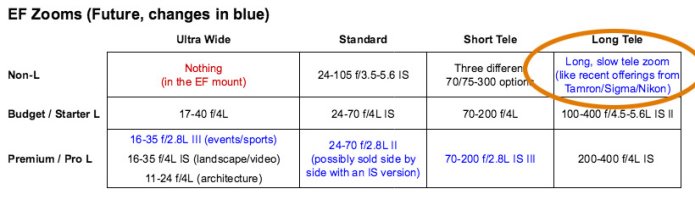
I've been arguing for Canon to make that similar lens and fill that circled bucket below, but this lens will be priced out of that bucket, I believe. It would sit alongside the 100-400 II as longer variant. No chance it's a cheapo reach lens.

- A
 

Attachments

  • EF Zooms copy future.jpg
    EF Zooms copy future.jpg
    75.5 KB · Views: 226
Upvote 0
ahsanford said:
neuroanatomist said:
ahsanford said:
So I'm not calling that Nikon lens a gamechanger for IQ, it's just a gamechanger for first-party reach for the dollar in a zoom lens. It's the sort of lens that gets an amateur into birding.

Agreed - and for that reason, I can see Canon developing/releasing a similar lens.

Yes, but this patent may not be that lens. I agree with others that this will be clearly north of $2k for that speed at that FL range.

I've been arguing for Canon to make that similar lens and fill that circled bucket below, but this lens will be priced out of that bucket, I believe. It would sit alongside the 100-400 II as longer variant. No chance it's a cheapo reach lens.

- A

Or, perhaps saying this a different way, how would you rate the value of:

100-400L II image quality +
first party reliable/consistent/fast AF +
600mm reach @ f/5.6 without teleconvertered cripplling of your AF spread?

...because there is no way to get that with an EF mount right now without buying a $11.5k 600L II.

In that light, Canon could throw down the gauntlet at $4k or so at launch and many might say "That's better than teleconverters. Sold. Take my money."

- A
 
Upvote 0
neuroanatomist said:
N2itiv said:
No disrespect intended, but you stick to your methods and I'll stick to mine. Lets agree to disagree.

With respect, your 'method' is not consistent with the way optical designs work. But you are certainly welcome to your own beliefs, regardless of their objective validity.

Let me be clarify my statement rather than having everyone read ahs' interpretation of what I said and assuming that's what I meant.
It's easier to correct wide to wide end or long to long end than it is to mix focal length (W to T). My comment, since we were initially discussing a long lens, is that the less FL variation you have in focal length (clarified as either end of the FL scale) the easier it is to correct the way lightwaves need to be bent across that spread. I do understand that a larger front element will add more challenges to my statement, which is only an approximate generalization. My previous post was amended but the board had already moved beyond it.
 
Upvote 0
ahsanford said:
neuroanatomist said:
ahsanford said:
So I'm not calling that Nikon lens a gamechanger for IQ, it's just a gamechanger for first-party reach for the dollar in a zoom lens. It's the sort of lens that gets an amateur into birding.

Agreed - and for that reason, I can see Canon developing/releasing a similar lens.

Yes, but this patent may not be that lens. I agree with others that this will be clearly north of $2k for that speed at that FL range.

I've been arguing for Canon to make that similar lens and fill that circled bucket below, but this lens will be priced out of that bucket, I believe. It would sit alongside the 100-400 II as longer variant. No chance it's a cheapo reach lens.

- A

It's a non-L. It will probably be out to compete with nikon's 200-500
 
Upvote 0
ahsanford said:
Don Haines said:
ahsanford said:
9VIII said:
Maybe sales for the 200-400+TC took a dive and they're figuring out a more attractive offering.

I don't think that's it. There's a big portfolio gap for Canon: leaving crop factors out, you cannot shoot past 400mm FF with a Canon zoom unless you're fond of teleconverters (which punishes IQ and can handcuff your AF options/performance).

This lens -- if it becomes a real product someday -- effectively solves that problem.

What's odd is that Nikon (more than Tamron or Sigma) really threw a monkey wrench in Canon's ability to ask for a lot of money for this lens. Consider: a similarly max-apertured 100-400L II costs over $2k, so one would imagine a 200-600 version of that speed of lens would cost a good deal more. But Nikon joining the budget masses with a first-party 200-500 lens at $1400 may force Canon to offer a 200-600 for a bit less than they had originally hoped.

- A

A lot of Nikon shooters like the 200-500F5.6 lens (about $1600 here in Canada). It sells well. To get to 500mm with Canon will cost you $10,500 and for the vast bulk of photographers, that's not an option. To get to 400mm with an IS lens will cost you $2400. Costs more for less reach.... the recommended path for beginner birders is away from Canon.

Birders are a significant portion of Canon's long lens market. They have to counter this with something, so a 200-600 F5.6 lens is the logical path to regain leadership in that segment. I think this lens will happen relatively soon....

Yep. See the attached. Nikon grabbed that circled bit with a vengeance with that 200-500 f/5.6 for $1,400.

Now we can discuss whether 500 vs. 600 is all that different or whether Canon sees this 200-600 as Mid-Level / Starter L or just a basic non-L lens (max aperture of the patent would imply this is a pricier 100-400L II and not a non-L starter lens), and I'm clearly mixing a three price point conversation with a 400 vs. 600 reach conversation, but any way you slice it, Canon's pricing gameplan (jump from $2k to $10K in the blink of an eye) is under a ton more pressure than it was even 2 years ago.

- A

index.php


I do believe Canon had this in the non-L ultra-wide option: http://www.canon.com/c-museum/en/product/ef316.html
 
Upvote 0
N2itiv said:
neuroanatomist said:
N2itiv said:
No disrespect intended, but you stick to your methods and I'll stick to mine. Lets agree to disagree.

With respect, your 'method' is not consistent with the way optical designs work. But you are certainly welcome to your own beliefs, regardless of their objective validity.

Let me be clarify my statement rather than having everyone read ahs' interpretation of what I said and assuming that's what I meant.
It's easier to correct wide to wide end or long to long end than it is to mix focal length (W to T). My comment, since we were initially discussing a long lens, is that the less FL variation you have in focal length (clarified as either end of the FL scale) the easier it is to correct the way lightwaves need to be bent across that spread. I do understand that a larger front element will add more challenges to my statement, which is only an approximate generalization. My previous post was amended but the board had already moved beyond it.

Your original statement was:

N2itiv said:
My math says the spread from 100-400 ='s 300mm. 300-600 has the same difference.
The 200-600 has an actual focal length spread of 400mm. A 400-600mm, as I mentioned, would be better @ only 200mm variation. The closer that FL variation is, the easier it is to correct for and make better optically.

A 200-600mm is a 3x zoom range, while a 100-400 is a 4x zoom range. You suggest that a 200-600 would be more difficult to design with similar optical quality than a 100-400, becuase the former has a 400mm 'spread' while the 100-400 has only a 300mm 'spread'. The point is, that's wrong. It's not the absolute difference in focal lengths, it's the relative difference. All else being equal, the 200-600mm would be easier to design to a given level of optical quality than the 100-400, becuase of the former's smaller zoom range.

 
Upvote 0
[/quote]

Or, perhaps saying this a different way, how would you rate the value of:

100-400L II image quality +
first party reliable/consistent/fast AF +
600mm reach @ f/5.6 without teleconvertered cripplling of your AF spread?

...because there is no way to get that with an EF mount right now without buying a $11.5k 600L II.

In that light, Canon could throw down the gauntlet at $4k or so at launch and many might say "That's better than teleconverters. Sold. Take my money."

- A
[/quote]

There is the 400doii that gives you a very good 560 f/5.6 with a 1.4xtc
 
Upvote 0
kaihp said:
ahsanford said:
I've been arguing for Canon to make that similar lens and fill that circled bucket below, but this lens will be priced out of that bucket, I believe. It would sit alongside the 100-400 II as longer variant. No chance it's a cheapo reach lens.

ahsanford, where (and when) did you get that matrix from? :P

Umm.... Google Docs. I made it myself. It's not real. It's just my read on things.

- A
 
Upvote 0
candc said:
There is the 400doii that gives you a very good 560 f/5.6 with a 1.4xtc

Yes, but Canon's answer of 'we make great teleconverters if you want to shoot over 400mm for less than $10k' no longer is good enough in 2015. The Tamron and two Sigmas now get you to 600mm without a teleconverter.

Now the Tamron and Sigma's come with all sorts of caveats -- the IQ will not be as good as a 100-400 II, and the AF will surely be flaky from time to time... but doesn't a teleconverter do the same thing?

So rather than see Tamron/Sigma as a threat, Canon should see it as a classic opportunity to offer a better product (and charge more for it).

- A
 
Upvote 0
neuroanatomist said:
N2itiv said:
neuroanatomist said:
N2itiv said:
No disrespect intended, but you stick to your methods and I'll stick to mine. Lets agree to disagree.

With respect, your 'method' is not consistent with the way optical designs work. But you are certainly welcome to your own beliefs, regardless of their objective validity.

Let me be clarify my statement rather than having everyone read ahs' interpretation of what I said and assuming that's what I meant.
It's easier to correct wide to wide end or long to long end than it is to mix focal length (W to T). My comment, since we were initially discussing a long lens, is that the less FL variation you have in focal length (clarified as either end of the FL scale) the easier it is to correct the way lightwaves need to be bent across that spread. I do understand that a larger front element will add more challenges to my statement, which is only an approximate generalization. My previous post was amended but the board had already moved beyond it.

Your original statement was:

N2itiv said:
My math says the spread from 100-400 ='s 300mm. 300-600 has the same difference.
The 200-600 has an actual focal length spread of 400mm. A 400-600mm, as I mentioned, would be better @ only 200mm variation. The closer that FL variation is, the easier it is to correct for and make better optically.

A 200-600mm is a 3x zoom range, while a 100-400 is a 4x zoom range. You suggest that a 200-600 would be more difficult to design with similar optical quality than a 100-400, becuase the former has a 400mm 'spread' while the 100-400 has only a 300mm 'spread'. The point is, that's wrong. It's not the absolute difference in focal lengths, it's the relative difference. All else being equal, the 200-600mm would be easier to design to a given level of optical quality than the 100-400, becuase of the former's smaller zoom range.

I want to thank you and everyone for their responses. What I was saying is that less focal spread can be sharper because the more FL spread you have, the more compromises must be made to the way light is bent/focused to an optical point across the range. It's not the only factor but a valid one. I wasn't trying to sidetrack the thread will not address again. Apologies!

This lens looks like it will have many compromises to meet a lower price point and one I would pass on, but an L zoom beyond the 100-400L ll would pique my interest.
 
Upvote 0
N2itiv said:
I want to thank you and everyone for their responses. What I was saying is that less focal spread can be sharper because the more FL spread you have, the more compromises must be made to the way light is bent/focused to an optical point across the range. It's not the only factor but a valid one. I wasn't trying to sidetrack the thread will not address again. Apologies!

This lens looks like it will have many compromises to meet a lower price point and one I would pass on, but an L zoom beyond the 100-400L ll would pique my interest.

Understood. My apologies for a windup response -- I should have just disagreed with the range vs. multiplier point and moved on.

- A
 
Upvote 0
The stated length of the lens doesn't seem to make sense with the stated focal length. This lens is 14 inches long, which is very close to the length of the 200-400 f/4.

I wonder if this implies that the design is a DO model, providing that shortening.

Alternate theory: they're using their new Blue Goo technology to essentially replace some elements that used to be used for color aberration correction.

Might be a funny-looking lens, sort of like a trumpet, which is a bit of what I think about the 400 f/4 DO II (which doesn't prevent me from wanting one dearly).
 
Upvote 0
ahsanford said:
candc said:
There is the 400doii that gives you a very good 560 f/5.6 with a 1.4xtc

Yes, but Canon's answer of 'we make great teleconverters if you want to shoot over 400mm for less than $10k' no longer is good enough in 2015. The Tamron and two Sigmas now get you to 600mm without a teleconverter.

Now the Tamron and Sigma's come with all sorts of caveats -- the IQ will not be as good as a 100-400 II, and the AF will surely be flaky from time to time... but doesn't a teleconverter do the same thing?

So rather than see Tamron/Sigma as a threat, Canon should see it as a classic opportunity to offer a better product (and charge more for it).

- A

True in general but the iq and af of the f/4 teles with the 1.4xiii is still excellent. The 400doii iq is like the 200-400 but in a lighter somewhat less expensive fixed fl form.
 
Upvote 0
The stated length of the lens doesn't seem to make sense with the stated focal length. This lens is 14 inches long, which is very close to the length of the 200-400 f/4.

I wonder if this implies that the design is a DO model, providing that shortening.

1) The 200-400 is internally zooming. So that 200-400 length represents what 400mm needs. I'd bet my left nut this 200-600 will not get that royal all-inside treatment. I'd expect this lens to telescope out when shooting long like a 24-something or 100-400 lens.

2) Lengths of other long zooms that aren't DO designs (from TDP: in inches, shortest / longest, both without hood):

  • Tamron 150-600: 10.57 / 13.67
  • Sigma 150-600 C: 10.55 / 13.66
  • Sigma 150-600 S: 11.77 / 15.31

So 14" doesn't seem unreasonable to me. Also -- aren't patents for the optical formula only, and tend to leave off length considerations like front filter rings, hood mounts and such?

- A
 
Upvote 0