I'm reading the patent again this morning, this is not a Google Translated version, but is translated by the Japanese Patent Web site, so it may translate differently. Its always less than what I'd like.
What I am reading is that the half mirror (Pellicle Mirror) is fixed. A part of the image beam from the lens is deflected down to the autofocus sensor while the rest passes thru to the main image sensor.
The AF sensor is also a image sensor, but with fewer and much larger photosites than the main image sensor.
The issue that they are using a lot of formulas and difficult language describes correction of the final image by the processor. The image is distorted as it passes thru the angled pellicle mirror, and to make it worse, different colors are distorted differently, and distance from the center of the axis also has a effect.
The patent tries to explain it here:
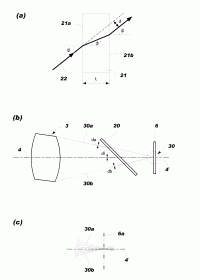
"Since a actual beam of light exists also in the direction right-angled to the paper side of Fig.2, more complicated aberration has generated it. However, to the optic axis 4, the half mirror 20 inclines and is arranged only in the section shown in Fig.1 (a) and Fig.2 (b). For this reason, it is the aberration which has symmetry in the paper side depth direction. The beam of light which has an angle in the right-angled direction to a paper side, and the beam of light 30a shown on the paper side differ in the half mirror 20 and the angle to accomplish from the beam of light 30b. For this reason, the focus positions which become the smallest [ aberration ] differ. That is, it has astigmatism.
The situation of aberration changes also with refractive indices of the half mirror 20 from a formula (1). Therefore, the situation of aberration changes also with wavelength. Since the angle of an incident beam of light changes with image height, according to the formula (1), the situation of aberration changes also with image height."
I've copied figure 2 below if that helps. Figure 1 is just the general side view as posted in the main topic.
I do get the impression that Mr. Rube Goldberg is alive and well! I'd be surprised to see this ever appear in a production camera, but Its possible. One of their points is that it reduces cost by eliminating the complicated moving mirror mechanism. I'd like to see that go away as well, but wonder just how perfectly a inverse filter designed to cancel out the distortions during processing of the image from the pellicle mirror will actually work. Photographers are clever, and always manage to use a camera in a way that no one thought of.



 Canon made it 10 years earlier and skipped it because of it's disadvantages back then. Today it may come back because of the High ISO Sensors and the EVF-Concept but if you look right at it, the Mirror is reversed (as mentioned).