
Post your 'Noise by Ten' results

Yesterday I was al little bit bored and try the 'Noise by Ten' test.

- Set your body on a tri-pod and select manual mode
- Cover eyecup with piece from neckstrap
- Put on your lenscap
- Set your lens at manual focus
- Aperture f/10
- ShutterSpeed 10 seconds
- ShutterDelay 10 seconds
- Put your setup in the darkest place possible
- Run all ISO modes

Body: Canon 5D Mark III
Lens: Canon 50/1.4
5DMK3-CLEAN%2BISO.png


As you can see are ISO160 and ISO320 cleaner then ISO100. Even ISO640 is cleaner then ISO400
More noise is a bigger file and numbers don't lie. ;)

What are your results?
 
It only took 5 minutes total as you can see at the time/date... :) It does show the sweetspot and the weakspot of your camera.
Don't worry, my camera won't miss a thing this time of the year. I was just curious what the results were from other setups that you guys and girls have :)
 
Upvote 0
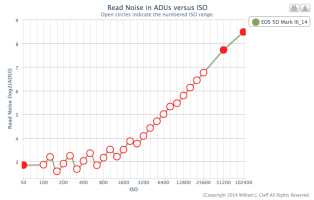
You could have saved yourself some effort and just looked at the read noise charts on Bill Claff's site. ;)

It's also important to realize that read noise is only one contributor to the total noise in an image, and often it's not the most significant contributor.
 

Attachments

  • Claff Read Noise.png
    Claff Read Noise.png
    53.9 KB · Views: 198
Upvote 0
This is my experience too. I refreshed a topic last night about something similar.

I haven't done exactly the same test as you, but I see the lens as something invariant in this so I skipped that and had the body cap on while shooting through all my ISOs. My files from the test are long gone (there weren't exactly any keepers in the bunch ;) ), but I remember a sequence much like yours. I still to this day tend to shoot at ISO 320, ISO 160 and then ISO 800. At these, it's much more likely that I manage to get the image that I'm after.
Any image will contain noise, and any image will clean up some in post, but since I'm "financially challenged" when it comes to selecting SW for my postprocessing I prefer to have the cleanest looking image come out of the camera.

Edit: Thanks, Neuro! Didn't know of the Claff-charts. Will have to dive into that pile of data...
 
Upvote 0
Thanks for killing what could have been an interesting thread to post items that could increase knowledge and understanding, and which, also, could have been a way to keep DRones and trolls from posting in topics that are far far away from needing overly lengthy elaborations.
 
Upvote 0
DominoDude said:
Thanks for killing what could have been an interesting thread to post items that could increase knowledge and understanding, and which, also, could have been a way to keep DRones and trolls from posting in topics that are far far away from needing overly lengthy elaborations.

The subject has been beaten to death, the topic should be killed.
 
Upvote 0
Mt Spokane Photography said:
DominoDude said:
Thanks for killing what could have been an interesting thread to post items that could increase knowledge and understanding, and which, also, could have been a way to keep DRones and trolls from posting in topics that are far far away from needing overly lengthy elaborations.

The subject has been beaten to death, the topic should be killed.
What this shows is how signals are amplified inside the camera. ISO's like 160, 320, and 640 are the base numbers. An ISO like 200 is gotten to by digitally multiplying the signal.... and to do that you are LOOSING the accuracy of your sensor.

An understanding of how your camera works is usually a good thing. Yes, the information is already available in charts on various sites, but what is wrong with experimenting with your camera to see what happens?
 
Upvote 0
I've done this test for 'real world' shooting where I can ETTR and also care about DR and I'll stick to the 'base' ISO's thank you.

In no test could I reproduce that ISO320 is cleaner than ISO100. But I didn't take any shots with the lens cap on, only shots with a high DR in the scene and so that my highlights were just unclipped and then looked at the shadows.
 
Upvote 0
I didn't mean to say that ISO 320 is, in absolute terms, cleaner than ISO 100. It's the combination I use most to get the exposure I need. In the old film and analogue days I mostly shot 400ASA film to get what I needed.
As an example: I shoot a lot of birds, and frequently find myself with my shoulders and everything above that shoved deep into bushes, and to get a decent exposure I need rather short shutter times and then I go for ISO 320 or ISO 800 to easier find an aperture that match subject, DOF and so on without getting too much of an underexposure.
So I use ISO 160, where others might have gone for ISO 100, or ISO 200. ISO 320, instead of ISO 250, ISO 400, or ISO 500. If available light is in abundance of course I click down to ISO 160, and adjust my aperture, and the shutter, if my hand is steady. On those occasions where other factors rule, it's ISO 320 that is preferred.
 
Upvote 0