Review: Sensor Performance of the 7D Mark II

East Wind Photography said:
Bundu said:
jrista said:
The 7D II has pronounced horizontal banding. I was hoping that at the very least the 7D II would just have random read noise...the presence of the horizontal banding is extremely dismaying to me.
I really want to try/start astro photography. I have a 7DmarkII. When do this banding occur and how do I prevent/minimalise it?
Thank you for all the info.

You can only minimize it and other effects by taking shorter exposures, taking dark frames, and staking using something like Starstax or other application that can stack multiple sub exposures to enhance signal to noise.

ie; 60 ten second exposures will produce better results than a single 600 second exposure.

Avoiding banding in astrophotography is easy. See my review and then my post processing:
http://www.clarkvision.com/reviews/evaluation-canon-7dii/
http://www.clarkvision.com/articles/night.photography.image.processing/
Use ISO 1600.

My astrophoto and nightscape images made with the 7D Mark II, as well as other recent canon cameras have had no dark frames, no flats, just a simple raw conversion align and average (astrophotos), or simple raw conversion and mosaic (nightscapes).
There is no need for bias, dark frames, or flats (with profiled lenses) with modern digital cameras of the last few years.

Roger
 
Upvote 0
djrocks66 said:
As much as I like my 7DMKII, it's sensor is still pretty much the same as the rest of the crop cameras Canon has made Since the T2i-7D. Yes the High ISO noise is improved a little and the dual pixel for video is cool but it's image quality and amount of recoverable information in the Raw files is pretty much the same. I would not be happy if I had to shoot Landscapes with this camera only. I bought it for Wildlife and will probably just keep a 400mm mounted to it. Yes the AF and tracking is amazing. My 16MP Fuji X-T1 produces so much better files then the 7D in every way. If Canon would put a Sony sensor in their DSLR's I would be so happy. As far as a body, performance, menu and functionality camera I think it is Canons best one yet. ( for the money ) But game changer? Nah. It is what it is. A great Sports or Wildlife camera. If it had a Sony sensor or a real newly designed one that had the Dynamic Range of the Sony sensors it would be a Game Changer ( yes I said dynamic range because that is important to the type of shooting I do ) I'm not saying you can't shoot anything else with this camera, because you can, I am just disappointed that Canon is not pushing their sensor tech to improve dynamic range. Even if you don't agree with the whole Dynamic Range argument it is a big discussion on every photography forum. Maybe one day Canon will listen. Just my opinion of course.

When I looked at the 7DII raw data from ISO 100-12,800, and compared it to the 18MP sensor, I saw substantially improved detail at low ISO (more than would be expected from the small pixel count increase), and more than one stop of improved performance at high ISO (can be as much as two stops depending on processing and ISO). Low ISO DR seems pretty much unchanged (and largely irrelevant to me).
 
Upvote 0
Bundu said:
jrista said:
The 7D II has pronounced horizontal banding. I was hoping that at the very least the 7D II would just have random read noise...the presence of the horizontal banding is extremely dismaying to me.
I really want to try/start astro photography. I have a 7DmarkII. When do this banding occur and how do I prevent/minimalise it?
Thank you for all the info.


The most effective way that I have found to manage banding, both vertical and horizontal, are some photoshop actions called Astronomy Tools. These scripts are the best debanding I have ever found, period, and there are some other very useful astro processing scripts (like Local Contrast Enhancement, star reduction, increase star color, and others) in this set as well. More than worth the money.


http://www.prodigitalsoftware.com/Astronomy_Tools_For_Full_Version.html
 
Upvote 0
East Wind Photography said:
Bundu said:
jrista said:
The 7D II has pronounced horizontal banding. I was hoping that at the very least the 7D II would just have random read noise...the presence of the horizontal banding is extremely dismaying to me.
I really want to try/start astro photography. I have a 7DmarkII. When do this banding occur and how do I prevent/minimalise it?
Thank you for all the info.

You can only minimize it and other effects by taking shorter exposures, taking dark frames, and staking using something like Starstax or other application that can stack multiple sub exposures to enhance signal to noise.

ie; 60 ten second exposures will produce better results than a single 600 second exposure.
Thank you, I will take some photos of the night sky at different exposures to see at which exposures banding become a problem.
Roger N Clark said:
East Wind Photography said:
Bundu said:
jrista said:
The 7D II has pronounced horizontal banding. I was hoping that at the very least the 7D II would just have random read noise...the presence of the horizontal banding is extremely dismaying to me.
I really want to try/start astro photography. I have a 7DmarkII. When do this banding occur and how do I prevent/minimalise it?
Thank you for all the info.

You can only minimize it and other effects by taking shorter exposures, taking dark frames, and staking using something like Starstax or other application that can stack multiple sub exposures to enhance signal to noise.

ie; 60 ten second exposures will produce better results than a single 600 second exposure.

Avoiding banding in astrophotography is easy. See my review and then my post processing:
http://www.clarkvision.com/reviews/evaluation-canon-7dii/
http://www.clarkvision.com/articles/night.photography.image.processing/
Use ISO 1600.

My astrophoto and nightscape images made with the 7D Mark II, as well as other recent canon cameras have had no dark frames, no flats, just a simple raw conversion align and average (astrophotos), or simple raw conversion and mosaic (nightscapes).
There is no need for bias, dark frames, or flats (with profiled lenses) with modern digital cameras of the last few years.

Roger
Thanks for all the info. I will study the above to use my camera properly. A lot to learn that's for sure. Luckily I am off on a three week holiday into Mozambique. Time enough to try a bit of everything.
 
Upvote 0
Bundu said:
I am going to need a tracking mount. Any recommendations? Not top of the line stuff, already spent way over budget on equipment this year. In fact the cheapest product that is proficient enough.

That depends very strongly on the OTA and what you are going to do with it.
 
Upvote 0
Bundu said:
I am going to need a tracking mount. Any recommendations? Not top of the line stuff, already spent way over budget on equipment this year. In fact the cheapest product that is proficient enough.

Yeah I agree. It depends on the weight of the rig, does it need to fit in a backpack or something you will use from home only or can transport in a car? Are you going to shoot deep space objects or wide star fields?

Cheap solutions can give you hours of frustration and not deliver what you expect.
 
Upvote 0
East Wind Photography said:
Bundu said:
I am going to need a tracking mount. Any recommendations? Not top of the line stuff, already spent way over budget on equipment this year. In fact the cheapest product that is proficient enough.

Yeah I agree. It depends on the weight of the rig, does it need to fit in a backpack or something you will use from home only or can transport in a car? Are you going to shoot deep space objects or wide star fields?

Cheap solutions can give you hours of frustration and not deliver what you expect.

Or work perfectly great depending on what you're doing (i.e. planetary imaging or maybe star clusters versus faint fuzzies with a slow OTA).
 
Upvote 0
East Wind Photography said:
Bundu said:
I am going to need a tracking mount. Any recommendations? Not top of the line stuff, already spent way over budget on equipment this year. In fact the cheapest product that is proficient enough.

Yeah I agree. It depends on the weight of the rig, does it need to fit in a backpack or something you will use from home only or can transport in a car? Are you going to shoot deep space objects or wide star fields?

Cheap solutions can give you hours of frustration and not deliver what you expect.

This is about the minimum you can get away with.....

http://ca.skywatcher.com/_english/02_mounts/02_detail.php?sid=68
 
Upvote 0
Don Haines said:
East Wind Photography said:
Bundu said:
I am going to need a tracking mount. Any recommendations? Not top of the line stuff, already spent way over budget on equipment this year. In fact the cheapest product that is proficient enough.

Yeah I agree. It depends on the weight of the rig, does it need to fit in a backpack or something you will use from home only or can transport in a car? Are you going to shoot deep space objects or wide star fields?

Cheap solutions can give you hours of frustration and not deliver what you expect.

This is about the minimum you can get away with.....

http://ca.skywatcher.com/_english/02_mounts/02_detail.php?sid=68
Looks great, and not too expensive!
Maybe I should rather ask this; what would you recommend me starting off with (deep space and/or wide star fields) taking into account the equipment I have - 70D, 7DII, 100-400L, ext 1.4III, 70-300, 15-85, 50 1.4, 60 2.8 macro. I am getting a 10-22 this weekend.
All will be transported by car - rough tracks - 4x4. We will be spending half our time in the bush where there is no light pollution and the stars is so bright it seems like you can touch them!
Thank you again for your input.
 
Upvote 0
Bundu said:
Don Haines said:
East Wind Photography said:
Bundu said:
I am going to need a tracking mount. Any recommendations? Not top of the line stuff, already spent way over budget on equipment this year. In fact the cheapest product that is proficient enough.

Yeah I agree. It depends on the weight of the rig, does it need to fit in a backpack or something you will use from home only or can transport in a car? Are you going to shoot deep space objects or wide star fields?

Cheap solutions can give you hours of frustration and not deliver what you expect.

This is about the minimum you can get away with.....

http://ca.skywatcher.com/_english/02_mounts/02_detail.php?sid=68
Looks great, and not too expensive!
Maybe I should rather ask this; what would you recommend me starting off with (deep space and/or wide star fields) taking into account the equipment I have - 70D, 7DII, 100-400L, ext 1.4III, 70-300, 15-85, 50 1.4, 60 2.8 macro. I am getting a 10-22 this weekend.
All will be transported by car - rough tracks - 4x4. We will be spending half our time in the bush where there is no light pollution and the stars is so bright it seems like you can touch them!
Thank you again for your input.

This looks pretty good as it allows you to use your own stuff to reduce costs and extra stuff you need to travel with. Watch the weight. Very easy for a camera and lens to reach the max limit and cause the tracking motor to start slipping (best case) or break (worse case). Though the 100-400 is pretty light.

I've not seen this mount but I may get one myself to play around with.
 
Upvote 0
East Wind Photography said:
Bundu said:
jrista said:
The 7D II has pronounced horizontal banding. I was hoping that at the very least the 7D II would just have random read noise...the presence of the horizontal banding is extremely dismaying to me.
I really want to try/start astro photography. I have a 7DmarkII. When do this banding occur and how do I prevent/minimalise it?
Thank you for all the info.

You can only minimize it and other effects by taking shorter exposures, taking dark frames, and staking using something like Starstax or other application that can stack multiple sub exposures to enhance signal to noise.

ie; 60 ten second exposures will produce better results than a single 600 second exposure.


You have to be careful with advice like this, as it is not simple and strait forward. Yes, stacking more subs can increase SNR, but SNR is not the only thing that matters. There are caveats here.


First, there is SNR and there is Signal. A low signal can have a high SNR by reducing noise...but it's still a low signal. If you are not gathering data on dimmer nebulosity (or say outer galaxy halo), your simply not gathering it. You cannot make it appear out of nowhere, and even if you gather a photon per minute on the faintest details, you are going to need many hundreds of subs to average out noise enough to actually see those details. The only way to improve the strength of those dimmer details is to expose longer (or get a better camera with lower read noise, and cool it to obscenely cold temperatures).


Second, fixed pattern noise does not average out. Fixed bands (I have several on my 5D III), hot and cold pixels, these things are REINFORCED by stacking, not removed. The same goes for dust spots...if you do not take proper flats that have identical dust spots, they will be reinforced with stacking, becoming little "black holes" in your images. (So, I disagree with Roger here...DLSRs are quite good these days, but that has nothing to do with why we need flats, and if we use flats, we at the very least need to use biases.) There are ways of mitigating the reinforcement of noise artifacts. The use of dark frames is one. The use of dithering during imaging is another (although with DSLRs you have to be pretty aggressive due to the use of AA filters on most cameras...and that high aggression in dithering can lead to other problems.) Bias frames can also be used to remove the fixed pattern inherent in the sensor due to manufacturing, however this usually only reveals itself with very deep stretching.


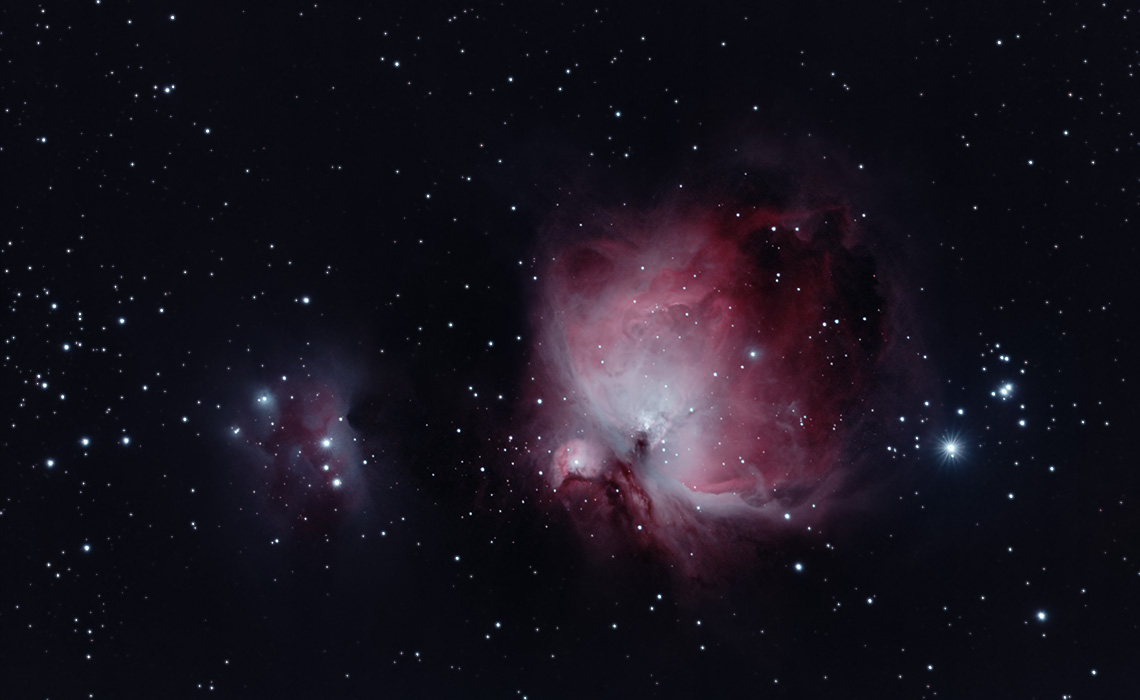
In the end, you have to decide what you want. Do you want a light exposure that just pulls out the brighter details, or do you want a deep exposure that pulls out the very faint details? If you want deeper exposures, then you need to expose longer. You could stack a hundred 60 second exposures, and that will reduce noise, but it will not increase the exposure, it will not increase the signal strength. It just makes the signal more complete. My first Orion image, here below, are 120 second exposures:


m42-and-running-man1.jpg


This was my second astro photo. There are a decent number of frames here, 30 of them to be exact. Noise was reduced a fair amount, however a lot of the fainter details are buried in the read noise and dark current. I know this, because I reprocessed it recently, and tried to pull out more detail:


orions-and-running-man.jpg


I could take more exposures....60, 90. The problem with integrating sub frames is the more you integrate, the less an impact each frame has on improving signal. Integrate 30x, you reduce noise by a factor of ~5.5, integrate 100x you reduce noise by a factor of 10x (more than triple frames, less than double the reduction in noise), integrate 400x you reduce noise by a factor of 20x (four times the number of frames again, over 13x the number I originally started out with, to double the reduction in noise again.) The simple fact here is that I may eventually reveal some more of the faint details...but those details are going to have a very weak signal. They are going to suffer from quantization noise and posterization.


There are guys who do something called lucky imaging, where they take countless very short exposures, then stack 500 or 1000 frames. They use cameras with EXCESSIVELY low noise (i.e. <1e-) at extremely cold temperatures (-55 to -70 degrees celsius below ambient), which is orders of magnitude lower than the best DSLRs on the market today. To achieve something similar with a DSLR, you would still need longer "short" exposures (say 15, 20, 30 seconds instead of 5 or 10), and you would need many thousands more, to reduce noise to levels low enough where you could actually see the fainter details.


You can integrate more and more and more data, and you get diminishing returns. No one integrates 400 2-minute exposures. Some guys with $20,000 EMCCD cameras integrate 1000 2-5 second exposures at -40C dT or colder. Most people simply expose longer to improve the SIGNAL, which concurrently improves the SNR of both the bright and faint parts of the object. You then still get a bunch of subs and integrate those to reduce noise and improve the SNR even more. You cannot simply reduce exposure time and hope to get the same results as longer exposures in astrophotography. You can improve the results of bright details, you are likely to not get dim details at all unless you integrate hundreds of frames.

 
Upvote 0
jrista said:
In the end, you have to decide what you want. Do you want a light exposure that just pulls out the brighter details, or do you want a deep exposure that pulls out the very faint details? If you want deeper exposures, then you need to expose longer. You could stack a hundred 60 second exposures, and that will reduce noise, but it will not increase the exposure, it will not increase the signal strength.

Yes, it will, by definition (exposure is illuminance time product).

From an exposure standpoint, one one-hour shot is the same as 3600 one-second shots. All the same light will be gathered.

There are diminishing returns with longer subs even when you account for the various noise sources.

http://www.starrywonders.com/basicgraph.jpg
 
Upvote 0
jrista said:
East Wind Photography said:
Bundu said:
jrista said:
The 7D II has pronounced horizontal banding. I was hoping that at the very least the 7D II would just have random read noise...the presence of the horizontal banding is extremely dismaying to me.
I really want to try/start astro photography. I have a 7DmarkII. When do this banding occur and how do I prevent/minimalise it?
Thank you for all the info.

You can only minimize it and other effects by taking shorter exposures, taking dark frames, and staking using something like Starstax or other application that can stack multiple sub exposures to enhance signal to noise.

ie; 60 ten second exposures will produce better results than a single 600 second exposure.


You have to be careful with advice like this, as it is not simple and strait forward. Yes, stacking more subs can increase SNR, but SNR is not the only thing that matters. There are caveats here.

Great info here but I think you went 10000ft over everone's head. The original request was from someone just starting out. ;)

As you stated to get rid of some type of noise you have to take dark frames of the same exposure...and to get rid of dust you need white exposures that show the dust.
 
Upvote 0
Lee Jay said:
jrista said:
In the end, you have to decide what you want. Do you want a light exposure that just pulls out the brighter details, or do you want a deep exposure that pulls out the very faint details? If you want deeper exposures, then you need to expose longer. You could stack a hundred 60 second exposures, and that will reduce noise, but it will not increase the exposure, it will not increase the signal strength.

Yes, it will, by definition (exposure is illuminance time product).

From an exposure standpoint, one one-hour shot is the same as 3600 one-second shots. All the same light will be gathered.

There are diminishing returns with longer subs even when you account for the various noise sources.

http://www.starrywonders.com/basicgraph.jpg


Purely theoretically, yes. If you had a noise-free system, this is true. We do not have noise-free systems.
 
Upvote 0
jrista said:
Lee Jay said:
jrista said:
In the end, you have to decide what you want. Do you want a light exposure that just pulls out the brighter details, or do you want a deep exposure that pulls out the very faint details? If you want deeper exposures, then you need to expose longer. You could stack a hundred 60 second exposures, and that will reduce noise, but it will not increase the exposure, it will not increase the signal strength.

Yes, it will, by definition (exposure is illuminance time product).

From an exposure standpoint, one one-hour shot is the same as 3600 one-second shots. All the same light will be gathered.

There are diminishing returns with longer subs even when you account for the various noise sources.

http://www.starrywonders.com/basicgraph.jpg


Purely theoretically, yes. If you had a noise-free system, this is true. We do not have noise-free systems.

Right...that's why I said "from an exposure standpoint" and provided that plot that adds the effect of noise.
 
Upvote 0
Lee Jay said:
jrista said:
Lee Jay said:
jrista said:
In the end, you have to decide what you want. Do you want a light exposure that just pulls out the brighter details, or do you want a deep exposure that pulls out the very faint details? If you want deeper exposures, then you need to expose longer. You could stack a hundred 60 second exposures, and that will reduce noise, but it will not increase the exposure, it will not increase the signal strength.

Yes, it will, by definition (exposure is illuminance time product).

From an exposure standpoint, one one-hour shot is the same as 3600 one-second shots. All the same light will be gathered.

There are diminishing returns with longer subs even when you account for the various noise sources.

http://www.starrywonders.com/basicgraph.jpg


Purely theoretically, yes. If you had a noise-free system, this is true. We do not have noise-free systems.

Right...that's why I said "from an exposure standpoint" and provided that plot that adds the effect of noise.


Sorry, didn't check the plot. I guess exposure was a bad word. The signal strength does not increase. Noise is reduced by averaging, but the strength of the signal remains the same. With digital systems, once your into detail that's buried in the read and dark current noise, you have a serious quantization noise problem. You could stack 3600 frames...but that faint detail is not going to be as detailed as it would be if you used the longest relevant exposure for your level of read noise.


Going off your plot, I'd say stacking 15 minute exposures would be the idea. You maximize your signal strength in each sub, and can integrate fewer subs to average out the read noise and reveal the faintest details. Your going to get most of the detail above the noise floor, and exposed well enough that your not going to face quantization error issues.
 
Upvote 0
jrista said:
Sorry, didn't check the plot. I guess exposure was a bad word. The signal strength does not increase. Noise is reduced by averaging, but the strength of the signal remains the same.

No, the signal strength (the number of photons collected) does increase. That is, in fact, the main purpose of doing it.

With digital systems, once your into detail that's buried in the read and dark current noise, you have a serious quantization noise problem.

Actually, you have a serious read and dark current noise problem.

You could stack 3600 frames...but that faint detail is not going to be as detailed as it would be if you used the longest relevant exposure for your level of read noise.

Yes, that's the whole point of that plot.

Going off your plot,

Not mine, by the way.

I'd say stacking 15 minute exposures would be the idea.

No, you have to re-do that plot for your level of light pollution and for the noise of your camera and f-stop of your optics.
 
Upvote 0
@jrista - thanks, but I think I will start at the basics and just try and get a few nice photo's first! Thereafter I will come knocking at your door again. If my fist photo is half as good as your first I will be mighty proud of myself.
@east wind - downloaded DeepSkyTracker a few days ago and yes, what you said

[As you stated to get rid of some type of noise you have to take dark frames of the same exposure...and to get rid of dust you need white exposures that show the dust.]

is about as much as I know at this point in time. But that is one of the great things about starting out, there is such a lot to learn.
 
Upvote 0