Review: Sensor Performance of the 7D Mark II

Hmm, I may be confused. Are those charts dark current, or dark current noise? I guess I thought those charts were dark current noise, rather than dark current. If they are actually dark current...how are you actually measuring that, if the dark current is subtracted on-sensor by the CDS units? The dark current itself wouldn't be in the RAW image data to be measured... If you were deriving it from dark current noise, how do you differentiate read noise from dark current noise in the RAW data?


If you are saying the 7D II has that low of dark current, not just very low dark current noise, then I misunderstood something about your review of the 7D II...
 
Upvote 0
Roger N Clark said:
Then I combined my Horsehead and M42 into a panorama. Note these images were independently stretched and one had over 2 times the exposure:
http://www.clarkvision.com/galleries/gallery.astrophoto-1/web/horsehead+m42_300mm_c11.21.2014.0J6A1631-1750-SigAv.h-pan1-b5x5s.html


Very nice!


I checked out the 7D 1 horse head. I actually like the processing on that one more...the flame nebula in the new one from the 7D II has some funky tonal transitions, flame has nice smooth transitions on the older image. That kind of stands out and draws the eye in the new image, but I'm sure it could be fixed. (At least, I hope it can...that isn't some artifact of the data, is it?)
 
Upvote 0
Roger N Clark said:
There seems to be a lot of emphasis on dynamic range and read noise.

Because that is what Canon has fallen way behind on.

In long exposure photography with digital cameras (not cooled scientific cameras), there are generally 3 factors that impact detecting faint signals:
1) noise from dark current
2) adequately digitizing the low end
3) pattern noise
4) in night sky photography: airglow (light from the night sky)
Note read noise and dynamic range are not factors.

True, but the average person doesn't do long exposure astro photography and thus a lot more comments on the DR and read noise.


So to detect faint signals and record the best detail in that faint signal, whether low light astro photo, or shadow detail in a very dark shadow, it is best to work at an iso that adequately digitizes that low end, and that is NOT at low iso, whether canon, nikon, sony, or whomever. It has nothing to do with read noise.

I didn't think quantization noise came up since they didn't produce enough real data to matter yet.

Do the same thing with Canon data and, surprise, the dynamic range can be increased more than a stop. The Nikon methodology seems ugly to me from a science standpoint, but it produces amazing results in pleasing images and boosts dynamic range measurements that ignore that fact. Do the same thing with canon and see similar amazing results.

You don't see similar amazing results at all. The details are just not there even if the noise is 'less'.

The internet is abuzz over dynamic range at low iso and canon's "poor" performance in that area. Yes, canon remains low in this regard, but higher dynamic range at the high end where dynamic range is shrinking and thus more important for high iso photographers.

Yes, but:

1. not everyone is a high iso photographer/astro photographer only
2. Canon is not behind up there much so of course that is not what people will complain about

They key is one can make great photos with any system, and if one knows the weaknesses (and they ALL have weaknesses), then one can compensate for known weaknesses in real world imaging.

Of course, but the fact is that you can also get freedom to take a lot more types of shots and can be free to spend a heck of a lot less time slaving over post-processing for some types of shots with other systems.

A final point. If the internet DR is everything poeple had a point about dynamic range being such a problem they (and DXO Mark) seem to think it is, there could never have been a decent image made with slide film and its 5 to 7 stops of DR. That is obviously not true. Modern DSLRs have impressive dynamic range and if one can't make a good image with 10 stops of DR, I'm sorry, but that is saying more about the photographer than the camera.

BS implication at the end there

And of course you can take a billion amazing shots with a Canon DSLR today and you could take a billion amazing shots with K64. But that doesn't mean that shooting with a D810 might not open you up to a ton of extra possibilities that might be tricky or impossible in some other cases. Maybe some people are interested in shooting that stuff too.

It says a lot about someone to call out those who care about that.


Roger Clark
http://www.clarkvision.com/
[/quote]
 
Upvote 0
LetTheRightLensIn said:
BS implication at the end there

And of course you can take a billion amazing shots with a Canon DSLR today and you could take a billion amazing shots with K64. But that doesn't mean that shooting with a D810 might not open you up to a ton of extra possibilities that might be tricky or impossible in some other cases. Maybe some people are interested in shooting that stuff too.

It says a lot about someone to call out those who care about that.

So both the Canon and the Nikon are very good cameras. Both have relative strengths and weaknesses and both will get you pictures in certain scenarios that the other won't and both make certain things easier than the other. You pick the camera system that's best for you is the simplistic answer. Me, I'd pick the 7dII over the Nikon but that's because it suits me, others would choose differently.

What I won't do is head over to a forum dedicated to the other tech and say that its weaknesses mean it's a worse system just because it doesn't suit me personally. Which oddly is what a number of people do here.
 
Upvote 0
jrista said:
My current project, wide field Orion's Sword with the 5D III+EF 600/4 II+Astronomik CLS-XL, using 480s, 300s, 90s and 15s exposures at ISO 400 (dithered, calibrated with a 200-frame master bias and 30-frame master flat along with the cosmetic corrections for hot and cold pixels in DSS), has revealed a lot of the very faint outer dust regions. This image below is just 1 hours worth of 300s exposures (out of my minimum goal of 6 hours), with sensor temperatures around 12-16°C gathered during the dark late waning/new moon phases:
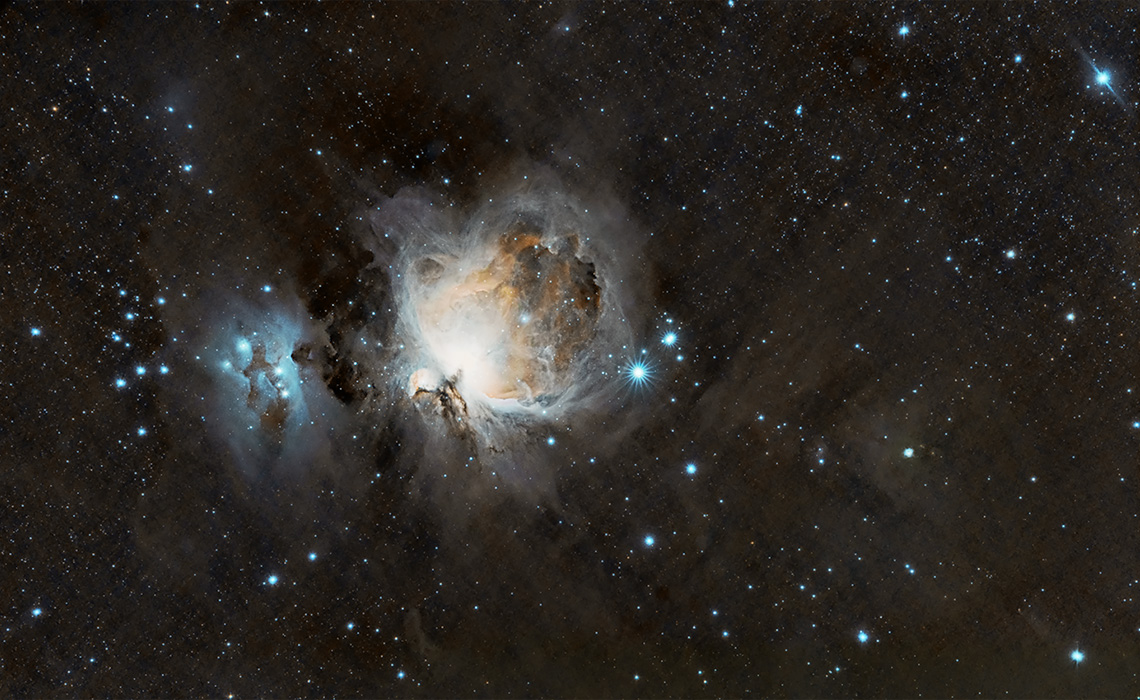
orions-sword-wide-field.jpg


The outer detail is rather noisy, as it's still buried in the noise floor (I presume primarily dark current/dark current noise, given the sensor temperatures). I had to perform some extensive color noise reduction and debanding to get it as clean as it is. Hence the reason for the newer 8 minute exposures...however all of the brighter stars and many of the medium sized stars are clipped already in the 5 minute exposures (or so close to clipping that they burn out when processing).

I also grabbed a handful of 10 minute exposures, however that did not seem to reveal any additional faint detail, although it did slightly improve the SNR of that faint detail. It primarily increased the amount of clipping in my brighter stars even more, to the point I found it completely unacceptable. Given the amount of noise overall, and the amount of color noise, I would much prefer to take the quantization noise and use an Exmor at ISO 100 or 200, avoid clipping the stars entirely, and get even longer exposures...say 12 minutes. I think in the end, based on my experience with a couple integrations from D5100s, the results would be far cleaner in the outer dark nebula regions. (Granted...that's anecdotal, and I don't really have the right to share the data without the consent of the owners...but as far as my own experiences influencing my own choices, there you have it.)

As a side note, since I did bring up the use of ISO 100/200 on Exmor-based cameras as a means of avoiding clipped stars. I recently started using the HDRCompostion tool in PixInsight, along with the MaskedStretch tool after linear processing. The image above I believe is actually a composition of my 300s and 90s exposures. HDRComposition with a set of decreasing exposure-length integrations, and MaskedStretch, along with very high precision 32-bit IEEE float FITS data, should help preserve the star detail and avoid blowing them out. Masked stretch can have an odd effect on stars...giving them a somewhat unnatural falloff into the background, but I guess I'll have to see if that is preferential to heavily blown out larger stars from 480-600 second exposures. As is usually the case, there are options to deal with camera limitations in post. If I had the option, I'd still use a D800 at ISO 100 or 200, take even longer exposures, and maybe even still do HDRComposition...just with fewer sets of exposures. (Why? Because it takes a really freaking LOOOONG time to get all that data in the first place! :P Many days, sometimes spanning a couple of months, depending on the weather. Anything I can do to lessen the amount of time I have to spend pointing my camera at the sky gathering data when your talking about getting dozens if not hundreds of many-minute long exposures is extremely valuable, IMO.)

That's a beautiful shot, in my opinion, but may I ask (and apologies if it should be obvious) why the colours are that way? In visible light, the Orion Nebula looks pink/green in my shots.
 
Upvote 0
Don Haines said:
As digital cameras mature, you will see less and less difference in IQ between revisions... everyone is approaching a wall.

I think this is an important point. People keep throwing around the term 'game changer'. Actually evolutionary improvements on good designs (and I still contend that the DSLR is a good design for many purposes) is surely better than revolutionary creations that don't stand the test of time. Not that I'm saying any given camera is that.
 
Upvote 0
jrista said:
Hmm, I may be confused. Are those charts dark current, or dark current noise? I guess I thought those charts were dark current noise, rather than dark current. If they are actually dark current...how are you actually measuring that, if the dark current is subtracted on-sensor by the CDS units? The dark current itself wouldn't be in the RAW image data to be measured... If you were deriving it from dark current noise, how do you differentiate read noise from dark current noise in the RAW data?


If you are saying the 7D II has that low of dark current, not just very low dark current noise, then I misunderstood something about your review of the 7D II...

Table 2 in my review http://www.clarkvision.com/reviews/evaluation-canon-7dii/
shows dark current in column 3.

Dark current is suppressed, but the noise is not. In a long exposure with no light, the noise is a combination of that from dark current plus apparent read noise. If the exposure is long enough, then thermal noise dominates over read noise. Read noise is subtracted (noise adds as the square root of the squares) leaving thermal noise. The log plot (Figure 3) shows an excellent linear trend. Sometimes the curves turn upward (Canon 6D, 1DX in the figure) indicating sensor heating limits the sensor from getting to a low temperature. The last 5 columns in Table 3 show the noise from dark current for different exposures so you can see where noise from dark current is greater than read noise. Noise from dark current is independent of ISO.

Roger
 
Upvote 0
scyrene said:
That's a beautiful shot, in my opinion, but may I ask (and apologies if it should be obvious) why the colours are that way? In visible light, the Orion Nebula looks pink/green in my shots.


I chose to process such that the colors would come out that way. ;) It started as an accident, as I used SCNR to reduce green channel noise too early in the process, but I kind of liked it, as it made the image look more like some narrow band images I've seen, so I left it.


Normal coloring is gray for the outer reflection dust on Orion Neb, pinkish for the inner Ha glow, and blueish for the reflection off Running Man.
 
Upvote 0
Roger N Clark said:
Flat fields are not needed if you are using profiled camera lenses. Certainly start with a clean sensor, but with the step above, you should have no dust spots and with fast lenses, dust spots don't really show. During raw conversion (e.g. photoshop ACR) simply select the lens profile and viola! the flat field is applied. Quick and simple. Again details in the above link.

May I ask, do lens profiles cover colour imbalances across the frame, or just vignetting/distorition? The biggest hurdle with using the 85mm f/1.2L II I found was a complex range of colours that was asymmetrical across the frame, especially apparent after heavy processing.
 
Upvote 0
fragilesi said:
So both the Canon and the Nikon are very good cameras. Both have relative strengths and weaknesses and both will get you pictures in certain scenarios that the other won't and both make certain things easier than the other. You pick the camera system that's best for you is the simplistic answer. Me, I'd pick the 7dII over the Nikon but that's because it suits me, others would choose differently.

What I won't do is head over to a forum dedicated to the other tech and say that its weaknesses mean it's a worse system just because it doesn't suit me personally. Which oddly is what a number of people do here.

+1

I think you forgot about the part where those who choose to do the latter seem (falsely?) surprised at the reaction they (intentionally) provoke, then proceed to complain about the flak they receive.
 
Upvote 0
Mt Spokane Photography said:
Roger N Clark said:
Jon,
Your bar tests are not equal. The NX1 chart is severely overexposed on the bright end so no wonder it shows better on the low end.

Roger

Its difficult to do a test right, which is why there are so few online testers that are highly respected. Even so, I try to read as many as possible, since they sometimes come at things from a different angle. I've seen so many conflicting reviews and poorly done ones online that it gets frustrating. (Clarkvision is one of the good ones).

One thing that I think I have seen is many posts of beautiful bird photos, but the feather detail is smeared. I haven't yet formed a opinion because its a very difficult subject to photograph, and I have only seen FF or 1.3 crop images that are better. Lens settings, shutter speed, vibration, air temperatures, distance to subject, etc all play a part, so real world images often merely reflect the photographers capabilities to deal with all those things.

Feather detail is the holy grail for me - as in, the individual filaments. Of course, at web resolution, it's not always important. In my experience, it's mostly distance to the subject, though other factors are doubtless important :)
 
Upvote 0
Roger N Clark said:
jrista said:
Hmm, I may be confused. Are those charts dark current, or dark current noise? I guess I thought those charts were dark current noise, rather than dark current. If they are actually dark current...how are you actually measuring that, if the dark current is subtracted on-sensor by the CDS units? The dark current itself wouldn't be in the RAW image data to be measured... If you were deriving it from dark current noise, how do you differentiate read noise from dark current noise in the RAW data?


If you are saying the 7D II has that low of dark current, not just very low dark current noise, then I misunderstood something about your review of the 7D II...

Table 2 in my review http://www.clarkvision.com/reviews/evaluation-canon-7dii/
shows dark current in column 3.

Dark current is suppressed, but the noise is not. In a long exposure with no light, the noise is a combination of that from dark current plus apparent read noise. If the exposure is long enough, then thermal noise dominates over read noise. Read noise is subtracted (noise adds as the square root of the squares) leaving thermal noise. The log plot (Figure 3) shows an excellent linear trend. Sometimes the curves turn upward (Canon 6D, 1DX in the figure) indicating sensor heating limits the sensor from getting to a low temperature. The last 5 columns in Table 3 show the noise from dark current for different exposures so you can see where noise from dark current is greater than read noise. Noise from dark current is independent of ISO.

Roger


Interesting. Any chance you have the margin of error as you get up into the higher ISO settings? I'm curious to try this method out on some of the cameras I am interested in buying. I've heard from other astrophotographers that dark current on Sony Exmor sensors is the lowest they have ever seen, and they no longer bother with dark frames as a result. Some don't even bother with dithering, as they haven't seen reason to.


For the most part, I've just relied on manufacturer spec sheets to get dark current values. I've seen some tests from the likes of Craig Stark and a few others that indicate at least for the Sony ICX sensors that dark current is around 0.003-0.002e-/s/px at -10C, which is low enough that you have to expose for 30 minutes before dark current levels even reach the RN level of those sensors. You have to expose for 2h 42m before dark current noise reaches the RN level of those sensors. Hence the reason it's usually considered a non-factor.


Anyway, I'm curious what you use to process the data and get your results? I haven't had a chance to see if I can open the RAW images in PixInsight without debayering. I am pretty sure Iris software can do that, though, so at the very least, I could fall back on that. I'm curious now to see what the dark current of the 5D III is in practice...just for my own benefit, so I can determine how long I should be exposing to avoid excessive DCN levels.
 
Upvote 0
TLN said:
game changing, game changing, game changing, blah blah..

But show photos from 7d1 and 7d2 to people, and they' won't recognize what camera is where.

What is really game changing, sony A7 or a7s. Or new 5-axis sensor stabilization in A7 II. Btw it cost as much as 7d2.


Until you shoot indoor sports, or indoor anything for that matter. Some people couldn't tell my iphone photos from a Nikon D700 or 5D Mark II outdoors on a sunny day. Is that supposed to NOT be game changing? And then the rest of your post is Sony blah blah blah, which costs as much as everything else that people can freely choose to purchase for their needs.
 
Upvote 0
jrista said:
Interesting. Any chance you have the margin of error as you get up into the higher ISO settings? I'm curious to try this method out on some of the cameras I am interested in buying. I've heard from other astrophotographers that dark current on Sony Exmor sensors is the lowest they have ever seen, and they no longer bother with dark frames as a result. Some don't even bother with dithering, as they haven't seen reason to.

How do they deal with the amp noise at the frame edges? The A7 and both A7Rs I've owned all had pretty severe purple glow when you start pushing up the ISO and it seems like this would be a major problem without dark frames.
 
Upvote 0
Chosenbydestiny said:
TLN said:
game changing, game changing, game changing, blah blah..

But show photos from 7d1 and 7d2 to people, and they' won't recognize what camera is where.

What is really game changing, sony A7 or a7s. Or new 5-axis sensor stabilization in A7 II. Btw it cost as much as 7d2.


Until you shoot indoor sports, or indoor anything for that matter. Some people couldn't tell my iphone photos from a Nikon D700 or 5D Mark II outdoors on a sunny day. Is that supposed to NOT be game changing? And then the rest of your post is Sony blah blah blah, which costs as much as everything else that people can freely choose to purchase for their needs.


I believe the game changer argument was in relation to astrophotography. If the dark current really is as low as Roger has determined, then the 7D II has some of the lowest DC in the industry. I'm curious to know how much the Exmor has, I think it is similarly low, but regardless...for Canon, that level of very low dark current is a solid improvement over prior sensors, which is a pretty big deal for astro imaging.
 
Upvote 0
raptor3x said:
jrista said:
Interesting. Any chance you have the margin of error as you get up into the higher ISO settings? I'm curious to try this method out on some of the cameras I am interested in buying. I've heard from other astrophotographers that dark current on Sony Exmor sensors is the lowest they have ever seen, and they no longer bother with dark frames as a result. Some don't even bother with dithering, as they haven't seen reason to.

How do they deal with the amp noise at the frame edges? The A7 and both A7Rs I've owned all had pretty severe purple glow when you start pushing up the ISO and it seems like this would be a major problem without dark frames.


I've seen a faint amount of purplish noise in A7r images...across the whole frame though, and only when you stretch really heavily. I haven't seen much in the way of what I would call amp glow, though. Nothing like the amp glow I get with the 5D III anyway. I am not sure about the A7, I've heard it's worse with that camera. If it is amp glow or some other thermal signal, then yes, you would need darks to handle it. In the case of the 5D III, if it presents badly, I just crop a little tighter and exclude the worst of it (because its primarily along the right edge o the frame)...without regulating sensor temp, creating and integrating with darks becomes a major pain.
 
Upvote 0
Thanks for visiting, Roger. I need to read some of the general introductory material at your site, a lot of the details are above my head.

The takeaway is that 7D2 is better than 6D for astrophotography?

I am interested in the 7D2 mostly for its "intended" use, bird and wildlife photography, but dabble in UWA astro-landscape when I get the chance - relative dark is about 2 hours away, but not much can deal with the cloudiness :P in my location (Midwest).

BTW, Sony fans, IBIS may be great for many commonly used focal length lenses, but it is severely challenged when using supertelephoto lenses.
 
Upvote 0
fragilesi said:
What I won't do is head over to a forum dedicated to the other tech and say that its weaknesses mean it's a worse system just because it doesn't suit me personally. Which oddly is what a number of people do here.

You are making a false assumption that most of those bringing up low ISO DR are Nikon/Sony/etc. users when most are actually long time Canon users. So there is no going over to the 'other' forum since they are posting in their own brand's forum to begin with.

And it's interesting that some improvements for astro photography are awesome (and they are) but then if say some landscape (not that only landscape shooters can benefit) shooter is looking for a 3 stops improvement, that's just minor nonsense and it's all on the photographer, people have made great pics forever so why should they even care, it just says something about the photographer doesn't it.

Well yeah how about we say the same and ask Roger to go back to shooting astro on D30 then? After all if he can't make due with shooting his pics on a D30 even though thousands of amazing pics have been taken with a D30 I guess that just says something about him and not the D30 right? Come on! Why doesn't he just use a pinhole camera for his work? People have made awesome pics with those right? If he can't then I guess that just really says a lot about him right?

Just sick of all the nonsense where people just put down anyone who dares want to push things forward regarding something that someone else doesn't need/do or regarding something their pet brand that they worship doesn't do the best.

Gotta love it, 14% better this and much better dark current that and it's a game changer (fine enough) but then if someone brings up 3 stops DR at low ISO it just says something bad about them, who could care about such nonsense as that. ::)
 
Upvote 0