My current project, wide field Orion's Sword with the 5D III+EF 600/4 II+Astronomik CLS-XL, using 480s, 300s, 90s and 15s exposures at ISO 400 (dithered, calibrated with a 200-frame master bias and 30-frame master flat along with the cosmetic corrections for hot and cold pixels in DSS), has revealed a lot of the very faint outer dust regions. This image below is just 1 hours worth of 300s exposures (out of my minimum goal of 6 hours), with sensor temperatures around 12-16°C gathered during the dark late waning/new moon phases:
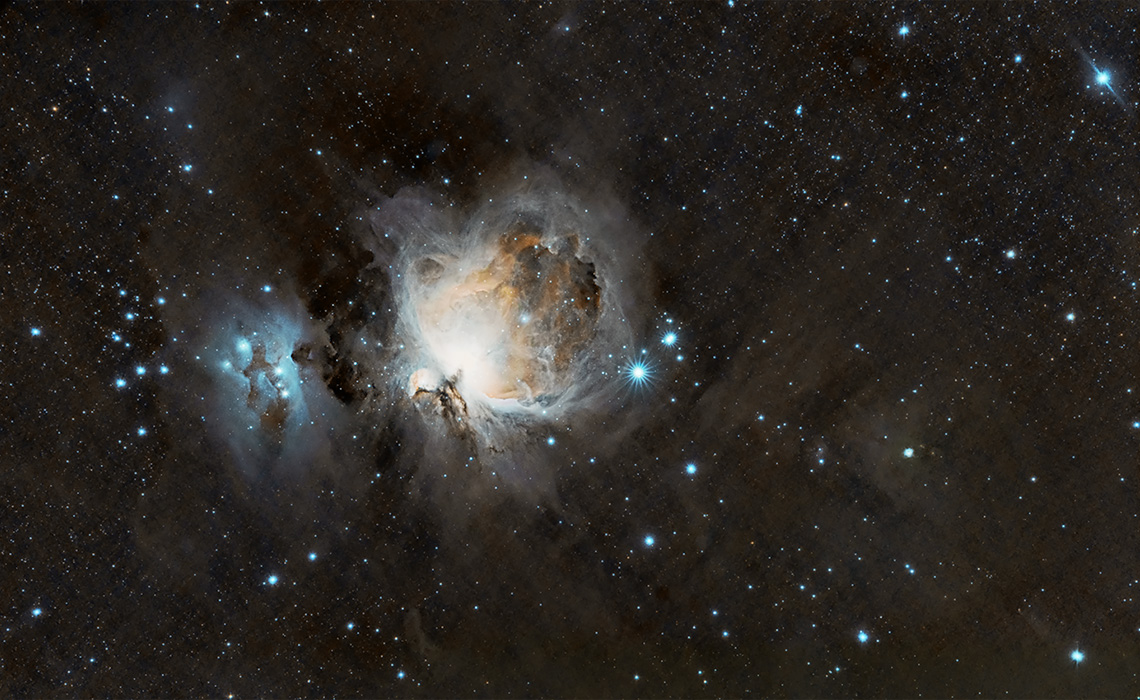
The outer detail is rather noisy, as it's still buried in the noise floor (I presume primarily dark current/dark current noise, given the sensor temperatures). I had to perform some extensive color noise reduction and debanding to get it as clean as it is. Hence the reason for the newer 8 minute exposures...however all of the brighter stars and many of the medium sized stars are clipped already in the 5 minute exposures (or so close to clipping that they burn out when processing).
I also grabbed a handful of 10 minute exposures, however that did not seem to reveal any additional faint detail, although it did slightly improve the SNR of that faint detail. It primarily increased the amount of clipping in my brighter stars even more, to the point I found it completely unacceptable. Given the amount of noise overall, and the amount of color noise, I would much prefer to take the quantization noise and use an Exmor at ISO 100 or 200, avoid clipping the stars entirely, and get even longer exposures...say 12 minutes. I think in the end, based on my experience with a couple integrations from D5100s, the results would be far cleaner in the outer dark nebula regions. (Granted...that's anecdotal, and I don't really have the right to share the data without the consent of the owners...but as far as my own experiences influencing my own choices, there you have it.)
As a side note, since I did bring up the use of ISO 100/200 on Exmor-based cameras as a means of avoiding clipped stars. I recently started using the HDRCompostion tool in PixInsight, along with the MaskedStretch tool after linear processing. The image above I believe is actually a composition of my 300s and 90s exposures. HDRComposition with a set of decreasing exposure-length integrations, and MaskedStretch, along with very high precision 32-bit IEEE float FITS data, should help preserve the star detail and avoid blowing them out. Masked stretch can have an odd effect on stars...giving them a somewhat unnatural falloff into the background, but I guess I'll have to see if that is preferential to heavily blown out larger stars from 480-600 second exposures. As is usually the case, there are options to deal with camera limitations in post. If I had the option, I'd still use a D800 at ISO 100 or 200, take even longer exposures, and maybe even still do HDRComposition...just with fewer sets of exposures. (Why? Because it takes a really freaking LOOOONG time to get all that data in the first place!

Many days, sometimes spanning a couple of months, depending on the weather. Anything I can do to lessen the amount of time I have to spend pointing my camera at the sky gathering data when your talking about getting dozens if not hundreds of many-minute long exposures is extremely valuable, IMO.)


 It started as an accident, as I used SCNR to reduce green channel noise too early in the process, but I kind of liked it, as it made the image look more like some narrow band images I've seen, so I left it.


