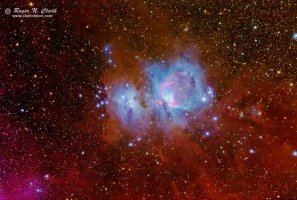
Roger N Clark said:
Him Jon,
That's funny as I live in Colorado too, and made the Horsehead and M42 images from the Denver Astronomical Society site near Byers. The skies there are OK, but not super, and it was a night of bright airglow and high cirrus, so not great conditions. I often work in dusty environments too, and far dustier than Colorado (e.g. the dusty Serengeti).
Ah! Well, cool! I had no idea. Colorado seems to be a hotspot for astrophotographers...I've met at least half a dozen on CloudyNights...and more seem to show up all the time. We should have a star party.

Roger N Clark said:
My sky was magnitude 21.1 per square arc-second. Contact me off list. The next new Moon, maybe we could go to the same location. New Moon will be the weekend of Dec 20. I would like to get out to a dark site. Not sure where you live in Colorado.
I'll PM you.
Trying to keep the rest of this as compact as possible, so I'm going to snip some stuff out.
Roger N Clark said:
Lets try this example. It is raining uniformly over your back yard (if you don't have one, pretend you do). You cover the back yard in pans to collect water. Does it matter how big the pans are assuming none overflow? No it doesn't. The amount of water collected depends on the rate of rainfall and the time you leave the pans out.
.../snip/...
So your system was receiving 81300 / 71000 = 1.14 times more light per pixel per second. But your image size is larger so an object in your image covers more pixels and more pixel equal more light FROM the SUBJECT. You have more pixels by the factor 2.81/2.148, or 1.3 times in each dimension, so 1.3^2 = 1.7 times more pixel on the subject. That combined with the 1.14 gives 1.94x. So your system delivered 1.94 times the light per second as my system. You exposed for 60 minues to my 27.5, so another 60/27.5 = 2.18 times more light.
Total light collected for your image from the subject = 1.94*2.18 = 4.2 times more light than for my image. That means 4.2 times more light from the Trapezium, 4.2 times more light from a small nebula, etc.
Roger N Clark said:
See above; you got more light.
A couple of things. I still think things between the two cameras normalize out a bit once the factors below are considered, hence the reason I'm still skeptical that the 7D II is a huge improvement over prior Canon cameras, however I may be swayed here...so bear with me.
1.
I was using the Astronomik CLS filter. Without the filter, sure, I'd have gathered more total light. The filter blocks about 1 1/3rd stops of light, so, at the very least, instead of a 4.2x increase in *total* light gathered, it's 4.2/2.66, or around 1.57x more *total* light. I agree, there is a difference in TOTAL light gathered.
In the case of regular old terrestrial photography, this factor of total light gathered is very significant, as it can mean less noise. Thing is, it can mean less noise because you can frame the subject the same in both FF and APS-C cameras. In doing that, you gather more light in total for the same subject...more pixels on subject...more detail, less noise. I fully agree with that point.
However...
2. Is pixel size really
meaningless when it comes to astrophotography? Yes, I gathered more light
in total with the larger frame, however as far as signal to read noise ratio, that is a per pixel thing. I have more sensor area spread out over more pixels, and I put more light onto
more pixels in total, but the
amount of light per pixel was lower (again, don't forget that I had a filter in place that was blocking 1 1/3rd stops of light).
Going off of a 1.14x difference in light gathered without the filter, 1.14/1.56 = 0.73x. Assuming this is right, the signal of each pixel was thus closer to the noise floor than with your 7D II image...and the SNR of each pixel was lower. Consequence of me using a filter.
Using the data from your reviews, read noise of the 5D III at ISO 400 is 9.8e- (surprising...I was going off of sensorgen data, which put it around 5.something electrons...which is barely more than half what your tests indicate...I think your test is more accurate, given my experience with noise at ISO 400), while read noise from the 7D II at ISO 1600 is 2.4e-. I would (while using the filter) need to collect four times more subs to reduce noise to a similar level of one single 7D II frame, and even more than that to reduce noise to the level of your integration. I think the integration I shared before was 12x300s subs, so RN would have been averaged down to about 2.82e-. Assuming 27 subs with the 7D II, your integrations noise floor would have been 0.46e-.
Yes, I gathered more light in total
per sensor. I gathered less light
per pixel, and had to deal with more read noise. The SNR in my subs was lower, signal was lower, noise floor was higher (ok, I conceed, higher ISO would probably have been better!)
I also had more skyfog (which, BTW, was extracted with PixInsights DynamicBackgroundExtraction...when skyfog is removed, the object signal is left behind, and since that signal is weaker, often significantly weaker, than the skyfog+object signal, it's even noisier). I don't know what the skyfog was that night, so I couldn't tell you what e-/min skyfog there was vs. e-/min object signal. Regardless, between the filter and the skyfog, I do not believe my OBJECT signal strength (which is largely what I was left with after DBE in PixInsight) was nearly as high as yours. If I had imaged under 21.1mg/sq" skies
without a filter, I have no doubt my results would have been significantly better, probably more similar to yours (with the added negative of the 5D III banding...really hate that junk!
)
Anyway. My point is... I was imaging with a filter, under ~18mg/sq" skies tops, so it is not surprising that the 7D II image is cleaner...but were basically comparing apples and oranges at the moment, so I don't think the differences between my image and yours are proof that the 7D II is a "game changer." I do, however, now believe the 7D II is a solid improvement for astrophotography over prior Canon cameras, with maybe the exception of the 6D (it produces some pretty good data as well.)
I could be off base here...been at this too long now today.
I really would like to hit a dark site with you, get some better data, and do a better and more "apples to apples" comparison. The 7D II may really be a huge improvement. It would be interesting to test a couple other cameras as well, one with an Exmor, and if possible, the Samsung NX1. (I would really love to see you test a couple of those cameras using your method...the only broad source of low-level test data like that that we have is DXO, and so much of what DXO does is buried within a black box...I have a hard time trusting their data. Your reviews are open and detailed...would be awesome to see the D810, A7s, and NX1 tested by you.) I would be willing to bet the NX1 and A7s both trounce any Canon camera out there as far as astrophotography goes...but, that's mostly based off of my own testing. I don't have the quality of data you do when I examin raw data.
Anyway, I am happy to admit that used under the right conditions, say 21.1mg/sq" skies and no filter, it may perform significantly better than I give it credit for...dark noise/hot pixels may not be as much of an issue if I could expose shorter. I may be blaming the 5D III for noise levels that are actually imposed on me by light pollution...
...and that leads me to this thought. I am interested in the ISO settings you've used. You certainly had much lower read noise. Maybe it's just a matter of my skyfog levels, as after I extract them with DBE, the remaining object signal is usually quite a bit noisier. I may simply be exposing longer to combat that issue, and thinking about it, the light added to the stars by light pollution does not get extracted, which may actually be the real cause of my star clipping issue. I've been exposing longer at lower ISO to get more dynamic range to avoid clipping my stars (which does seem to help), at the cost of faint detail SNR.
Roger N Clark said:
If you had a brighter sky, that would limit how faint you could get. But see my review on the 5DIII. it still suffers from banding. I also have dark frames and I agree that it has amp glow, so not the best implementation of on sensor dark current suppression, especially considering when it was introduced. The 7D2 is much better.
Aye, I have very bright skies a lot of the time (and sometimes, they get very dark...orange zone if not darker). The 300 second subs I gathered were actually made on a night with poor visibility and high scattered light as well. I don't know if you remember, but back when we had that deep cold front moving through Colorado just a couple weeks ago, there were some clear nights, but the sky was REALLY milky and bright...transparency was terrible. That was the first time I imaged Orion...and it was probably a really bad idea to use data from those days. I forgot about that earlier today, but I may simply discard that whole entire set of data, and start fresh on a clearer night... That may have significantly limited my ability to expose good signal strength on those faint outer details... :-\
Roger N Clark said:
See above on the amount of light. 4.2x. Color blotchiness is a function of the raw converter, not the sensor. There is negligible banding at ISO 1600 in the 7d2.
The sensor data in my reviews is independent of any lens or raw converter. Many things one sees online are also a function of the lens and raw converter used.
Compare my 5DIII data: http://www.clarkvision.com/reviews/evaluation-canon-5diii/to the 7D2 data: http://www.clarkvision.com/reviews/evaluation-canon-7dii/Look at the pattern noise in tables 2a and 2b. The 5DIII shows significant banding even at ISO 1600. Not so with the 7D2. That makes a major difference in pulling out faint detail. The 5DIII also has higher dark current, and that too limits your ability to get faint.
Ok, fair enough. I have noticed that CaptureOne doesn't seem to have as much problem with the blotchy color as Lightroom. I still use Lightroom, as CaptureOne has far less support for various RAW file types, and my 60-day trial is going to run out any day now. But, it did seem to produce cleaner noise. I am not sure what PixInsight does, I think it's configurable, so I can go poke around. I may also be able to load the image without debayering.