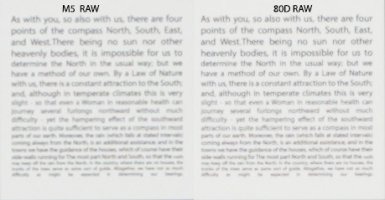
Thank's for the links. The M5 has gone back to preview status at the time of writing this for some reason...
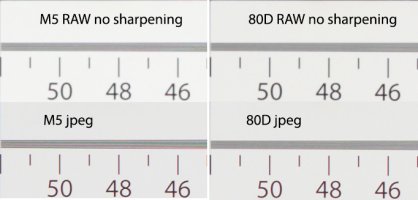
I would also note that the resolution seems to be more problematic for the M5 than the 80D, but that could be be the jpeg compression in the M5 samples. The 80D samples are processed RAW.
M5:
80D:
Edit: I've used the "Studio shot comparison" at the DPR to illustrate RAW vs JPEG with M5 vs 80D:
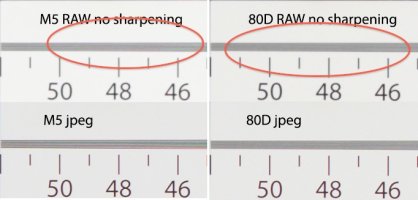
Thanks for drawing our attention to the dpr comparison. I downloaded the RAW and jpeg data and draw the opposite view. The M5 outresolves the 80D but the 80D has better contrast. Here is a collage of the crops at iso100 of the chart where resolution is at the highest. The RAW are converted in DPP with no sharpening or noise reduction.
Edit - see my next post the better contrast is only an illusion.
Thanks for drawing our attention to the dpr comparison. I downloaded the RAW and jpeg data and draw the opposite view. The M5 outresolves the 80D but the 80D has better contrast. Here is a collage of the crops at iso100 of the chart where resolution is at the highest. The RAW are converted in DPP with no sharpening or noise reduction.
On closer inspection, I see that the apparent better contrast of the 80D is only illusory. The RAW is slightly less exposed for the 80D after processing. When I match up the background, the M5 has as good contrast as the 80D. The 80D is not separating the lines at all, whereas the M5 does show some separation. The M5 does have a very good sensor.
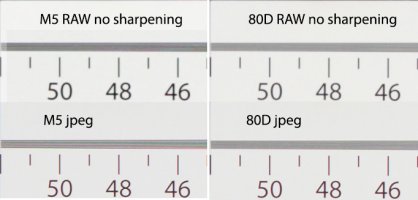
You have to download to see the image properly as the site does its usual blurring of images.
Here's another example. You can see on the left of each about 1/3rd up that journey, difficulty and attraction are better resolved by the M5. Of course, perhaps dpr may not have focussed the 80D as well as it has the M5.
What I have found is that the pictures made with my M5 have really high resolution and exceptional micro contrast at 100% when shot with RAW, a good prime lens, stopped down and making sure there is zero motion and camera shake blur.
My impression is that it has a weaker AA filter, but I could be wrong.
In that case, perhaps you would be so good as to explicitly state the formula and weightings that DxO uses to determine their overall score. While you're at it, please also explain why the majority determinant of their scores consider only performance at base ISO.
You have a greater likelihood of Trump releasing his tax returns than DXO releasing the specifics of their methods. I'd love to see either the *very* complicated polynomial that governs the overall lens score calculation... or the revision history of said equation that shows that resolution was deprioritized on/around the release of the 5DS R. ;D
We could exhaust an entire thread of jokes about "things that will happen before DXO releases their algorithm"
At this point I don't know why it even makes headlines at CR. As far as I'm concerned, none of their data is to be trusted unless an algorithm or repeatable experiment is shown. It's akin to trying to wade through and find the truths of a habitual liar
Could not agree more DXOMark testing methods are flawed, I don't work for Canon but Ive tested hundreds of cameras without a lens, testing the lens & then the combination together. We have very exacting standards that are repeatable and using the high resolution CIPA chart with an even field illumination sphere, f stop machines, MTF, projection, etc.
We can even show results on a theatre screen with split screen to compare lenses & cameras . Many of the Canon lenses DXOMark listed as "average" were better and we test batches of lenses not one. We can also very accurately measure DR (its amazing to see the difference sometimes between different cameras of the same type including high end cinema video cameras).
This does tend to show up the poor Canon cameras and lenses as well as the very good ones but that's no different to any other manufacturer including Leica, Cooke & Zeiss lenses.

)