Show your Bird Portraits

Jack Douglas said:
Jrista, as always a source of encouragement!

Something that I got, by going with the old chair base, is very free rotation. I just reach out and it spins with a finger. Having 5 props around the main stump allows quite a bit of versatility to the background. I did add the dead birch a few days back.

For anyone else, this prop was purely an experiment and I can tell you that midway through I felt discouraged because it was a couple of pretty intense days of construction without a clue whether the final result would be satisfactory - especially the 5 bedsprings held by 3 wire circles (surplus welding wire thrown out by your "typical government funded institution").

If your're tempted to do something vaguely similar go for it as I'll bet you'll be thrilled. I roll mine out of the way to clean the deck and roll it east or west to shoot depending on time of day etc. Happy as a lark! ;)

If only the birds were as excited and would tell their friends!! But, I was visited by an angel. :)

Jack

Sounds like you've taken your bird setups to a whole new level! Your definitely getting some much better shots, now, no question. Your skill is rapidly improving. I look forward to seeing your shots a year from now! ;D
 
Upvote 0
ooF Fighters said:
A local Double Crested Cormorant. Evil looking thing! Kind of an overcast day, which helped to keep the shine off the feathers & show more detail on this all black subject.
Color on the water is a reflection from peoples clothing on a bridge, out of sight in the background.

Aw, I wouldn't call them evil looking. Most people don't seem to care much for how cormorants look, I guess...but personally, I love their heads. Especially their eyes...stunning blue jewels.

Great shot. Well lit and his pose is great.
 
Upvote 0
Jack Douglas said:
Wish I had something new.... The pose now has some branches, better or negative, anyone?

Oh, there's that tongue again!

6D 300 640th F8 ISO 320

Jack

I would always eliminate foreground content if you can. The foremost thing in your scene should be the bird and it's perch. Foreground blur just interacts oddly with the in-focus subject plane, and never really looks good. Put the branches (and whatever else you want back there) behind the bird, enough that they blur almost into indistinction, but best avoid foreground OOF junk...it always looks terrible (no matter how much skill you have.)

The only real exception would be foreGROUND (or maybe pine fronds that kind of stretch to the bottom and/or top edges of the frame). Ground nicely fades into an aesthetically pleasing blur that does not usually directly interact with any subject plane elements.
 
Upvote 0
IslanderMV said:
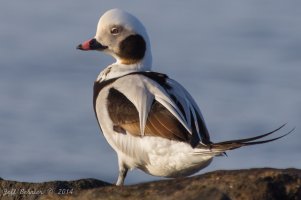
Long-tailed Duck - male non-breeding plumage.

Rare to see them near shore, they usually winter way off-shore. Had to use major ninja skills to get close.

100-400mm

He's a beauty! And I totally believe you have some pretty mad sneaking skillz to get close enough, if that is a full or nearly-full crop at 400mm. :P I can't get that close to birds here in colorado, far too jittery...hence my purchase of the 600mm f/4 II.
 
Upvote 0
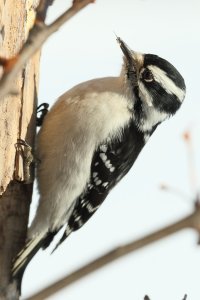
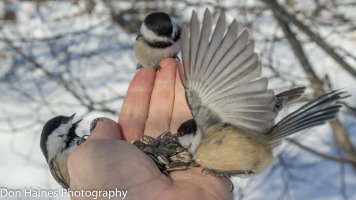
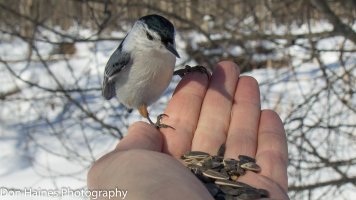
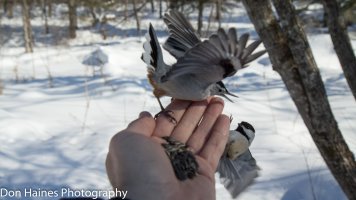
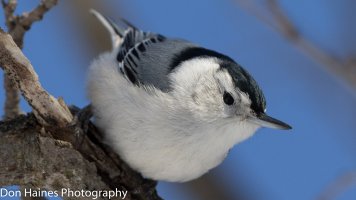
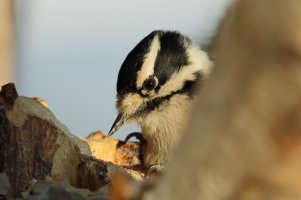
So I head out again with my new 150-600 lens to go take bird pictures.... and I end up shooting with a wide angle lens as the chickadees and nuthatches were very friendly...
 

Attachments

  • IMG_3034-2.jpg
    IMG_3034-2.jpg
    361.8 KB · Views: 590
  • IMG_3018.jpg
    IMG_3018.jpg
    399.9 KB · Views: 587
  • IMG_2978.jpg
    IMG_2978.jpg
    277.8 KB · Views: 595
  • IMG_2977.jpg
    IMG_2977.jpg
    410.2 KB · Views: 595
Upvote 0
Jack Douglas said:
IslanderMV, I just love that duck!

jrista, I'm guessing this doesn't really work either??

Jack

Same deal. You can see where the foreground object blurrs into the stuff behind it. That just never really works. Not in the general case anyway. Birds are highly detailed. If you did that with things that did not contain as much fine detail as birds and bark, you might be able to put OOF foreground elements to good purpose, but I am not a big fan of it for anything nature, really. The only time I've seen foreground OOF work is when the only thing from the subject plane it obscures is the birds feet and legs. I've seen this a couple times, where shorebirds sometimes have one or both feet obscured by a slight hump of sand in the foreground.

Overall, though, my personal recommendation is you keep the subject plane unobscured.
 
Upvote 0
Thanks again jrista and I think you're right. I'm trying things but not the best judge of the final result.

A while back I was debating a friend who generally knows more than me, having gotten into DSLRs fairly seriously some years back. He tends to be very particular about things.

Here's what we didn't agree on, as he tried to push me towards producing a photo of wildlife that reproduces as closely as possible what the eye had seen. This was in the context of shooting a bison that was almost black to the eye with snow everywhere. I said that if I was shooting a brown bear in the bush and it was dull, I'd wan't a picture of a "brown" bear if possible, not a dark blob. This seemed to register with him a little but I think both of us are a little unsure about how to view such things. Any comments jrista or anyone else?

In the wild you take what you can get but since this shot is staged I largely had control. I assume this weed is also a distraction. Any comment - negative is fine! ;) Others may be learning from my mistakes too.

Jack


Jack
 

Attachments

  • Distraction_12639.JPG
    Distraction_12639.JPG
    562.3 KB · Views: 505
Upvote 0
Jack Douglas said:
Thanks again jrista and I think you're right. I'm trying things but not the best judge of the final result.

Certainly! Don't stop trying. That's how you learn.

You might want to pick up Michael Freeman's books on photography...they will give you an EXCELLENT core basis for the general photographic stables: Exposure, Composition, Tone & Color.

You should also pick up Art Morris' book The Art of Bird Photography (the older book, not the newer CD ebook). ABP is an excellent book, especially the chapter on exposure. You'll learn more from Art than I could ever possibly teach you. I strive to be as good as him some day, but I figure I'll be about his age before I am, and I could never compare to the teacher he is.

Jack Douglas said:
A while back I was debating a friend who generally knows more than me, having gotten into DSLRs fairly seriously some years back. He tends to be very particular about things.

Here's what we didn't agree on, as he tried to push me towards producing a photo of wildlife that reproduces as closely as possible what the eye had seen. This was in the context of shooting a bison that was almost black to the eye with snow everywhere. I said that if I was shooting a brown bear in the bush and it was dull, I'd wan't a picture of a "brown" bear if possible, not a dark blob. This seemed to register with him a little but I think both of us are a little unsure about how to view such things. Any comments jrista or anyone else?

Photography is an art. Art is a matter of personal style. Your in the experimental phase, so right now, the best advice is to keep experimenting, play with exposure, try silhouettes, try exposing so you see the brown bear as a brown bear, etc.

Some people aim to produce "clinical" photographic results...they only care about the technical perfection. To be perfectly honest, I've always found such photography to be bland and artless. There is rarely any feeling in photos created clinically...to perfectly and exactly reproduce just what the physical eye saw, ignoring what the minds eye saw. I think involving aspects of both is important...its the ratio of the mix that really boils down to personal style. You sound much more like a minds eye kind of guy to me...you want to share what you feel you saw as much as what you actually saw (maybe more.) I wouldn't ignore that!

Find your personal style. It won't happen overnight. It'll require time and dedicated effort, trialing various approaches and figuring out which ones best represent what you saw AND felt to your viewers. I may have a lot of advice to give (and I honestly thank you for listening, even if you don't take my advice!), but I am still exploring and discovering my own personal style. I've been photographing birds for two years now. I have a better sense of what my own personal style is, but I haven't really perfected the technique that will allow me to achieve that style every time I point the lens and press the shutter button.

Also, don't forget that post-processing is just as much a critical part of the process as what you do in camera. The camera is a clinical device...it will expose the world according to the technical specifications of its design, and the mechanical and electronic settings you give it. You have some control over those personal style aspects in-camera from the standpoint of composition and scene layout...but I think the bulk of personal style is brought out in the way you process. (I think it's always been this way as well...even in the days of film, critical photographers spent untold hours in their darkrooms playing with chemical baths, dodging, burning, perfecting transfer processes, etc.) Color, tone, contrast, crop, vignetting, etc. are all elements of style. Use them to your advantage.

 
Upvote 0
jrista, thank you for that most thorough explanation about various things. I try to soak it all up and none of the advice is ignored, maybe forgotten at times, but never ignored. One of my daughters is very enthused having spent many hours with me last summer at the pond and she's artisticly inclined. We have a grand time relating to these things. She inherited my modest Nikon gear, which as a student she wouldn't likely have been inclined to afford, and in a couple weeks was completely up to speed. Unfortunately she is far away at university.

I've bought an number of good books but that one was quite expensive so I'll check the library and then decide on spending. Thanks again.

BTW I've made a mod for the skytracker that I'll post in the star thread.

Jack
 
Upvote 0