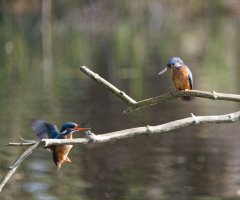
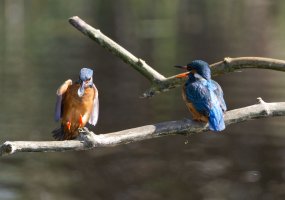
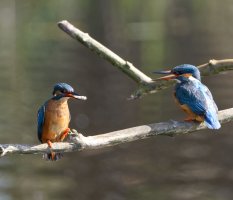
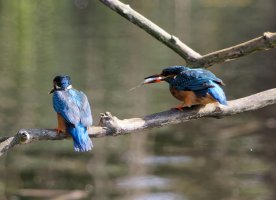
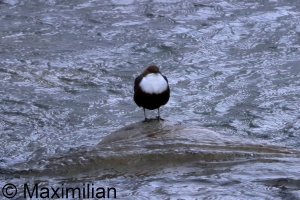
Show your Bird Portraits

I do a lot of butterfly and dragonfly photography and much prefer the RF 100-500mm for that, or even the RF 100-400mm (or adapted EF 100-400mm for you), unlike for birds where I prefer the RF 200-800mm. The best shots are when you are close up, and you can get to about 1.2-1.1 meter away with the 100-500mm and 100-400mm, with magnifications of ~0.3x and ~0.4x, respectively. The mfd of the 200-800mm at 800mm is 3.3m and you get much less magnification, and have to zoom out to get closer and boost the magnification. It's relatively infrequent that you can't get close, and some of the keen ones use macro lenses. With the 100-400 and 100-500mm, you can get sufficiently close to dragonflies to resolve the individual lenses on their eyes, and I've never been able to do that with the 200-800mm. Even better is that the RF 100-500 takes the 2xTC well and you can get ~0.6x magnification at 1000mm.
The reminder for the MFDs for various zoom lenses is appropriate.

The reality of the butterfly shot in question here (via the 200-800) is that I left my front door with the hope of imaging birds (and I did!). The acquired image is, sort of, good enough...despite the fact that indeed, I was required to take a step or two back from the subject, in order to acquire focus...at the bush near the corner of our garage.

But the lens, as used, resolved the images for the sensor sufficiently well, I think, for demonstration purposes.

This sort of thing is, in fact, my reality when it comes to photography--'sufficiently well'--and depends on the gear that I have in my hands.

As for as 'the keen ones' and 'macro lenses'...my few attempts at macro photography?

The results (with bugs and insects) indicate I need more practice. Much more...not so keen, apparently.:cool:
 
  • Like
Reactions: 1 user
Upvote 0
I just remembered I posted a careful comparison of the RF 200-800mm and RF 100-500mm close up shots. The upshot was that at ~3.5m (or more) the 200-800mm at 500mm or 600mm is slightly sharper than the 100-500mm. At 2.4m, the RF 200-800mm is as sharp in the centre at 500 and 600mm as the RF 200-500mm but field curvature causes loss of sharpness of the longer lens moving away from the centre. At close to the minimum focal length of close to a meter, for which you have to zoom out to 200mm for the RF 200-800mm, the RF 100-500mm at 500mm has a larger image. Both are sharp at the centre but the 200mm loses sharpness quickly away from the centre.
So quick take home message is that for greater than 3m, the RF 200-800mm is my choice, for shorter distances the RF 100-500mm.

 
  • Like
Reactions: 1 users
Upvote 0
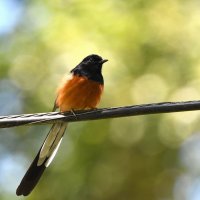
@ISv No luck yet on the Orange-cheeked Waxbill. But here's a White-rumped Shama I photographed last month on a trip to Vietnam.

R5MkII RF200-800mm

View attachment 228729
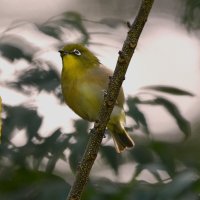
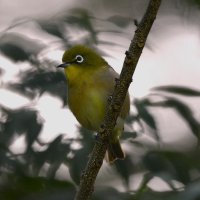
White-rumped Shama is pretty common on Oahu (incl. Honolulu town) too. Not as common as the Japanese white eye but still common.
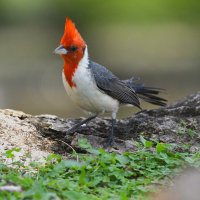
Theese are from today - Foster Botanical garden.

DSC_2976.jpgDSC_2929.jpgDSC_2940.jpg
 
  • Like
Reactions: 4 users
Upvote 0
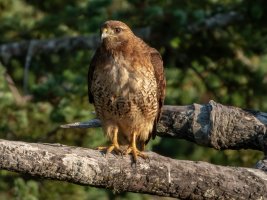
While waiting for the hummingbirds to return (saw a couple the other day), here is a shot of a Red Shouldered Hawk taken 6 years ago with the P1000. Yes, Canon could beneficially add a super zoom back into the line.

View attachment 228748
6 years is a long wait. Was the P1000 any good for hummingbirds?
 
Last edited:
  • Haha
Reactions: 1 user
Upvote 0
a025.gif
Beautiful shot, Dragon.
 
Upvote 0
6 years is a long wait. Was the P1000 any good for hummingbirds?
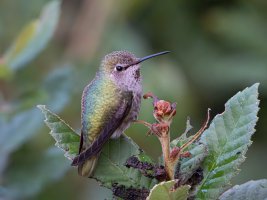
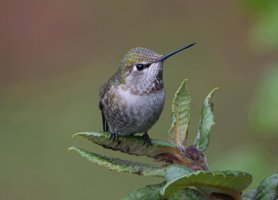
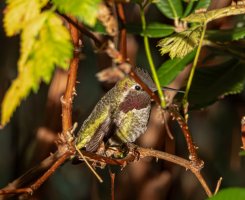
Only waiting for hummers since January. They accurately guessed that February was going to be nasty and bugged out (BTW, they almost always guess correctly - a skill our long-range forecasters could learn from). To your question, yes, the P1000 works pretty well for hummers, but it does take some practice, since the combination of the VC and the AF is a bit unpredictable at the long end of the lens. The R7 with the 200-800 is both better and much more consistent, but that is one of the few combos I have found that really outshines the P1000. The P1000 has much poorer pixel level performance, so you have to zoom in closer and also watch out for too much contrast given the limited dynamic range of the sensor and you need considerably more light to keep the ISO down (ISO 400 is about as far as you can push it). The P1000 also "needs" more help from Topaz to get really good results. The 200-800 does focus a few feet closer than the P1000 for equivalent useful magnification and the R7 is quite usable at ISO 6400. Those are both big deals when shooting hummingbirds. Here are a few P1000 shots as examples of what it can do. The lens on the P1000 is remarkably good, when you consider it is actually a 540mm f/8 lens at full reach and a 125:1 zoom to boot. The hawk shot was at 324mm (about 2000mm FF equivalent).

DSCN1003-Edit.jpg

DSCN1042-Edit.jpg

DSCN1468-Edit.jpg
 
Last edited:
  • Like
Reactions: 4 users
Upvote 0