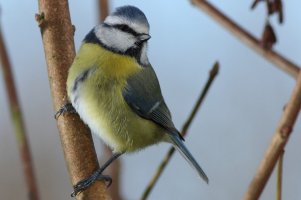
Show your Bird Portraits

Keith_Reeder said:
Yep - I've seen lots and lots which were taken in great light too, Steve. In fact I'm frequently shoulder-to-shoulder with supposedly far better kit than mine (often in crappy light, too - like when I'm shooting rugby or moto-x during the Winter), and I rarely see incontrovertible proof of its superiority, either in IQ terms or in terms of the number of "keepers".

There's usually a slight edge, but never one commensurate with the difference in price..!

;)

I agree. Doesn't mean I still don't want that 600 f4 vII though! If I had the cash I'd be all over it for that slight edge. But in the meantime I'll keep soldiering on with this terrible, just terrible, third party lens

Greater Yellowlegs by No Small Wave, on Flickr
 
Upvote 0
Steve said:
Keith_Reeder said:
There's usually a slight edge, but never one commensurate with the difference in price..!

;)

I agree. Doesn't mean I still don't want that 600 f4 vII though! If I had the cash I'd be all over it for that slight edge. But in the meantime I'll keep soldiering on with this terrible, just terrible, third party lens

I think you guys would both say differently if you actually had the opportunity to use the 600/4 II in the field. ;) It is a wickedly sharp lens, and it is scientifically capable of being significantly sharper than any lens that drops down to an f/6.3 aperture because your more diffraction limited at the smaller aperture. At f/4, the 600/4 II is capable of resolving more in terms of spatial resolution than any current DSLR sensor. At f/6.3, there are quite a number of sensors capable of resolving more in terms of spatial resolution. Those differences DO result in realizable real-world gains. Even at narrower apertures, the lens rapidly becomes diffraction limited, and exhibits ideal performance (not the case with a lens that is aberration-limited at f/6.3, like the Tamron or Sigma 150-600's...those lenses would need to be stopped down quite a bit to reach purely diffraction-limited performance levels). These images have had NR in the background, but the subjects themselves have been untouched:

bIzLMFB.jpg

ofVMbyf.jpg

iLQTa0K.jpg


There is more to the 600/4 II than just it's sharpness, though. The AF is wicked fast, and when paired with the 1D X or 5D III (and, probably, the upcomming 7D II), you get all the benefits that an f/4 max aperture offer...such as more usable cross-type AF points. That gives you a lot more freedom as far as scene composition goes, without having to resort to real-time oddities like focus and recompose (focused on the body with cross-type f/4 AF points in the left-hand segment of the 5D III's 61pt AF system):

Ipk9PgK.jpg


You can't discount the IS system in the 600/4 II either. Nothing else I've ever used, including Sigma lenses that have OS, have ever even remotely come close to the kind of slow shutter hand-holdability that the four to five stop IS system in Canon's great whites offers. You can hand-hold between 1/20th to 1/30th...which is a godsend for some kinds of birds...like the Night heron, which often sits perfectly still, but is usually out in extremely low light:

night-heron-at-night-1-of-1.jpg


It's also extremely handy for those fantastic moments of hand-held flight photography:

x9Nut6z.jpg
 
Upvote 0
jrista said:
I think you guys would both say differently if you actually had the opportunity to use the 600/4 II in the field. ;)

If you want to buy me one I definitely won't turn it down! I'm aware, as I'm sure Keith is as well, that the Canon superteles are great. I've not had the chance to use a 600 but I've used a friend's 500 and its marvelous. In that post you quoted I even said I'd love to have the 600 f4 II because I know its great. There is a lot it will do but one thing it won't do is make someone a good photographer. I've met quite a few people with top of the line kit that take bad pictures because they think its enough just to buy the right gear.

And really, when you get down to it, the differences are relatively minor. Yes, you have one more stop, yes the AF is a bit faster, yes its a bit sharper but none of those features matter if you can't approach a bird or if you're shooting straight down at the top of a duck's head at midday from a fully extended tripod. That's really what we're discussing here - that there is a massive gulf between good and bad photography skills and minor differences in the equipment. I feel like I do pretty well with what I can afford. I feel like I do better than a lot of the people I've met who can afford more. Gear does make a difference, certainly. I couldn't make the images I want with a Rebel and a kit zoom. But there is a definite level of diminishing returns as you go higher up the chain.

Personally, I think it would be cool if Canon and Nikon required a portfolio review before selling people superteles. "Sorry buddy, not that great. Let's see what you can do with this 400 f5.6 for a bit. Get back to us in six months" ;)
 
Upvote 0
That "you can see every feather barb at 100% view" argument only impresses other photographers, Jon - it's essentially an irrelevance to anyone who views your images who isn't a photographer.

(That said, I've supplied exactly the same sort of example myself to indicate the capabilities of the Siggy 120-300mm f/2.8 OS + 2x TC - I get the basis for doing so. But as I say, it's only interesting to photographers).

Steve's right on point here: nobody (least of all me) is trying to suggest that - other things being equal - the "best" kit won't serve to maximise opportunities, but for the most part it won't make an appreciable difference in most circumstances: as we'd all acknowledge, there's more to wildlife photography than the gear.

Indeed, for my style of photography, an anchor of a lens - and tripod, and gimbal - would be a positive disadvantage: I like to be mobile, and I shoot exclusively handheld, not least because of the flexibility and "agility" this approach affords. A Canon supertele would positively slow me down. Even aside from the logistics of using such gear, the weight doesn't appeal either.

And here's another thing. I could have chosen a Canon 300mm f/2.8 IS instead of the the Siggy, but I have never, ever understood how any wildlife 'tog can function with fixed focal length lenses: I know they do, but it is a source of constant bafflement to me.

Even in the pics I've posted up here in the last day or two, the focal length is all over the place - I literally could not manage without being able to zoom.

The only Canon "super" lens that gives something like the flexibility I need, is the 200-400mm f/4: I love the idea of that lens (especially with the built-in 1.4x TC), but - having seen innumerable examples from it - I'm back to "it's not so much better in terms of the end result that I could justify it".

For the record, I have actually used a 600mm f/4 (not the latest version) at some length, courtesy of a UK pro shooter I'm friendly with, and - honestly - it's not for me. The disadvantages to me that result from it aren't outweighed by the fairly minimal (at the image level) superiority of the lens over my kit.

Yes, it's sharper at 100%, and yes, it's AF is better than the Siggy + 2x. But my Siggy is much better at say, 300mm, and at f/2.8: and is at least as fast focusing as the 600mm when the Siggy is naked or with the Canon 1.4x attached.

I can't get out to 840mm/1200mm of course, but I've rarely if ever needed to, whereas I routinely need less than 600mm...

And I reiterate that at the image level the benefits of the Canon superteles are largely lost on the viewing public: I have never, ever been told that my efforts would be better if only they were sharper...

As long as I can do this at 600mm - and I can, all day long - I'm happy enough. And let's be honest: if I'd told you that it had been taken with a Canon supertele, you'd have no reason, on the basis of its sharpness and detail, not to believe me.

(It's almost wide-open, too - no drastic stopping down to get this level of sharpness).

 
Upvote 0
Eastern Yellow Robin - Kinglake National Park.
After spending a dismal morning trying to photograph these and other small birds (they have a habit of perching in bushes, meaning, lots of images of in focus twigs and out of focus birds), this one plonked itself on a branch, in the open. The only catch was the bush between me and the Robin. Moving myself slightly, I managed to sight the bird through a gap, hence the blurry green at the bottom of the image. 20 shots later, it took off, but it certainly made my day. 5D3 with 300mm f4

0n4517OmtPYTFYALNnDJU-paN34htjzHeftqasPEG2g=w686-h779-no
 
Upvote 0
"But there is a definite level of diminishing returns as you go higher up the chain."

Very true and something I learned in forking out $7k of my inheritance on the 300 2.8 II which I compared carefully to the Nikon AF 70-300 I owned. I see both points of view and the validity of various comments on either side but if you can't justify the $$$ it's a no brainer - enjoy the less expensive gear cause it's still very good.

Just be careful to not say overly critical things about the high level stuff or folk will get ruffled, but not me. I do what I like and you do what you like and we still have free speech for now at least. Heaven help us when the crazys take over.

Jack
 
Upvote 0