SIGMA Announces the 14mm F1.8 DG HSM Art Series Lens

Curious to see the discussion on this.

No one has ever been able to make a lens that is simultaneously [UWA] + [f/2 or faster] + [coma well controlled]. The astro camp only ever gets two out of three.

For those defending the Sigma 12-24 f/4 Art and the 16-35 f/2.8L III, both could be used for astro, but the former is f/4 and the latter has that lovely > 4 EV of vignetting at 16mm f/2.8 -- exactly where astro folks would prefer to use it.

The 20 f/1.4 Art and 24 f/1.4 Art didn't control coma well from what reviews (and folks here at CR) have said. So this 14 f/1.8 Art represents Sigma's third try in recent times at a dream astro lens. Of course, there are many other uses for all three of these lenses -- none are dedicated astro tools -- but a good slice of prospective buyers will jump right to the coma testing page when this new lens is reviewed. Presuming it's sharp, coma really is the make/break metric for a whole group of photographers here.

- A
 
Upvote 0
ahsanford said:
Curious to see the discussion on this.

No one has ever been able to make a lens that is simultaneously [UWA] + [f/2 or faster] + [coma well controlled]. The astro camp only ever gets two out of three.

For those defending the Sigma 12-24 f/4 Art and the 16-35 f/2.8L III, both could be used for astro, but the former is f/4 and the latter has that lovely > 4 EV of vignetting at 16mm f/2.8 -- exactly where astro folks would prefer to use it.

The 20 f/1.4 Art and 24 f/1.4 Art didn't control coma well from what reviews (and folks here at CR) have said. So this 14 f/1.8 Art represents Sigma's third try in recent times at a dream astro lens. Of course, there are many other uses for all three of these lenses -- none are dedicated astro tools -- but a good slice of prospective buyers will jump right to the coma testing page when this new lens is reviewed. Presuming it's sharp, coma really is the make/break metric for a whole group of photographers here.

- A
True. And at least Norhern hemishpere inhabitants can be more patient (Milky way dependent) until the new sigma gets released and reviewed :)
 
Upvote 0
3kramd5 said:
CanonFanBoy said:
"Distinctive bokeh effect" even at 14mm. I'd like to see that.

According to my calculator: 3ft from the subject at f/1.8 / 14mm... focus kicks in at 2.4ft runs 1.62ft deep to 4.02ft and then back out of focus.

MFD is 10.6 inches, not 3 feet. DOF in that use case is about 1.3".


I often use my 25mm f/2 that way (ultra close thus shallow DOF at wide angles). It's a unique look, but doesn't play in many situations.

CanonFanBoy said:
Some of you that are gonna buy right away ( before testing or reviews) are brave souls.

shrug... BH and Amazon have great return policies. If it's a dud, I'm out a couple grand for a couple weeks. NBD.

I said nothing about MFD. I was speaking about a specific distance from a subject at wide open aperture and what the plane of focus would be.

10.3" from a subject wouldn't probably be used too often. Especially with a 1.3" DOF. :)

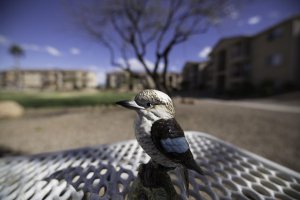
Now, I did run outside with my 15-30 Tamron to see what I could get bokeh wise. The MFD is supposed to be 11". Photo is SOOC except for resizing. No corrections.

I'm sure the wider aperture of the Sigma 14mm f/1.8 DG HSM will get better out of focus background due to the wider aperture, but I found that less than 2 feet from the subject (With the Tamron) brought everything in the photo into sharp relief... which is great for the astro guys.

Problem is that Sigma is touting the bokeh when lack of Coma and uncorrected distortion ought to be the major selling point. Just my opinion, which might be lame or not. :) :) :)

Correction for myself: MFD does not equal distance of front element to subject.
 

Attachments

  • Bird.jpg
    Bird.jpg
    97.3 KB · Views: 179
Upvote 0
CanonFanBoy said:
3kramd5 said:
CanonFanBoy said:
"Distinctive bokeh effect" even at 14mm. I'd like to see that.

According to my calculator: 3ft from the subject at f/1.8 / 14mm... focus kicks in at 2.4ft runs 1.62ft deep to 4.02ft and then back out of focus.

MFD is 10.6 inches, not 3 feet. DOF in that use case is about 1.3".


I often use my 25mm f/2 that way (ultra close thus shallow DOF at wide angles). It's a unique look, but doesn't play in many situations.

CanonFanBoy said:
Some of you that are gonna buy right away ( before testing or reviews) are brave souls.

shrug... BH and Amazon have great return policies. If it's a dud, I'm out a couple grand for a couple weeks. NBD.

I said nothing about MFD. I was speaking about a specific distance from a subject at wide open aperture and what the plane of focus would be.

10.3" from a subject wouldn't probably be used too often. Especially with a 1.3" DOF. :)

Now, I did run outside with my 15-30 Tamron to see what I could get bokeh wise. The MFD is supposed to be 11". Photo is SOOC except for resizing. No corrections.

I'm sure the wider aperture of the Sigma 14mm f/1.8 DG HSM will get better out of focus background due to the wider aperture, but I found that less than 2 feet from the subject (With the Tamron) brought everything in the photo into sharp relief... which is great for the astro guys.

Problem is that Sigma is touting the bokeh when lack of Coma and uncorrected distortion ought to be the major selling point. Just my opinion, which might be lame or not. :) :) :)

Correction for myself: MFD does not equal distance of front element to subject.

All I'm saying is: you aren't going to see a substantially shallow DOF unless you get up close, and since you'd "like to see that ["Distinctive bokeh effect" even at 14mm]," you should prepare to move towards the subject.

As I said, it doesn't play in many situations, but it can. Your "bird" photo is an example where I think it works.

I personally dump a huge pile of salt on any marketing claims of bokeh, since it's an entirely subjective quality.
 
Upvote 0
3kramd5 said:
CanonFanBoy said:
3kramd5 said:
CanonFanBoy said:
"Distinctive bokeh effect" even at 14mm. I'd like to see that.

According to my calculator: 3ft from the subject at f/1.8 / 14mm... focus kicks in at 2.4ft runs 1.62ft deep to 4.02ft and then back out of focus.

MFD is 10.6 inches, not 3 feet. DOF in that use case is about 1.3".


I often use my 25mm f/2 that way (ultra close thus shallow DOF at wide angles). It's a unique look, but doesn't play in many situations.

CanonFanBoy said:
Some of you that are gonna buy right away ( before testing or reviews) are brave souls.

shrug... BH and Amazon have great return policies. If it's a dud, I'm out a couple grand for a couple weeks. NBD.

I said nothing about MFD. I was speaking about a specific distance from a subject at wide open aperture and what the plane of focus would be.

10.3" from a subject wouldn't probably be used too often. Especially with a 1.3" DOF. :)

Now, I did run outside with my 15-30 Tamron to see what I could get bokeh wise. The MFD is supposed to be 11". Photo is SOOC except for resizing. No corrections.

I'm sure the wider aperture of the Sigma 14mm f/1.8 DG HSM will get better out of focus background due to the wider aperture, but I found that less than 2 feet from the subject (With the Tamron) brought everything in the photo into sharp relief... which is great for the astro guys.

Problem is that Sigma is touting the bokeh when lack of Coma and uncorrected distortion ought to be the major selling point. Just my opinion, which might be lame or not. :) :) :)

Correction for myself: MFD does not equal distance of front element to subject.

All I'm saying is: you aren't going to see a substantially shallow DOF unless you get up close, and since you'd "like to see that ["Distinctive bokeh effect" even at 14mm]," you should prepare to move towards the subject.

As I said, it doesn't play in many situations, but it can. Your "bird" photo is an example where I think it works.

I personally dump a huge pile of salt on any marketing claims of bokeh, since it's an entirely subjective quality.

True. But Sigma is making claims like this:
Canon Rumors said:
Going beyond fast shutter speed, this lens can capture a swarm of fireflies with crystal clarity, a beautiful bokeh effect, and outstanding control of light streaking.

THAT, I would like to see. A swarm of fireflies. Crystal clarity. A beautiful bokeh effect. Outstanding control of light streaking. Also claiming corner to corner sharpness. And all of this at the same time. ;)
 
Upvote 0
CanonFanBoy said:
3kramd5 said:
CanonFanBoy said:
3kramd5 said:
CanonFanBoy said:
"Distinctive bokeh effect" even at 14mm. I'd like to see that.

According to my calculator: 3ft from the subject at f/1.8 / 14mm... focus kicks in at 2.4ft runs 1.62ft deep to 4.02ft and then back out of focus.

MFD is 10.6 inches, not 3 feet. DOF in that use case is about 1.3".


I often use my 25mm f/2 that way (ultra close thus shallow DOF at wide angles). It's a unique look, but doesn't play in many situations.

CanonFanBoy said:
Some of you that are gonna buy right away ( before testing or reviews) are brave souls.

shrug... BH and Amazon have great return policies. If it's a dud, I'm out a couple grand for a couple weeks. NBD.

I said nothing about MFD. I was speaking about a specific distance from a subject at wide open aperture and what the plane of focus would be.

10.3" from a subject wouldn't probably be used too often. Especially with a 1.3" DOF. :)

Now, I did run outside with my 15-30 Tamron to see what I could get bokeh wise. The MFD is supposed to be 11". Photo is SOOC except for resizing. No corrections.

I'm sure the wider aperture of the Sigma 14mm f/1.8 DG HSM will get better out of focus background due to the wider aperture, but I found that less than 2 feet from the subject (With the Tamron) brought everything in the photo into sharp relief... which is great for the astro guys.

Problem is that Sigma is touting the bokeh when lack of Coma and uncorrected distortion ought to be the major selling point. Just my opinion, which might be lame or not. :) :) :)

Correction for myself: MFD does not equal distance of front element to subject.

All I'm saying is: you aren't going to see a substantially shallow DOF unless you get up close, and since you'd "like to see that ["Distinctive bokeh effect" even at 14mm]," you should prepare to move towards the subject.

As I said, it doesn't play in many situations, but it can. Your "bird" photo is an example where I think it works.

I personally dump a huge pile of salt on any marketing claims of bokeh, since it's an entirely subjective quality.

True. But Sigma is making claims like this:
Canon Rumors said:
Going beyond fast shutter speed, this lens can capture a swarm of fireflies with crystal clarity, a beautiful bokeh effect, and outstanding control of light streaking.

THAT, I would like to see. A swarm of fireflies. Crystal clarity. A beautiful bokeh effect. Outstanding control of light streaking. Also claiming corner to corner sharpness. And all of this at the same time. ;)
But no stars? Strange they mentioned fireflies but not stars. It seems there is a swarm of ... fireflies photographers out there that I have no idea about ;D
 
Upvote 0
CanonFanBoy said:
True. But Sigma is making claims like this:
Canon Rumors said:
Going beyond fast shutter speed, this lens can capture a swarm of fireflies with crystal clarity, a beautiful bokeh effect, and outstanding control of light streaking.

THAT, I would like to see. A swarm of fireflies. Crystal clarity. A beautiful bokeh effect. Outstanding control of light streaking. Also claiming corner to corner sharpness. And all of this at the same time. ;)

I think I'd like to see that, too. the bokeh would be the background at night? Probably quite smooth, being solid darkness! Control of light streaking at, what, 1/640? How can I possibly believe the coma claims?

The only way I know to get that effect is to apodize myself with three shots of mescal in quick succession.
 
Upvote 0
tron said:
CanonFanBoy said:
3kramd5 said:
CanonFanBoy said:
3kramd5 said:
CanonFanBoy said:
"Distinctive bokeh effect" even at 14mm. I'd like to see that.

According to my calculator: 3ft from the subject at f/1.8 / 14mm... focus kicks in at 2.4ft runs 1.62ft deep to 4.02ft and then back out of focus.

MFD is 10.6 inches, not 3 feet. DOF in that use case is about 1.3".


I often use my 25mm f/2 that way (ultra close thus shallow DOF at wide angles). It's a unique look, but doesn't play in many situations.

CanonFanBoy said:
Some of you that are gonna buy right away ( before testing or reviews) are brave souls.

shrug... BH and Amazon have great return policies. If it's a dud, I'm out a couple grand for a couple weeks. NBD.

I said nothing about MFD. I was speaking about a specific distance from a subject at wide open aperture and what the plane of focus would be.

10.3" from a subject wouldn't probably be used too often. Especially with a 1.3" DOF. :)

Now, I did run outside with my 15-30 Tamron to see what I could get bokeh wise. The MFD is supposed to be 11". Photo is SOOC except for resizing. No corrections.

I'm sure the wider aperture of the Sigma 14mm f/1.8 DG HSM will get better out of focus background due to the wider aperture, but I found that less than 2 feet from the subject (With the Tamron) brought everything in the photo into sharp relief... which is great for the astro guys.

Problem is that Sigma is touting the bokeh when lack of Coma and uncorrected distortion ought to be the major selling point. Just my opinion, which might be lame or not. :) :) :)

Correction for myself: MFD does not equal distance of front element to subject.

All I'm saying is: you aren't going to see a substantially shallow DOF unless you get up close, and since you'd "like to see that ["Distinctive bokeh effect" even at 14mm]," you should prepare to move towards the subject.

As I said, it doesn't play in many situations, but it can. Your "bird" photo is an example where I think it works.

I personally dump a huge pile of salt on any marketing claims of bokeh, since it's an entirely subjective quality.

True. But Sigma is making claims like this:
Canon Rumors said:
Going beyond fast shutter speed, this lens can capture a swarm of fireflies with crystal clarity, a beautiful bokeh effect, and outstanding control of light streaking.

THAT, I would like to see. A swarm of fireflies. Crystal clarity. A beautiful bokeh effect. Outstanding control of light streaking. Also claiming corner to corner sharpness. And all of this at the same time. ;)
But no stars? Strange they mentioned fireflies but not stars. It seems there is a swarm of ... fireflies photographers out there that I have no idea about ;D

Why look at stars when swarms of fireflies are posing? Here's a link for you. Looks like the photos are pure bokeh. Obviously not the miracle working Sigma 14mm. ??? I can't see a single leg or antenna or wing.
 
Upvote 0
ahsanford said:
Curious to see the discussion on this.

No one has ever been able to make a lens that is simultaneously [UWA] + [f/2 or faster] + [coma well controlled]. The astro camp only ever gets two out of three.

For those defending the Sigma 12-24 f/4 Art and the 16-35 f/2.8L III, both could be used for astro, but the former is f/4 and the latter has that lovely > 4 EV of vignetting at 16mm f/2.8 -- exactly where astro folks would prefer to use it.

The 20 f/1.4 Art and 24 f/1.4 Art didn't control coma well from what reviews (and folks here at CR) have said. So this 14 f/1.8 Art represents Sigma's third try in recent times at a dream astro lens. Of course, there are many other uses for all three of these lenses -- none are dedicated astro tools -- but a good slice of prospective buyers will jump right to the coma testing page when this new lens is reviewed. Presuming it's sharp, coma really is the make/break metric for a whole group of photographers here.

- A
...Certainly not the majority.
 
Upvote 0
AvTvM said:
bwud said:
I know what coma does, it just struck me that it is generally only emphasized in discussions of astrophotography (portrait artists for example I don't recall ever being concerned with coma). My guess is that the subject essentially being small round points makes coma particularly destructive.

coma aberration is only an issue with MOVING objects [like stars in long-time exposures]. Portraits are usually taken with subject not in motion. And most of the time with subject not in corner of frame. So not much of an issue for portrait artists. ;)

Utterly incorrect. Even by your standards, this is poor.
 
Upvote 0
scyrene said:
AvTvM said:
bwud said:
I know what coma does, it just struck me that it is generally only emphasized in discussions of astrophotography (portrait artists for example I don't recall ever being concerned with coma). My guess is that the subject essentially being small round points makes coma particularly destructive.

coma aberration is only an issue with MOVING objects [like stars in long-time exposures]. Portraits are usually taken with subject not in motion. And most of the time with subject not in corner of frame. So not much of an issue for portrait artists. ;)

Utterly incorrect. Even by your standards, this is poor.

You are right and so is @Tron. My first sentence was incorrect. Coma aberration affects static subjects ... e.g. making stars appear as if they were moving, dragging a tail behind them. That's what confused me for a moment. Looked it up again https://en.wikipedia.org/wiki/Coma_(optics) and included an edit in my earlier post.
 
Upvote 0
Perhaps slightly off topic, but wouldn't it be rather easy to correct for slight coma if you know the lens coma characteristics (easily measurable with point light sources), focus distance (pretty much guaranteed to be at infinity for astrophotography purposes) and know that there is nothing out of focus?

For each position on the sensor there'd be a measurable point spread function. It varies in shape and orientation radially. Deconvolution isn't cheap but should be able to yield quite good results for well behaved systems like this and has been in use in astronomy for decades by now, for example in the Hubble telescope.

http://www.astrosurf.com/buil/iris/tutorial12/doc30_us.htm
http://cds.cern.ch/record/576204/files/0208247.pdf
 
Upvote 0
hne said:
Perhaps slightly off topic, but wouldn't it be rather easy to correct for slight coma if you know the lens coma characteristics (easily measurable with point light sources), focus distance (pretty much guaranteed to be at infinity for astrophotography purposes) and know that there is nothing out of focus?
It's an interesting point, but unfortunately deconvolution is far from easy, in particular for these wide-angle lenses where the PSF is strongly position-dependent. HST images are by comparison far easier to de-convolve, since the PSF is extremely stable and changes only subtly with position in the field (the focal length of HST is >120000 mm, so quite far from wide field...). Even so, since de-convolution is generally an ill-posed inverse problem, some regularisation strategy is needed even in this case (like "maximum entropy").

If the PSF was very well characterised and parametrised, it should be possible to in principle make a reasonable deconvolution. It is a fairly major effort though, and the computational cost would be enormous. I would be very interested in seeing the results if anyone feels tempted to try it out....
 
Upvote 0
epsiloneri said:
hne said:
Perhaps slightly off topic, but wouldn't it be rather easy to correct for slight coma if you know the lens coma characteristics (easily measurable with point light sources), focus distance (pretty much guaranteed to be at infinity for astrophotography purposes) and know that there is nothing out of focus?
It's an interesting point, but unfortunately deconvolution is far from easy, in particular for these wide-angle lenses where the PSF is strongly position-dependent. HST images are by comparison far easier to de-convolve, since the PSF is extremely stable and changes only subtly with position in the field (the focal length of HST is >120000 mm, so quite far from wide field...). Even so, since de-convolution is generally an ill-posed inverse problem, some regularisation strategy is needed even in this case (like "maximum entropy").

If the PSF was very well characterised and parametrised, it should be possible to in principle make a reasonable deconvolution. It is a fairly major effort though, and the computational cost would be enormous. I would be very interested in seeing the results if anyone feels tempted to try it out....

Could this technique be applied to swarms of fireflies? Or would maximum entropy be better achieved with bug spray?
 
Upvote 0
Ah-Keong said:
wow. Gigantic!

https://www.dpreview.com/news/4711801152/cp-2017-hands-on-with-sigmas-newest-lenses
::)

Not really wow. Just physics.

All of Sigma's 'firsts' of madly wide apertured glass are behemoths -- the 20 f/1.4, 24-35 f/2, the 18-35 f/1.8, etc. It's a combination of the realities of those apertures with the added heft of more complicated/involved designs that are gunning for that great wide open performance. It's the Zeiss Otus story all over again... but with a ton more focal lengths, decent-to-solid working AF, a much lower price and the Sigma badge on it. :D

- A
 
Upvote 0
epsiloneri said:
hne said:
Perhaps slightly off topic, but wouldn't it be rather easy to correct for slight coma if you know the lens coma characteristics (easily measurable with point light sources), focus distance (pretty much guaranteed to be at infinity for astrophotography purposes) and know that there is nothing out of focus?
It's an interesting point, but unfortunately deconvolution is far from easy, in particular for these wide-angle lenses where the PSF is strongly position-dependent. HST images are by comparison far easier to de-convolve, since the PSF is extremely stable and changes only subtly with position in the field (the focal length of HST is >120000 mm, so quite far from wide field...). Even so, since de-convolution is generally an ill-posed inverse problem, some regularisation strategy is needed even in this case (like "maximum entropy").

If the PSF was very well characterised and parametrised, it should be possible to in principle make a reasonable deconvolution. It is a fairly major effort though, and the computational cost would be enormous. I would be very interested in seeing the results if anyone feels tempted to try it out....

I agree with everything you say. Especially about the computational cost and the problems of handling noise in the frequency domain. This isn't something you'd see done in-camera, but for astrophotography where you're stacking dozens of several-second long exposures already, an extra minute or two of processing on a modern computer should still be acceptable if the results are good enough.

My point was exactly that which you base your initial assumption on, that the PSF should be well characterisable and parameterisable. Additionally, for shooting the stars with a UWA prime, you have both fixed focal length and focus distance fixed, so two parameters fewer.

There's a deconvolution example in the OpenCV dev distribution if someone wants to play around. The easy way out would be similar to what was done in one of the links I supplied: piece-wise application of different PSFs and then a merge.
 
Upvote 0