So what makes a camera a "pro" camera?

neuroanatomist said:
Canon wants to sell cameras (and lenses) to people who take pictures, whatever they're called.
+1
I am with you on that one.
To me, many will find me wrong, professional photographers are business people. It is the business side of the job that makes them special, that differenciates them from enthusiasts.
My question is, professional gear; is that the best gear for the job or the gear a professional uses? Don't get me wrong, why would you use a 5D mk iii for weddings if you can use a 1DX? The silent shoot? I own both and I have used both during weddings.
In my mind, correct me if I am wrong, a business person would calculate the benefit, cost vs income. I doubt they would buy the best gear if a lesser cost one can do the job correctly.
So my question to the OP is did you have in mind the best gear for the job or the gear used by people who makes money of it.
Looking at myself, I spent 3 or 4 times on the hobby part of my photography than the making money. I am one of those who shoots for money in order to pay for the amount used to buy the gear for my hobby.
 
Upvote 0
dryanparker said:
RLPhoto said:
neuroanatomist said:
The person holding it.
And making money with it.

Yes to Neuro's point, but not necessarily yes to RL's.

Not every professional makes a living (or any money at all) using their camera. Think of all the fantastically talented hobbyists out there, or perhaps fine art photographers. These are "professionals" in terms of their knowledge, capacity and portfolio quality, but it's not necessarily about money.

That said, I'll concede to RL that "professionals" are often described by some associations (ASMP, for instance) as those making a living with their camera.
I'm positive that there are many photogs who don't make money that are 100x better than most pros, but nonetheless they are not professionals. They are advanced amateurs, which is not a bad thing.

A professional takes pictures and makes money with the photos. Some pros are absolute garbage, others not so bad but consistent and others are really good. I have overhead costs that involve things such as extra taxes, a LLC, insurance and other stuff that being a pro is required (or recommended for good business.) The line is blurred some with weekend semi-pro shooters but they still are professionals who get paid.

so a pro camera is the camera that makes me money.
 
Upvote 0
A "pro" camera is the one a pro attaches his/hers lenses to, to get the work done. It's a camera which its user don't feel the need to debate the pros and cons of, since it is a reliable tool that can be depended on.
 
Upvote 0
I do not think a pro camera has anything to do with the person holding it.

A pro will choose the best he can use (buy/borrow/etc) for the job in front of him/her. If that person can only get his hands on a Samsung Galaxy Note 3 to take pics, that does not make that phone a pro camera.

I think manufacturers decide which are the pro models, whether it be a set of knives, a camera or laptop (though in the latter they are called business models rather than pro).

Just look at cars. All Mercedes-Benz will get you from a to b, but the S series may do it in a lot more comfort and style than the lowly C series.

If you shoot sports, then it would be the top of the range Nikon or Canon combined with the best glass you can get. If you shoot landscape or architecture, you may be more tempted by the 5D Mark III then the 1D X for example.

If a pro shoots with a 50D that does not make the 50D a pro model, it does however make it that pro's model.
 
Upvote 0
expatinasia said:
I think manufacturers decide which are the pro models, whether it be a set of knives, a camera or laptop (though in the latter they are called business models rather than pro).

But what criteria do they use to make that determination? For any pro criterion you choose I can probably find a counter-example. About the only criteria I can think of that might have no exceptions would be profit margin and level of support from the manufacturer. Here are some proposed criteria and why each doesn't hold.

Image quality: 6D arguably has equal/better IQ compared to 1DX

Physical toughness: Pro studio photographers don't need this (e.g. MFD)

Speed: Pro landscape or studio photographers don't need this (e.g. MFD)

You get the idea.
 
Upvote 0
expatinasia said:
I think manufacturers decide which are the pro models, whether it be a set of knives, a camera or laptop (though in the latter they are called business models rather than pro).
Errm, being pedantic for just a moment...I have a Macbook Pro laptop. Must make me a pro! Whoo-hoo!
This is an entertaining thread! 8) I hope the OP has got something out of it.

-pw
 
Upvote 0
Orangutan said:
expatinasia said:
I think manufacturers decide which are the pro models, whether it be a set of knives, a camera or laptop (though in the latter they are called business models rather than pro).

But what criteria do they use to make that determination? For any pro criterion you choose I can probably find a counter-example. About the only criteria I can think of that might have no exceptions would be profit margin and level of support from the manufacturer. Here are some proposed criteria and why each doesn't hold.

Image quality: 6D arguably has equal/better IQ compared to 1DX

Physical toughness: Pro studio photographers don't need this (e.g. MFD)

Speed: Pro landscape or studio photographers don't need this (e.g. MFD)

You get the idea.

The manufacturer sets the pro level, and I do not know what that is. But generally speaking it is the best overall performance and life of product etc. Whether it be kitchen knives or cameras, the manufacturer will more often than not say that this model is aimed more at pros over an inferior product etc. That's just the way it is. If a new set of knives comes out and has one benefit, or even two over the pro set then I would imagine that most manufacturers would consider putting those benefits into their new pro line when the time comes to do so.

Same applies for everything, pans, ovens, laptops, cars. etc.

pwp said:
expatinasia said:
I think manufacturers decide which are the pro models, whether it be a set of knives, a camera or laptop (though in the latter they are called business models rather than pro).
Errm, being pedantic for just a moment...I have a Macbook Pro laptop. Must make me a pro! Whoo-hoo!
This is an entertaining thread! 8) I hope the OP has got something out of it.

-pw

Haha! But now you are confusing a name for a product line. Manufacturers like Dell and Lenovo have business lines (the pro equivalent of a camera) which are made to last longer and more often than not have much higher quality build and components than their consumer lines. Even though those consumer lines may have some advantages (lighter, more stylish etc).

But for some to say it is the people behind the camera that makes the camera a pro camera makes no sense to me. Like I said before a 50D does not become a pro camera because it is used by a pro, it is just a pro's camera.
 
Upvote 0
RLPhoto said:
I'm positive that there are many photogs who don't make money that are 100x better than most pros, but nonetheless they are not professionals. They are advanced amateurs, which is not a bad thing.

A professional takes pictures and makes money with the photos.

+1

The only Difference between Pro and competent Amateur - is making Money ( with it ) or not.
A Pro Camera ist a Pro Camera when a Pro use it, in my Business every tool is a Pro Tool when
i use(buy) it - and i´ll be able to mark them as a buy for Pro uses to the Governourment - and this
Costs will reduce my Profit - and so it reduces the Amount of my Taxxes i have to Pay.
If i bought a expensive Cam. - i will not be automatically a Pro, if i earn not enough Money as a Pro
with my expensive Camera, i will not be a Pro for al long Time ;D .

IF i would be a Pro, i would buy that Kind of Camera which does the Job for me, including an
Backupbody - because a fail of the Device would prohibit my Work for the Day .
( And better Bodys with 2 Cards recording parallel to avoid Cardfailures )

The most important Piece for a good Photo is the Person behind the Camera, but only when he/her
get Paid for the Work he/her is a Professional.

I am only an Amateur in Photographics, but i am a Pro in my Business .
My (Semi)Pro 5DM3 does not make me a Pro :o .

Edit: and my 5DM3 is an Amateurbody because i am an Amateur ;)

Only my 2 ct´s

Bernd
 
Upvote 0
ajfotofilmagem said:
Suppose I need a photographer shoot a wedding with me. If I had to choose between the options below, I decide by the number 2:

OPTION 1 - Only one 5D classic + 28-135mm

OPTION 2 - One T5i with grip + 17-55mm + 430EXii + other T5i + Sigma 50mm Art

I can not choose who would be the pro in this case. Having more gear does not imply to me that it is a pro. Having a 1dx does also not mean to me that he can deliver nice photos.

So, I join the group that agree with Neuro that the pro is not the gear but the photographer itself.
 
Upvote 0
expatinasia said:
Just look at cars. All Mercedes-Benz will get you from a to b, but the S series may do it in a lot more comfort and style than the lowly C series.

So the S series is for professional drivers? Why are so many taxi cabs Toyotas and Fords, and so many limos Lincolns and Chryslers?

However, Mercedes does make vehicles for professional drivers. Here's one: ;)

1000682_1950418_799_532_Mercedes-Benz_Unimog_U_4023_und_U_5023_13C429_62.jpg
 
Upvote 0
expatinasia said:
Orangutan said:
expatinasia said:
I think manufacturers decide which are the pro models, whether it be a set of knives, a camera or laptop (though in the latter they are called business models rather than pro).
But what criteria do they use to make that determination?

The manufacturer sets the pro level
But generally speaking it is the best overall performance and life of product etc.

These seem like two distinct, sometimes contradictory criteria. The first one is purely marketing, meaning there's not really any objective criterion. The second seems vague. These criteria are more likely to tell us useful information about the marketing department than the products.
 
Upvote 0
What makes a camera a "pro" camera?

1. If the camera marketing department calls it a pro camera
2. If a professional photographer uses it

I don't think there is any other "standard" for what ever the term "pro camera" means.

I would opine that any camera I use is, by definition, not a pro camera. ;D
 
Upvote 0
The Bad Duck said:
Clearly it has to say "pro" in the name of the camera.
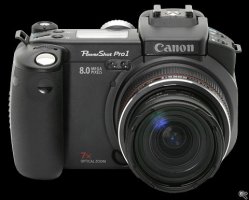
So... canon pro-1 must be the only canon pro camera, right?
Canon Pro-1! Whoa! (Rhymes with Pro...) Now there's a killer of a camera. This is embarrassing, but I had the misfortune to know someone whose neighbors brother-in-law actually had one of the ten or so of these cameras that were sold in this country.

-pw
 
Upvote 0
Yes it is fair to say that any camera that is being used by a real professional is a pro grade camera, whatever it is.

Not sure if this has been mentioned before, but by the sounds of it I don't think many here realise the abuse that a real pros gear has to take, especially if it is portable stuff like a dslr and lenses. It has to be able to take that abuse and keep working, same for lenses. It also has to function satisfactorily under stressful, rushed situations. Take the 650D for example, a camera I had for a short while. The rear controls were so doll-like I couldn't feel them half the time. Take the 6Ds top command wheel, it's so softly clicked I can't feel it when I'm having to work fast. The rear wheel is even worse. What about lenses that have elements glued in place with three spots of glue like the Tamron 24-70. Just recently I had put the camera plus 24-105L on the dashboard in a Land Rover, had to pull out really quick in traffic and the camera shot off backwards and crashed into the footwell. I didn't even have to consider any damage. A friend of mine in Australia had a 1DII + 70-200 knocked over on a full height tripod onto a Tarmac pavement; no issues.

So if you're going to baby your gear you can get away with almost any camera that offers full control, esthetic satisfaction apart, and not withstanding unforeseen accidents, but gear that must keep working to keep paying the photographer has to be more robust.
 
Upvote 0