Something with 50mm L lens that make it different

PBD,
No, I didn't cheat, there is seriously no fun in cheating. There were a few where I had really no idea and had to guess. It will be interesting to see the results to see if what I got correct was based on what I thought, or if I got lucky.

You are very well mannered about all of this, I will give you that. Even in the face of people getting upset with it. You dodged my questions though about if you think you could see the differences in out of the camera images?

Tom
 
Upvote 0
talicoa said:
PBD,
No, I didn't cheat, there is seriously no fun in cheating. There were a few where I had really no idea and had to guess. It will be interesting to see the results to see if what I got correct was based on what I thought, or if I got lucky.

You are very well mannered about all of this, I will give you that. Even in the face of people getting upset with it. You dodged my questions though about if you think you could see the differences in out of the camera images?

Tom

I didn't intentionally dodge anything, just missed a few bits here and there.

The question of noticing differences out of camera is interesting, and obviously the backbone of my post in the other thread, which started this, was that we do so much post processing virtually all intrinsic lens characteristics are masked, and almost all of us do some post processing.

I was watching a Joel Grimes video the other day and he doesn't care what lens or even camera he uses, he will mix Pentax 645D and Canon 5D MkIII files shot with a variety of lenses for his composites, mostly the 24-70 f2.8 MkII always at f7.1 and the 24 TS-E with the Canon, and he is a sharpness freak. But he gets all the images to have the same colour and contrast characteristics. Whether we like it or not it is predominately our post handling of the captured images that makes the image, even a simple crop can change an f1.4 shot to an f1.2 shot!

Do I think I could tell the differences in ooc images? Like most of you, sometimes yes but most times no, I certainly profess no special powers! I found with the EF50 1.2L that there was a very narrow window of usability where it shone, and if you shoot predominantly in that window then the lens is very good. But a scalpel is no good if you are cutting bread, and most of us cut bread a lot more often than we perform operations, to most of us a scalpel is dead weight and of no practical use, however a good surgeon can perform most operations with a bread knife.

I know which images were shot with which lens, and I have slightly bigger copies of them, but even I, with a relatively keen eye and experience of all the lenses used and literally thousands of 50 f1.4 images, don't believe some of them.

 
Upvote 0
privatebydesign said:
But a scalpel is no good if you are cutting bread, and most of us cut bread a lot more often than we perform operations, to most of us a scalpel is dead weight and of no practical use, however a good surgeon can perform most operations with a bread knife.

Agree with the rest, but I don't believe a good surgeon (even the greatest surgeon) can perform even the most basic of operations with a bread knife, or even with a dull scalpel for that matter (I have to do surgeries for a living ;) ). There is something about the right tool for the job.

 
Upvote 0
sagittariansrock said:
privatebydesign said:
But a scalpel is no good if you are cutting bread, and most of us cut bread a lot more often than we perform operations, to most of us a scalpel is dead weight and of no practical use, however a good surgeon can perform most operations with a bread knife.

Agree with the rest, but I don't believe a good surgeon (even the greatest surgeon) can perform even the most basic of operations with a bread knife, or even with a dull scalpel for that matter (I have to do surgeries for a living ;) ). There is something about the right tool for the job.

You haven't watched enough "The Walking Dead" :-) Or how about the various emergency tracheotomies done with a ball pen?

Cut me a bit of slack with my metaphor!
 
Upvote 0
privatebydesign said:
You seem to be missing the point, if the screen isn't calibrated to the same colour as the original subjects illuminant then the colours can't match

We're talking about two different things.
I'm just saying that the computer can tell you what you are looking at in that moment, what flavour of light is coming out of the screen, which is what many people seem to debate. I'm not debating the accuracy of the image capture system.
 
Upvote 0
9VIII said:
privatebydesign said:
You seem to be missing the point, if the screen isn't calibrated to the same colour as the original subjects illuminant then the colours can't match

We're talking about two different things.
I'm just saying that the computer can tell you what you are looking at in that moment, what flavour of light is coming out of the screen, which is what many people seem to debate. I'm not debating the accuracy of the image capture system.

I don't think we are.

As a purely hypothetical point you are saying that one section of the flower reflects a specific wavelength of light, and that one screen pixel can emit that same single wavelength, here we agree, where we differ is you say the whole flower will look identical to the screen, I am saying it won't unless the screen is specifically calibrated to every image illuminant on the fly. One tone, hue, and saturation of the flower and screen might "match", but the rest won't, they will be shifted by the screen calibration, go to "correct" another pixel for tone, hue, and saturation and the first will shift.

In this hypothetical theoretical situation, the flower and screen can't possibly reflect and emit the same light wavelengths unless the screen calibration and spectral characteristics are exactly the same as the flowers illuminant spectral characteristics, for every single shot. That is not how it works. You might think that a colour picker registering 146,37,101 would be the same colour everywhere, but it isn't.

You cannot get around the screen calibration limitation, more specifically, you can't get around the difference between the screens spectral characteristics and the image illuminations spectral characteristics, in talking about accurate colours you can't ignore the inaccuracies and limitations of the image capture and reproduction systems.
 
Upvote 0
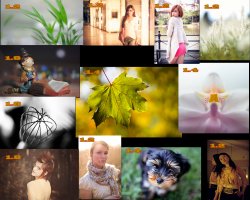
Well, PBD, looks like it's possible for you to tell others that you've had at least one person identify without error when a 50L 1.2 was used . . . I picked just one image and it was a 1.2 shot. Just call me Mr. 100% :P

I'm sure glad I didn't pick the horse. I would have hit 50% immediately, but the grass at the top left would have taken me back to 66.66%. Your images made for a pleasant diversion, since it really was somewhat of a roll of the dice (for me, anyway) as to what I selected. Glad I went with the grass and quit guessing right then and there :D
 
Upvote 0
privatebydesign said:
So the answer.

Three lenses, all Canon 50's the 1.8, the 1.4 and the 1.2L.
Hmm, could foreground/background distance relationship have more to do with shallow DOF than the aperture? Or PP vs. native lens contrast? I think so. I think the only shot is obviously not to the f/1.4 or f/1.2 and that's the little figurine with the book because the bokeh looks less smooth. Then again, poor use of contrast in post could make bokeh harsh, too.

Nice challenge - maybe you should start a new one in its own thread - battle of the 35L vs. f/2 IS vs. f/2.8 or maybe 70-200 f/2.8 (all versions) vs. 135 f/2?
 
Upvote 0
mackguyver said:
privatebydesign said:
So the answer.

Three lenses, all Canon 50's the 1.8, the 1.4 and the 1.2L.
Hmm, could foreground/background distance relationship have more to do with shallow DOF than the aperture? Or PP vs. native lens contrast? I think so. I think the only shot is obviously not to the f/1.4 or f/1.2 and that's the little figurine with the book because the bokeh looks less smooth. Then again, poor use of contrast in post could make bokeh harsh, too.

Nice challenge - maybe you should start a new one in its own thread - battle of the 35L vs. f/2 IS vs. f/2.8 or maybe 70-200 f/2.8 (all versions) vs. 135 f/2?

The distance relationship was a big part of how I guessed. There is one with a girl sitting in a field pretty far away from the camera. The shallower depth of field in that one, I think could only be from the 1.2 wide open. It is pretty extreme for that distance. Like wise, the Horse is relatively close, if it were the 1.2 wide open, there would be a much smaller slice in focus.

I based my guesses on the fact that all of the lenses were shot wide open, but that isn't true, and some of the photos have been blurred artificially, like the one of the lady looking up the roof. There is no way to get that plane of focus without a tilt shift lens, or some post processing.

Still this was fun, and I say make more of these. Just make sure the exif shows the lenses wide open, and watchout for any major manipulation.

Also, it is too late to do the math, but my 50% correct was significantly better than guessing. Guessing would average a 33%, and that additional 17% is hard to come buy, especially when there were shots stopped down, and manipulated in post. So I feel pretty good that you can see differences.
 
Upvote 0