
State of large aperture lenses & digital cameras

Jan 24, 2012
49
0
4,916
Camera makers artificially boost the ISO (i.e. invisibly set the ISO and noise to be higher than what you told it to) when you are using apertures wider than f/2.8 because digital sensors don't capture the rays coming in at oblique angles (i.e. large relative angle with the normal vector) very well. (This also has implications with respect to the amount of background blur; film will give better blur at large apertures.) This means that larger apertures have less benefit than you would naively expect on digital cameras.

My question is whether newer lenses and sensors do better in this regard than older ones. Does anyone have the means to test this? If you have a "newer" fast lens, you just need to set the aperture, remove the lens (you need the lens attached to stop down the aperture), tape the contacts (to keep the camera from ISO-cheating), take a test shot, and repeat with a set of aperture/time combinations that should give the same exposure. (1)

I am particularly interested in the Sigma 35mm on a 5d iii, 1dx, or 6d (what with the talk of a new Canon 35mm and all)

(DxO measures the lens transmission in T-stops, but they only seem to do it wide open {at least as far as I can see with recent lenses}, so you can not tell the difference between light loss due to poor hemispherical integration at the sensor and other sources, e.g. reflections or manufacturers lying about the aperture.)

(1) One potential problem with this testing methodology is that the advertised aperture is usually different (read: faster) than the actual aperture. I do not know if the apertures reported when stopped down are accurate in an absolute sense or based on number of stops from wide open.
 
I've followed this topic for some time and I've noticed that Panasonic and Leica both tout that their sensors allow more oblique rays to hit the photocells, but I don't know of any advancements with the SoNikon or Canon sensors. It seems like the 5DIII sensor has significant advances beyond the extra pixel over the 5DII, but I don't know if this is one of them.

The way I see it, is that extra light or not, you're still getting the amazing shallow DOF and bokeh with fast lenses (something the DxO article seems inconceivably ignorant of) and the high-ISO performance is so good now that I'm not sure the light loss matters in all but the most extreme examples. I wish the manufacturers didn't cook their exposure to compensate, but I don't think it's a huge deal.

Now excuse me while I go off to shoot with my 5DIII / 85 f/1.2 II in the dark corners of my house...
 
Upvote 0
mackguyver said:
The way I see it, is that extra light or not, you're still getting the amazing shallow DOF and bokeh with fast lenses
Problem is, it's those same high incidence angle photons that give you the shallow DOF as well. A sensor that is better at capturing them or a lens that compensates for the sensor's shortcomings would still help you out.
 
Upvote 0
qwerty said:
mackguyver said:
The way I see it, is that extra light or not, you're still getting the amazing shallow DOF and bokeh with fast lenses
Problem is, it's those same high incidence angle photons that give you the shallow DOF as well. A sensor that is better at capturing them or a lens that compensates for the sensor's shortcomings would still help you out.

At the risk of re-opening a previously opened can of worms (the kind found in canned apples that KR might use to make a Pi), light falling at extremely oblique angles from a lens with a very wide aperture is detected at progressively reduced efficiency by smaller pixels, but that doesn't make the out of focus light at those wide apertures less out of focus. When you open up from f/2 to f/1.2, for example, the extra light isn't all hitting the sensor at progressively more oblique angles. If that we're the case, only the OOF regions of the image would be darker, and the clandestine ISO boost the camera applies would have to be selectively applied only to those regions.
 
Upvote 0
neuroanatomist said:
qwerty said:
mackguyver said:
The way I see it, is that extra light or not, you're still getting the amazing shallow DOF and bokeh with fast lenses
Problem is, it's those same high incidence angle photons that give you the shallow DOF as well. A sensor that is better at capturing them or a lens that compensates for the sensor's shortcomings would still help you out.

At the risk of re-opening a previously opened can of worms (the kind found in canned apples that KR might use to make a Pi), light falling at extremely oblique angles from a lens with a very wide aperture is detected at progressively reduced efficiency by smaller pixels, but that doesn't make the out of focus light at those wide apertures less out of focus. When you open up from f/2 to f/1.2, for example, the extra light isn't all hitting the sensor at progressively more oblique angles. If that we're the case, only the OOF regions of the image would be darker, and the clandestine ISO boost the camera applies would have to be selectively applied only to those regions.

My (admittedly limited) understanding is that (at least in the middle of the frame) the extra rays coming in from increasing the aperture actually do hit the sensor at a more oblique angle. (For an object at the edge of the frame its a bit more complicated; rays hitting on the same side of the lens are less oblique and the ones hitting the other side are more oblique).

Your "if that were the case..." argument seems to implicitly imply that the in-focus portions of the image _don't_ result from similar oblique rays (i.e. that oblique <-> oof). However, in or out of focus does not depend on the angle of the incident light on the sensor, but rather rather the rays are focused.

I am not an expert on optics by any means, so feel free to correct me if I am wrong. In a couple minutes of searching, there is at least one other fool out there on my side on digital diminishing blur.
http://www.luminous-landscape.com/essays/an_open_letter_to_the_major_camera_manufacturers.shtml
 
Upvote 0
qwerty, all I can say is that if the out of focus light wasn't reaching the sensor, then a f/1.2 image would like the same as a f/2 or higher image. I can tell you that is not the case at all - the f/1.2 image will have much shallower DOF. The effective ISO is getting an artificial boost, so we're being "robbed" of image quality in terms of noise, color, and DR (at least at higher ISOs). At the end of the day, fast lenses are still great for shallow DOF, fast AF, and they will always let in more light, even if the ISOs are getting a boost.
 
Upvote 0
mackguyver said:
qwerty, all I can say is that if the out of focus light wasn't reaching the sensor, then a f/1.2 image would like the same as a f/2 or higher image. I can tell you that is not the case at all - the f/1.2 image will have much shallower DOF. The effective ISO is getting an artificial boost, so we're being "robbed" of image quality in terms of noise, color, and DR (at least at higher ISOs). At the end of the day, fast lenses are still great for shallow DOF, fast AF, and they will always let in more light, even if the ISOs are getting a boost.

Noone ever said that a larger aperture didn't give you a smaller DOF or allow a shorter exposure time with the same (real) ISO. The issue is that you don't get all of the benefit you expect based on the change in aperture; if I recall correctly, it's something like half a stop of benefit going from f/2->f/1.4 instead of a full stop. I suppose the way to experimentally compare DOF would be to compare a digital camera to a film camera.

(Note: I just found http://photo.stackexchange.com/questions/4459/do-dslrs-play-games-with-iso-when-used-with-fast-lenses; I guess you could compare the diameter of a point blurred to see the effect of incidence angle on effective aperture. However, you can't just take the outer diameter of the disc, because the problem isn't that _none_ of the light gain from the larger aperture gets in, but that not all of it gets in, so you would need to look at the falloff function. I might actually play around with this later this week.)
 
Upvote 0
In practice it's not worth worrying about unless you want to shoot at f1, which has been noted in some of the recent Speed Booster tests. Even according to the DXO test charts there's barely any effect at f1.4.
 
Upvote 0
qwerty said:
I guess you could compare the diameter of a point blurred to see the effect of incidence angle on effective aperture. However, you can't just take the outer diameter of the disc, because the problem isn't that _none_ of the light gain from the larger aperture gets in, but that not all of it gets in, so you would need to look at the falloff function.

I think you've just disproved your own point. The diameter of a background blur disc is determined by subject magnification, the relative distances of subject and background, and the aperture diameter (i.e. focal length / f-number). Intensity isn't part of the equation. If 'those same high incidence angle photons ... give you the shallow DOF as well,' (i.e. determine the effective aperture in terms of DoF), then the with a dSLR at wide apertures, diameter of the blur disc would be smaller than expected, and the reduction in blur disc size expected as the aperture is closed down would not be as great at wider apertures compared to narrower apertures. Also, relative decrease in blur disc size would be greater with a smaller pixel pitch.

I took a series of shots of a group of several point light sources from a fair distance (there's a conviently placed conical array of point light sources in the house at this time of year ;) ), with the 85mm f/1.2L II focused at the MFD. I shot successively decreasing apertures with both the 1D X (which isn't represented on DxOMark's plot, but should lose less oblique light due to the relatively larger pixel pitch), and with the EOS M (which should lose about the most light of any sensor in their plot, based on the small pixel pitch, equivalent to the 7D). The framing was the same, meaning the blur discs on the APS-C images were larger due to the greater distance.
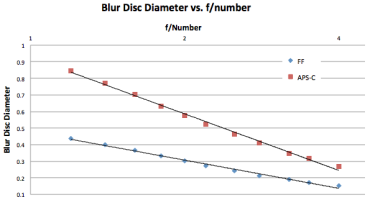
I averaged the maximum diameters of the same set of blur discs in each shot. For the wide aperture shots, measuring the maximum diameter meant the 'corner-to-corner' of the cat's-eye shapes that result from optical vignetting in the lens. Looking at the f/number (plotted on a log2 scale for comparison to the linear measurement of diameter), the relationships are linear, as one would expect from the hypothesis that while the overall intensity of light reaching the sensor at wide apertures is reduced, the DoF is not affected.
 

Attachments

  • Blur Discs.png
    Blur Discs.png
    28.5 KB · Views: 273
Upvote 0
Wow, Wow, Wow-----I learn some thing great and some thing new in this post to day. Thanks you very much.
I need to learn " HOW ITs WORK" , to understand the end result, not just try, try and try---I must know the theory " WHSAT, HOW and WHY ?" too
Thank you so much.
Surapon
 
Upvote 0