• The Canon Rumors Forum has officially been shut down as of July 10, 2026.

    All data will be deleted on September 16, 2026.

    the ad free experience will return by July 17, 2026.

Ultrafast wide angles

  • Thread starter Thread starter rjsmedo
  • Start date Start date
Status
Not open for further replies.
R

rjsmedo

Guest
What is the point in an ultra fast wide angle lens? I notice the 16-35mm f2.8 costs nearly double the next step down, 17-?mm f4

Will you really see any difference depth of field wise in a wide angle zoom lens? wouldn't you want to stop down anyways if you are using this kind of lens (ie: photojournalism, landscape, night photography)?

maybe i'm missing the point. can someone please explain?
 
The ability to shoot in low light without flash.

Wide apertures aren't just for depth of field - they also let in more light. That is the main point in them.

More light means you can have faster shutter speed (less motion blur) and lower ISO (less noise) thus better quality pictures for a correct exposure.

If you don't know why a bright lens is useful then it is probably best that you save your money.

Ali

www.alipaul.com
 
Upvote 0
There's alway a trade off - wide apertures let in more light, but have a shallower depth of field. However, that trade off is actually minimized with wide angle lenses, which have a deeper DoF reesulting from the short focal length. At 16mm f/2.8 focused at 10 feet, everything from 5 feet to infinity is within the DoF, and you get twice the light of f/4.

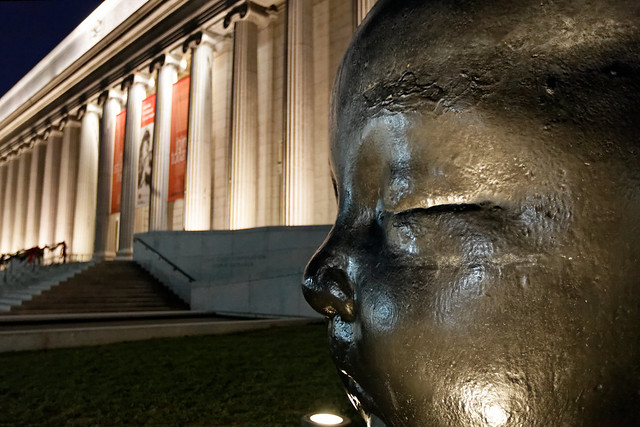
Also, a fast wide angle lens with a close subject can still deliver shallow DoF at that wide angle, for an interesting perspective. Here's an example:


EOS 5D Mark II, EF 16-35mm f/2.8L II USM @ 27mm, 1/25 s, f/2.8, ISO 3200

For me, choosing the 16-35mm f/2.8 over the 17-40mm f/4 was about flexibility - the ability to shoot in low light when needed. A lens can always be stopped down, right?
 
Upvote 0
neuroanatomist said:
There's alway a trade off - wide apertures let in more light, but have a shallower depth of field. However, that trade off is actually minimized with wide angle lenses, which have a deeper DoF reesulting from the short focal length. At 16mm f/2.8 focused at 10 feet, everything from 5 feet to infinity is within the DoF, and you get twice the light of f/4.

Also, a fast wide angle lens with a close subject can still deliver shallow DoF at that wide angle, for an interesting perspective. Here's an example:


EOS 5D Mark II, EF 16-35mm f/2.8L II USM @ 27mm, 1/25 s, f/2.8, ISO 3200


Outstanding photo, explanation and response!

For me, choosing the 16-35mm f/2.8 over the 17-40mm f/4 was about flexibility - the ability to shoot in low light when needed. A lens can always be stopped down, right?
 
Upvote 0
"At 16mm f/2.8 focused at 10 feet, everything from 5 feet to infinity is within the DoF, and you get twice the light of f/4. "

...

The DOF is determined by aperture, focal length, and focal distance.

If you frame the same shot with two lenses of different focal lengths, using the same aperture you will observe the same DOF. In order to frame the same shot using a 40mm vs a 20 mm lens, you need to stand half as far away, the shots will have the same DOF, but very different looks of course.

Ex. This is an extreme example, but using a 5dmkII, both of these will make the main subject about the same size in the frame, and yield about the same DOF:

40mm lens at f 1.4 with focal distance 10 feet yields DOF = 1.61 feet
and a 20mm lens at f 1.4 with focal distance 5 feet yields DOF = 1.64 feet

see . http://dofmaster.com/dofjs.html (make sure to click calculate)
 
Upvote 0
The 16-35 is twice as fast at f/2.8. Hence, twice as much! And worth every penny. I have had 3 photographers who have worked for me in the past sell their F/4 wide angles to get the 16-35 f2.8 as their f/4 just weren't fast enough. If you are going to get one, get the 2.8!!!
 
Upvote 0
Etienne said:
The DOF is determined by aperture, focal length, and focal distance.

...and circle of confusion, which is why sensor size has an effect on DoF. At the same aperture, focal length, and focal distance, a FF sensor will have deeper DoF than a 1.6x crop sensor.
 
Upvote 0
neuroanatomist said:
Etienne said:
The DOF is determined by aperture, focal length, and focal distance.

...and circle of confusion, which is why sensor size has an effect on DoF. At the same aperture, focal length, and focal distance, a FF sensor will have deeper DoF than a 1.6x crop sensor.
Yes, but the same aperture, focal distance, and equivalent focal length will yield a shallower DOP with a FF sensor. Big distinction, since in your example would yield two different pictures in composition.
 
Upvote 0
Soon as the sun sets or you go inside, that extra stop makes all of the difference in the world. The 17-40 is a great lens, though. I had one and sold it after getting the 16-35mm. And I can guarantee if Canon or Nikon came out with a 2.0 or 1.8 16-35 at three or even four times the price, there's be plenty of people in line to buy it since even 2.8 can come up short.
 
Upvote 0
KyleSTL said:
neuroanatomist said:
Etienne said:
The DOF is determined by aperture, focal length, and focal distance.

...and circle of confusion, which is why sensor size has an effect on DoF. At the same aperture, focal length, and focal distance, a FF sensor will have deeper DoF than a 1.6x crop sensor.
Yes, but the same aperture, focal distance, and equivalent focal length will yield a shallower DOP with a FF sensor. Big distinction, since in your example would yield two different pictures in composition.

Exactly ... Photographers compose a photograph. In order to get the same photograph on the 5DII and the 7D, you either need to change the focal length or the focal distance (get closer with the 5DII).

The following all give the same sized subject in the frame of the camera:

5DII, 80mm, f1.4, 10 feet away DOF = 0.39 feet

7D, 80mm, f1.4, 16 feet away DOF = 0.64 feet

7D, 50mm, f1.4 10 feet away DOF = 0.65 feet

In all cases the 5DII gives about 1.3 stops equivalent shallower depth of field for the same composition and f stop in comparison to APS-C. The important consideration is that no matter what gear is in his hands, a photographer seeks to compose a certain shot. With a crop camera he either has to move backwards (increasing DOF in the process), or use a shorter focal length (also increasing DOF in the process).
 
Upvote 0
Cornershot said:
Soon as the sun sets or you go inside, that extra stop makes all of the difference in the world. The 17-40 is a great lens, though. I had one and sold it after getting the 16-35mm. And I can guarantee if Canon or Nikon came out with a 2.0 or 1.8 16-35 at three or even four times the price, there's be plenty of people in line to buy it since even 2.8 can come up short.

Canon has the 24 1.4, and the 35 1.4 for low light work. Both awesome lenses. a 16-35 2.0 would be enormous and heavy. I'd pass on that zoom and go for the primes anyway, and they'd still have a full stop advantage.
 
Upvote 0
True, they'd be big and heavy. But not too much so considering the 16-35mm isn't that much heavier than the 17-40. And I carry the 70-200 2.8 for work, which is very heavy.


Etienne said:
Cornershot said:
Soon as the sun sets or you go inside, that extra stop makes all of the difference in the world. The 17-40 is a great lens, though. I had one and sold it after getting the 16-35mm. And I can guarantee if Canon or Nikon came out with a 2.0 or 1.8 16-35 at three or even four times the price, there's be plenty of people in line to buy it since even 2.8 can come up short.

Canon has the 24 1.4, and the 35 1.4 for low light work. Both awesome lenses. a 16-35 2.0 would be enormous and heavy. I'd pass on that zoom and go for the primes anyway, and they'd still have a full stop advantage.
 
Upvote 0
Etienne said:
In order to get the same photograph on the 5DII and the 7D, you either need to change the focal length or the focal distance (get closer with the 5DII).

Obviously. Thus, with my 135mm f/2L on my 5D Mark II or my 85mm f/1.2L on my 7D, I can get an equivalent shot (at least in terms of DoF and perspective) for a fixed subject distance with both lenses wide open.
 
Upvote 0
neuroanatomist said:
I wonder how big the filter threads would need to be?

Depends on your definition of need. With long lenses you have a hard lower limit on the filter size, not so with the wide ones. Here you want the front element to be as bulbous as possible to avoid a shallow angle of incidence.
Compare the Nikkor 17-35/2.8,16-35/4, Canon EF 16-35/2.8I and 17-40/4, as counterpart we have the Tokina 16-28/2,8 which has got really good corners.
 
Upvote 0
Lawliet said:
neuroanatomist said:
I wonder how big the filter threads would need to be?

Depends on your definition of need. With long lenses you have a hard lower limit on the filter size, not so with the wide ones. Here you want the front element to be as bulbous as possible to avoid a shallow angle of incidence.

The original 16-35mm f/2.8L used 77mm filters. The MkII version uses 82mm filters. I'd expect an f/2 version of such a lens to be designed for at least 86mm filters, perhaps 95mm filters - getting further into the area of hard-to-find filters. Even with my 16-35mm f/2.8L II, though I have a B+W Käsemann CPL in 82mm (which also fits my TS-E 42mm f.3.5L II), I'd really like a dark ND filter (e.g. 10-stops), but they aren't available in round/threaded.
 
Upvote 0
Status
Not open for further replies.