*UPDATED* Canon EOS 5D Mark IV Specifications & Image

Re: Canon EOS 5D Mark IV Specifications & Image

unfocused said:
neuroanatomist said:
...if you downsample the 50 MP sensor to 20 MP, the noise will be the same. If you evaluate both at 100%, the 50 MP image will appear noisier (but bigger). If you crop the 50 MP image down to 20 MP, it will be noisier than the image shot at 20 MP.

Thanks Neuro,

But this still leaves me wondering why Canon and Nikon keep their flagship models to the lowest pixel count and why Sony offers a camera with low pixel count for high ISO performance. And...why review sites consistently rate these lower mp models better at low light/high ISO.

FPS .. and who knows why Sony does anything.

edit: also to add the sports shooting pros that dominate that segment don't really want larger files.
 
Upvote 0
Re: Canon EOS 5D Mark IV Specifications & Image

neuroanatomist said:
unfocused said:
I have to admit, as a non-technical person (I just take the pictures, I don't design the cameras) I find this all a bit confusing. Perhaps people can answer some simple questions?

At ISO 6400, which image will have less noise? One from a 20 mp full frame sensor or one from a 50 mp full frame sensor?

At ISO 6400, while image will have less noise? One from a 20 mp full frame sensor or one from a 20 mp APS-C sensor?

When comparing sensors of different sizes (your second question), the larger sensor will have lower noise becuase it gathers more total light, and image noise is proportional to total light gathered. There are per-pixel noise effects, too, but those are overwhelmed by the difference in total light gathered.

When comparing sensors of the same size (your first question), the differences are more subtle. The sensor with the smaller pixels (which is the same as more MP, but it's the size not the number that matters), if you downsample the 50 MP sensor to 20 MP, the noise will be the same. If you evaluate both at 100%, the 50 MP image will appear noisier (but bigger). If you crop the 50 MP image down to 20 MP, it will be noisier than the image shot at 20 MP.

Simply downsampling isn't correct though.

shooting at 50mp on the 5Ds .. allows you to process those images with aggressive NR far more than you could with a 22Mp image and THEN downsample for sharpness and clarity back down to 22mp.

that is really where the "I don't need more Mp's and need more high ISO" crowd gets it wrong.
 
Upvote 0
Re: Canon EOS 5D Mark IV Specifications & Image

unfocused said:
neuroanatomist said:
...if you downsample the 50 MP sensor to 20 MP, the noise will be the same. If you evaluate both at 100%, the 50 MP image will appear noisier (but bigger). If you crop the 50 MP image down to 20 MP, it will be noisier than the image shot at 20 MP.

Thanks Neuro,

But this still leaves me wondering why Canon and Nikon keep their flagship models to the lowest pixel count and why Sony offers a camera with low pixel count for high ISO performance. And...why review sites consistently rate these lower mp models better at low light/high ISO.

Because most of the reviewers are not explaining their methodology, they invariably look at 100% views rather than normalising to make more valid comparisons.

The manufacturers have been fighting consumer preconceived prejudices for ever. Having said that the 1D series from Canon and the D* series from Nikon have both previously had high and low pixel count models, market forces have obviously proven the high pixel versions are not economical. After all, they both offer much higher MP 'lower' models, the 5DS/R and D810, again very similar cameras. I'd put the absence of higher MP blue ribbon cameras down to nothing more than market forces.

For a perfect example of the pixel size/noise misdirection just look at 5D MkIII images compared to downsampled 5DSR images.
 
Upvote 0
Re: Canon EOS 5D Mark IV Specifications & Image

kevl said:
privatebydesign said:
kevl said:
StudentOfLight said:
Some conjecture on my part...
I wonder how much of a difference lens sharpness makes. Noise is most obvious in dark pixels. Where there is true subject detail, a sharper lens would more successfully separate light into adjacent pixels. It would dump more light into an adjacent bright pixel leading to a high SNR for that pixel. At the same time the darker pixel would be significantly darker so a bit of noise would still be masked by lower output brightness perhaps?

Before the Canadian price increases I finally sold my 70-200 2.8L and bought the 2.8L IS II. The difference in noise performance on my 5D3 is about a stop. Not because the lens makes the camera better in low light... but because it resolves so much more information and is noticeably sharper. I still try not to, but now I can deliver images at ISO 3200 to clients.

For years I thought the only noticeable difference between the lenses would be IS and figured since I had a tripod I didn't need it. I was soooooooooooo soooo very wrong. It really is night & day.

I'd like to see actual side by side images that illustrate that.

493 (the lighter room) is the 5D3 @ ISO 3200 hand held with the 70-200 2.8L and 398 (darker room) is the same only with the 70-200 2.8L IS II and IS is turned off because I had the world's worst night and made several mistakes.

These are crops of wider images. I tried to find similar situations and images.

EDIT: sharpening and noise reduction have both been turned to 0 in Lr.

I could not deliver the first image, but I did deliver the second image (even though you can see camera shake in it).

As so often that just isn't a valid comparison. The scenes have different EV's, the lighter image is a much tighter crop/it has much fewer pixels, the images have different exposures, they have very different contrast levels, etc etc.
 
Upvote 0
Re: Canon EOS 5D Mark IV Specifications & Image

unfocused said:
neuroanatomist said:
...if you downsample the 50 MP sensor to 20 MP, the noise will be the same. If you evaluate both at 100%, the 50 MP image will appear noisier (but bigger). If you crop the 50 MP image down to 20 MP, it will be noisier than the image shot at 20 MP.

Thanks Neuro,

But this still leaves me wondering why Canon and Nikon keep their flagship models to the lowest pixel count and why Sony offers a camera with low pixel count for high ISO performance. And...why review sites consistently rate these lower mp models better at low light/high ISO.

As rrcphoto states, lower MP counts can mean higher frame rates, which is a big part of why the CaNikon flagships have lower MP counts.

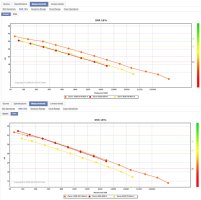
As to why reviewers rate the lower MP sensors higher, as PBD says, they're looking at 100%. As above, on a pixel level smaller pixels have higher noise. Compare DxO's signal:noise (SNR) data for the 1D X II (orange), 5DsR (red), and 7DII (yellow).

Their Screen view (top panel) is essentially comparing them at 100%, so you're looking at per-pixel noise. The SNR is higher for the 1D X II (bigger pixels mean less noise per pixel), and the 5DsR and 7DII are basically the same (same size pixels, and sensor size doesn't matter when looking at the pixel level).

For their Print view (bottom panel), they are (mathematically) downsampling the data to 8 MP, so you're effectively looking at whole-image noise. In that case, you see that there is basically no difference between the 1D X II and 5DsR (bigger sensor means more total light gathered, meaning less image noise), whereas the 7DII has lower SNR (less total light, more image noise).
 

Attachments

  • SNR.jpg
    SNR.jpg
    271.8 KB · Views: 120
Upvote 0
Re: Canon EOS 5D Mark IV Specifications & Image

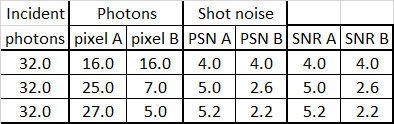
I've attached a table I threw together quickly to hopefully help illustrate my thought process. (For simplicity sake I've excluded read noise and Pixel response non-conformity and thermal noise)

If you define a noisy pixel as one where SNR value is lower than 5 then:
Scenario 1 has two noisy pixels
Scenario 2 has one borderline pixel and one noisy pixel
Scenario 3 has one clean pixel and one noisy pixel.
 

Attachments

  • Hypothetical.jpg
    Hypothetical.jpg
    23.9 KB · Views: 1,127
Upvote 0
Re: Canon EOS 5D Mark IV Specifications & Image

rrcphoto said:
neuroanatomist said:
unfocused said:
I have to admit, as a non-technical person (I just take the pictures, I don't design the cameras) I find this all a bit confusing. Perhaps people can answer some simple questions?

At ISO 6400, which image will have less noise? One from a 20 mp full frame sensor or one from a 50 mp full frame sensor?

At ISO 6400, while image will have less noise? One from a 20 mp full frame sensor or one from a 20 mp APS-C sensor?

When comparing sensors of different sizes (your second question), the larger sensor will have lower noise becuase it gathers more total light, and image noise is proportional to total light gathered. There are per-pixel noise effects, too, but those are overwhelmed by the difference in total light gathered.

When comparing sensors of the same size (your first question), the differences are more subtle. The sensor with the smaller pixels (which is the same as more MP, but it's the size not the number that matters), if you downsample the 50 MP sensor to 20 MP, the noise will be the same. If you evaluate both at 100%, the 50 MP image will appear noisier (but bigger). If you crop the 50 MP image down to 20 MP, it will be noisier than the image shot at 20 MP.

Simply downsampling isn't correct though.

shooting at 50mp on the 5Ds .. allows you to process those images with aggressive NR far more than you could with a 22Mp image and THEN downsample for sharpness and clarity back down to 22mp.

that is really where the "I don't need more Mp's and need more high ISO" crowd gets it wrong.

I get that. Which is why I will buy a 5DsR if the 5D4 doesn't deliver... it has anti-flicker, min shutter options and then I just downsample to a better image.
 
Upvote 0
Re: Canon EOS 5D Mark IV Specifications & Image

neuroanatomist said:
Mikehit said:
deorum said:
i dont want to get in the debate if MP=noise or not.
you seem to agree with me, but for some reason you mention a "semantic" way that this statament is true (if you crop the 50mp image to 20mp, it will have more noise)

which is pointless, since your are comparing then on different basis the same camera

It is less about 'comparing them on a different basis' as how you use the camera.
Photographing small animals the chances are a vast majority of your images will be cropped whether you are using full frame or APS-C. In that situation, per-pixel noise is important.
If you are a landscape photographer the chances are that cropping will be less important and the summation of more, but smaller, pixels will cancel out the quality of the large pixel.

+1 - not pointless at all, to any bird/wildlife shooter.

For example, if you have a 5DIII and a 400mm lens, and you need to get more pixels on your subject (the tiny bird in the middle of the frame), should you get a 5DsR or a 600/4 + 1.4xIII? Getting the 5DsR and cropping will mean more noise than getting the 600+1.4x and using your 5DIII, and also better overall IQ...but it's also a lot more expensive. Smaller pixels don't mean a free lunch.

OTOH, if you're filling the frame with your subject, there are advantages to smaller pixels with no meaningful disadvantage.
I would like to grab the chance and ask for an opinion on a slight different senario:

Same lens , different camera (crop/no crop). Focal Length limited situations only (bird photography).

In my case I have 7D2 and 5D3. Also I have 500mm II and 1.4XIII and 2XIII

So the questions:

7D2+ 500 or 5D3 + 500 + 1.4 ?
7D2 + 500 + 1.4XIII or 5D3 + 2XIII ?

OK in the latter case 2X makes AF more difficult but let's assume almost static subjects.

To tell the truth it is I who should have made the comparisons. But I have not!

But I have tried 7D2 + 500 and 7D2 + 500 + 1.4X ( FYI I have used 500 with my 5D3 in other - non bird - cases).

In both cases 7D2 can be used with 1 stop advantage so by setting the lens fully open this can be translated to one stop difference in ISO. (Not to mention that in 2X case we would have to stop down say 2/3 of a stop to compensate for the loss of IQ).

I believe in this situation there is no clear advantage of a full frame camera (and even if there is one it is very small).
 
Upvote 0
Re: Canon EOS 5D Mark IV Specifications & Image

kevl said:
privatebydesign said:
kevl said:
privatebydesign said:
kevl said:
StudentOfLight said:
Some conjecture on my part...
I wonder how much of a difference lens sharpness makes. Noise is most obvious in dark pixels. Where there is true subject detail, a sharper lens would more successfully separate light into adjacent pixels. It would dump more light into an adjacent bright pixel leading to a high SNR for that pixel. At the same time the darker pixel would be significantly darker so a bit of noise would still be masked by lower output brightness perhaps?

Before the Canadian price increases I finally sold my 70-200 2.8L and bought the 2.8L IS II. The difference in noise performance on my 5D3 is about a stop. Not because the lens makes the camera better in low light... but because it resolves so much more information and is noticeably sharper. I still try not to, but now I can deliver images at ISO 3200 to clients.

For years I thought the only noticeable difference between the lenses would be IS and figured since I had a tripod I didn't need it. I was soooooooooooo soooo very wrong. It really is night & day.

I'd like to see actual side by side images that illustrate that.

493 (the lighter room) is the 5D3 @ ISO 3200 hand held with the 70-200 2.8L and 398 (darker room) is the same only with the 70-200 2.8L IS II and IS is turned off because I had the world's worst night and made several mistakes.

These are crops of wider images. I tried to find similar situations and images.

EDIT: sharpening and noise reduction have both been turned to 0 in Lr.

I could not deliver the first image, but I did deliver the second image (even though you can see camera shake in it).

As so often that just isn't a valid comparison. The scenes have different EV's, the lighter image is a much tighter crop/it has much fewer pixels, the images have different exposures, they have very different contrast levels, etc etc.

I'm sorry I didn't bring my testing lab with me to work.

Those are similar enough to demonstrate the difference. I thought we were discussing. Apparently we're arguing and I have no more interest in that.

Lots of forum warriors so few photographers.

I'm not arguing. You made what I consider to be a fairly unusual claim and I simply asked for comparative images to illustrate your point. Get defensive if you like but I don't believe your claim is valid and I just pointed out the glaring inconsistencies with your illustrative images.

Contrast is the main factor in apparent sharpness, to use a high contrast image to a low contrast image to prove your point seemed strange. But ignore that, look at both at 100% and there is practically no difference in detail, certainly non that isn't explained by the differences in contrast.

Just compare the two shirts when both put to 100%.
 

Attachments

  • Screen Shot 2016-08-11 at 1.32.18 PM.png
    Screen Shot 2016-08-11 at 1.32.18 PM.png
    321.3 KB · Views: 1,325
Upvote 0
Re: Canon EOS 5D Mark IV Specifications & Image

kevl said:
Those are similar enough to demonstrate the difference.

Of course there's a clear difference... But from that pair of images it's not remotely possible to conclude that there's a difference in the image noise due to the lens used. All you're showing is that the 70-200 II is sharper wide open than the 2.8 non-IS...and that's not news to anyone (well, except maybe DxO).


kevl said:
Lots of forum warriors so few photographers.

I'm not sure which category you fall into, but PBD is definitely in the latter.
 
Upvote 0
Re: Canon EOS 5D Mark IV Specifications & Image

tron said:
neuroanatomist said:
Mikehit said:
deorum said:
i dont want to get in the debate if MP=noise or not.
you seem to agree with me, but for some reason you mention a "semantic" way that this statament is true (if you crop the 50mp image to 20mp, it will have more noise)

which is pointless, since your are comparing then on different basis the same camera

It is less about 'comparing them on a different basis' as how you use the camera.
Photographing small animals the chances are a vast majority of your images will be cropped whether you are using full frame or APS-C. In that situation, per-pixel noise is important.
If you are a landscape photographer the chances are that cropping will be less important and the summation of more, but smaller, pixels will cancel out the quality of the large pixel.

+1 - not pointless at all, to any bird/wildlife shooter.

For example, if you have a 5DIII and a 400mm lens, and you need to get more pixels on your subject (the tiny bird in the middle of the frame), should you get a 5DsR or a 600/4 + 1.4xIII? Getting the 5DsR and cropping will mean more noise than getting the 600+1.4x and using your 5DIII, and also better overall IQ...but it's also a lot more expensive. Smaller pixels don't mean a free lunch.

OTOH, if you're filling the frame with your subject, there are advantages to smaller pixels with no meaningful disadvantage.
I would like to grab the chance and ask for an opinion on a slight different senario:

Same lens , different camera (crop/no crop). Focal Length limited situations only (bird photography).

In my case I have 7D2 and 5D3. Also I have 500mm II and 1.4XIII and 2XIII

So the questions:

7D2+ 500 or 5D3 + 500 + 1.4 ?
7D2 + 500 + 1.4XIII or 5D3 + 2XIII ?

OK in the latter case 2X makes AF more difficult but let's assume almost static subjects.

To tell the truth it is I who should have made the comparisons. But I have not!

But I have tried 7D2 + 500 and 7D2 + 500 + 1.4X ( FYI I have used 500 with my 5D3 in other - non bird - cases).

In both cases 7D2 can be used with 1 stop advantage so by setting the lens fully open this can be translated to one stop difference in ISO. (Not to mention that in 2X case we would have to stop down say 2/3 of a stop to compensate for the loss of IQ).

I believe in this situation there is no clear advantage of a full frame camera (and even if there is one it is very small).

Focal length limited, the setup which gets you more pixels on target will win (since it provides more data).
Non-FLL, the setup which gets you more sensor are on target will win (since it provides more signal).
 
Upvote 0
Re: Canon EOS 5D Mark IV Specifications & Image

tron said:
7D2+ 500 or 5D3 + 500 + 1.4 ?
7D2 + 500 + 1.4XIII or 5D3 + 2XIII ?

I believe in this situation there is no clear advantage of a full frame camera (and even if there is one it is very small).

Depends on the available light. If it's a bright, sunny day when you're shooting birds, there's not going to be a major IQ difference, and in that case I'd be inclined to the 7DII options for the better AF. But in lower light situations, the 5DIII + TC will have the advantage. Note that 'lower light situations' doesn't mean really dim light, becuase if you're shooting flying birds you need high shutter speeds and that means higher ISO.
 
Upvote 0
Re: Canon EOS 5D Mark IV Specifications & Image

3kramd5 said:
tron said:
neuroanatomist said:
Mikehit said:
deorum said:
i dont want to get in the debate if MP=noise or not.
you seem to agree with me, but for some reason you mention a "semantic" way that this statament is true (if you crop the 50mp image to 20mp, it will have more noise)

which is pointless, since your are comparing then on different basis the same camera

It is less about 'comparing them on a different basis' as how you use the camera.
Photographing small animals the chances are a vast majority of your images will be cropped whether you are using full frame or APS-C. In that situation, per-pixel noise is important.
If you are a landscape photographer the chances are that cropping will be less important and the summation of more, but smaller, pixels will cancel out the quality of the large pixel.

+1 - not pointless at all, to any bird/wildlife shooter.

For example, if you have a 5DIII and a 400mm lens, and you need to get more pixels on your subject (the tiny bird in the middle of the frame), should you get a 5DsR or a 600/4 + 1.4xIII? Getting the 5DsR and cropping will mean more noise than getting the 600+1.4x and using your 5DIII, and also better overall IQ...but it's also a lot more expensive. Smaller pixels don't mean a free lunch.

OTOH, if you're filling the frame with your subject, there are advantages to smaller pixels with no meaningful disadvantage.
I would like to grab the chance and ask for an opinion on a slight different senario:

Same lens , different camera (crop/no crop). Focal Length limited situations only (bird photography).

In my case I have 7D2 and 5D3. Also I have 500mm II and 1.4XIII and 2XIII

So the questions:

7D2+ 500 or 5D3 + 500 + 1.4 ?
7D2 + 500 + 1.4XIII or 5D3 + 2XIII ?

OK in the latter case 2X makes AF more difficult but let's assume almost static subjects.

To tell the truth it is I who should have made the comparisons. But I have not!

But I have tried 7D2 + 500 and 7D2 + 500 + 1.4X ( FYI I have used 500 with my 5D3 in other - non bird - cases).

In both cases 7D2 can be used with 1 stop advantage so by setting the lens fully open this can be translated to one stop difference in ISO. (Not to mention that in 2X case we would have to stop down say 2/3 of a stop to compensate for the loss of IQ).

I believe in this situation there is no clear advantage of a full frame camera (and even if there is one it is very small).

Focal length limited, the setup which gets you more pixels on target will win (since it provides more data).
Non-FLL, the setup which gets you more sensor are on target will win (since it provides more signal).
This summarizes it well but I believe that the senarios above are close:

7D2 + 500 = 800mm equivalent (it's easier than to count pixels)
5D3 + 500 + 1.4X = 700mm

OK the difference I guess in pixels is (800/700)**2 ~ 1.3 => ~30% more pixels.

At the same time we can shoot with 1 stop less in ISO. So I guess the question is whether a FF like 5D3 is much better than 1 stop from an APS-C...
 
Upvote 0
Re: Canon EOS 5D Mark IV Specifications & Image

neuroanatomist said:
tron said:
7D2+ 500 or 5D3 + 500 + 1.4 ?
7D2 + 500 + 1.4XIII or 5D3 + 2XIII ?

I believe in this situation there is no clear advantage of a full frame camera (and even if there is one it is very small).

Depends on the available light. If it's a bright, sunny day when you're shooting birds, there's not going to be a major IQ difference, and in that case I'd be inclined to the 7DII options for the better AF. But in lower light situations, the 5DIII + TC will have the advantage. Note that 'lower light situations' doesn't mean really dim light, becuase if you're shooting flying birds you need high shutter speeds and that means higher ISO.
+ 1 Indeed! I forgot about that! I had seen it happen in many bird photos this Spring. In fact I remember myself mentioning it in some 7D2 related threads. Thanks.
 
Upvote 0
Re: Canon EOS 5D Mark IV Specifications & Image

kevl said:
If you or the other person you assure me is definitely a photographer disagree then please show me a better comparison. Or we can agree to disagree. That's fine by me.

I've never owned the 70-200/2.8L non-IS, so you won't be seeing comparisons from me. I don't find your comparison convincing....clearly, it's subjective.
 
Upvote 0
Re: *UPDATED* Canon EOS 5D Mark IV Specifications & Image

Good to go:
4:2:2 <> 8bit 500mbps MJPEG - could that be the great thing about ONLY-CANON-has-it-perhaps-for-the-first time?

7 FPS - just like my good old Canon 40D
I presume the ISO would be around 104k where 25K would be the hard limit for any descent photo.

SIDEnote: I didn't know there existed 8 inch floppy, nor that there is still a vendor with a classy 1999 website that still produce them.

Idea: CR must be CH (Canon Humor). ;-)
 
Upvote 0
Re: Canon EOS 5D Mark IV Specifications & Image

kevl said:
neuroanatomist said:
kevl said:
Those are similar enough to demonstrate the difference.

Of course there's a clear difference... But from that pair of images it's not remotely possible to conclude that there's a difference in the image noise due to the lens used. All you're showing is that the 70-200 II is sharper wide open than the 2.8 non-IS...and that's not news to anyone (well, except maybe DxO).


kevl said:
Lots of forum warriors so few photographers.

I'm not sure which category you fall into, but PBD is definitely in the latter.

Yes the IS II is sharper wide open, and that's why noise is less of a perceived issue when using it. The 2.8L starts off (comparatively) softer and so the noise the camera produces at 3200 makes the image unusable.

If I wanted to go through my last 80K images I'm sure I could find a closer matches to compare but I didn't think that was necessary. I'm also not motivated to do so.

Yes the first image is a tighter crop but neither has been down or up sampled. They are actually lit fairly similarly where the highlight was much brighter than the ambient. In the second the room was much darker, but the highlight was almost exactly the same. While the second is obviously sharper it also suffers much less from noise even though it was shot in a situation which should make noise more of an issue than the situation of the first image.

So complain all you want... they really are close enough to demonstrate what I expressed. That I get about a stop better noise performance for my end products with the IS II. I would never deliver an image at 3200 with the 2.8L but I can with the IS II.

If you or the other person you assure me is definitely a photographer disagree then please show me a better comparison. Or we can agree to disagree. That's fine by me.

EDIT: frack this forum keeps putting my text into the quotes above... was fine before.

When I have an idea that I think has an impact on my photography I take the time to test it. Too often our thoughts are not based on strong comparative empirical evidence, we enter the exercise with preconceived ideas and our 'comparisons' invariably illustrate that.

Years ago I wanted a 7D, I'd bought into the 'more pixels on duck' theory so I borrowed one (actually two). Well after conducting my own genuine comparative tests I concluded that the 'pixels on duck' theory is largely a fallacy and the 7D had no real value for me. I have been very outspoken for years about that darn 'pixels on duck' nonsense and that is only because I took an hour to prove it to myself.

Your images are nothing like each other, I don't believe your assertion and you have not shown anything to support it. I'm not saying you are wrong, I am saying you haven't shown evidence to support your idea. Of course you don't have to, but if you don't then you should expect to get called out by people who do try hard to better their output and take a small amount of time to actually prove it to themselves.
 
Upvote 0
Re: *UPDATED* Canon EOS 5D Mark IV Specifications & Image

Diko said:
Good to go:
4:2:2 <> 8bit 500mbps MJPEG - could that be the great thing about ONLY-CANON-has-it-perhaps-for-the-first time?

7 FPS - just like my good old Canon 40D :D :D :D

that's the same as the 1DC:

The Canon 1DC uses Motion Jpeg / YUV 4:2:2 to compress the massive 4k 24p resolution video files. It's a variable bit rate of around 500 Mbps that will change depending on the shot and ISO level.

and most likely the same as the 1DX Mark II .. so no.. something they've already done.

7 fps is a bit of a downer.
 
Upvote 0
Re: *UPDATED* Canon EOS 5D Mark IV Specifications & Image

rrcphoto said:
that's the same as the 1DC:

The Canon 1DC uses Motion Jpeg / YUV 4:2:2 to compress the massive 4k 24p resolution video files. It's a variable bit rate of around 500 Mbps that will change depending on the shot and ISO level.

and most likely the same as the 1DX Mark II .. so no.. something they've already done.

7 fps is a bit of a downer.


Who knows... but that with the motion JPEG could be only in this DSLR... Not quite acquainted if anyone else has it... 1DC IMO doesn't count.

I said I wouldn't buy 5Dm3 for the lack of wi-fi. Now I will buy this one for that particular feature (aside from the updated specs, of course).

7fps is a downer. Agree.
 
Upvote 0
Re: Canon EOS 5D Mark IV Specifications & Image

neuroanatomist said:
kevl said:
If you or the other person you assure me is definitely a photographer disagree then please show me a better comparison. Or we can agree to disagree. That's fine by me.

I've never owned the 70-200/2.8L non-IS, so you won't be seeing comparisons from me. I don't find your comparison convincing....clearly, it's subjective.

Correct me if I am wrong but surely all you'd need to do is compare two 70-200 f2.8 IS MkII images, one with spot on focus the other slightly defocused?
 
Upvote 0