What’s Coming Next from Canon?

Don't think about it, just do :)
The 100-500 is 200g lighter than the 100-400 and a 16y newer lens with better IS, AF, etc.
For me it's very important because it's my #1 travel lens even when just backpacking around places like Iraq, Pakistan, Afganistan, etc, so wight matters a lot.
It gets even lighter if you replace its enormous lens shade with the one made for the RF 50mm f/1,2. I never had any flares issues despite it being shorter. :giggle:
Edit: The second one I bought for the RF 70-200 f/4.
Sure, you look a bit less professional...
 
Upvote 0
Actually, some blurring of a dragonfly's wings in flight is rather attractive and parallels shooting helicopters and prop aircraft when, I believe, the devotees want the propellers and rotors blurred. I've shot 1000s of dragonflies in flight and have quite a few with crisp wings. The head-on one has a blurred body but that to me adds life to the photo. All taken with the RF 100-500 on the R5 or R5ii - you need a light lens to swivel fast.

View attachment 229579View attachment 229580View attachment 229581View attachment 229582View attachment 229583
To me, i like the detail better, but I can definitely understand your helicopter and prop analogy. Frozen blades in flight ain’t natural.

To those of us in the fixed wing community, the wisdom on the rotary wing community is “Helicopter lives are kinda like cat lives, but you never know how many of them there are, so you don’t want to go using them unnecessarily.”

In flight school I flew the T-34C, then at Cherry Point, the TAV8B’s mid to late 90’s. During the 70’s the AV-8A’s were dubbed the “Carolina Yard Darts”.
 
Upvote 0
It gets even lighter if you replace its enormous lens shade with the one made for the RF 50mm f/1,2. I never had any flares issues despite it being shorter. :giggle:
Edit: The second one I bought for the RF 70-200 f/4.
Sure, you look a bit less professional...
Interesting approach, I'll check.
I have all of them, 100-500, 70-200/2.8, 70-200/4 and I love all, always a hard choice which one to take. Trying to foresee the future what situations I will encounter. It's usually the 100-500 or the 70-200/4.
 
Upvote 0
Don't think about it, just do :)
The 100-500 is 200g lighter than the 100-400 and a 16y newer lens with better IS, AF, etc.
For me it's very important because it's my #1 travel lens even when just backpacking around places like Iraq, Pakistan, Afganistan, etc, so wight matters a lot.
hahaha no no, there has been a misunderstanding: the RF 100-400mm is one of the reasons I bought into the RF mount: for its size and price at the provided quality. I can't justify spending ~3k on a lens. I don't make money with my gear and I prefer to use the rest of my disposable income for travels. :D
 
Upvote 0
[...]

Canon makes great zoom lenses! I am a staunch evangelist for the 70-200Z (including w/ 2x). All of these taken with the 2x on:
Which camera are you using that with? I'm considering getting the 70-200Z later this year, because I keep running into having not enough light with the RF24-105 F/4L and the RF100-500L combination. It won't fix physics, I'll still need to stop down to get enough in focus, but having the option to use f/2.8 and a 2x is very attractive. And it turns out Panamoz has the lens much, much cheaper than local stores.
 
Upvote 0
Nice photos, I haven’t bought the RF extenders, and while I own both the EF’s, I haven’t ever shot with them, but given the amount of EF glass I have, I figure it better to have them and not need them, than to need them, and not be able to get them. I used the Sigma 1.4 on the 150-600 Sigma lens to shoot the moon, and occasionally flip the 1.4x into position on the EF 200-400 f4L +1.4x.

It was nice of you to share the photos, to see what the RF 2x can do on the Z.

I shot a dragon fly resting on a croc and flies on a caiman, but unfortunately the photos were too shallow of depth of field. I saw your photos and it I thought, great pictures, but man, if only all the wings were crisp or the entire butterfly was in focus, with the background blown out like it is, they would be National Geographicesque, I know, next to impossible with a dragonfly in flight.

I just don’t think I am ready to spend $589 for 1.4x and a loss of a stop of light, mentally, I think I prefer to shoot APS-C for the 1.6 crop factor, hence the interest in a high-end R7 II, and the thought of $689, while giving up two stops of light, has me hoping they come through with a $5-6K L tele zoom, c’mon Canon, don’t let us down.

Thanks! Honestly with dragonflies, the wings are pretty long and perpendicular to the body, so with higher magnification, you're probably not going to get a full DOF on both at the same time. DOF can be a challenge on moving insects at high magnification, very much on butterflies as well.

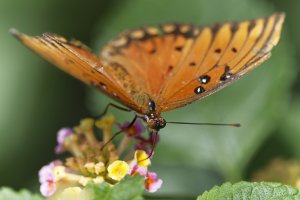
The 2 butterfly shots there were in sunlight with an AD800 pro flash. I often shoot butterflies at f/7.1 for solid DOF and speed, but getting perfect alignment of the wing plane and focus plane requires some luck and/or patience. Flash definitely adds a lot to the shots imo, but it's more like 1fps vs 30, and autofocus struggles in insects up close, so getting focal plane and wing alignment as well as AF and a buffered flash all synchronized isn't easy! The Fritillary butterflies are also rather shy.

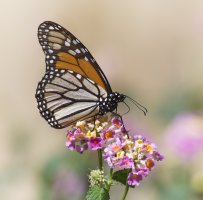
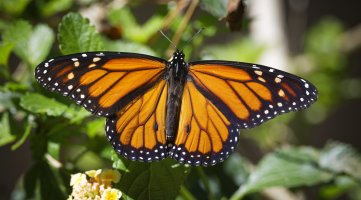
Here's a Monarch with maybe ~95% wing coverage in the focus plane (this was f/10.0, honestly I'll be trying some f/8.0-f/10.0 with my new AD800 flash setup since the full power flash gives me 2-3 stops over daytime sunlight). This one with R5II and 70-200Z + 2x as before, but no flash.
140k_E9A9542_DxO_R52.jpg
This one has quite a lot of wing detail as well:
180k_E9A1720_DxO_R52.jpg

Ahhh, yes…the free lunch that comes with a smaller sensor. Truly magical. ;) The reality is that you’re losing over a stop of light with APS-C compared to full frame. Along with the smaller FoV (effective increase in focal length), you get 1.3-stops more noise. So, for example, ISO 3200 on APS-C looks like ISO 8000 on FF.
You know, I wish this were mentioned more often! Some MFT folks LOVE talking about their affordable, super fast lenses with long FF-equivalent focal lengths, but the reality is that crop sensors always pay the light tax. If they're 2 stops faster with 1/4th the sensor... perhaps they've gained less than they think lol.

Actually, some blurring of a dragonfly's wings in flight is rather attractive and parallels shooting helicopters and prop aircraft when, I believe, the devotees want the propellers and rotors blurred. I've shot 1000s of dragonflies in flight and have quite a few with crisp wings. The head-on one has a blurred body but that to me adds life to the photo. All taken with the RF 100-500 on the R5 or R5ii - you need a light lens to swivel fast.
Wow, great dragonflies! 400mm is definitely a bit limiting (on my end) for dragonflies, and I'd have to try to find some local spots suitable for photographing them. The one I shared earlier took quite awhile to capture, it was a reasonably large lake shore (on vacation) and I had never attempted a flying insect before that actually. What f-stop/exposure are you typically using for these?

Which camera are you using that with? I'm considering getting the 70-200Z later this year, because I keep running into having not enough light with the RF24-105 F/4L and the RF100-500L combination. It won't fix physics, I'll still need to stop down to get enough in focus, but having the option to use f/2.8 and a 2x is very attractive. And it turns out Panamoz has the lens much, much cheaper than local stores.
All these shots are with the R5II. I do really love the 70-200Z. The 0.6x magnification at 400mm is very, very nice for shy insects imo. It's quite good for just about anything else as well! I have very high hopes for Canon's next long RF L zoom, if the 70-200Z is any indication.

Some without 2x:
90k_E9A4093_DxO_R52.jpg
90k_E9A7953_DxO_R52.jpg
100k_E9A4001_DxO_R52_2.jpg
A few more with 2x:
90k_E9A6396_DxO_R52.jpg
110k_E9A1548_DxO_R52.jpg
110k_E9A1922_DxO_R52.jpg
190k_E9A2038_DxO_R52.jpg
 
Last edited:
  • Like
  • Love
Reactions: 3 users
Upvote 0
Ahhh, yes…the free lunch that comes with a smaller sensor. Truly magical. ;) The reality is that you’re losing over a stop of light with APS-C compared to full frame. Along with the smaller FoV (effective increase in focal length), you get 1.3-stops more noise. So, for example, ISO 3200 on APS-C looks like ISO 8000 on FF.
Yeah, it’s a pet peeve when they say they get more reach, when actually they are capturing the image on a smaller sensor vice truly getting more focal distance. So many misunderstandings in the community. I actually thought about making a YT video to address those misconceptions and also addressing the light issue, that being said, sometimes there is a use for a flagship R7 II 😉

Or the response, just zoom with your feet, when that step is a fall off a sheer surface 😅

The other pet peeve, APS-C vs FF with pixel size and density and its effects on SNR, I actually had a YTer reach out to me after correcting him in the comments for spreading misinformation. Between the internet and AI, I worry about future generations, LOL.
 
Last edited:
Upvote 0