A few thoughts to add to the already good advice you've received so far:
Composition
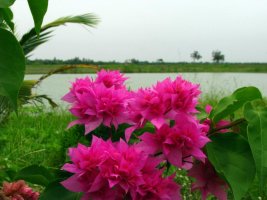
The effect of strong horizontal lines (especially the dark band of land between water and sky) and a more-or-less centered subject (I'm assuming the flowers are the subject) tends to lead to a fairly flat feeling image -- not much in the image gives a feeling of depth or draws me in. This is where leading lines can help.
Experiment with shots from various angles to see if something in the environment can be incorporated into the framing to draw the eye in toward the flowers. If there was a fence, railing or sidewalk near the flowers in your example, you could compose the image in such a way that the fence forms a diagonal line that brings the eye from the edge of the frame toward the flowers. In cases where the surroundings are boring or distracting, a very tight framing might be more appropriate (i.e. fill the frame with your subject).
One other thought on composition: your subject falls off the bottom of the frame a bit. In this particular composition, it leads to a feeling of ambiguity (are the flowers really the subject?).
Content
It can be helpful to avoid including anything in the image that doesn't specifically contribute to the message or composition you're trying to convey or produce.
For example, I took some portraits of a young girl dressed up in her fancy cowgirl duds (she shows horses). The portraits turned out very well, but there were some stains on the wall behind her, so I cloned them out in Lightroom.
In another example, an environmental family portrait I was shooting was on a beautiful grassy slope under some massive cottonwood trees. The framing was just right, but in post, I cloned-out all the little twigs and leaves that were scattered around the grass.
These are small things that few would notice specifically if they saw the original, but snapping back and forth between original and retouched, it becomes obvious how distracting little things can be and how much stronger of an image it is without them.
Eliminating anything (either in composition or in post-processing) that's not relevant to the message or context will add to the strength of the image.
In the example you provided, there are a couple of things I'd have excluded (either in composition, if possible, or in post). The first is in the bottom-left corner. That little patch of muted color from other flowers is a little distracting. I'd clone it out. If it was a field of flowers and other flowers add to the context or feel, they'd stay. In this image, they take away from the flowers the viewer should be paying attention to.
Another thing to consider is the palm fronds in the upper left corner. It can be nice to use things like that to "frame" your subject, but there's nothing on the right side to balance it (all the more necessary when the subject is centered). The lower frond looks a bit dead and breaks the horizon line as it arcs toward the flowers, so I'd clone it out.
Anyway, you probably get the idea -- simplify or remove anything that doesn't strengthen the presentation of the subject.
Lighting
It's been mentioned that the exposure could be boosted a bit. Once you start shooting in RAW and use a good program to process them (I really like Lightroom), you can manipulate the light to very gently draw the eye to your subject. This can be done by adding a subtle vignette and/or using a local adjustment to boost the exposure of just the subject. Vignettes are a matter of taste, and for me, if it's immediately noticeable that a vignette has been applied, then it takes away from the image. The trick is to apply just enough that the eye naturally moves to the brighter part of the image (the subject). Incidentally, this effect also contributes to a feeling of depth.
So there you go -- three concepts to consider the next time you're shooting (or processing) your photos. There are all kinds of other things to add, but that would be too much. I'd recommend taking a look at Mike Browne's YouTube channel. He has dozens of well-presented, easy to understand tutorials that cover most of the topics of composition, lighting and technique you'd need to get going strong.
Here's a link:
https://www.youtube.com/user/photoexposed/videos
Hopefully this information is helpful! Enjoy your gear and learning how to get the most out of it -- it's a near-endless learning experience. Most of all, enjoy the images you capture.
Take care...