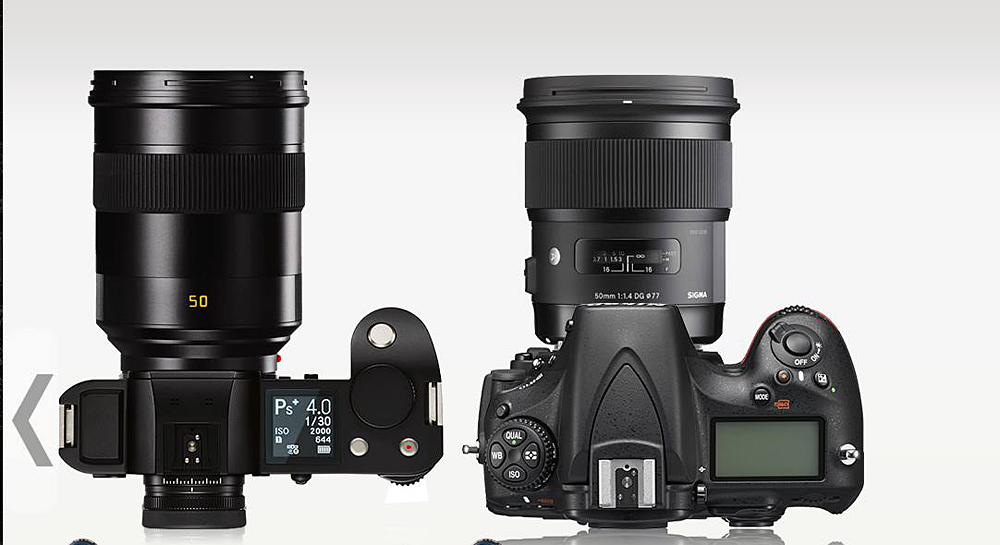
What will be the mirrorless full-frame mount?

After the recent CR2 that stated we are not getting a new mount with Canon's upcoming FF mirrorless


  • Total voters
    81
  • Poll closed .
AvTvM said:
So why should Canon NOT introduce a native mirrorless/short flange-distance FF lens line-up along with a new lineup of mirrorless FF cameras?

The more I look into the short flange issue, the more I am convinced that mirrorless is not ready for FF unless they use the longer flange distance of the DSLR. As I mentioned earlier, when I first bought a Sony A7 and then A7 II, I thought the problem was the kit lens. Both versions were as poor a lens as I had ever bought. Now, after reading numerous articles and viewing some lens reviews, it seems clear (at least to me) that with current sensor tech, the short flange distance creates big problems with sharpness, CA, and vignetting. CA and vignetting can be improved dramatically either by in-camera or post processing, but the lack of sharpness away from the image center is concerning. It was the reason I returned both Sony A7's and would be very hesitant to consider a short flange mirrorless camera until the sensors are redesigned to create a better angle of light hitting the sensor's edges. And now I know why my Canon lenses with adapter had much better results on the Sony - it was the added flange distance - not the lenses themselves.

From Imaging Resource's review of the Sony FE 24-70mm f/4 ZA OSS Zeiss Vario-Tessar: "At 24mm, the lens displays good sharpness right in the center of the frame, even wide open, but outwards and especially in the deep corners it's noticeably soft. Surprisingly, even stopping down doesn't improve the corner softness at 24mm, and by ƒ/16-ƒ/22, diffraction comes into play and reduces sharpness all around even more."


And this is the higher end lens, not the kit lens that I bought, which was probably worse! Looking at other reviews it seems like the short flange distance has been a problem that has not yet been solved when it comes to FF.

While I might be interested in a FF mirrorless offering, it seems clear to me that any FF mirrorless needs to keep the same flange distance as a DSLR. If you want smaller and lighter, then mirrorless works reasonably well at APS-C or Micro Four/Thirds size, but for FF, so far at least, the DSLR flange distance is going to give you far better IQ, in my opinion.
 
Upvote 0
ahsanford said:
Luds34 said:
Too long, too expensive... and you forgot a biggie, too slow. f/2.8 on a prime lens? And only f/1.8 on a ~50mm lens that isn't a complete budget lens like the entry level "nifty fifty" from either Canon or Nikon. Just not competitive in my opinion.

Sure, but you can't let the tiny 50mm FF options boss your expectations here. That FL seems to break all the rules of physics in terms of FF + f/2 or faster + small in a way that you just don't see at any other FL.

That was exactly my point. The only lens you listed that was fast was Sony's "50mm" and I was just pointing out at the focal length you can get really fast or match the f/1.8 and have a tiny lens in the Canon camp.

Either way, my point was the Sony FE equivalent prime lenses are easily a stop off on max aperture at the same FL while coming in at the same, or even larger, size as the Canon equivalents. It doesn't appear Sony did themselves any favors by pushing both the throat diameter and flange distance as far (read small) as they did.
 
Upvote 0
AvTvM said:
Bob Howland said:
You never define what an "EF-X" lens mount is, for example, specifying its throat diameter, flange distance and communications protocol. Please do so.

ok, here goes .. my amateur *guess*:

'EF-X" is what I would call it. It signals full compatibility with EF lens lineup and the -X signifies possibilities that far eXceed the past and that it is "the future of photography" ... or something along these lines will be stated in Canon marketing materials. No idea what they will really call it.

image circle: 36x24mm FF sensor -> 43.3 mm diameter

flange distance: ca. 22mm [4 mm more than EF-M and Sony E/FE, 3mm more than Leica L-Mount] - makes lens design somewhat easier and will still allow for reasonably compact cameras]

throat diameter: ca. 48mm [Sony FE is 46mm, Canon EF-M is about 45mm]

lens mount / communication protocol: some additional contacts/firmware features for future/new native "EF-X" lenses. Fully functional and backwards compatible with EF lens mount Protocol [within the limits of the repective lens, its AF drive, IS, etc.].

Frontal view of mount and sensor will be similar to Leica SL ... not like Sony A7 where sensor corners are almost hidden.
leica_10850_sl_typ_601_mirrorless_1445436358000_1192093.jpg


Camera size will probably also be similar for [eventually] upcoming Canon MILC flagship "X1". For all those 1D/X/II shooters who love things Texas size. :)


btw: Sony E mount for FF lenses: Sigma CEO also says narrow diameter makes lens design more diffcult .. http://www.mirrorlessrumors.com/sigma-interview-mirrorless-is-growing-and-we-will-make-more-lenses-for-it/

I honestly think you might be the most illogical person I've come across in a while. Lets look at the SL you used in your own post:

Size%2Bcomparison%2B4.jpg


I'm sorry, but Canon is not going to make a new mount of the future, and then design it so that all of their fast and expensive lenses that professional use most will be bigger, heavier, and more unwieldy, so that their cheaper and slow lenses can be more compact. Again, it's better to have the weight in the body because that is your pivot point when you hold it, extra weight and length in the lense is going to create a larger moment about the pivot point. That's basic physics. Something like that would be even more annoying now that you don't give as much grip space by trying to turn your camera into a point and shoot.

That makes absolutely no sense, and the fact that you think it does makes me question if you actually have an MBA.
 
Upvote 0
aero1126 said:
AvTvM said:
Bob Howland said:
You never define what an "EF-X" lens mount is, for example, specifying its throat diameter, flange distance and communications protocol. Please do so.

ok, here goes .. my amateur *guess*:

'EF-X" is what I would call it. It signals full compatibility with EF lens lineup and the -X signifies possibilities that far eXceed the past and that it is "the future of photography" ... or something along these lines will be stated in Canon marketing materials. No idea what they will really call it.

image circle: 36x24mm FF sensor -> 43.3 mm diameter

flange distance: ca. 22mm [4 mm more than EF-M and Sony E/FE, 3mm more than Leica L-Mount] - makes lens design somewhat easier and will still allow for reasonably compact cameras]

throat diameter: ca. 48mm [Sony FE is 46mm, Canon EF-M is about 45mm]

lens mount / communication protocol: some additional contacts/firmware features for future/new native "EF-X" lenses. Fully functional and backwards compatible with EF lens mount Protocol [within the limits of the repective lens, its AF drive, IS, etc.].

Frontal view of mount and sensor will be similar to Leica SL ... not like Sony A7 where sensor corners are almost hidden.
leica_10850_sl_typ_601_mirrorless_1445436358000_1192093.jpg


Camera size will probably also be similar for [eventually] upcoming Canon MILC flagship "X1". For all those 1D/X/II shooters who love things Texas size. :)


btw: Sony E mount for FF lenses: Sigma CEO also says narrow diameter makes lens design more diffcult .. http://www.mirrorlessrumors.com/sigma-interview-mirrorless-is-growing-and-we-will-make-more-lenses-for-it/

I honestly think you might be the most illogical person I've come across in a while. Lets look at the SL you used in your own post:

Size%2Bcomparison%2B4.jpg


I'm sorry, but Canon is not going to make a new mount of the future, and then design it so that all of their fast and expensive lenses that professional use most will be bigger, heavier, and more unwieldy, so that their cheaper and slow lenses can be more compact. Again, it's better to have the weight in the body because that is your pivot point when you hold it, extra weight and length in the lense is going to create a larger moment about the pivot point. That's basic physics. Something like that would be even more annoying now that you don't give as much grip space by trying to turn your camera into a point and shoot.

That makes absolutely no sense, and the fact that you think it does makes me question if you actually have an MBA.

Does that include all the people, including Neuro, who think the M-mount is going FF? Face it, most of the people who post on this site are marketing guru wannabees and nobody here seems to have very much real expertise in optical design.
 
Upvote 0
I don't know s**t about marketing but I do know math and physics......

What the entire discussion boils down to is three things.....

1) you can have narrow diameter lenses, or you can have fast lenses, but you can not have both.

2) the sharper you bend light, the harder it is to deal with chromatic aberration and vignetting and the poorer the image quality, so you can have high image quality, or you can have short lenses, but you can not have both.

3) the acceptable trade off between the two factors above is a matter of opinion, and as such, has no definitive answer, so the arguing can continue forever without resolution.
 
Upvote 0
"Most illogical person alive" ... Thanks for the compliment. Comes right after "sexiest man alive". 8)

However, you may have misread my previous postings.

I would like to get an FF MILC in as small as possible package [preferably Sony RX1R-II form factor and size] with a set of 3 or 4 as-small-as-possible, moderate aperture primes and 2 decent, compact f/4 zooms (16-35, 24-70). For everything else - f/1.4 lenses, teles, super-teles, Tilt-Shift - I would happily use big, large EF glass with a small adapter. Like 99% of other photo amateurs, I do not use big glass very often.

I am convinced, moderate aperture mirrorless FF primes can be built very compact, optically very good (but not Otus/stellar) and very affordable. I am looking at 24/2.8, 35/2.0, 50/1.8 IS, 85/2.4 IS. Provided, the maker choses a flange distance and mount diameter that makes FF lens design easier than the stupid choice Sony made by using E-Mount not only for crop as originally intended, but also for FF.

I expect Canon - before they bring my desired ultra-compact "X-3" FF MILC - to bring a MILC flagship first. 1-series mirrorless killer beast called X-1, as behemoth in size as the Leica SL-1. It will do 4k video internally, 8k externally and shoot 99 fps RAWs for 9999 captures in a row ... and cost north of 10k. After all, we are talking Canon.

Later on, they will bring an X-5 model [comparable to today's 5D series] and a sweet small X-3 [comparable to 6D series] for me.

That's my prediction. Yes, I am pulling it out of my ass, but 1. my ass is rarely wrong and 2. at least as smart as many self-proclaimed experts' asses. ;D
 
Upvote 0
Don Haines said:
I don't know s**t about marketing but I do know math and physics......

What the entire discussion boils down to is three things.....

1) you can have narrow diameter lenses, or you can have fast lenses, but you can not have both.

2) the sharper you bend light, the harder it is to deal with chromatic aberration and vignetting and the poorer the image quality, so you can have high image quality, or you can have short lenses, but you can not have both.

3) the acceptable trade off between the two factors above is a matter of opinion, and as such, has no definitive answer, so the arguing can continue forever without resolution.

pretty much it!

also what's the path of least resistance?

for short registration distance full frame, canon has ALOT of sensor work to do - and it has to be specific for mirrorless, it's rather unnecessary for DSLR's.

They can't just shove a 5D Mark IV sensor in there. they have to re-work it drastically.

For a limited run, that will increase costs, probably more than what they'd save going mirrorless.
 
Upvote 0
rrcphoto said:
Don Haines said:
I don't know s**t about marketing but I do know math and physics......

What the entire discussion boils down to is three things.....

1) you can have narrow diameter lenses, or you can have fast lenses, but you can not have both.

2) the sharper you bend light, the harder it is to deal with chromatic aberration and vignetting and the poorer the image quality, so you can have high image quality, or you can have short lenses, but you can not have both.

3) the acceptable trade off between the two factors above is a matter of opinion, and as such, has no definitive answer, so the arguing can continue forever without resolution.

pretty much it!

also what's the path of least resistance?

for short registration distance full frame, canon has ALOT of sensor work to do - and it has to be specific for mirrorless, it's rather unnecessary for DSLR's.

They can't just shove a 5D Mark IV sensor in there. they have to re-work it drastically.

For a limited run, that will increase costs, probably more than what they'd save going mirrorless.


Yes, the short flange distance is a real issue. People should read your post and the linked post more carefully. They continually ask for things that are not possible presently. Here's another article that convinces me that keeping the present EF mount is really the only PROFESSIONAL alternative. While every gear-head has been praising Sony and wondering why Canon can't be more like Sony, maybe they just don't get it. Maybe Canon hasn't been waiting to get into mirrorless at the Pro level because they are conservative and slow - maybe it is because they don't want to put out a camera that gives you crappy IQ away from the image center and really limits the types of lenses that you can use.

http://ilovehatephoto.com/2015/02/23/3-detailed-reasons-not-to-switch-to-sony-full-frame-mirrorless-system/
 
Upvote 0
AvTvM said:
Like 99% of other photo amateurs, I do not use big glass very often.

Wow I didn't know I was such a rarity, you know, an amateur who regular shoots big glass.

Oh-oh, wait a minute... Does this make me part of the one percent then? Will there be some sort of movement and protest against people like me? Yikes, I better consider switching to slow, normal zoom or something. ;)
 
Upvote 0
Luds34 said:
AvTvM said:
Like 99% of other photo amateurs, I do not use big glass very often.

Wow I didn't know I was such a rarity, you know, an amateur who regular shoots big glass.

Oh-oh, wait a minute... Does this make me part of the one percent then? Will there be some sort of movement and protest against people like me? Yikes, I better consider switching to slow, normal zoom or something. ;)
My observation is that the serious amateurs have better cameras and lenses than most of the pros do.....
 
Upvote 0
Luds34 said:
AvTvM said:
Like 99% of other photo amateurs, I do not use big glass very often.

Wow I didn't know I was such a rarity, you know, an amateur who regular shoots big glass.

Oh-oh, wait a minute... Does this make me part of the one percent then? Will there be some sort of movement and protest against people like me? Yikes, I better consider switching to slow, normal zoom or something. ;)

Not sure I'm with AvTvM on this, but it depends on what he/she means.

If by big glass, they mean $10k+ superwhites, then sure. Few amateurs other than very serious birders/wildlife folks own those.

But if by 'big glass' they mean your run-of-the-mill 'reasonably-sized pickle jars', like an f/1.4 prime or an f/2.8 zoom, I see enthusiasts with those all the time. (Think about it -- why go to the trouble of buying a FF rig if you are just going to put dainty f/2.8 primes and modest f/4 zooms on it?)

- A
 
Upvote 0
neuroanatomist said:
AvTvM said:
I hold an MBA degree (Marketing major) from a renowned European Business university ... don't tell me anything about market segmentation / how to define target groups and about product differentiation. Been there, done that.

Judging by your statements in these forums, not well at all. It's ok, though...I know PhDs who are dumb as posts in their field.

Most of the Taxi Drivers I've met in my city have PhD's.
 
Upvote 0
Don Haines said:
My observation is that the serious amateurs have better cameras and lenses than most of the pros do.....

That somewhat makes sense.

I do not think the 1% argument is unreal though; I would also suggest that bird & sports enthusiasts make up the largest portion of that 1% big glass owner amateur. I also imagine that many many of the members of this forum are in that 1%.

Lots of rebels with 18 55's or 50 1.8's out there getting regular hard use.. Especially when you can get a used T3i or better for $300 or less at a pawn shop all day long...
 
Upvote 0
TeT said:
Don Haines said:
My observation is that the serious amateurs have better cameras and lenses than most of the pros do.....

That somewhat makes sense.

I do not think the 1% argument is unreal though; I would also suggest that bird & sports enthusiasts make up the largest portion of that 1% big glass owner amateur. I also imagine that many many of the members of this forum are in that 1%.

Lots of rebels with 18 55's or 50 1.8's out there getting regular hard use.. Especially when you can get a used T3i or better for $300 or less at a pawn shop all day long...
Big time!

The vast majority of Canon DSLRs out there are Rebels and the vast majority of lenses out there are kit zooms. We do not represent the masses.
 
Upvote 0
Luds34 said:
AvTvM said:
Like 99% of other photo amateurs, I do not use big glass very often.

Wow I didn't know I was such a rarity, you know, an amateur who regular shoots big glass.

Oh-oh, wait a minute... Does this make me part of the one percent then? Will there be some sort of movement and protest against people like me? Yikes, I better consider switching to slow, normal zoom or something. ;)

i cannot prove it, but am still convinced, pnly a very tiny minority of non-pro shooters use big glass regularly. i am aware though, that on this forum birders seem to be extremely overrepresented, much more so than plane spotters, who are the other (small) group of amateurs regularly using "big (long/tele) glass".

all other amateurs may *very occasionally* use a tele fl beyond 300mm at the zoo, on a wildlife safari trip or for some outdoor sports event (even i have done so), but again it is a tiny fraction of users and and even smaller fraction of images captuted.
 
Upvote 0
AvTvM said:
Like 99% of other photo amateurs, I do not use big glass very often.

Well, based on camera to lens ratios released by both Canon and Nikon, I'd say 95% or more amateurs never use any lens except the one that came with their camera. Could be why we will see a fixed lens version first.
 
Upvote 0
unfocused said:
AvTvM said:
Like 99% of other photo amateurs, I do not use big glass very often.

Well, based on camera to lens ratios released by both Canon and Nikon, I'd say 95% or more amateurs never use any lens except the one that came with their camera. Could be why we will see a fixed lens version first.

that one, single "kit lens" happens to be a zoom lens, not a bolted-on 35mm prime ... as on Sony RX1/R/II and to be feated on a futre, wventual xannon Ff compact cam. main reason i won't ever consider such a camera.
 
Upvote 0
AvTvM said:
Luds34 said:
AvTvM said:
Like 99% of other photo amateurs, I do not use big glass very often.

Wow I didn't know I was such a rarity, you know, an amateur who regular shoots big glass.

Oh-oh, wait a minute... Does this make me part of the one percent then? Will there be some sort of movement and protest against people like me? Yikes, I better consider switching to slow, normal zoom or something. ;)

i cannot prove it, but am still convinced, pnly a very tiny minority of non-pro shooters use big glass regularly. i am aware though, that on this forum birders seem to be extremely overrepresented, much more so than plane spotters, who are the other (small) group of amateurs regularly using "big (long/tele) glass".

all other amateurs may *very occasionally* use a tele fl beyond 300mm at the zoo, on a wildlife safari trip or for some outdoor sports event (even i have done so), but again it is a tiny fraction of users and and even smaller fraction of images captuted.
I think you are right.

I would be willing to bet that even among "pro shooters", there are very few using big/long glass. After all, many/most? pros are the wedding photographers and studio photographers.... and have very little need for a 600F4....

I think that the users of big/long glass are a small proportion of all shooters, and that small group comes mostly from affluent amateur photographers.... the birding/wildlife/plane spotters... I do not know a single pro who uses them for work, but the birding community has them in spades!
 
Upvote 0