Why aren't zoom lenses faster than 2.8?

Status
Not open for further replies.
sandymandy said:
Zooms are supposed to be allround lenses, easy to carry and ready for all situations (kind of). Having a bigger aperture would make the lenses big and bulky and not comfortable to carry around. For example if you want 2.0 at 200mm the lens would have to be 10cm diameter. 70mm would require a 50mm diameter for f/1.4.
That's the simple way of looking at it, but look at the reality of what already exists in terms of zooms and primes - the situation is even worse than you predict, so we end up with something that is all but impossible to afford, carry, or use.

Take the 70-200/2.8L (non IS) vs the 200/2.8L II - when fully zoomed, the 70-200 offers the same unstabilised 200/2.8 as the prime. A 200/2.8 theoretically needs a 71.4mm aperture, and the prime indeed has a 72mm filter thread, and is 136mm length, weighing in at 765g. The zoom has a 77mm filter, 194mm long, and weighs 1310g.

Taking those increases over an existing 200/2.8 and applying them to the 200/2 IS lens to end up with a theoretical 70-200/2.0 IS lens, and you get a 136mm diameter, 296mm length, 4.3kg lens. And then there's the price factor between the prime and zoom too. It would cost (years after the introduction price tax disappears, like it has on the 200/2.8, 70-200/2.8 and 200/2) something in the region of £7000 - so lets call it comfortably more than £10,000 at introduction. There clearly wouldn't be a market for something like that.

However, a very limited zoom range around the 50mm mark would be simpler to make faster - 50mm after all does seem to be the easiest focal length to make fast (think of the 50/1.0 L, and also how small the current 50/1.4 is), so a 40-60/2.0 probably isn't pushing the boundaries of what's possible. But with such a small zoom range, why not just get a much cheaper, smaller and optically better 50 instead?

Having said that, smaller imaging circle lenses exist faster than f2.8 - take the Olympus m4/3 35-100/2.0 lens. But that is an equivalent of a 70-200/4.0 FF lens. And that Canon 25-100/1.8 is a 16mm lens (crop factor of 3.4), so in FF terms its a 85-340/6.1 lens.
 
Upvote 0
The Canon. 25-100mm lens was a cinema lens designed for a format that was much smaller yet was very heavy, about the size if a 70-200mm f/4.0 is. The sensor size was around 1/4 of full frame so while yes such a lens is possible it would be huge and expensive.

Say if you wanted a 28-85mm f/2.0. It would cost at least $10,000 based on Canons manufacturing costs for lenses of similar size, weigh 4-6 lbs and would use 120mm filters, and be over 12 inches long.

The market would be so small for such a lens Canon would likely change $20,000 or more.

Simply put such a product would be very convention defying.

You can also buy a number of f/3.5 zooms for medium format cameras which are equivalent for f/2.2 lenses on full frame. Leica makes one like that, that's equivalent to a 20-60mm lens.

Personally I think a 70-200mm f/2.0 zoom for 7k is realistic and would sell.
 
Upvote 0
K3nt said:
It is quite easy actually. If you want to know what size it would require just divide the focal length with the required f-stop and you'll see what size the front element diameter would be. So, for a 100-400mm f/1.2 the front element would be 33,3cm in diameter.

Actaully, that 'rule' applies to telephoto lens designs but not all lens designs. Else, the front element of the 16-35mm f/2.8L would be only 1.25 cm in diameter.
 
Upvote 0
rs said:
sandymandy said:
Zooms are supposed to be allround lenses, easy to carry and ready for all situations (kind of). Having a bigger aperture would make the lenses big and bulky and not comfortable to carry around. For example if you want 2.0 at 200mm the lens would have to be 10cm diameter. 70mm would require a 50mm diameter for f/1.4.
That's the simple way of looking at it, but look at the reality of what already exists in terms of zooms and primes - the situation is even worse than you predict, so we end up with something that is all but impossible to afford, carry, or use.

Take the 70-200/2.8L (non IS) vs the 200/2.8L II - when fully zoomed, the 70-200 offers the same unstabilised 200/2.8 as the prime. A 200/2.8 theoretically needs a 71.4mm aperture, and the prime indeed has a 72mm filter thread, and is 136mm length, weighing in at 765g. The zoom has a 77mm filter, 194mm long, and weighs 1310g.

Taking those increases over an existing 200/2.8 and applying them to the 200/2 IS lens to end up with a theoretical 70-200/2.0 IS lens, and you get a 136mm diameter, 296mm length, 4.3kg lens. And then there's the price factor between the prime and zoom too. It would cost (years after the introduction price tax disappears, like it has on the 200/2.8, 70-200/2.8 and 200/2) something in the region of £7000 - so lets call it comfortably more than £10,000 at introduction. There clearly wouldn't be a market for something like that.

However, a very limited zoom range around the 50mm mark would be simpler to make faster - 50mm after all does seem to be the easiest focal length to make fast (think of the 50/1.0 L, and also how small the current 50/1.4 is), so a 40-60/2.0 probably isn't pushing the boundaries of what's possible. But with such a small zoom range, why not just get a much cheaper, smaller and optically better 50 instead?

Having said that, smaller imaging circle lenses exist faster than f2.8 - take the Olympus m4/3 35-100/2.0 lens. But that is an equivalent of a 70-200/4.0 FF lens. And that Canon 25-100/1.8 is a 16mm lens (crop factor of 3.4), so in FF terms its a 85-340/6.1 lens.

Thanks for the knowledge, fascinating post.
 
Upvote 0
neuroanatomist said:
K3nt said:
It is quite easy actually. If you want to know what size it would require just divide the focal length with the required f-stop and you'll see what size the front element diameter would be. So, for a 100-400mm f/1.2 the front element would be 33,3cm in diameter.

Actaully, that 'rule' applies to telephoto lens designs but not all lens designs. Else, the front element of the 16-35mm f/2.8L would be only 1.25 cm in diameter.
That's typical, I was just starting to get it and now you complicate things again ;)
 
Upvote 0
JonB8305 said:
Canon used to make a 25-100 F/1.8

Keep in mind that this is a cine lens - about the image circle of an EF-s.
If one took a common 70-200/2.8 and welded an inverse TC2 to it he'd get an 35-100/1.4. Makes me think of the fast 4/3rds zooms...
Now the same trick for EF would require a f/2.8 zoom for medium forma (6x9 should work, 6x7 feels like a tight fit)as a baseline. Not pretty.
 
Upvote 0
If you research the primary cons for any premium lens, regardless of brand, you will see 'size' 'weight' and 'cost'..
How well received do you think a 70-200mm with an 6" objective lens, ~6lb heft, and ~$5,000 price tag would be??
 
Upvote 0
As lenses get larger apertures, particularly at shorter focal lengths, it becomes difficult to keep the edges sharp, eliminate field of curvature, etc. This means larger diameter glass and more elements.
Since the cost to grind glass increases with size, cost of large diameter lens elements skyrockets. Now, add several more expensive elements to try and correct distortions, CA, etc, and the price gets out of control.
For expensive lenses, the market is much smaller, so development and tooling charges are amortized over just a few lenses, maybe 1000 more or less. Spread that $1 million over 1000 lenses, and just the development cost is $10,000 per lens, and add another $10,000 manufacturing cost, and you have a lens that sells for $40,000, which is what the low volume cinema lenses sell for.

For a lens that sells 100,000 copies, the amortization might be $100 each, and the price is more reasonable.
 
Upvote 0
EvillEmperor said:
How come the G15 is a 1.8-2.8 and doesn't weigh a 100lbs? I actually wouldn't mind a variable aperature zoom like the G15's. why don't they do that?
Completely different sensor.
In relation to the actual question, there ARE zooms faster than f/2.8, just for other sensors.
An f/2.8 lens on a medium format camera will be completely different to a 35mm camera, and different in a micro 4/3 sensor.
 
Upvote 0
Hobby Shooter said:
neuroanatomist said:
K3nt said:
It is quite easy actually. If you want to know what size it would require just divide the focal length with the required f-stop and you'll see what size the front element diameter would be. So, for a 100-400mm f/1.2 the front element would be 33,3cm in diameter.

Actaully, that 'rule' applies to telephoto lens designs but not all lens designs. Else, the front element of the 16-35mm f/2.8L would be only 1.25 cm in diameter.

Not to worry. The formula is pretty much correct. But there are other factors that come in to play. But as a rule of thumb it works good. It does not take in to account the convex and lens shapes required for UWA lenses for example, as pointed out. If you did make a straight 35mm by f2.8 you could theoretically get away with a 1.25cm diameter, but that's not 100% of the story. :)
That's typical, I was just starting to get it and now you complicate things again ;)
 
Upvote 0
EvillEmperor said:
How come the G15 is a 1.8-2.8 and doesn't weigh a 100lbs? I actually wouldn't mind a variable aperature zoom like the G15's. why don't they do that?
The G15 has a relatively small sensor with a 4.6x crop factor, and the lens as a result has a very small imaging circle. In 35mm terms, its 6.1-30.5/1.8-2.8 lens is the equivalent of a 28-140/8.3-12.9 lens. Nothing too special. Small imaging circle lenses have been doing this for years - most camcorders with tiny 1/6" sensors have quite big zoom ranges, yet they open up to about f1.8 at the wide end.

But your question about variable aperture makes sense. These constant aperture lenses such as the 70-200's are pushing the limits at 200mm due to the entrance pupil opening up to almost the size of the front element, but down at 70 you get the impression they're held back. It probably would be possible with just some minor tweaks to make a 70-200/2.0-2.8 lens.

As around 50mm seems to be about the sweet spot for easy to make large apertures, zooms at the other end of the range such as 16-35's might be possible with f2.8 at 16mm, and getting slightly larger, again to about f2.0 at around the 35mm mark.
 
Upvote 0
VirtualRain said:
Canon makes a wicked 35-3500mm f1.7 IS lens for HDTV... The only problem? You need a trunk to carry it and it costs $200K ;D

http://www.canon.com/premium-lib/movie/t002/index.html
It looks like its this lens you've found:

http://www.canon.co.uk/broadcast/tv_lenses/studio_field_lenses/DIGISUPER_100_xs/index.aspx?specs=1

9.3-930mm/1.7-4.7, designed for a 2/3" sensor. That's a 3.93x crop factor to convert to 35mm terms, so its effectively a 36.5 to 3650mm lens, with an aperture varying between f6.6 and f18.4 - very impressive stuff (especially having a 100x zoom and being able to crop into an area just 1.38cm x 0.78cm with its built in 2x TC enabled), but it doesn't fit the bill as being equivalent to a FF zoom with an effective aperture bigger the f2.8.

Going bigger seems to be the only option. A lens like the Hasselblad 50-110/3.5-4.5 seems to be a good bet. In 35mm speak its f2.5 at the wide end of its focal range.
 
Upvote 0
rs said:
9.3-930mm/1.7-4.7, designed for a 2/3" sensor. That's a 3.93x crop factor to convert to 35mm terms, so its effectively a 36.5 to 3650mm lens, with an aperture varying between f6.6 and f18.4 - very impressive stuff (especially having a 100x zoom and being able to crop into an area just 1.38cm x 0.78cm with its built in 2x TC enabled), but it doesn't fit the bill as being equivalent to a FF zoom with an effective aperture bigger the f2.8.

Wow, it weighs 52 pounds and costs $166,769.95!
 
Upvote 0
EvillEmperor said:
How come the G15 is a 1.8-2.8 and doesn't weigh a 100lbs? I actually wouldn't mind a variable aperature zoom like the G15's. why don't they do that?

Most photographers have a huge misunderstanding about this issue. Simply put the bigger the sensor is the bigger the lens, and the bigger the sensor and lens, the more light you get falling onto the sensor.

That f/1.8-f/2.8 lens on the g15 equivalent both in the amount of light it gathers and apparent background blur, and in every way that matters to a full frame:

f/10-f/16 lens.

Much less impressive.

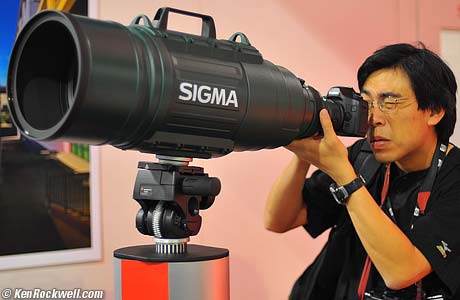
To actually be equivalent to an f/1.8 lens on full frame the G15 would have to have an f/0.3 lens, which if using the same optical design would have a 29 centimeter front filter thread (11.4 inches in diamiter). It would look something like this in dimensions:

D3R_4567-460.jpg
 
Upvote 0
Status
Not open for further replies.