Show your Bird Portraits

- Animal Kingdom
- 33423 Replies
But not a phallus-y.The birds and the bees is still a bit of a phalacy.
Upvote
0
But not a phallus-y.The birds and the bees is still a bit of a phalacy.

The birds and the bees is still a bit of a phalacy.Roughly 3% of birds, primarily waterfowl such as ducks, geese, and swans, have an external phallus. cf. Leda and the Swan.

Yeah, my only STM lens is the EF 40mm f/2.8 STM pancake, and I have such a mixed relationship with it: on one hand, I love the compact nature for casual walk-around — but on the other the AF drive and manual interaction really irks me. I won't say I hate it, but I will say the only reason it remains in my kit is the compactness. If that's how STM lenses in general are being done I wouldn't vote for them with my cash. It's been such a turn off I haven't even made time to try the RF editions, but I suppose I should to see if they've improved.Absolutelly.
And I hope that STM focusing will keep improving if that's the road for future less expensive lenses. I don't know how it is on the 24mm, but when I tried it on the 28mm I hated it, that's the main reason I didn't buy it.
I like to think we get to subtract 3 years for the pandemic. 4 years if you were involved in the work tracking the virus pre-North America awareness.but 2019 was 7 years ago, and 2016 was 13 years ago.
 All of my lenses are much fresher that way. And movies. And my own age, to be honest.
Iphones dropped 28mm as their main focal length back in 2019, almost seven years ago.
Samsung Galaxy S series dropped 28mm in 2016, even before the RF system existed.
ASUS Zenfone, back when they were a thing, never had 28mm as their main lens.
No doubt, I actually own a phone that is over 5 years old, but 2019 was 7 years ago, and 2016 was 13 years ago.Not everybody change their iphone every 3 years.
I'd say it's not a new phenomenon, the market seems to demand 24mm, and Canon just seems to acknowledge that. After 1995, they have released just two 28mm full-frame lenses, but five 24mm full-frame lenses. I think that says a lot.Also the fact that the only 28mm RF Canon produced is a pancake is pretty telling in my opinion in how the lens is marketed. And there is no new 28mm from Sigma, despite having done a huge Art one previously. For me it's just sad.
Roughly 3% of birds, primarily waterfowl such as ducks, geese, and swans, have an external phallus. cf. Leda and the Swan.And male birds are distinctly lacking anatomically to be a suitable paradigm.
Nice photos! Where in Waikiki did you see the Orange-Cheeked Waxbill?Long story short: I was planing to go today on the other side of the Island but landed in Waikiki: decided to give one more chance to the Orange-Cheeked Waxbil (last seen 2025.12.31! Few more attempts later were unsuccessful) before I check it "eventually lost". It was there!!
Took some photos but my attention got on another Waxbill (for sure the Common Waxbill but "strange"!). I took bunch of photos to document the bird, posting just two.
Starting with photos of Japanese White Eye and Saffron Finch. The last photo is how the Common Waxbill should look.
View attachment 228653View attachment 228654View attachment 228655View attachment 228656View attachment 228657View attachment 228658View attachment 228659
View attachment 228660

Absolutelly.28mm or the equivalent has a rather long history in photography, especially for reportage where it still gives a decently natural looking wide view for situational context. Much better than 35mm. Tired smart phone looks for the 28mm perspective aside, I think that (in the backdrop of zooms) for primes 24mm simply took off and is “close enough” — similar to how 50mm is generally accepted as the natural perspective lens but really a high 40s is closer to that goal. I think 28mm will live a long, long life as a consumer grade lens but for the limited manufacturing and sales space 24 has too much gravity and will remain king across the quality / robustness tiers. Just like the 50mm.
28mm or the equivalent has a rather long history in photography, especially for reportage where it still gives a decently natural looking wide view for situational context. Much better than 35mm. Tired smart phone looks for the 28mm perspective aside, I think that (in the backdrop of zooms) for primes 24mm simply took off and is “close enough” — similar to how 50mm is generally accepted as the natural perspective lens but really a high 40s is closer to that goal. I think 28mm will live a long, long life as a consumer grade lens but for the limited manufacturing and sales space 24 has too much gravity and will remain king across the quality / robustness tiers. Just like the 50mm.Not everybody change their iphone every 3 years. But I do agree that there is a variety of reasons for why it is not a popular focal lenght in serious cameras, and surely they overlap.
Also the fact that the only 28mm RF Canon produced is a pancake is pretty telling in my opinion in how the lens is marketed.


Not everybody change their iphone every 3 years. But I do agree that there is a variety of reasons for why it is not a popular focal lenght in serious cameras, and surely they overlap.He pretty much wrote the opposite.
Iphones dropped 28mm as their main focal length back in 2019, almost seven years ago.
Samsung Galaxy S series dropped 28mm in 2016, even before the RF system existed.
ASUS Zenfone, back when they were a thing, never had 28mm as their main lens.
It’s been a long time since “smartphones used 28mm on their main cameras”, and Canon never invested seriously in this focal length, as there has never been a 28mm L lens in their history. Nikon did invest seriously, Leica does, Sony doesn’t, Canon doesn’t.
As much as I like 28mm, I have to recognise it is not the most common focal length.
And male birds are distinctly lacking anatomically to be a suitable paradigm.And bees have no sex-linked chromosomes at all. Yet we teach kids about ‘the birds and the bees’. Lol.
The world's in the state it is for a reason.Sometimes I wonder how some of the people posting here function in their daily lives, when the statements they make here show a clear disconnection from objective reality.
Just saying that Canon (and all the other manufacturers) will tell us whatever is they think will keep us buying their gear.Canon Russia publicly stated that there was more chance of a new model than not.
That logically tells us they were considering to NOT make another one.
Even when they cancelled DSLRs, we know that a 5D V was under development and later cancelled.
With Powershots, the G7X and SX only went back into production because market demand was so strong.
You are free to infer whatever you want from the information available.
I am free to consider other possibilities.
Sometimes I wonder how some of the people posting here function in their daily lives, when the statements they make here show a clear disconnection from objective reality.Sometimes I wonder if you aren't paid by Canon to post here.
And bees have no sex-linked chromosomes at all. Yet we teach kids about ‘the birds and the bees’. Lol.Interestingly, birds are the opposite of humans for sex linked chromosomes. Whereas human men are XY and women YY, male birds are ZZ and females WZ.
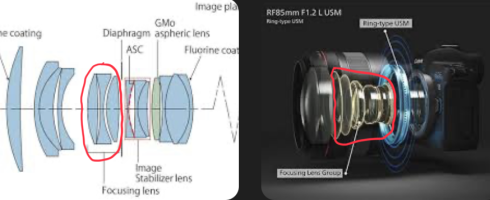
It seems that the RF 85/1.4L VCM is also VCM-only, without a Nano USM motor. Several online reviews state that it has both, but I can’t find anything from Canon saying anything other than VCM. The lens appears to have only a single focusing group, whereas lenses with VCM + Nano USM or Dual Nano USM have two focusing groups (one floating).The RF 14/1.4L has two VCM motors, though I think that's the only lens so far with that configuration.
I suspect a redesign would be needed, for either a smaller focusing group or two focusing groups. I believe Ring USM is still more powerful. Compare the focusing group of the RF 85/1.4L VCM (3 elements) with that of the RF 85/1.2L (7 elements), for example.Maybe a dumb question, but would it be impossible for Canon to take the RF 50mm F1.2L (or the 85mm) USM and "just" replace the USM-motor with a VCM style motor? or is the motor inside a lens so composed that a total redesign of everything is necessary?
Sometimes I wonder if you aren't paid by Canon to post here.Lol, yeah Canon has a team of PR flaks working around the clock to deflect, defer and diffuse the massive public outcry over this huge issue. The burning resentment raging through the camera market is killing Canon’s camera sales, leaving them in the embarrassing position of being #1 in ILC sales for the 23rd year in a row.
If Canon doesn’t stem this massive tide of customer angst, what will happen to their market leadership?
Nothing, of course. The minuscule number of people who gripe about this non-issue on the internet might switch brands. But probably most of them will just keep whining and do nothing.
I have the Laowa 35mm TS for my X2D II. It is a good lens in terms of IQ, but it is also quite a bit heavier than the 2 TS-E lenses I used to have (24mm II and 17mm)... so much so that I cannot use it without tripod, while I was comfortable to hand hold the TS-E lenses. Tilt is actually doable hand held, but shift, especially vertical, is a problem. for me at leastCanon has recently thrown everything into the 14/1.4 to the extent that it is an expensive but wonderful lens. I fear that they may do the same with the TS-E lenses.
Laowe have 2 lenses for tilt/shift or shift only to differentiate from a 25% price difference. This makes sense to me as I would only use shift if I was to get one and AF wouldn't be a critical issue. To line up the vertical elements would be manual/tripod. Not sure how AF could also shift automatically for composition.
I can't imagine Canon having 4 options for one focal length: shift/tilt-shift, AF or manual so Canon is likely to add everything in and then be a marvellous technological creation but with a $$$$$ price ("The Homer"?).... especially for a 14mm TS-R
Not even sure what the nomenclature would be for a shift only lens "S-R"?
Sure it does. Canon can say they're not technically lying so no suing them (as if one would).It sounds better in press and interviews when journalists ask about it. So instead of saying "we not allow it", they can just say they negotiating or something.
Both can be true.That is a reasonable conclusion, but another one is that Canon set the price too high just to make enough money for themselves to sense when we buy a third-party lens instead of a Canon lens.
A price that makes sense for Canon does not necessarily make sense for a third party.
They all are businesses.