What’s Coming Next from Canon?
- By scyrene
- EOS Bodies
- 196 Replies
Lower pricesWhat is there to improve?


Upvote
0
Lower pricesWhat is there to improve?
I suppose the "coming" 14/15mm TS-E will be internally shifting, and this new feature could simplify AF implementation.It’s interesting, it seems very unexciting. Nothing in that list really grabs my attention. I’ve just offloaded a lot of Ef gear to semi fund an R5 II and an RF 70-200 2.8. I was waiting for an R3 II or a new high MP R5. I think it will be a long wait. I have an R5 already and it’s a great camera. I’ll be interested to see if the R5 II is much of an improvement. This will be all camera companies dilemmas from now on. What is there to improve? The wow factor of 2000-2020 will be long gone. It’s hard to even imagine how a lens can be improved from now on.
My only wish is a 15mm TS-E . It doesn’t need autofocus, it doesn’t even need tilt.
That and a 100MP Full Frame (surely not too much to ask)
 )
)
Consider that 600mm f/5.6 requires the same front element size as 300mm f/2.8, meaning a 300-600/5.6 is going to be very similar to a hypothetical 150-300/2.8 (the 300-600/5.6 would be a little heavier and a bit longer). That hypothetical 150-300/2.8 sounds very much like the real RF 100-300/2.8L, which is priced at $10,600.A fixed F/5.6 300-600 would slot in around $5000-$7000 roughly.
A fixed F/5.6 300-600 would slot in around $5000-$7000 roughly. At F/4 I could see such a beast being $12000 but F/5.6 at $12,000 isn't happening.Me too but I can't see it being cheaper than the very similar RF 100-300mm f/2.8L IS USM if it's an L lens I would expect it to be at least 10% more expensive.
If Canon made a non L 300-600mm f/5.6 as they did with the RF 200-800 using cheaper elements and coatings and consumer grade materials then it should be a bit cheaper than the RF 100-300mm f/2.8L IS USM but personally I'd rather they made it a full on L lens and hopefully get the weight down and add a built in 1.4 extender for 420-840mm f/8 with it engaged. I'd be happy to save up for this even if it's USD $12,000


Me too but I can't see it being cheaper than the very similar RF 100-300mm f/2.8L IS USM if it's an L lens I would expect it to be at least 10% more expensive.The Canon 300-600 mm f5.6 is likely to be the last telephoto lens I buy from Canon.
The Sony 100-400 mm f4.5 lens is a brilliant lens from Sony and is reasonably light weight at 4 lbs. with a 1.4x TC you get a 140 mm to 560 mm f6.3 lens.
There was a 5GHz WiFi camera certification that was classified until Mid-June which is the R6 V, the other certification was a 4Ghz which lines up with the R8 MKii retro camera.There is still one (or two?) 6GHz wifi camera certifications floating around, implying the existence of higher end bodies on the way.
Also very curious about cinema eos. Would've been really happy with the R5II sensor in a C400 body...


Yeah it was 1 am and I couldn’t get back to sleep, so I was awake, but in a bit of mental fog and linked dynamic range and sensor noise a little more than I should have. Was also getting at AF and an improved basement, maybe an EV of -6 or -7, things that make a legitimate difference, not just numbers. Better handling at a higher ISO is easier than rewriting the physics of optics.??
If online chatter is to be believed, everything Canon releases is a PR disaster.
I had an email exchange with B&H customer service when I requested that my order for 10 caps be cancelled, and I told them that I ordered from another vendor because I needed more than 10 caps. Soon after that, the preorder dropdown changed from the 1-10 that it was when I placed the order to 1-10+, enabling you to enter a larger quantity.
 .
. 
You mean zooming manually? It responds very well.How was it zooming in and out using the zoom ring?
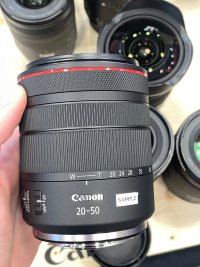
Quick question: I cannot find a detail about this lens: does it cover the FF image circle at every focal length or does it require stretching?
Thanks
It does not cover the entire full-frame sensor at 20mm, I have completely black corners on my RAW files. I just can't share them because I was photographing people.Unknown at this point, I believe. There was no patent published for this specific lens (there was a patent that included the design that became the RF-S 14-30 PZ, and a design for a 20-50mm f/4-5.6 lens; that patent did not list image heights).
If I had to guess, I would suspect some correction is required at the wide end. At least, I would not be surprised by that.
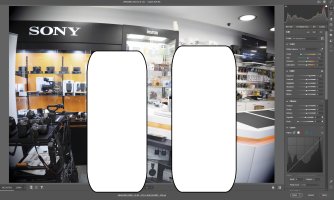
Unknown at this point, I believe. There was no patent published for this specific lens (there was a patent that included the design that became the RF-S 14-30 PZ, and a design for a 20-50mm f/4-5.6 lens; that patent did not list image heights).Quick question: I cannot find a detail about this lens: does it cover the FF image circle at every focal length or does it require stretching?

I had an email exchange with B&H customer service when I requested that my order for 10 caps be cancelled, and I told them that I ordered from another vendor because I needed more than 10 caps. Soon after that, the preorder dropdown changed from the 1-10 that it was when I placed the order to 1-10+, enabling you to enter a larger quantity.Interesting, I ordered 30 of the new caps from B & H. They confirmed the order, just pending on delivery. IMHO, this is an update that only makes sense if you go wholesale. Perhaps it is because I didn't order immediately after the preorder button was available and hence didn't have the "first batch" constraint.
How was it zooming in and out using the zoom ring?I tried the lens yesterday, what do you want to know?