The Canon EOS R5 Has Officially Been Discontinued

I love my R5. It has been my work horse and even I have the R5ii now, I still shoot with both of them.
I might have to let go my like new 5Div one day but it's the last of the 5D generation. :)
I've not yet made the jump from a R5 to a R5ii. Do you find much difference between the files from either camera? Sharpness, IQ, noise, DR, colour space?
  • Like
Reactions: 1 user
Upvote 0

Canon RF 70-150mm f/2.8 IS STM Coming To Complete the Trilogy?

This will depend on:
- Its sharpness (won't easy to beat the 70-200 f/4)
- The photographer's preferences (lighter lens or longer focal, need for a higher luminosity or not)
- Its build quality (again, the 70-200 is hard to match)
- Price, weather resistance etc...
I know for sure that I'll keep my ultra compact 70-200, since I often use 200mm, and usually at f/5,6. I don't often need wide apertures.
If the new lens started at 50mm, I might give it a try, since in cities 15-35 and 50-150 would make a really nice pair, (plus 24 TS!).
And no, I'm not interested in the Sony 50-150, it weighs 1,4 kg. and needs a :sick: Sony camera body.
PS: If you can crop 150mm, you can also crop 200mm...
These days, we have SO many options and choices. We are truely bless with our gear options. After my EF 16-35 II L musings on the RF 14L thread, I was just thinking about how many UWA lenses are now available on the RF mount. Back in the EOS 5DII days..there were only a few options.
I was just looking at how good the little RF 16-28mm f2.8 STM lens is....it's a stunning little lens. I'm kind of guessing the RF 70-150 2.8 STM wil be cut from a similar cloth....small, light, sharp, sealed, not quite as long as this L brother...great price point, a great alternative!
  • Like
Reactions: 1 user
Upvote 0

Canon Announces the Canon RF 14mm f/1.4L VCM

Unfortunately I only own the EF version. The 14mm 1.4 VCM will only be my 3rd RF lens. I haven't tried the EF version for astro.
Please, don't use the Canon EF 14/1.4 for astro! That lens has a horrible 'coma' which is well known. I started in the 'EF-era' with astro and got really frustrated by the poor image quality of the EF wide-angle lenses. But after around 2010 more and more suitable 3rd party lenses became available for astro photography. I only use the Canon EF 35/1.4 II for tracked, stacked and stitched panoramas nowadays and that lens is really good, but it's also a relatively modern lens (from 2015).

Concerning the 14mm VCM lens: I'm a bit skeptical because of the heavy 'vignette' of 4 EV for astro as I would use that lens for panoramas. I already get sometimes 'colorful' corners after removing the vignette with my recent lenses and they have usually a vignette of max. 3 EV in the corners (and I'm using modern cameras with a large DR: R8 and R6)

The optical quality (coma!) is looking good, but I'm not sure if this 'stretching' might give problems (e.g. when stacking).

In total: The RF 14/1.4 is a nice lens, but there are alternatives - for astro - now (and each of these 14mm lenses has pros and cons).
  • Like
Reactions: 1 user
Upvote 0

Canon Announces the Canon RF 14mm f/1.4L VCM

The first two versions of the EF 16-35mm f2.8 were not very good, the third version was very good, even on my 5DsR.
Lensrentals has done testing and comparisons: https://www.lensrentals.com/blog/2016/10/canon-16-35mm-f2-8l-mark-iii-optical-bench-tests/
And https://www.lensrentals.com/blog/2016/12/real-world-testing-of-the-new-canon-16-35mm-f2-8l-iii/
I used a the EF 16-35 IIL a lot...weddings, landscapes etc. It was my goto UWA lens of choice for well over 15 years. It was a top tier performer when it was launched, it far eclisped the competition in terms of it's build and image quality. However....that was then, back when 12mp was considered "excessive" or "legendary". The EF 16-35IIL was small, light, convieniet and delivered a lot of great images for me. Stopped down, it was as sharp as the camera sensors it was attched too....however pop this old lens onto a R5 and shoot wide open and it is dissapointing in comparison.

The lens dos not have a flat film plane, so the corners are always slightly soft unless the lens is stopped down. It also suffers from really bad CA, correctable in post but still one of the worst lenses in this regard. It also suffered from a internal reflection if the incoming light hits the front element in a certain direction.
BUT, it's still got the best suns stars of any lens I've ever used and once stopped down to f8...it's sharp enough across the frame.

I've personally found that there is no "one" UWA lens, I've always had to have several options depending on the shooting situation. My typical landscape bag woud have my EF 16-35IIL as my goto, my EF 8-15mm fisheye (defished it's really good) and my trusty old TS-e 17L (movement swings and stunning IQ and straight line compositions).

These day's I have a EF 11-24L as my main UWA, but it's super heavy and cumbersome. But it's performance is superlative. I miss the convienince of the EF 16-35IIL. I'm still using my EF 8-15mm Fisheye too. But I really need a more versatile general UAW zoom. The RF10-20L is very tempting, small and light with amazing focal coverage.
Upvote 0

Canon Announces the Canon RF 14mm f/1.4L VCM

Hi!

Your pictures are nice, but for the theory you should check Clark again. I haven't found anything better and I like his old style web pages somehow. They aren't polished as the modern stuff, but full of very good information, based on physics!

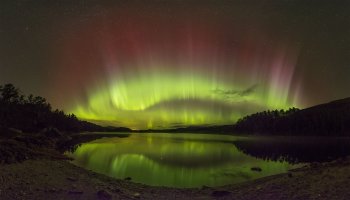
Concerning stitching of aurora pictures: Usually that works for me pretty well, but I found a better solution by shooting several cameras simultaneously. See the image below with the reflections fitting perfectly to the aurora.

Concerning parallax error: Yipp, there is a parallax error in the foreground, but without straight lines it's easy to hide in the darkness.

Concerning projections: Yes, I really love the different projections in PTGui!

9.jpg
  • Like
Reactions: 5 users
Upvote 0

The Canon EOS R5 Has Officially Been Discontinued

not sure that is fair. 5d4 does some things better, but my daughter really likes the R because of the exposure simulation
The R and 5 DIV are the most reliable cameras I've ever been using. The trouble I had when using them simultaneously, is that I sometimes forgot that the 5 DIV doesn't show the exposure in the OVF, unlike the R's EVF. And I just forgot to adjust the exposition on the 5 D, resulting in white or black pictures...
  • Like
Reactions: 1 users
Upvote 0

The Canon EOS R5 Has Officially Been Discontinued

I have a R6ii and a R5 and I cannot see any real world resolution difference between their EVF units. I actually prefer the EVF from my R6ii over the R5 because it’s got a bit more contrast and bite.
Also, just to add to this: The R6ii's AF works way better in lower light. The R5 struggles with it's AF tracking at higher iso values in comparision. But the fact that the R5's eye detection is like switchable mode makes the AF experiance / behaviour much easier to control than on the R6ii. The R6ii's eye detection is pretty much always on in every AF mode and where there's a subject that confuses the Eye detection (butterflies for example) it can be a wrestle to bypass.
The colour space on the R5 is very vibrant, the R6ii is much more neutral and chooses a while balance that is superior (IMHO) and needs less post processing.
The R5 seems to much through batteries at an alarming rate compared to the R6ii. This is becuase the R5's AF is permanantly engaged, where as the R6ii's AF only engages once the shutter is half pressed.
I tend to put my fsat / bright glass on my R5 (primes) and my darker glass (zooms) on my R6ii and they make a really powerful comb in my camera bag.
I like my R5 a lot, the higher resolution is overkill fro a lot of my general events photography but it's a camera that I really enjoy using. In fact I'm very happy with both of my camera bodies at the moment. I think if I was to upgrade my R5 at some point, it would be for a R5ii not a R6iii.
I think some new glass is calling me this year, not my cameras.
Upvote 0

A Canon RF 7-14mm f/2.8-3.5 Fisheye Zoom is Coming Soon

Blanket statements are always a bit precarious. I have spent the last few months seriously looking at Nikon's offerings - and they do have some excellent choices. But in my experience - and my preferences, Canon would be my choice. During the 5 years or so I have been shooting wildlife (mostly birds) I find that primes are far too restrictive. Those lightweight Nikon PF lenses are sure tempting, but I will choose a zoom over a prime every time. I do prefer a lightweight lens, though, so the best wildlife lens in my opinion is the Canon RF 100-500. For many birds I shoot, maximum reach is another preference, in which case, the RF 200-800 is something no one else offers, and it is also relatively affordable, which is my other preference. So, based on that, my vote for the best two wildlife lenses available at a reasonable cost are both Canon.
Primes are restrictive but the 200-800 only resolves to about 650mm (per tests in this forum) and beyond that it just makes the image bigger without any additional detail resolved. You'd do just as well with the Nikon 180-600 and then up-sizing in Photoshop or with an AI resizer. Or the Sony 200-600 for that matter.
Upvote 0

Canon Announces the Canon RF 7-14mm f/2.8-3.5 Fisheye Zoom lens

Curious, is there a way to use a protective filter? I'm kind of rough on my gear :), I need all the protection I can get. I think there is a lens hood, which will help a bit, but does not work if you shoot at 7mm. Also, anyone use this for basketball, love to see some photos.
Protective filter for a lens with 190 degree field of view?
Upvote 0

Show your Bird Portraits

Lovely photos! Especially if you can take them from the comfort of your lanai.
Thanks!
Yeah, yesterday it was possible. Not today: the sustained northeaster winds are up to 36 mph with gusts (and it's mostly gusts!!!) up to 60 mph. According to the forecast it will get worst afternoon and into Monday. I don't want to be in the shoos of the tourists who did pay $$$$ for vacation on Hawaii in these days!
Upvote 0

Canon Announces the Canon RF 14mm f/1.4L VCM

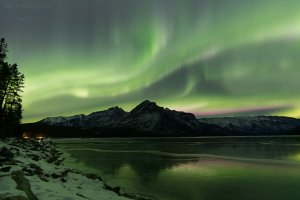
Here is some aurora, which I shot a few weeks ago (Jan 20). I used my 16/2.8, single frame. Would I have liked a 14/1.4? Heck yea. But suppose you already have a 24/1.4, then you can get pretty close by shooting two adjacent frames and stitching. You have to be quick in reframing, though. A friend of mine does this with excellent results. He was shooting beside me that evening and I have seen his composite images. You can't tell they're stitched.

The other bit about stitching is that it's easy to vary the projection (e.g. cylindrical, stereographic). One downside about rectilinear lenses is the area distortion. Sometimes straight lines are not needed.

6305MinnewankaSwirl.jpg
  • Like
Reactions: 4 users
Upvote 0

Canon Announces the Canon RF 14mm f/1.4L VCM

Clark starts with equation 1, says that it falls apart for unevenly lit scenes or subjects of limited size, and then works his way to equation 4 which takes into account subjects of a limited angular size.
Fair, but of course starscapes (even fields of stars) are unevenly lit scenes.

I just like to shoot stars every so often.
Excellent shot!
Upvote 0

Canon Announces the Canon RF 14mm f/1.4L VCM

Did you read the words immediately before that equation?


Clearly, the use of “internet expert” in quotes is a clue to the validity (i.e., lack thereof) of the equation that follows, which you dutifully reposted here. Does that mean you’re also an “internet expert”? Hint: it’s not a flattering appellation.
Clark starts with equation 1, says that it falls apart for unevenly lit scenes or subjects of limited size, and then works his way to equation 4 which takes into account subjects of a limited angular size.
Am I an internet expert? I dunno. I just like to shoot stars every so often. When I do, I shoot a grid and use a stitcher. In my experience, when optimizing control points, the errors get larger with closer subjects, which is due to parallax.

KanUpperLakeStereographic.jpg
  • Like
Reactions: 3 users
Upvote 0

Canon Announces the Canon RF 14mm f/1.4L VCM

No it does not. Look at Clarkvision's equation 1: light collection ∝ t * sensor_area / (f_ratio)2
Did you read the words immediately before that equation?

Another method of calculating light collection advocated by another "internet expert" is…

Clearly, the use of “internet expert” in quotes is a clue to the validity (i.e., lack thereof) of the equation that follows, despite which you dutifully reposted that equation here. Does that mean you’re also an “internet expert”? Hint: it’s not a flattering appellation.
  • Like
Reactions: 1 user
Upvote 0

Canon Announces the Canon RF 14mm f/1.4L VCM

No it does not. Look at Clarkvision's equation 1: light collection ∝ t * sensor_area / (f_ratio)2
The amount of light collected is proportional to the exposure time, the sensor area, and the inverse of the fstop squared. It is not proportional to the size of the entrance pupil or the focal length. Rather, it is proportional to the exposure settings (fstop, exposure time) as I pointed out in my original post.

Think of it this way. Suppose you point your camera at the stars, and suppose we have an evenly distributed star field. With a 14 mm lens, there are many more stars beaming light at your lens than there are if you had the 35 mm lens mounted. So even though the 14 mm lens has a smaller entrance pupil, it captures the same amount of light as a 35 mm lens with a larger opening does.

Now, we are talking total amount of light. On the other hand, if we have a subject with a limited size (moon, stars) then it does come down to entrance pupil size. With a longer focal length, a larger area of the sensor needs to be illuminated, which requires more light. This is the old pixels-per-duck argument.
For subjects of limited size, Clarkvision has the following equation:


So for objects of limited size, the light collected is proportional to the entrance pupil size.
You have not read the complete text, it states “Clearly equation 1 fails”.
  • Like
Reactions: 1 user
Upvote 0

Canon Announces the Canon RF 14mm f/1.4L VCM

The size of the entrance pupil of a 35mm at f1.4 is much larger (25mm) than the size of the entrance pupil of a 14mm at f1.4 (10mm). The larger entrance pupil collects more light.

Clarkvision has an explanation with examples.
No it does not. Look at Clarkvision's equation 1: light collection ∝ t * sensor_area / (f_ratio)2
The amount of light collected is proportional to the exposure time, the sensor area, and the inverse of the fstop squared. It is not proportional to the size of the entrance pupil or the focal length. Rather, it is proportional to the exposure settings (fstop, exposure time) as I pointed out in my original post.

Think of it this way. Suppose you point your camera at the stars, and suppose we have an evenly distributed star field. With a 14 mm lens, there are many more stars beaming light at your lens than there are if you had the 35 mm lens mounted. So even though the 14 mm lens has a smaller entrance pupil, it captures the same amount of light as a 35 mm lens with a larger opening does.

Now, we are talking total amount of light. On the other hand, if we have a subject with a limited size (moon, stars) then it does come down to entrance pupil size. With a longer focal length, a larger area of the sensor needs to be illuminated, which requires more light. This is the old pixels-per-duck argument.
For subjects of limited size, Clarkvision has the following equation:

The light collected from an object covering angular area Omega, Ω, e.g. the Moon, a star,a bird in a tree, a person's face, or any other object is

Light Collected = EtST ∝ A * Ω(object) * T * SE (equation 4)

where
EtST = Etendue (Et) times System efficiency (S) times exposure Time (T),
Etendue = A * Ω, also called the A Omega product,
A = lens aperture area (more precisely, the lens entrance pupil area),
A = pi * D2 /4. where D = Lens diameter (entrance pupil diameter),
D = aperture diameter = focal length / f-ratio,
pi = 3.14159,
Ω (Omega) is the solid angle of the object,
T is the exposure time, and
SE= system efficiency = optics transmission * fill factor * quantum efficiency.
So for objects of limited size, the light collected is proportional to the entrance pupil size.
Upvote 0

Filter

Forum statistics

Threads
37,419
Messages
972,747
Members
24,776
Latest member
LukyLuke83

Gallery statistics

Categories
1
Albums
29
Uploaded media
372
Embedded media
1
Comments
25
Disk usage
1 GB