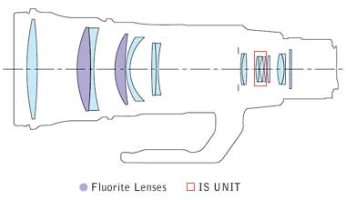
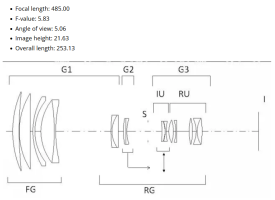
Canon Shows off RF 500mm F5.6 L IS in Latest Patent
- By Froschphoto
- Patents
- 76 Replies
I would be so into a 300-600 5.6 that would hopefully be a decent weight.
Upvote
0
If you're telling me I shouldn't use my experience with what I have to make a judgement call then we are disagreed.No, it's not. That was the point...you stated that you would rather have a supertelephoto prime than a zoom, and indicated that the distortion correction required for your wide angle lenses was one reason. The point was that what you see in terms of distortion at 24mm is not relevant for 500mm prime vs. a zoom lens covering that range (e.g. 300-600mm).
No, it's not. That was the point...you stated that you would rather have a supertelephoto prime than a zoom, and indicated that the distortion correction required for your wide angle lenses was one reason. The point was that what you see in terms of distortion at 24mm is not relevant for 500mm prime vs. a zoom lens covering that range (e.g. 300-600mm).Not so sure this is a valid comparison. 200mm to 24mm?
Not so sure this is a valid comparison. 200mm to 24mm?Just to drive Alan's point home, compare the distortion of the RF 200-800 to that of the EF 24/1.4L II prime that you prefer for its 'lower distortion'.
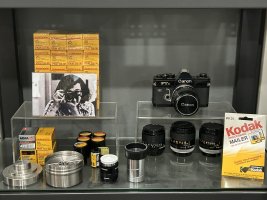
There have been many many fantastic photos made from retro cameras. Your comment does not make much sense, sir.To me, a "retro" camera is one you put on the shelf, and stays there except when you want to show it off to a relative.
Good to know. I don't have a 500mm or 600mm zoom to compare with at this time, just Canon and Nikon primes in those ranges. I had assumed similar issues, however.There is a complete difference between comparing a 24mm zoom with a 500mm zoom when it comes to distortion. There is minimal inherent distortion from 500mm lens as the inherent curvature from a 500mm radius over a 36mm frame is tiny compared with that from a 24mm radius over 36mm, which requires massive optical and digital correction.
Just to drive Alan's point home, compare the distortion of the RF 200-800 to that of the EF 24/1.4L II prime that you prefer for its 'lower distortion'.]I'm amazed at how much distortion correction eats into the scene, plus other issues, when comparing my shots from a tripod with prime vs zoom at same length. The EF 24mm 1.4 II captures a noticeable extra chunk over the 24-70 f/4 set to 24 as an example when corrections are applied.
There is a complete difference between comparing a 24mm zoom with a 500mm zoom when it comes to distortion. There is minimal inherent distortion from 500mm lens as the inherent curvature from a 500mm radius over a 36mm frame is tiny compared with that from a 24mm radius over 36mm, which requires massive optical and digital correction.Canon says if you still have one in stock then sell it at $1,599 CAD. In 2026. I didn't make the numbers up.
Canon EF 400mm f/5.6L USM | Super Telephoto Lens
The Canon EF 400mm f/5.6L USM super telephoto lens has one super UD-glass element with characteristics similar to fluorite and one UD-glass element, resulting in sharp pictures from corner-to-corner.www.canon.ca
- https://www.cpricewatch.com/product/00035/Canon-EF-400mm-f5.6L-USM-price.html?streetprice
Totally fair! And I trust your opinion on lens quality comparisons for things like birds, etc.
I do think that the zoom + prime combo at either tier for likely pricing ranges would be solid. I'm amazed at how much distortion correction eats into the scene, plus other issues, when comparing my shots from a tripod with prime vs zoom at same length. The EF 24mm 1.4 II captures a noticeable extra chunk over the 24-70 f/4 set to 24 as an example when corrections are applied. I agree that zooms are the ultimate in convenience when subjects move much closer or further, but when the situation permits I prefer to reach for a prime instead. Extra nice is that my better half and I can split the set and she can carry the zoom while I futz with the prime.
The EF 400/5.6 L was introduced in 1993 at $1250, which equates to $2750 in 2026, to put in perspective.
Totally fair! And I trust your opinion on lens quality comparisons for things like birds, etc.It was popular because there was no alternative. For a while, my favourite lens was the Nikon 500mm f/5.6 PF, an absolute cracker of a lens. However, I don’t miss it a bit as the RF 100-500 mm is just about as sharp and has all of the advantages of a zoom and close focussing, which outweigh for me the loss of 2/3 stops. Now, the extra 60% of focal length of the RF 200-800mm makes it my go to lens for birding. As good as a 500/5.6 is likely to be from Canon, I personally would probably give it a miss because it would not be used that much owing to the two Canon zooms. But, I am sure it would be the first choice for others and a useful and welcome addition.
The EF 400/5.6 L was introduced in 1993 at $1250, which equates to $2750 in 2026, to put in perspective. It was popular because there was no alternative. For a while, my favourite lens was the Nikon 500mm f/5.6 PF, an absolute cracker of a lens. However, I don’t miss it a bit as the RF 100-500 mm is just about as sharp and has all of the advantages of a zoom and close focussing, which outweigh for me the loss of 2/3 stops. Now, the extra 60% of focal length of the RF 200-800mm makes it my go to lens for birding. As good as a 500/5.6 is likely to be from Canon, I personally would probably give it a miss because it would not be used that much owing to the two Canon zooms. But, I am sure it would be the first choice for others and a useful and welcome addition.All true, of course, but perhaps the point is that the 400 f/5.6 provided a reasonable way for people to get — for the era — a combination of reach and affordability, as opposed to more expensive commercial-oriented solutions. In that regard, the EF 400 f/5.6 vis-a-vis the RF 500 f.5.6 in terms of hopes remain a valid call-out by forum members.
In a nod to your comment, things do get better.
Continuing the general conversation...
Putting a potential RF 500mm f/5.6 into economic context for primes:
And for zooms:
- Canon EF 500 f/4 IS II: CAD $11,999 (MSRP still listed)
- Canon RF 600 f/4: CAD 18,999
And the lenses of question:
- Canon RF 200-800 f/6.3-9: CAD $2,799
- Canon EF 100-400 f/4.5-5.6: CAD $2,999
- Canon RF 100-500 f/4.5-7.1: CAD $3,999
So if you look at the relative cost, the EF 400 f/5.6 was a fantastic option to get people into quality telephoto photography on the Canon platform. Given that for years anything over 400 was rather exotic the EF 400 5.6 was a remarkable offer, and with competitive IQ. Sure, no IS — but for a fraction of the cost of anything else and still with moderate internal sealing (no fogging)... uh, whatever.
- Sigma L or E 500 f/5.6: CAD $4,399 (market benchmark)
- Canon EF 400 5.6: CAD $1,599 (MSRP still listed)
If Canon made this a red ring lens then it would probably pair very well with a 100-500, and if a silver ring lens then the 200-800. I think Canon could offer it for around the same price as the Sigma, maybe a pinch more, if red and probably for CAD $3,500 if silver should they really want to make a market statement similar to the 200-800, which itself is priced very fairly compared to historic and modern "peers".
A dual silver offering of the 200-800 and 500 5.6 with similar, as appropriate, build, functionality, and costing would be an epic combo for the prosumer and advanced amature market. It would also probably be a great grab-and-go for tight spaces for pro's as well.

The latest version of PL9 (just this week) finally uses Nvidia GPU well. Much faster processing times than in the past. Looks like they finally moved to Cuda.Back to DxO PL. Long story -short: more than an year my PL8 stopped working, I upgraded to PL9 and it was the same - they didn't recognize my credentials (!?). It was with my old computer (Windows 10). My new computer is Windows 11 and voila - at once I'm a legitimate owner. The problem is that I can download only PL9 - the previous editions are not available in DxO store for downloading (I like the simplicity of PL6 and PL8 since I don't always need all of the new features of PL9)! Anyway: the noise reduction and the control of the colors are day and night in comparison with the Windows Photos program (not a surprise!). Today it was good day to take photos in low light (overcast and windy and most importantly - finally no rain!!!) and to see what the last edition of PL9 can do! I missed the fraction of second when the Japanese White-eye landed on the flowers of the Jade vine - it could be a nice photo...
View attachment 228972View attachment 228973View attachment 228974View attachment 228976View attachment 228977View attachment 228978
All true, of course, but perhaps the point is that the 400 f/5.6 provided a reasonable way for people to get — for the era — a combination of reach and affordability, as opposed to more expensive commercial-oriented solutions. In that regard, the EF 400 f/5.6 vis-a-vis the RF 500 f.5.6 in terms of hopes remain a valid call-out by forum members.The RF 100-500mm is an order of magnitude or more better than the EF 400/5.6. It is sharper at 500 than the prime at 400, has excellent IS against its absence, faster AF, will focus close and had all the advantages of zoom for framing as well as longer with little extra weight. I’ve used both extensively and the zoom is indeed not close, it is miles ahead.
Had (have) exactly the same...Wow!
I'm impressed on your lens ID's - my Leitz enlarger and slide projector lenses.
Wow!I see a Focotar and a Colorplan...very good choices!
The funny bayonet was the only reason why I chose the Minolta SRT 101 over Canon's FTb Ql.
While dreaming, still a poor student, of a Leicaflex SL and a Nikon F2. Which I both bought a few years later.
I see a Focotar and a Colorplan...very good choices!
The RF 100-500mm is an order of magnitude or more better than the EF 400/5.6. It is sharper at 500 than the prime at 400, has excellent IS against its absence, faster AF, will focus close and had all the advantages of zoom for framing as well as longer with little extra weight. I’ve used both extensively and the zoom is indeed not close, it is miles ahead.I'm asking here for this lens for years, thank god!! Make it happen Canon!!
I loved my EF 400mm 5.6L and never had a lens like this again! (no, 100-500 L is not close).
It may not sound much, but to me it would. Given the lens is of decent optical quality and in combination with a TC it translates into an additional 140/200mm.what is the use of a 300-600 f5.6 if Canon has the 100-500 of very decent quality. You would gain 100mm and 2/3 stop of light at the cost of 7k? IMHO 600/5.6 would be ideal in combination with the 100-500. Light, small and with very good optical quality. With the extender RF 1.4 and 2.0 ideal which would cover all needs from 100-1200mm.
The Astro-Cam market is also illustrative. Astro-Cams (from ZWO and QHY among others) are pretty close to 'sensor in a box' designs where most of the complexity is offloaded to a universal driver. They have many designs where they offer a color and mono version of the same camera differing only in which version of the sensor they use. Even here, the mono versions are always more expensive.Apart from Leica, Ricoh and PhaseOne have done monochrome versions of existing models as well. In all cases the monochrome version costs more than the color one and in all case the only difference is lack of color filtering. The color versions are all niche products admittedly, but the monochrome ones are niche in a niche

my point was: the R5 and R5C are different beasts and extrapolating from them that a no video version would cost less would be incorrect in my opinionPhysical cooling is the main difference similar to what is being rumoured with the V version but takes out IBIS which offsets the passive cooling. We don’t know what the relative cost difference is.
The R5c has not only longer run times but also 8k60 vs 8k39 on the R5.
Adding the cinema menus but only via restart makes it a video SW version but looks to be shoe horned in vs a redeveloped integrated SW release.
Apart from Leica, Ricoh and PhaseOne have done monochrome versions of existing models as well. In all cases the monochrome version costs more than the color one and in all case the only difference is lack of color filtering. The color versions are all niche products admittedly, but the monochrome ones are niche in a nicheI can’t comment on colour vs monochrome as canon hasn’t done that before and Leica charge what the market will bare.
Canon has released 2 Astro sensor bodies with the IR filter removed and charged more but that was a long time ago