Canon Says it’s up to Sigma to Make Full-Frame RF Lenses

Leica's M series cameras at least are mainly a luxury gadget for rich people, so Leica may have more Louis Vuitton bag like profit margins per camera (but making the mechanics of such cameras isn't cheap). I am always amused when I meet rich Chinese guys in the streets of Frankfurt where I live (we have a big Leica store): they proudly have their brandnew Leica with a sort of Noctilux lens attached hanging around their necks - and use their smartphones for taking images :ROFLMAO: But, of course, marketing wise it was a smart move that saved Leica from bankruptcy. In fact, Andreas Kaufmann, a smart rich guy, was the one who saved Leicy, and as German I am grateful that this legendary company survived thanks to him - despite the fact that I'd never buy a Leica, too expensive for what it offers.
I often bought new Leica gear in the -distant- past. They were expensive, but still not in an excessive way. And quality, apart from the R4, was top. Few Japanese lenses could compete.
But in more recent years, quality and features no longer reflected in the exaggerated sales prices. Also, more and more "Leica" lenses were rebranded Panasonics and Sigmas.
Service is the slowest one you could imagine.
More and more, Leicas are becoming expensive, often unreliable toys (sensors, ISO selector, freezing etc...) for collectors or rich people.
I wonder if real photographers are the ones who spend $12000 on a portrait tele 90mm lens.
There are certainly still "real" M users, I'm one of them, yet I can't help regretting that this glorious camera company is rapidly becoming a member of the luxury industry.
Edit: As I wrote in another post, I am more than happy that I can now use even the Leica M UWA lenses without issues on the R5 II. "Italian flag": Gone! ☺️
Sorry, but for the price of one single M11, I can get two R5 II + an RF 50mm f/1,4...
I still like the M, but not what it is now meant to represent.
Upvote 0

Canon Says it’s up to Sigma to Make Full-Frame RF Lenses

The only additional investment would be to change the mount and the comm protocols.
Those are not all additional costs: production and testing of the RF mount lenses must be arranged, packaging, marketing, add SKU to ordering and shipping systems, distribution, service/ repair organization etc. etc.
  • Like
Reactions: 2 users
Upvote 0

Canon Says it’s up to Sigma to Make Full-Frame RF Lenses

First question: How much of a licensing fee would Canon want for Sigma to sell each lens in RF mount?
How can any of us possibly know?
Second question: If that amount became public knowledge, what would be the effect on Canon's reputation as a good company to buy stuff from, with the choices being: Damage greatly, Damage slightly, Neutral, Benefit slightly, Benefit greatly?
I don't see how it would make a difference, other companies do it don't they? Or at least people claim they do.
Upvote 0

Canon Says it’s up to Sigma to Make Full-Frame RF Lenses

But Sigma has to make enough of those lenses to be PROFITABLE. That means more than "Sigma would simply sell as many lenses as they can make, be very happy with the revenue."

Revenue MUST cover expenses And return a profit. Obviously, Sigma hasn't figured out how to do that for RF yet. What if Sigma can only fit 500 lenses for ff RF into the current facility capacity and production schedule? Would that be PROFITABLE?

Sigma is in business to make money. Period. It is not in business to be altruistic.

Not as simple as people want to believe, then again, simple if you follow the $. "But demand would be through the roof! They'd make millions!" Nobody HERE knows that. Sigma would know better.

My guess is that RFs is a bigger market with much higher volume and potential sales/profit than ff.
But a lot of the expenses to develop those lenses have been already incurred into by Sigma. The only additional investment would be to change the mount and the comm protocols. Lens design and productionalization has happened already.

If Sigma is selling them now to L and FE clients it means that they are already (or believe they will be) making money on those lenses.

So, again, I don't think that the capacity argument holds any water.
  • Like
Reactions: 1 users
Upvote 0

Canon Says it’s up to Sigma to Make Full-Frame RF Lenses

I also had the opportunity to test this massive lens (I think it was nicknamed "Sigmonster") with a Canon DSLR attached (forgot which one) on a Sigma booth that - strangely - was set up on Frankfurt book fair about 10 years ago. Results were soft, out of focus and completely disappointing even stopped down to f = 8. No match for my old EF 500mm f/4.5 L USM lens with a 1.4x TC III attached (my standard combo for birding back then), which was getting with effectively 700mm focal length close to 800mm and could deliver decently sharp images @ f = 6.3.
You have mentioned the EF 400/4.5 a couple of times. I got intrigued a few months ago when one was on sale from WEX. It was priced too high at about £1500 or so. At 25+ years old and focus by wire with no recourse to repair, I passed it by. At £500, I might have bought one for fun. I would guess that at the sacrifice of 1.3 stops, the RF 100-500mm is clearly sharper, and I would further guess that the RF 200-800mm is far sharper at 700mm.
Upvote 0

Canon Says it’s up to Sigma to Make Full-Frame RF Lenses

Leica's M series cameras at least are mainly a luxury gadget for rich people, so Leica may have more Louis Vuitton bag like profit margins per camera (but making the mechanics of such cameras isn't cheap). I am always amused when I meet rich Chinese guys in the streets of Frankfurt where I live (we have a big Leica store): they proudly have their brandnew Leica with a sort of Noctilux lens attached hanging around their necks - and use their smartphones for taking images :ROFLMAO: But, of course, marketing wise it was a smart move that saved Leica from bankruptcy. In fact, Andreas Kaufmann, a smart rich guy, was the one who saved Leicy, and as German I am grateful that this legendary company survived thanks to him - despite the fact that I'd never buy a Leica, too expensive for what it offers.
There are those who use Leica for their photographic pluses but there those, as you describe, who display them as "Positional Goods"" https://en.wikipedia.org/wiki/Positional_good
Upvote 0

Canon Says it’s up to Sigma to Make Full-Frame RF Lenses

I enjoyed the 300-800mm they had on display too, but it needed stopping down 2/3’s of a stop to be really sharp.
I also had the opportunity to test this massive lens (I think it was nicknamed "Sigmonster") with a Canon DSLR attached (forgot which one) on a Sigma booth that - strangely - was set up on Frankfurt book fair about 10 years ago. Results were soft, out of focus and completely disappointing even stopped down to f = 8. No match for my old EF 500mm f/4.5 L USM lens with a 1.4x TC III attached (my standard combo for birding back then), which was getting with effectively 700mm focal length close to 800mm and could deliver decently sharp images @ f = 6.3.
Upvote 0

Canon RF 300-600mm Update…. Again

Yesterday, out with the R5ii/RF200-800mm, I was doing just that. A Mallard flew past the hide at its usual breakneck speed and I zoomed out to about 350mm, and I don't know how the camera was able to focus in the fraction of a second it was in view - I couldn't track it and I hardly saw it in the viewfinder. Then, I shot a Red Kite lazily soaring in the distance at 800mm. That lens is tack sharp at 600mm and below, and sharp enough at 800mm. I would be tempted by another Canon zoom, but it would have to be light enough for me to hike with and hand hold - I am most likely older than you.

View attachment 228707View attachment 228708
Looooove that photo of the Mallard (y)

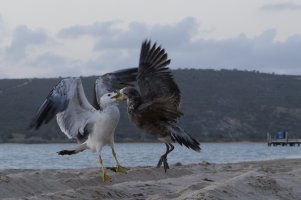
Was sitting on the beach one day and there was these gulls beside us. Suddenly a couple of them got in a fight and I quickly grabbed the camera and started shooting (I had the 100-500mm on at the time). I didn't have a clue what I was shooting but just pointed in the direction and amazingly some of the photos came ok.

_MG_2824_DxO.jpg
  • Like
Reactions: 4 users
Upvote 0

Canon Says it’s up to Sigma to Make Full-Frame RF Lenses

Take a company like Leica (yes, they do it different). They make 40 cameras a day. Major products usually take about a year to meet the demand. How much would it cost them to increase production to 60 a day? A boatload. Sigma is closer to Leica than they are to Canon. Leica's revenue is actually higher than Sigma's.
Leica's M series cameras at least are mainly a luxury gadget for rich people, so Leica may have more Louis Vuitton bag like profit margins per camera (but making the mechanics of such cameras isn't cheap). I am always amused when I meet rich Chinese guys in the streets of Frankfurt where I live (we have a big Leica store): they proudly have their brandnew Leica with a sort of Noctilux lens attached hanging around their necks - and use their smartphones for taking images :ROFLMAO: But, of course, marketing wise it was a smart move that saved Leica from bankruptcy. In fact, Andreas Kaufmann, a smart rich guy, was the one who saved Leicy, and as German I am grateful that this legendary company survived thanks to him - despite the fact that I'd never buy a Leica, too expensive for what it offers.
  • Like
Reactions: 1 users
Upvote 0

Canon RF 300-600mm Update…. Again

Yesterday, out with the R5ii/RF200-800mm, I was doing just that. A Mallard flew past the hide at its usual breakneck speed and I zoomed out to about 350mm, and I don't know how the camera was able to focus in the fraction of a second it was in view - I couldn't track it and I hardly saw it in the viewfinder. Then, I shot a Red Kite lazily soaring in the distance at 800mm. That lens is tack sharp at 600mm and below, and sharp enough at 800mm. I would be tempted by another Canon zoom, but it would have to be light enough for me to hike with and hand hold - I am most likely older than you.

View attachment 228707View attachment 228708
Alan, I like the red kite in particular - and it looks like the cloudy overcast weather in which I catched one about a week ago, but not with the RF 200-800. So the zoom served you well...
Upvote 0

Canon RF 300-600mm Update…. Again

My EF 800m f/5.6 gave great photos but due to the size I got rid of it (not helped with arthritis in my wrist).
4.5 kg was always to heavy for me, because I prefer to shoot birds hand-held. I found out, that a 3 kg lens for me personally sets the limit for shooting BIF in useable time frames before I have to put the lens down, in particular because I often pair it with a 1.4x TC III. That's why I used an old EF 500mm f/4.5 L USM for many years, before I upgraded to an EF 600mm f/4.0 III past year, which has about the same weight but is less front heavy, a gorgeous fast lens for hand-held shooting. I bought that lens used from MPB.com, btw. I buy the big glass always used, also my EF 500/4.5 many years ago. Back then, this lens already looked quite battered but was optically and technically in perfect condition (I could test it), so I got it for a decent price. It then served me through literally many 100.000s, I guess far more than a Million, shots, w/o failing (crashes, very dusty environments, combined sand & salt water spray storms on shores etc.). Canon's rugged quality turned out to be much better than Nikon's in our experience. My wife uses Nikon, and and we had so many failures with that gear, DSLR mirror stuck, several AF drives broken, failed buttons on a rainy trip that this can't be just bad luck - my wife caresses her gear much more than me; only Nikon's D500 seems to be up to Canon's quality, it never failed.
A couple of youtubers here in Oz took out the 200-800 for a spin when it first came out and did a great video on the benefits of the zoom. Yes, it needs a few turns to go from 200-800 but just the fact having the flexibility meant they could shot birds close up, but then catch BIF's at a greater distance.
Some early videos of Duade Paton and his Buddy Jan Wegener convinced me to take a plunge with the RF 200-800, since their videos are about real life wildlife photography, and they know how to shoot good images.
  • Like
Reactions: 1 users
Upvote 0

Canon EOS R7 Mark II to Have Stacked 40MP Sensor?

I once was in a pharmacy in Switzerland, proud owner of a 2 years old Leica digital M 240. The black enamel had already suffered from use, showing shining brass underneath. The pharmacist asked me if I enjoyed collecting classic cameras...;)
You see, "classic" is no rigid definition.
It's a very good point. One could say, even now, they keep "the classic Leica design."
  • Like
Reactions: 1 user
Upvote 0

Canon Says it’s up to Sigma to Make Full-Frame RF Lenses

I have a friend here in Wiltshire who is a Canon gear collector and he as pretty much every variant of every white Canon lens. It's what he does and it's his hobby. We all have our different reasons / use case scenario to buy and have certain kit and this is his. He's a really nice guys and he knows everything there is to know about each lens. Each one is pampered and looked after. He's an amazing resource and he's often keen for me to take out some of his lenses to see how I would use them. For me, it's great way of trying out some lenses for a few hours and see how they fare. He's not bothered with the RF 400L and RF 600L because they are so similar to the EF mkIII's.
Ooookkkaaayyyy. I seem to need to discuss with my friends how they seriously need to step up their hobby game. 😏
  • Like
Reactions: 1 user
Upvote 0

Canon Says it’s up to Sigma to Make Full-Frame RF Lenses

I played with one of these at “focus” at the Birmingham NEC a few years back on the Sigma stand. It was mounted on a massive fixed to the floor tripod. Because it was the trade / pro day, they let me put my own 5D3 on it, try it out and shoot a few frames. It was exciting to use but disappointing when I later looked at the files.
Guess what, it was a little bit soft at 500mm and it had noticeable back focus. Under the hall lights its af was a bit inconsistent. But hey…it’s a Sigma, what a surprise!
I enjoyed the 300-800mm they had on display too, but it needed stopping down 2/3’s of a stop to be really sharp.
Haha - but the image quality is not the point of the big green. It’s the Hulk, and no one watched the Hulk for the outstanding special effects. 😜
  • Like
Reactions: 1 user
Upvote 0

Canon Says it’s up to Sigma to Make Full-Frame RF Lenses

The big green is the Sigma 200-500 f/2.8. It was introduced after Sigma introduced their 120-300 f/2.8 and 300-800 f/5.6 lenses, weighed 35 pounds and, the last time I saw it listed, had a price of $27,000. I was posting on DP Review when it was introduced and the ridicule it got at introduction was severe. I was extremely disappointed because I wanted a 200-500 f/4. The Sigma CEO said that it was a dream of his father's and it had to be made or the father would haunt him..

It seems that this generation's oddity is the BF. Maybe they should have considered a very compact APS-C L-mount body to compete with Sony's 6X00 series and provide a market for APS-C L-mount lenses..

If Neuro is correct about the Canon-Sigma RF-mount licensing agreement, and he probably is, there is probably also a penalty clause if Sigma releases the details of that agreement, specifically the amounts of the licensing fees. Canon is hardly blameless in this situation. Buyer-seller relationships are inherently adversarial.
I played with one of these at “focus” at the Birmingham NEC a few years back on the Sigma stand. It was mounted on a massive fixed to the floor tripod. Because it was the trade / pro day, they let me put my own 5D3 on it, try it out and shoot a few frames. It was exciting to use but disappointing when I later looked at the files.
Guess what, it was a little bit soft at 500mm and it had noticeable back focus. Under the hall lights its af was a bit inconsistent. But hey…it’s a Sigma, what a surprise!
I enjoyed the 300-800mm they had on display too, but it needed stopping down 2/3’s of a stop to be really sharp.
Upvote 0

Small Mammals

Nice detail. That's a big centipede. Mongoose is thinking "lunch".
Not that big actually: I think it's 13-15 cm in length. I can't count the ## of the legs between the stones but it's probably Scolopendra subspinipes which "normally" gets up to 20cm. On Maui someone captured a specimen with length 36.6 cm (if it's the same species or it could be a very new species!) :eek:!
  • Like
Reactions: 1 user
Upvote 0

Converting RS-485 to RS-422 using optical extender with SDI Video transmission

Hello, I am currently using a Questtel SDI-over-fiber extender with RS-485 data for serial control. I have recently switched to a Canon CR-N300 camera, which provides an RS-422 interface for control. Given the differences between RS-485 (2-wire, half-duplex) and RS-422 (4-wire, full-duplex), I would like to confirm whether it is feasible to implement an RS-485 to RS-422 conversion within the signal path and maintain reliable communication over the existing fiber extender.
Specifically, can a protocol-transparent hardware converter be used in this scenario?
Any recommendations on compatible solutions for integrating RS-422 control over the current infrastructure would be greatly appreciated.

Show your Bird Portraits

6 years is a long wait. Was the P1000 any good for hummingbirds?
Only waiting for hummers since January. They accurately guessed that February was going to be nasty and bugged out (BTW, they almost always guess correctly - a skill our long-range forecasters could learn from). To your question, yes, the P1000 works pretty well for hummers, but it does take some practice, since the combination of the VC and the AF is a bit unpredictable at the long end of the lens. The R7 with the 200-800 is both better and much more consistent, but that is one of the few combos I have found that really outshines the P1000. The P1000 has much poorer pixel level performance, so you have to zoom in closer and also watch out for too much contrast given the limited dynamic range of the sensor and you need considerably more light to keep the ISO down (ISO 400 is about as far as you can push it). The P1000 also "needs" more help from Topaz to get really good results. The 200-800 does focus a few feet closer than the P1000 for equivalent useful magnification and the R7 is quite usable at ISO 6400. Those are both big deals when shooting hummingbirds. Here are a few P1000 shots as examples of what it can do. The lens on the P1000 is remarkably good, when you consider it is actually a 540mm f/8 lens at full reach and a 125:1 zoom to boot. The hawk shot was at 324mm (about 2000mm FF equivalent).

DSCN1003-Edit.jpg

DSCN1042-Edit.jpg

DSCN1468-Edit.jpg
  • Like
Reactions: 8 users
Upvote 0

Canon Says it’s up to Sigma to Make Full-Frame RF Lenses

It’s my second favorite focal length behind 85mm, it was the first lens that I was able to get the shallow depth of field in portraiture photography and once I had great bokeh, it was hard to go back.

With my background, I enjoy the physics of optics, so you are spot on, that photography has developed into an opportunity to collect gear, and I suffer from GAS, as much as the next guy.

I don’t imagine the Sigma is on par with the Canon, but I don’t do a lot of wildlife photography and the ROI on the Great Whites isn’t there for me personally. I became fond of Sigma for their build quality when I wasn’t comfortable paying the price of L glass, and thought the Sigma was a better value than the non-L Canon lenses as far as optics and build quality. Sigma took that to a new level with the introduction of their Art and Sports line of lenses. Once I started buying L lenses, I still hung on to all my Sigma lenses. I was late to the mirrorless party, as was Canon.

Plus Canon had to do a great job in the ability to adapt EF lenses to the RF mount because of its late arrival, and the lack of RF lens options, so old personal favorites such as the EF 85 1.4L still held their magic for me. Is it as good optically as the RF 85 1.2L, no, but the sentimental attachment is still there. You stay with the girl that you brought to the dance.
I have a EF 135mm f2.0 L and a EF 85mm f1.2 II L for that very reason, they are just amazing portrait lenses. The 135L is versatile and very easy to use, way easier than the 85IIL. The 85IIL needs careful use due to it's razor thin DOF, but in the right hands can produce beautiful results.

Well, if I ever need some one to ask 135mm advice from...I'll ask you! For me, I only want one lens of a certain type and for me and my personality type, I need that lens to simply be the "best of breed". The Canon Rf 135mm f1.8 LIS is a lens I greatly admire...but I actually prefer the smaller legacy EF f2.0 version.

I think the EF 85mm f1.4 LIS is actually a fair bit sharper than the older EF 85mm f1.2 II L (wide open). It's AF is vastly superior and you can crank out High Speed 12fps with it, where as the f1.2 is only 8fps and the AF struggles to keep up. However, I just love the images I get out of my f1.2 lens. I really should upgrade to the RF variant, but it's a difficult investment when the EF lens is still giving me great results.

I have a friend here in Wiltshire who is a Canon gear collector and he as pretty much every variant of every white Canon lens. It's what he does and it's his hobby. We all have our different reasons / use case scenario to buy and have certain kit and this is his. He's a really nice guys and he knows everything there is to know about each lens. Each one is pampered and looked after. He's an amazing resource and he's often keen for me to take out some of his lenses to see how I would use them. For me, it's great way of trying out some lenses for a few hours and see how they fare. He's not bothered with the RF 400L and RF 600L because they are so similar to the EF mkIII's.
  • Like
Reactions: 1 user
Upvote 0

Canon Says it’s up to Sigma to Make Full-Frame RF Lenses

First question: How much of a licensing fee would Canon want for Sigma to sell each lens in RF mount?
A figure of 30% has been suggested.

Second question: If that amount became public knowledge, what would be the effect on Canon's reputation as a good company to buy stuff from, with the choices being: Damage greatly, Damage slightly, Neutral, Benefit slightly, Benefit greatly?
I doubt that anyone outside of a relatively minuscule handful of forum participants would even know…or care. The average lens buyer wouldn’t care beyond whether or not the lenses were available. “We” do not represent the market.

Assume that a lens (1) costs $50,000 to bring it to market (also known as Non-recurring expenses or NRE) (2) but only $400 in RE (Recurring expenses) to make each additional lens (3) and sells for $600.
Do you really think a 33% margin on a $600 lens is reasonable? Seems very far fetched.

But run with that…with a 30% license fee, your hypothetical lens would then have a 3.3% margin, $20 per lens. 2,500 units just to recoup the NRE. Do you think a company planning a 50% markup would be happy giving up 90% of that in licensing fees?
  • Like
Reactions: 1 users
Upvote 0

Filter

Forum statistics

Threads
37,473
Messages
975,024
Members
24,816
Latest member
GLBDD

Gallery statistics

Categories
1
Albums
29
Uploaded media
372
Embedded media
1
Comments
25
Disk usage
1 GB