Found Canon 28-80mm f2.8 and Canon 80-200mm f2.8, thoughts?

I have both lenses. They work very well in digital cameras and quality is like the new ones. The 28 80 is USM and focus work manual or auto all the time without the need of change the slider button. Quality is better than the 24 70 2.8L that have many problems with the alignment on the camera sensor: one side is out of focus.
The 80 200 i use mainly for video, always at 2.8, and manual focus is very easy and smooth. In autofocus mode it is not an USM lens, but is very fast. And is black! Is for this reason i never changed it for a new one.
If the lenses worked well on film work well on digital.
Upvote 0

Nikon D4 for $3500 w/o Box & Warranty

neuroanatomist said:
I'm not certain it's a good idea to meet up with someone you strongly suspect is a thief, even in a public place. You may go home without the stolen camera...and without your wallet.
+1.
A favorite trick is to get someone with $$ to look, and then rob them. Even in a public place, its done all the time. Even happened in a bank!
Upvote 0

Canon abandoned EOS M?

mrsfotografie said:
ecka said:
dilbert said:
ksagomonyants said:
Sonyalpharumors.com has recently posted a link to the top-selling mirrorless and DSLR cameras in Japan http://www.sonyalpharumors.com/2013-sales-sony-nex-5r-is-the-most-sold-mirrorless-camera-in-japan/
According to this link, Canon EOS-M is the second top-selling mirrorless camera in Japan. I know it's not worldwide but anyway, it seems that Japanese like it.
Another interesting thing is that EOS Kiss X5 (T3i) is the top-selling DSLR in Japan.
DSLR percentages:
Canon share: 48.7%
Nikon share: 41.5%
Ricoh share: 3.4%
Sony share: 1.7%
Mirrorless percentages:
Olympus: 25.4%
Sony: 23.1%
Panasonic: 11.5%
Canon: 9.2%
Ricoh: 7.8%
Nikon: 5.7%
Canon's single EOS M body gets 9.2%, while Panasonic's 10 (ish) bodies are getting only 11.5%? :D
In the Netherlands, the Nikon-1 is a hot seller ;)
Then we have the solution for Canon and Nikon ending inventory of mirrorless cameras: ??? Canon sends all their stock of M for Japan, while Nikon sends all of its stock of "1" to the Netherlands. :P
Upvote 0

6D clearance sale

dgatwood said:
Doubtful. Although the 6D is a pro body, it is mostly marketed as a step-up for Rebel users who want to move to full frame. The Rebel line changes approximately annually. Based on that, I'd expect the 6D line to have a similar upgrade interval, or at worst, only a little slower.

Well then, the 6D II is already 4 months late...and counting.

dgatwood said:
With that said, I half expect Canon to fold the 7D and 6D together into a high-MP full-frame body in 2014

Exceptionally unlikely. High MP full frame paired with good AF will be a 'merger' of the 6D and 7D is in the sense that it will cost at least as much as the 6D and 7D combined. A camera like that would come in above the 5DIII in the lineup, and may well only be available as a 1-series.
Upvote 0

Developments in technology

Full-frame cameras are expensive for two reasons: economies of scale, poor fabrication yields, and inefficient use of the wafer.

Economies of scale are straightforward. When you sell more of a product, the cost of tooling up the manufacturing line is amortized over a larger number of units, as is the cost of R&D. Additionally, if you sell more of a product, yield becomes more critical (because if you sell a million units, even a 1% failure rate is a *lot* of returns), which means that you're forced to do more work up front to polish the design, which tends to pay off in the long run.

Fabrication yields are also directly affected by the die size (the chunk of silicon that turns into a single chip). The larger the die size, the more problematic flaws in the silicon wafer become. Suppose you know that 10% of the surface of the chip will be unusable (it really isn't that high—I chose a big number to make the math easier). Suppose that manifests itself as a stripe across the middle of the wafer. If that wafer has a hundred chips on it, that might affect only the ones near the center—maybe 15 chips, which gives you an 85% yield—close to the 90% ideal yield. If that wafer has only four chips on it, that same stripe might affect two of them, resulting in only a 50% yield. If you're really unlucky, it might also affect the corners of the remaining two parts, resulting in a 0% yield.

Of course, realistically, a wafer that bad would be rejected, but there are lots of random flaws that can occur when manufacturing a chip, and the flaws almost all occur in rates that are proportional to the surface area. If you know that you'll have one bad pixel out of every million and a 10 MP crop body sensor, you'd expect 10 bad pixels on average, so if you consider 20 to be the bottom acceptable limit, most of your chips will pass. If you move up to a full-frame sensor with the same density, you're now at a 25.6 bad pixels on average, and most of your chips will fail. :)

Finally, there's the question of inefficient use of the wafer. The wafer is round, which means there's some waste whenever you make a square chip on it. The bigger the chip, the bigger the waste. Now if you're careful, you might be able to print some other minor parts (e.g. voltage regulators) in the remaining space so that you don't waste as much, but otherwise, there's a significant overhead to bigger dies.
Upvote 0

Quality of Zeiss Lenses

Having been a lifetime user of Zeiss optics from my Zeiss Ikon, my Contax/Hasselblad SLR days and now using some of those lens with adapters on Canon, I can say they do make some average lens that are based on really old designs like the Sonnar or Planar for their short and middle focal lengths.

Now having said that, one can say that Zeiss has a common problem it shares with many old companies and that they rest on their laurels. They do have some exceptional lens designs, like the Distagons, like my 28mm f/2 and 35mm PC lens. Both have light falloff into the FF corners but there is little to get around this optical phenomenon, and with Photoshop, no real need to either.

Zeiss' Makro-Planars are well regarded by those who have used them, and a 50mm or 100mm version would be on my "to buy" list, if I wasn't already using my old 120mm f/4 from my Hasselblad.

To use a macro lens, you need to be careful to do all you can to reduce shake: Tripod, mirror lock-up and a remote (or self-timer) releases need to be in use.
Upvote 0

5D Mark III--What is this? Dust, smearing, fibers, . . . ?

I finally got around to having another go at cleaning my sensor. I think I'll leave well enough alone at this point. The current condition seems much improved. I see three obvious spots, and I feel comfortable ignoring them since they do not show up in "normal" (i.e., non-dust-detecting) photographs, whether the images are processed or unprocessed. Only though choosing deliberately close levels in Photoshop to look for/find/show dust do these three spots appear. This will do for now. It happens to be that the sensor is now cleaner than it was when the camera was new. That helps take the sting out of the frustration of a few days ago.

To give more information on the cleaning, I cleaned the sensor today with a Visibledust VSwab (green) moistened with VDust Plus. After taking a test shot, the smears and fibers of before were gone, though there remained a section of droplets on the right side of the image--something along the lines of what an inefficient wiper blade might leave on your windshield (windscreen).

I then wiped the sensor with a second swab moistened with Visible Dust's Sensor Clean, and that got me to what you see in the attached image. Before and after each swabbing, a Giottos Rocket Air Blower was used, and I insepcted the sensor with a VisibleDust Quasar Sensor Loupe 7x.

In the past, I was able to get a T3i Rebel sensor cleaner than what you see here, and it was when shooting the test image at f/32. Only one faint spot would show up in the photo.

For the images I've posted, I photographed an overcast daytime sky. Part of my interest in having dust-free images at f/16 is because I photograph aircraft from time to time, and the shots are taken often in the f/10 to f/16 range. With the sky as a background, dust spots are easily seen, and when there are upwards of 17 of them (which was the case with the then new T3i), removing them in post is can be a "PITA".

Practice and proper technique are important in sensor cleaning. As VisibleDust cleaning swabs are somewhat expensive (over US $40 for 12 of the green 1.0x size), there is incentive learning good technique quickly. In the meantime, I am waiting for delivery of a Lenspen SensorKlear II so that I have another option for future cleanings.

I give my sincere thanks to those who replied with their helpful comments and suggestions. I also stand with Neuro in his caution against doing more than is warranted under given contexts or circumstances.

Attachments

  • 2014-01-04-0002w.jpg
    2014-01-04-0002w.jpg
    722 KB · Views: 1,080
Upvote 0

Bracket and boom stand recommendations for 43" octagonal Apollo Orb softbox

I saw the Calumet boom and stand today. The boom has " a remote crank at the back of the arm controls the direction of the light source mounted at the other end up to 135°" (from product description). I have to say that the remote crank is a delight to use and operates smoothly. The whole apparatus can assume a smaller profile, and one need not attach the casters if frequent repositioning of equipment is not necessary. There is no doubt that this piece is more than is necessary for a 43-inch softbox and three Speedlites, but I am going with this option, as I intend to use more substantial lights and modifiers in the future. It will be my only boom, and it fits well with my current and future lighting tasks.

As always, I am grateful for the tremendously sober comments and suggestions from the members of this forum. Many thanks to you all!
Upvote 0

Price History of 300 2.8 II

why should canon rebate their big white lenses. I think that everybody who bought one, would own it until he dies ;-)
I was looking more than one year to get a uses one, but their wasn`t any offer !!!
So in May I bought a new one - it`s an awesome lens, the best lens I ever had - - I will own it for the rest of my life ;.)
The price since may is exact the same - I don´t think canon will rebate it.
Upvote 0

bad senzor on 5D mark III

I took pictures with the 5D Mark III and two years before the 5D Mark II and my final verdict is that the 5D Mark III posterize more fine detail to vibrant colors and lower noise about only a few people I rebut this opinion ... I have tried different settings and I've had enough Canon disappoint me again as well as the recent 70D which has a lot of noise even at the lowest ISO
Upvote 0

Dual CF or Combo memory slots?

I have dual memory slots in the 1D MII and didn't appreciate it for a long time. Now that the 5D MIII is here in the same format with Eye-Fi available with the firmware update I like it. The pro 16 GB card sending to a cloud storage for safe keeping... I like the idea. I've lost images when cards dies between camera body and computer. Lost my cable years ago so had no option. Even shooters clinging to older 1D * bodies can use the dual slot with Eye-Fi. I got to try it with the 1D MII. I see Live View focusing for large area photographs as a plus using a tablet or laptop to see a bigger image with more detail than the small back can show. And another + is moving forward with the faster cards of both types in the bag already.
Upvote 0

Lens dilemma for night sky

A few things.

First, if you're not viewing at full size or anything close, problems with coma, chromatic aberration, and astigmatism are less important. Resized to average web viewing can cover a lot of sins.

Second, as Nubu said, you can use tracking mounts with reduced speed if you're shooting foreground/horizon too. I've never used the 1/2x speed on my iOptron SkyTracker, but others have with good results (within reason of course, especially at reduced size).

Third, the Samyang/Rokinon f/2.8 is a wonderful lens for daytime and night ultra wide angle work. You can't get front-mounted filters for it, but I was wondering what kind you meant? If astro filters, the slot-in type (for crop sensor) are good (this is why I use it on the 50D). Other wide angle lenses may take rear-mounted gel filters.

One thing not widely discussed is ability to focus. I would use the 24-105 f/4 for astro work, but it is too dark and the magnification too low (even at Live View x10) to get accurate focus on stars at 24mm, so has never worked for me. You can try different manual focus points through trial and error - I found the Samyang's less loose focus ring easier for this. But with a wider aperture lens, the brighter image can help with focus.

Stopping down isn't always worth the effort. I have experimented with the 85 f/1.2 II at various apertures, and I'm not sure the benefits of less vignetting and distortion at narrower apertures exceeds the loss of light. Do look into flat frames, which are master images taken that can be used to cancel out most of the colour and vignetting problems (but not coma etc; NB it can be hard getting flat frames at the shortest focal lengths).

One last thing. It may be cheaper and easier, depending on where you live, and if you drive, to go to darker locations. Most of what I do in astro work is fighting light pollution. If you can go somewhere dark, any camera will take good wide angle astro images. Good luck in any case!

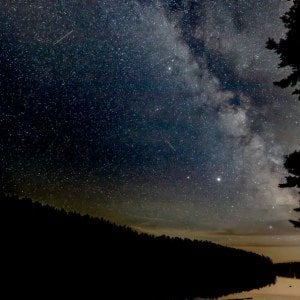
Below: Milky Way from suburbia, Samyang 14mm (70mins stacked + tracked, no darks/flats).

Attachments

  • 10563291156_cc135ef975_b.jpg
    10563291156_cc135ef975_b.jpg
    745.5 KB · Views: 332
Upvote 0

5d3/Fuji Xe 2 test

Evaluative is potentially problematic in scenes like this, for a start it is proprietary and Canon have never said how, exactly, the scene metering, and subsequent exposure, is influenced by the evaluation.

It looks to me like it automatically underexposed to protect the highlights, which most of the time would be a good thing. Obviously you needed to over expose the Canon image and under expose the Fuji image, but an interesting "test" would be to use each different exposure mode on the Canon and see what different exposures you get. If you can't chimp in a situation like this then any of the other three metering modes is going to be more consistent and predictable as there is no proprietary evaluation in the exposure calculation. Trying to outsmart Evaluative is not easy and often not intuitive.
Upvote 0

EF 400mm f/5.6L IS on the Way?

GMCPhotographics said:
mackguyver said:
kirispupis said:
Very true, but that doesn't mean I can still wish they filled it. :)

Then again from Canon's point of view:
- I purchased the 100-400
- I purchased the 70-200/2.8 II + 2x III. The image quality + AF was close enough to the 100-400 to no longer justify carrying it.
- I still wasn't happy with the image quality + AF, so I bought the 400/5.6
- I still wanted something with IS and a bit more reach, so after some time I used the money I was saving for the 600/4 II and bought a 200-400/1.4x with the justification that it is far more flexible.

So in the end Canon got a lot more money out of me than if they had just introduced a 500/5.6 IS in the first place. :)
Sounds familiar - my path was 70-300 f/4.5-5.6 IS, 70-200 f/4L IS (+1.4x II), 400 f/5.6L, 300 f/2.8L IS II + 1.4xIII & 2xIII. I will say that the 400mm had me satisfied for many years.

Lol....I passed on the 100-400 LIS, and went straight for a 400mm f5.6 L.
Then I took up a 70-200 f2.8 LIS II and 1.4x and 2x teles.
Then I sold the 400mm f5.6 L and picked up a 400mm f2.8 LIS.
Apart from the weight, I couldn't be happier!
Canon, the retailers, and eBay love us for sure!
Upvote 0

only canon, nikon and sony will survive?

TAF said:
But I think most camera companies will survive. I also think the future looks particularly bright for the first company that can produce an APS-C mirrorless camera, that has DSLR-like performance, small size and well laid out controls. Yesterday, in 35+ degree heat (>95F) and almost 100% humidity, I was sporting my little Fuji X-E1 at a local tourist attraction. I was getting a LOT of envious looks from sweaty, overburdened DSLR users.

X-E2, and the X-Pro1 replacement whatever it's called(X-Pro1s, X-Pro2, etc)
Upvote 0

My best Canon 600 mm. Lens cap replacement

surapon said:
neuroanatomist said:
The new nylon caps for the MkII supertele lenses are much easier to use than the previous pleather ones.

If you were looking for a reason to upgrade to the 600 II, maybe now you have one! ;)

Thanks you, Sir, Dear My Teacher, Mr. neuroanatomist.
Sorry, I will not Up date to New 600MM Soon, Because, The Last time that I use this 600 mm = 6-8 month ago, No, Sir, I am not the Birder or the Sports Photographer---BUT, I use just for the summer time for Shooting the Beautiful Ladies ON THE BEACH , FROM THE 10 th. FLOOR OF THE HOTEL BALCONY----hA, hA, hA---And My Wife get real up set with me , that the last summer---No, She does not up set for another Beautiful Photos, But She up set, because I just took her photos 3-4 Picture, and take 1,000 Photos of the Beautiful young Girls----Ha, Ha, Ha.
Nice to talk to you , Sir.
Happy Holiday to your family and you too.
Surapon

LOL ;D ;D ;D
Upvote 0

70-200mm F 2.8 IS 2 VS 70-200mm F4 IS

clartephoto said:
But unfortunately, I was disappointed with the 2.8 IS II. I thought it would be a "halfway point" between the 70-200 f/4L IS and the 200 f/2L IS, but unfortunately the reality was the 200 f/2L IS at f/4 has more smoother backgrounds than the 70-200 f/2.8 does at f/2.8!

Bokeh is not really the strongest point of the 70-200 2.8 II. It can get real nervous under some conditions.

I believe there always are some compromises in the design of zoom lenses. Yes even in excellent lenses such as the 70-200 II.
Upvote 0

DXOMark: Sigma 24-105 f/4 DG OS Reviewed


The Canon 24-105 is selling for $600-650 new, do you feel the Sigma is worth the 40-50% price premium?
[/quote]

Depends on your wallet... the 24-105L could go to $450 and that would not take away from what the S24-105 can still do. It's worth the money... and probably a good $200 more worth it for me. If I made money off this, I'd get a 24-70L or wait for the IS, but apart from that, I like it very much. I was on a speed boat going quite fast, snapping shots as we went along, I got almost no blurry shots... AF nailed, OS nailed. Great product.
Upvote 0

Filter

Forum statistics

Threads
37,439
Messages
973,589
Members
24,805
Latest member
chrisgphoto

Gallery statistics

Categories
1
Albums
29
Uploaded media
372
Embedded media
1
Comments
25
Disk usage
1 GB