• The Canon Rumors Forum has officially been shut down as of July 10, 2026.

    All data will be deleted on September 16, 2026.

    the ad free experience will return by July 17, 2026.

Canon Introduces New UHDgc Series of 2/3-Inch Portable Zoom Lenses for 4K UHD Broadcast Cameras

HTML:
<h3>Three New Lenses Deliver High Image Quality and Mobility</h3>
<b>MELVILLE, N.Y., April 2, 2018</b> – Canon U.S.A. Inc., a leader in digital imaging solutions, today announced the launch of three new portable zoom 4K UHD broadcast lenses<sup>1</sup>: the <b>CJ24ex7.5B</b>, <b>CJ18ex7.6B</b> and <b>CJ14ex4.3B</b>. These new additions are compatible with 4K UHD broadcast cameras that have 2/3-inch sensors. Flanking the existing UHDxs series of 4K portable broadcast lenses that deliver excellent optical performance, these three lenses usher in the newly launched UHDgc series that will broaden 4K UHD shooting options. These new lenses provide 4K UHD imaging quality at a price point that is more accessible to the majority of the broadcast market. Additionally, the new lenses provide impressive UHD optical performance while maintaining a compact and lightweight design to meet a wide range of needs for video productions that include documentaries, sports, events and news coverage.</p>
<p><!--more-->

The CJ24ex7.5B, CJ18ex7.6B and CJ14ex4.3B utilize Canon’s proprietary optical design technology featuring materials such as fluorite and Ultra-low Dispersion (UD) glass to achieve high 4K UHD performance across the entire zoom range. In addition, the lenses support the wide color gamut approved by the ITU-R BT.2020 UHD broadcasting standard<sup>2</sup>. These features are essential to HDR imaging. The lens ergonomics and digital servo operational controls are similar to previously announced Canon portable zoom lenses, providing users with maximum mobility in a variety of shooting situations.</p>
<p>“As 4K UHD origination becomes more popular in television news, the need for affordable lenses that can deliver the necessary imaging performance has grown,” said Yuichi Ishizuka, president and COO, Canon U.S.A., Inc. “The new UHDgc series of lenses provides the optical brilliance that makes Canon a leader in broadcast lenses, while at a budgetary level that will make them attainable to a large swath of the industry.”</p>
<p><b>Availability</b></p>
<p>The Canon CJ24ex7.5B and CJ14ex4.3B 4K Portable Zoom Lenses are scheduled to be available in summer 2018, while the CJ18ex7.6B lens is scheduled to be available in fall 2018*. In addition, the lenses are being shown publicly for the first time at the Canon booth (C4325) at the NAB Show 2018 in Las Vegas from April 9-12.</p>
<p>For more information please visit, <a href="https://www.usa.canon.com/internet/portal/us/home/explore/professional-video-solutions" target="blank"><b>usa.canon.com/provideo</b></a>.</p>
<span id="pty_trigger"></span>

Nikkei: Canon and Nikon to announce mirrorless pro models

HTML:
It was mentioned in the Nikkei, the worlds largest financial newspaper that both Canon and Nikon are moving towards mirrorless “pro models”.</p>
<p>We guess they are talking about full frame models here.  While short on details, it’s another interesting data point about Canon and Nikon’s future plans.</p>
<p>From <a href="https://www.nikkei.com/article/DGKKZO28850970R30C18A3EA4000/">Nikkei</a>, machine translated;</p>
<blockquote><p>Adopt high-class sensors that Canon and Nikon has on digital single lens reflex as mirrorless cameras. I was reluctant to divert a high performance sensor because I felt the opportunity of demand from the strong brand power of the SLR and the profitability, but I could not overlook the spread of the mirrorless market. Sony also pushes the backs of both companies by pushing out mirrorless and enhancing its presence in the professional market.</p></blockquote>
<p>Yeah awkward to say the least.</p>
<p>Essentially a short blurb about the fact that Sony’s mirrorless cameras are seen on the rise, and Canon and Nikon need to accelerate plans for a full frame mirrorless camera.</p>
<p> </p>
<span id="pty_trigger"></span>

Canon Patent application for more apodization filter lenses

HTML:
Canon adds another patent application for apodization filtered lenses, this time for;</p>
<ul>
<li>135/2.0</li>
<li>400/2.8</li>
<li>185/3.5</li>
</ul>
<p>I’m not sure about the utility or expense of a 400/2.8 with such a filter, but a 135/2.0 sounds interesting.</p>
<p>Japan Patent Application 2018-049102</p>
<span id="pty_trigger"></span>

Canon shows off it's new low light sensor, capable of 100fps video

HTML:
<iframe width="728" height="409" src="https://www.youtube.com/embed/mZNWt-GRD7s" frameborder="0" allow="autoplay; encrypted-media" allowfullscreen></iframe><p>Canon also released a video detailing it’s new 19um full frame low light sensor, improved from it’s first generation low light full frame sensor now capable of shooting up to 100 fps on 1080p video.</p>
<p>Canon USA also launched a new sensor portal <a href="https://www.usa.canon.com/internet/portal/us/home/explore/product-showcases/sensors">here</a>.  This portal contains a variety of information on three signature new sensors released by Canon including preliminary specification sheets and whitepapers on the following three sensors;</p>
<ul>
<li>the 120MP sensor that was previously mentioned</li>
<li>a 5MP 2/3″ Global Shutter sensor</li>
<li>a new 100fps 1080p low light sensor</li>
</ul>
<span id="pty_trigger"></span>

Canon 24-70 II f2.8 has decentered elements or not?

Hi guys,

I need some help here, after checking some of my recent shoots with my Canon 24-70 II f2.8 on my Canon 5D Mark 4 I realized the lens is quite soft on the corners in some photos at f8, could you please check the attachments and express your opinion if I should send it back for fix?

Attachments

  • IMG_4815-Edit.jpg
    IMG_4815-Edit.jpg
    3.4 MB · Views: 276
  • IMG_7135.jpg
    IMG_7135.jpg
    3.4 MB · Views: 237

Here Are Some Claimed Specifications For One of the Prototype Canon Full Frame Mirrorless Cameras [C

HTML:
<p>We’ve been receiving a lot of information lately about Canon’s upcoming full frame mirrorless camera, the following information is apparently about one of the prototype camera bodies currently being tested.</p>
<p><strong>Canon Full Frame Mirrorless Prototype Specifications:</strong></p>
<ul>
<li>Look & Feel: large grip with top LCD, very comfortable to hold; dials are very similar to those we found on the EOS 5D Mark IV.</li>
<li>Side articulating screen</li>
<li>Sensor: Upgraded version of the EOS 5D Mark IV sensor, obviously includes DPAF.</li>
<li>Frame rate: 10FPS</li>
<li>Silent shutter and 1/16000sec shutter speed is available</li>
<li>Focus control is very similar to EOS 5D Mark IV’s 61-pt AF system.</li>
<li>Dual SD card slots</li>
<li>Video Features: C-Log 1/2/3, Focus Guide</li>
<li>Formats available: 60p/30p/24p 4K (both DCI & UHD can be chosen).</li>
<li>FHD 120p</li>
<li>Weight: not very light, but similar to Sony A7 but a bit larger due to the big grip.</li>
</ul>
<p>The mount type remains the big omission from the information we continue to receive.</p>
<span id="pty_trigger"></span>

Luster vs cotton rag photo paper

I was about to make another order of photo paper from Red River Paper. Up to now I've always used luster paper, with pretty good results, but I'm curious about trying cotton rag paper. I print mostly landscapes. Anyone have any opinions on the two compared to each other? I'm concerned the colors might be less vibrant with the cotton rag stuff, since I assume it's less shiny than the luster. But it's much more expensive than the luster, so it's gotta be better, right? ;D

Canon celebrates 15th consecutive year of No. 1 share of global interchangeable-lens digital camera

HTML:
What more can be said about this? No great surprise really.  This year they held nearly half of the entire market.  It’s basically a monopoly right now.</p>
<p>TOKYO, March 28, 2018—Canon Inc. has announced today that the Company’s interchangeable-lens digital cameras (digital SLR and compact-system cameras) have maintained the No. 1 share of the global market for 15 consecutive years<sup>1</sup> from 2003 to 2017.</p>
<div class="col-md-12 col-sm-12 col-xs-12">
<p>Canon develops the key components featured in its interchangeable-lens cameras—CMOS image sensors, image processors and interchangeable lenses—in the pursuit of “Speed, Comfort and High Image Quality, the core concept of the EOS series.” The Company effectively responds to the needs of a wide range of users through its extensive lineup of cameras catering to all levels of photography from beginner to professional and a total<sup>2</sup> of 93 EF series interchangeable lenses.</p>
</div>
<div class="col-md-12 col-sm-12 col-xs-12">
<p>In 2003, the dawn of digital SLR cameras, Canon introduced its breakthrough EOS Kiss Digital (EOS Digital Rebel or EOS 300D Digital in other regions). This groundbreaking camera, which was competitively priced and featured a compact, lightweight design, captured the top share of the global market and set the stage for growth in the digital SLR market. Since that time, Canon has continued to launch a range of groundbreaking products, including the professional-model EOS-1D series and the EOS 5D series, which paved the way for digital SLR video recording. The Company has further bolstered the EOS lineup by continuing to introduce new products including accessories, interchangeable lenses and the EOS M series of compact-system cameras. During 2017, Canon introduced the EOS 6D Mark II as part of an impressive lineup of interchangeable-lens camera products<sup>3</sup> that supported the Company’s achievement of a 15th consecutive year at the top of the global market.</p>
</div>
<div class="col-md-12 col-sm-12 col-xs-12">
<p>Canon will continue to refine its diverse imaging technologies based on its core optical technology, combining still-image, video and network capabilities to expand and create an even stronger EOS System that meets the needs of increasingly diverse users to promote the spread of photo and video culture. What’s more, thanks to advances in imaging technology, Canon is opening up new expressive avenues, where texture, three-dimensionality and a sense of realism can be recreated in both still images and videos, to support appealing imaging experiences.</p>
</div>
<span id="pty_trigger"></span>

Canon C100 Mk iii - Release Date and Requested Features

Canon needs to update C100 line to make it up to date and portable at the same time. They have a new version of Digic procesors now, can add touch screen focus, better codecs than the old Avchd. C-Log2 is welcome, 10bits 4.2.2, All-I compression and many new features. Also the display and interface menu seems old even comparing to Canon Xa10 that i have. 4k it is not a must in this camera because we have C200. I want to upgrade to a new C100 or C200 in the future because i want to be able to grade the footage. If i don't want to buy the C200 as it what shoud i do? I may well go to the new Sony, Panasonic tech. Any news about a NAB 2018 release?

Canon shows off the 120MP APS-H sensor shooting video

HTML:
<iframe width="728" height="409" src="https://www.youtube.com/embed/40yruxcr-yQ" frameborder="0" allow="autoplay; encrypted-media" allowfullscreen></iframe><p>Remember that 120MP demo camera? Apparently it’s still around.  Here’s a camera with that sensor module (APS-H 120MP) shooting at 9.4fps video for advanced imagery and manufacturing applications.</p>
<p>Apparently 4k is over, bring on 13.2K ;)</p>
<p>Keep in mind that <a href="http://global.canon/en/news/2015/sep08e2.html">Canon’s been promising an actual camera with this for some time</a>, however the news gets more interesting with this video.  Going by normal development timelines, this camera should be ready to production if Canon decides to release it sometime later this year or next year.  Outside of the Canon development announcement, no other information or leaks on release have surfaced.</p>
<p>The thought of having a 120MP camera shooting 9fps leaves me a bit giddy.  It’ll be interesting to see what further develops from this.</p>
<p>While obviously this won’t interest the average consumer, the industrial possibilities are quite interesting. The ability to zoom into detail such as what we can’t do right now can lead to some interesting usages.</p>
<span id="pty_trigger"></span>

Reliable CFast cards for 1D X Mark II

Hi,

Been searching around a bit trying to decide which CFast cards to get for the 1D X Mark II. I've always used SanDisk CF and SD cards in all my cameras, but seems like there's been quite a few reliability problems with their CFast cards. Started looking into Lexar and sure enough there are issues there too. But then again perhaps this is all just a case of finding what I'm looking for (reliability issues).

There numerous discussions about this topic, however they all seem to date back to early-mid 2016. Thought I'd ask here for a more up-to-date view on what you guys have found to be reliable CFast cards to use with the camera, both for photos and 4K 50/60fps video.

Your input is much appreciated.

Auto Area AF Gone Wild

I had a hiccup yesterday when I finally had the opportunity to shoot a wild snowy owl. It was on a flagpole, and when it took off, I changed from single point AF to Auto Area. This was a simple thumb press, as I have both hooked up to different back-button-focus buttons. I've used this setup for years with no issues.

And then the lens started doing a strange, repetitive, short-distance focus racking. Perhaps three or four shifts in direction per second.

I had to follow the owl with single point. I was able to swap to my backup camera (a 5d4 with identical settings) and that one worked fine.

After the owl incident, I switched lenses on the questionable camera, and it did the same focus racking thing. I did find I could get auto area AF to work on very high contrast subjects. But not with lower contrast subjects, such as a snowy owl against the sky, or the line of a room corner leading up to the ceiling. My backup camera did these things fine.

I first figured I just have some odd setting switched on, but I literally went through the entire menu system, and there isn't anything set differently between cameras.

Could it be that there's a foreign object on the focus sensor or something? Just curious if this sounds like an obvious case of something. Thanks. -tig

Neuro has totally been holding out on us

Neuro,

Okay, SO many questions:

1) How long have you been writing at TDP?! How have we not heard this before?

2) Why am I just seeing this sweet EF-M lens reviews page at TDP now? Why isn't there an EF-M lens reviews pulldown in the 'Reviews' pulldown of the site?

https://www.the-digital-picture.com/Reviews/Canon-EF-M-Lens-Reviews.aspx

3) Why are you using your real name when you know fully well that AvTvM will find you IRL? He was just pictured heading your way below. :D

- A

Attachments

  • inyourmirrorslappers.jpg
    inyourmirrorslappers.jpg
    95.3 KB · Views: 1,393

Basic light meter questions

I'm using a 5DM3 and a Sekonic L-478D

1.) I dial in T=250, F=2.8 and the meter tells me to use an ISO of 20. The lowest ISO on the 5DM3 is 100 as far as I understand it, what do you do in this situation? Does this mean I have too much light and need to close down my aperture?

2.) I want to shoot some video so I switch to HD mode. I want to control F stop, Shutter, and f/s and let it provide me with ISO, though the way it is set up I enter the shutter, ISO, and f/s and it provides the aperture. I do not see any other options for this. How do I enter my desired aperture as a controlled value?

Thanks in advance.

Canon Cinema EOS C700 FF Coming

HTML:
<p>We<a href="http://www.canonrumors.com/an-update-on-canons-nab-2018-announcements-cr3/"> reported earlier this month that Canon’s big announcement was going to be for a modification</a> to a current camera. It looks like the Cinema EOS C700 is that camera.</p>
<p>We’re not sure if this will be something you can pay for if you’re a current Cinema EOS C700 owner, or if this will be an addition to the lineup.</p>
<p>We’ll also assume that “FF” means full frame, though the resolution is not known at the time of writing this.</p>
<span id="pty_trigger"></span>

Photos of Canon Smartphone with Integrated APS-C Sensor, Phone, Internet!

This is from an Internet source of mine in Europe who said he/she originally passed the following text and images onto Northlight Images UK (i've gotten rumor confirmations from that website before but this was sent directly to me!).

It purports to be a Canon Smartphone that is combined with a 4K video resolution APS-C sensor from the 7D mark2 and Android OS. The language is a bit flowery but again I am pretty sure the original source is from Germany and the UK as I see tells in the text that shows me the LIKELY TWO writers are English and German.

I have attached the two photos that came with the text and have perused the photos and in my opinion they look like testbed prototypes rather than finished products. They look a little too dinged up to be 3D rendered and there are some OTHER tells (I see two...can you find them too?) which make me believe they actually MIGHT BE REAL! The way they misspelled APS-C as AP-C on a consistent basis and some really flowery language shows me that at least one is not a native English-speaker. They ADMIT in the text that they have PURPOSEFULLY DISTORTED THE PHOTOS to ensure their anonymous nature.


Take a read and comment away:


Canon P5 AP-C Sensor Smartphone
Field Report from Camera Gruppe-CCHQ in Tokyo
2018-01-28

Written by Agents "Felicity" and "Uwe"

(Must unzip attached ZIP file containing two JPEG photos)
______________________________________

While in Tokyo, our review team met an industrious and very nervous technician "Innichi-san" whom we had invited to one of the many tiny and private sushi booths in this effervescent but chaotic metropolis.

He had an insane secret for us that proved beyond any rational doubt that Canon had the "Next Big Thing" in camera technology.

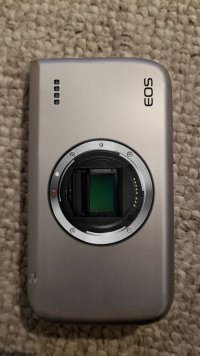
Skittish and watchful, our guest took out of what we saw to be a wooden teabox, a silver grey item wrapped in a simple cobalt blue hand-towel that initially looked rather similar to an oversized Powershot G9 series camera missing a number of vital parts.

Upon a closer look, with the four of us stuffed so uncomfortably close within this private booth, we suddenly realized we had something very special in our hands as no dials were present. No popup flash was present. No portruding lens element was present. But a very large plastic-film covered display indicating the primary function of a smartphone was most definitely present and accounted for!

Upon turning over the item over, the surprised looks within our group gave way to a most palpable "Shock And Awe" as we realized the implications of what lay present before us. The very obvious lens mount of either a Canon M5 or Canon 7D camera and a rather shallow inset box containing a large AP-C sensor but lacking any obvious mirror assembly made it immediately clear to us all that Canon has now (finally?) given us that insanely great "One More Thing..." moment.

A Silver Grey smooth finish with what we are told is a plastic prototype body containing all the elements of a 7D Mark II in a large form factor smartphone with a full-size touchscreen. By no mere coincidence, we did happen to have a Canon 7D Mark II with us as an immediate item of comparison which told us as much or more than what our nervous companion previously conveyed to us before our late lunch.

The sensor within the item was indeed the same physical size as our Canon 7D Mark II. The lens box was definitely shallower and most definitely had no mirror assembly!
And indeed, the mount itself was absolutely identical to our 7D except that the two screws that normally sit above the mount were not to be seen!

To the right of the lens mount, to the upper right corner were four inset LED lights which we assumed to be part of the on-board flash and light system for this smartphone. Our guest confirmed that it is both a camera flash and a continuously-lit flashlight similar to many current smartphone systems.

The lower right consisted of a rather large Canon "EOS" logo printed in black but otherwise identical to those present in other lower-end Canon point-and-shoot systems. Within the lower-middle edge of the smartphone was a tripod screwmount socket surrounded by four screws nearly identical in configuration to the Powershoot G9 series and with a grooved and vacant inset that also seemed identical in size and layout to the G9's electrical and power information stickers. We saw no battery insert and when pressed, our guest informed us the Lithium-Ion battery was sealed permanently inside the smartphone, but could be factory-replaced by sending in the phone to one of as-of-yet unnamed series of specialised Canon service centres.

There was a removeable clear sticker attached to the lower-left edge in landscape mode, that contained the words EOS P5 which we were told is to be the series name of this particular combined camera and smartphone device. Other versions in higher and lower price brackets are to be forthcoming. The device case and the display's plastic film covering seemed to be well used and were rather scratched and nicked which is due to the extensive in-field testing by Canon as told to us by our guest. This device shown to us is one of up to 30 such devices in current real-world testing. The final case is to be smooth metal and will not be the somewhat unfinished looking plastic case we were presented with.

Inquiring further about battery life, we were informed that 800 shots over five hours in addition to another full hour of phone calls for a total of six hours was the currently tested typical battery life. A quick charge mode of up to 80% of full charge within 2 hours was available. We were delighted to hear such impressive numbers
and even more impressed that these numbers were expected to actually improve by the time of product release.

Make no mistake, this is a very large mobile being what we measured to be about 27mm in thickness. The screen size which we did not measure, we are told in Imperial Measurement terms as being a "5.7 Inch" phone. The phone was in fact turned on in our presence and Android Nougat became the operating system version that was presented after a reasonable boot-up period. We were most impressed by the sheer clarity and brightness of the display itself. Told to us by our guest that
it is a 1920 by 1200 pixel OLED for battery life reasons, we were a tiny bit disappointed at its rather low and unusual resolution.

Abutted on the right side, when held in landscape mode, was nearly the same "joystick" button-set as on the M5 camera. In addition to the usual record button above and the menu button below, we were pleased to see and feel the ergonomic presence of the very familiar Canon M5 camera control system.

Entertaining us mightily, our guest further impressed us with a demonstration of the newer "Dark Mode" menu system that is much larger than the M5's and is fully-touchscreen. After the popup menu system hiccupped and displayed its displeasure at not having a lens attached, our guest astonished us by taking out of the tea box yet another device which we were gobsmacked to find out was the smartphone-specific detachable lens system which allowed the phone to take wideview images without any other lens. He simply twisted it onto the EF-S mount in a single motion
and by George, the viewscreen presented itself in its full clarity, it's sheer brilliance and absolutely no lag time!

While the menu system was familar, new items such as a luminance waveform monitor and RGB vectorscope overlay and a menu for zebra stripes was most evident and well-received by us.

When our guest switched over the lens while in live-view display mode to a 50 mm kit lens, we were astonished at the sheer technical brilliance of being able to instantly switch to an EF-S mount lens that is qualitatively far beyond what is on any other mobile on Earth!

A touch-moveable auto-focus box then showed us just how well DPAF works in its as-yet-unmatched wonder. Move the box overlay anywhere onscreen and the camera focuses very fast and very well indeed! Press the large silver-black button on the upper-right edge of the mobile and the usual half-press down and full press down functionality satisfied even more our already heightened senses. It was placed
perfectly and is of the optimum size to offer the excellent feedback for typical point-and-shoot operation.

We inquired as to whether video output was possible and after turning the phone to it's rightside short edge, a USB3.1 Universal plug was evident in addition to recessed and flip-tabbed dual-SIM card slots and a what were were told is a 128 Gigabyte capacity UHS-II Card Slot that is able to record up to 4K 4096 by 2160 pixels at a 1.3x crop at 60 fps into MOV container files. The recording segment time
is now fully unlimited going beyond 30 minutes. We were informed that a HDMI 2.1 port may be added by the final production date which also would offer truly clean video output at up to 60 fps 4k and 120 fps 1080p resolutions!

The truly impressive part I must say, is that the video file itself is now fully 10-bit using 4:2:2 colour samples H.264 (Not H.265?) which finally puts Canon on par with the Panasonic G5 camera series and we were able to confirm this via on-screen record settings which are brought up to the state-of-the-art at 4096x2160 at 60 fps
and 3840x2160 at 60 fps using 1.3x crop and full-sensor sampled 2048x1080 and 1920x1080 at 120 fps, and 1280x720 at 120 fps or 180 fps and the very new high frame rate (highly-cropped) 960x540 at 480 fps and 640x480 at 600 fps recording modes which should make you action-sports fanatics utterly ecstatic. These specifications bode very very well for Canon video shooters!

Most definitely not left out are the still shooters which we are pleased to inform that this mobile has specifications nearly identical to the Canon 7D Mark II with its 20.2 megapixels (5472x3648) and 22.50mm x 15.00 mm sensor size using the more-than-adequate 4.11 micron pixel pitch. ISO is Native 100 up to 16000 and is otherwise identical to the 7D MkII with its 25600 and 51200 extensions.

Yes! It most definitely has DPAF and outputs user-selectable 14-bit RAW, MRAW, SRAW, JPEG and the new-to-Canon JPEG-2000 wavelet-based files.

Continuous shooting mode is much improved over the 7D Mark II at an impressively snappy 11 fps allowing four full seconds of stills that are buffered to the storage media. Our guest indicated it is otherwise the same sensor as the 7D Mark II but uses a process that makes it considerably cheaper to manufacture. We received the impression from our guest that a Canon DIGIC series processor is not onboard and that all video and stills are processed by the Qualcomm 835 processor that is currently on the mobile device.

While we were allowed to take no photos with the mobile device itself, but we were allowed to take two photos of the camera using our own mobile. Just the lens-mount and the display sides were photographed so as to not overly cause unintended identification of our guest. We were also asked to distort the view of the phones so as to not overly cause major identifying marks or personal information to be accidentally presented. We are most happy to accommodate his requests for both anonymity and obfuscation!

After a further session of sake and sashimi, we were able to obtain and then discern the follow answers to our questions:

1. Who is this camera for?

- Enthusiast Videographers and Film Students who need a
budget 4K video camera at a less than full frame price point

- Enthusiast Stills photographers who cannot carry both a separate DSLR and Smartphone system

- Vacationers and Caravaners who want mobile phone features but with enthusiast camera capability

2. Who makes this camera?

- The mobile phone components are purported to be Original Designed and Manufactured under contract by HTC

- The display is Canon designed but manufactured elsewhere

- The imaging and onboard processing software is fully Canon's

- The AP-C sensor is essentially a 7D Mark II's but cheaper to manufacture

3. When is this camera to be announced or retailed?

- The stated announcement scenario is February 2019

4. What is its Retail Cost?

- The only price we received was in U.S. Dollars starting at $1400 U.S. or about 1100 Euros but may be higher

5. Does this Replace the Canon 7D Mark II or the Canon M5 cameras?

- No! These cameras are to be soon updated in-themselves for their
respective market segments but at higher than current specifications.

- This is an entirely new market segment directly competing with
flagship Samsung and Apple mobile telephony products.

6. What other Mirrorless Cameras or Smartphones are coming and When?

- A cheaper version of the above mobile but with a Canon "One Inch" sensor
and optical zoom but no external lens mount at a price point of 600 to 800 U.S. Dollars
announced in early to mid 2019

- A new high-end medium format sensor Cinema EOS video camera with
switchable 4k/8k video capability and larger photosites announced before NAB 2019

- Two stills-oriented Mirrorless EOS 1M series products with
medium format sensors and a newer, more robust EF-style lens mount.
One Camera is to have a greater-than 44 megapixel sensor and the second is to have
a 120 megapixels resolution announced in mid to late 2019. New larger lenses will
all have onboard night-readable LED screen for advanced metadata functionality

- The 44 megapixel camera is to have a global shutter and continuous mode shooting
of 24 or more fps and the 120 megapixel version is to have up to 8 fps in continuous mode
but no global shutter. Both will have improved DPAF and 4K video recording modes.
Low-light image gathering and low-light auto-focus capability is to be much improved
over the 1D/5D series cameras.


The new combined mobile telephony and camera device at a glance:

- Canon P5-series Smartphone with AP-C sensor

- Mirrorless with a mount for EF-S lenses.

- Resolution 20.2 Megapixels with a maximum resolution of 5472 x 3648 pixels

- 4.1 microns pixel pitch

- 27 mm body thickness

- 5.7 Inch OLED touchscreen display at 1920 by 1200 pixels resolution
No Lag during Live View.
Nearly identical imaging specifications shared with
Canon EOS 7D Mark II but has DCI 4K 10-bit 4:2:2 video!

- Currently Android Nougat Operating System and is upgradable in-field

- Selfie front camera is 1920x1080p 15/25/30 fps sensor looking much higher image quality than many we have seen

- Removable metal ring with Optical Quality Glass Cover for rear camera allowing
widescreen video and stills photo taking with no other external lens required.
Field of view is currently unknown when glass cover is attached.
5 mm lens bump when glass cover adapter is attached.

- All Canon EF-S lenses attachable when Glass cover is removed.

- 12 gigabytes of operating system memory

- one storage card UHS-II MicroSD slot 128 gigabytes maximum

- Dual SIM card slots allowing two separate mobile service providers

- Unlocked World Phone with Asia, Europe and North America GSM and 3G/4G frequencies in one device

- MOV video container format 4:2:2 10 bit H.264 video to file with embedded GOP-periodic GPS and other metadata.

- Stills have GPS and other metadata embedded into EXIF area

- Stills can be set to 14-bit RAW, SRAW, MRAW, JPEG and JPEG2000

- Qualcomm Snapdragon 835 processor (unknown processor speed but phone seemed snappy to use)

- Three colours available: Silver Grey, Solid White and Solid Black with smooth non-textured finish

- Has one USB-3.1 port with universal double rounded plug!
NO HDMI 2.1 PORT YET but may be added by final production!

- Has DPAF! Focus Box is Fully Moveable Onscreen

- Live View has no lag and has focus peaking, zebra stripes, and waveform/vectorscope overlay

- Clean 4K 4096x2160 60 fps 10-bit 4:2:2 Video Output via USB-3.1 port

- Portable multi-terabyte hard drive accessory coming after introduction
that plugs directly into USB 3.1 port for use as an external recorder
Camera/Mobile device will take care of all file and folder handling
and recording onboard the external drive using Plug and Play operation.


.
.

Attachments

  • Canon_P5_Smartphone_With_APC_Sensor_Sensor_View.jpg
    Canon_P5_Smartphone_With_APC_Sensor_Sensor_View.jpg
    254.1 KB · Views: 185
  • Canon_P5_Smartphone_With_APC_Sensor_Touchscreen_View.jpg
    Canon_P5_Smartphone_With_APC_Sensor_Touchscreen_View.jpg
    183 KB · Views: 180

5D3 date resetting.

I just got my 5D3 back from Canon service last week and have discovered a bizarre anomaly... the date resets after the camera is left off overnight. All other camera settings remain, such as file size, custom controls, etc., but the date resets to the year 2000. Now that I know about it, it is easy to set before each shoot - but it was annoying trying to sort all the images I shot last week.

Anyone ever experience this? Any ideas on how to fix it?

Thanks in advance!

Tamron says they are ready for Canon and Nikon mirrorless

HTML:
DPreview did an interview with Tamron executives at the CP+ show last month.</p>
<p>They asked the following question about, of course, Sony, and got back a rather intriguing answer.</p>
<h3>How important is the Sony customer base to you now?</h3>
<p>Very important. Everybody is going to mirrorless.<strong><em> Canon and Nikon will launch full-frame mirrorless cameras, probably in the near future. When this happens, we can easily make Canon and Nikon versions of our [native] E-mount lenses. The same design could work for [multiple mirrorless mounts].</em></strong></p>
<p>Unpacking this a bit more Tamron is assuming here that not only is Canon and Nikon going mirrorless, they are going mirrorless with a short registration distance camera mount.</p>
<p>As we have already posted today, it certainly looks like Canon is testing future mirrorless cameras, the big question left that just about everyone wants to know – what mount will it be? Will Canon disrupt the industry once again and come out with with a new mount? Will they use the EF-M mount or will they use the fact that they have over 130 million good reasons to keep with the EF mount and stay with the status quo.</p>
<p> </p>
<p> </p>
<p> </p>
<span id="pty_trigger"></span>
Keith from Northlight reviews the TS-E 50mm Macro

HTML:
<p>Keith the master of all things tilt and shift (and more!) released his review of the TS-E 50mm Macro today.</p>
<p><a href="http://www.northlight-images.co.uk/ts-e-50mm-f-2-8l-macro-review/">Please check out his review</a> for a multitude of sample photographs and information around the tilt and shift capabilities of what has seemed to turn out to be an exceptional trio of TS-E lenses from Canon.</p>
<p>His conclusions;</p>
<blockquote><p>As a basic 50mm lens the Canon TS-E50mm F2.8L Macro is an excellent sharp manual focus lens, with minimal distortions and a solid build quality warranting the ‘L’ name.</p>
<p>Then again you’re not buying a lens like this just to add to your 50mm lens collection – it’s all the ‘other stuff’ it does that makes you want a specialty lens like this (and the other TS-E lenses).</p></blockquote>
<p class="fs16 OpenSans-600-normal product-highlights-header"><a href="https://bhpho.to/2wv6j64">Product Highlights</a></p>
<ul class="top-section-list" data-selenium="highlightList">
<li class="top-section-list-item">EF-Mount Lens/Full-Frame Format</li>
<li class="top-section-list-item">Aperture Range: f/2.8 to f/32</li>
<li class="top-section-list-item">Two Ultra-Low Dispersion Elements</li>
<li class="top-section-list-item">One Aspherical Element</li>
<li class="top-section-list-item">Air Sphere and Subwavelength Coatings</li>
<li class="top-section-list-item">Maximum Tilt: +/- 8.5°</li>
<li class="top-section-list-item">Maximum Shift: +/- 12mm</li>
<li class="top-section-list-item">Minimum Focusing Distance: 10.6″</li>
<li class="top-section-list-item">Maximum Magnification: 0.5x</li>
</ul>
<blockquote><p> </p></blockquote>
<span id="pty_trigger"></span>

Lens for Crater Lake NP

My family and I are planning on visiting national parks in the Pacific Northwest including Crater Lake National Park this summer, and I've started looking into what focal lengths would be useful. I've seen a few webpages stating that an UWA lens is a must, but how wide of a lens is useful for Crater Lake NP? Is 16mm on FF wide enough or would a 11-24 or fisheye be useful?

Canon applies for WiFi certification for a number of cameras

Nokishita Camera today released a slew of information that was obtained from wifi test data for some upcoming cameras coming out for Canon.

The details are pretty vague at this time, as is the time frame, as Nokshita notes, this could be far looking data, out up to TWO years. This doesn't mean we're looking until 2021 before mirrorless full frame is released, just that unlike the certification authority leaks with model numbers and usually assembled kit packages, this is more in advance.

Some are getting rather breathless about this; but this also may point to bodies down the road from an initial release.

K424
Interchangeable lens camera
Full sizeFull Frame
Wi-Fi · Bluetooth installed
It is described as mirrorless image size (6720 × 4480) in the test data (since the detail column is filled with almost the same data as 5D Mark IV [K349], the image size may be a dummy possibility)
K433
Interchangeable lens camera
Wi-Fi · Bluetooth installed
It is described as mirrorless full sizefull frame in the test data (it is the same as the data of K424, so it is possible that the initial setting data was diverted for testing)

These two cameras are suggesting that 30MP test mirrorless cameras were submitted for Wifi connection tests. These may or may not be actual cameras that even hit the shelves, however, it's further proof that Canon is actively testing and readying full frame mirrorless camera(s). If you ever had doubts that Canon was testing these cameras, you shouldn't have them now.

A bunch of other cameras also hit the WiFi certification;

K436
Lens interchangeable camera (probably single lens reflex)
Wi-Fi · Bluetooth installed

K437
Lens interchangeable camera (probably single lens reflex)
Wi-Fi · Bluetooth installed
These could point to the 7D Mark III or a 90D camera or a rebel, it's nearly impossible to guess at this point in time.

There is also a bunch of compacts and what appears to be an APS-C Mirrorless. The M5 is certainly nearing replacement after the M50 was released, however, given the fact that this is in the future data that could be a year or more away, it's unknown any of these models could be current model replacement cameras.

EC801
Compact digital camera
Wi-Fi · Bluetooth installed
EC804
Compact digital camera
Wi-Fi · Bluetooth installed
More functions than EC 801 and EC 805 (probably G series)
EC 805
Compact digital camera
Wi-Fi · Bluetooth installed
EC 811
Mirror-less camera
Wi-Fi · Bluetooth installed

What do you all think? Do keep in mind, the following as Nokishita mentions;

Looking at the past data, it seems to be announced within approximately two years from the start of connection test if commercialized.

  • Locked
New camera registrations outed? *Possibly FF mirrorless?*

Someone care to comment on this latest nugget that surfaced?

https://goo.gl/w9jGwh

I can't tell if this is some red hot tell a FF mirrorless rig with a 5D4 sensor has just been outed, if these are just existing models being re-registered for kitting reasons, or if this is just normal regulatory noise/chatter for consumer electronics.

Would someone with stronger Japanese than Google take a bite at this, please?

- A

P.S. CR Guy: sorry to link Noki.shita but it seemed juicy enough to break protocol. ;)

Filter

Forum statistics

Threads
37,480
Messages
975,426
Members
24,816
Latest member
GLBDD

Gallery statistics

Categories
1
Albums
29
Uploaded media
372
Embedded media
1
Comments
25
Disk usage
1 GB