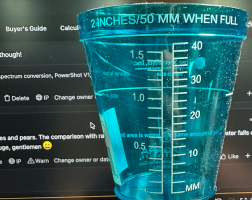
The exact same amount of light
per unit area hits both the full frame and APS-C crop portion of the sensor. But the APS-C area of the sensor (whether it's a FF camera in crop mode or an APS-C sensor in a different camera) is smaller than the area of the FF sensor and the smaller area collects less total light.
There's a reason I used the analogy of rain falling on two containers, one with a larger opening than the other. It's the same analogy used by many websites that explain these concepts. Most people can easily understand that with the same rate of rain falling on the two containers, the larger container will collect more water than the smaller container. In the same way, with the same flux of light falling on two different sized sensors, the larger one will collect more light than the smaller one. You are arguing that the smaller container will collect the same amount of water as the larger container, and that's simply wrong.
Your point is incorrect. Consider the case of the R5 using the full sensor vs. in crop mode. How are the exact same pixels less efficient in measuring light? Sorry, that's ridiculous. The pixels are the same, there are just fewer of them in the smaller area used in crop mode. The smaller area collects less total light.
The smaller sensor area collects less light. Rain in cup vs. rain in a bucket. It's that simple.
The R5 has a pixel size of 4.4 µm. For simplicity, let's say that a full frame lens mounted on the R5 is delivering 1000 photons per 4.4 µm during a 1/60 s exposure at f/2.8. The 45 million pixels will thus collect a total of 45 billion photons. If the R5 is used in crop mode for the same scene with the same exposure setting, the 'brightness' of the image will be identical, but the image will be smaller (17.3 MP) and a total of 17.3 billion photons will be collected during the exposure. Smaller sensor area, less light collected. Period.
You fail to understand. The larger container ('bucket') is the FF sensor, the smaller container ('cup') is the APS-C sensor.
You seem fixated on pixels, that's fine. To extend the analogy, imagine that you take some 0.5 cm diameter test tubes and tape them together in an array the size of a 16 cm cup, and take a smaller number of those 0.5 cm diameter test tubes and tape them together in an array the size of a smaller 10 cm cup. Now put those two arrays out in a steady rain for a few minutes. Which of those two arrays will collect more water – the set of ~920 test tubes in the larger array, or the set of ~340 test tubes in the smaller array? You are saying they will collect the same amount of water, and that's wrong.
View attachment 229709
The correct answer is that the larger array of those same-sized test tubes (on the left) will collect more total light than the smaller array (on the right).
APS-C crop mode on an FF sensor will have the same noise as an APS-C sensor. In that case, the areas used to capture the image are identical. That's the whole point. Image noise is inversely proportional to sensor area. Same size sensor, same noise.
You can compare images however you want, for your own purposes. There is an accepted methodology in the field, which is what I follow and adhere to in my explanation of these concepts.
A single smaller pixel collects less light than a single larger pixel. If you want to compare images at the level of single pixels, you go ahead. I term those who do so measurebators. Have fun at that.
When you take a few million pixels and use them to make a picture, the size of the pixels doesn't make a meaningful difference in the noise or the amount of light collected.
Which of these two identically-sized 'bucket' arrays of test tubes will collect more water – the one with the larger test tubes (left) or the one with the smaller test tubes (right)?
View attachment 229710
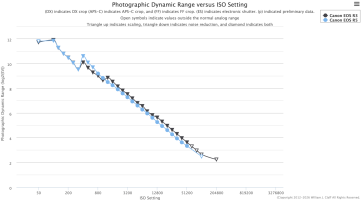
The correct answer is that the two arrays will collect practically the same amount of rain water. Just like a 45 MP and a 24 MP full frame sensor will collect the same amount of light and have the same image noise.



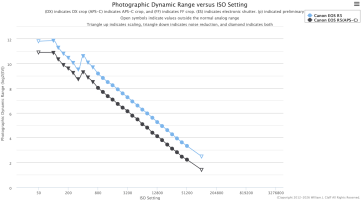
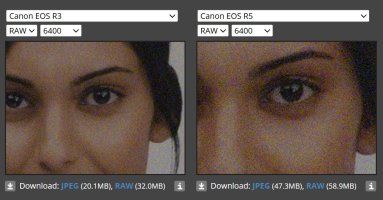
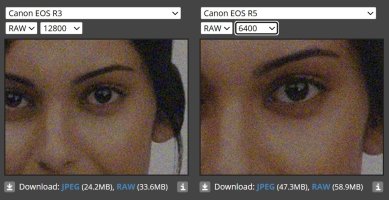
 The reality is that you’re losing over a stop of light with APS-C compared to full frame. Along with the smaller FoV (effective increase in focal length), you get 1.3-stops more noise. So, for example, ISO 3200 on APS-C looks like ISO 8000 on FF.