What’s Coming Next from Canon?

Ahhh, yes…the free lunch that comes with a smaller sensor. Truly magical. ;) The reality is that you’re losing over a stop of light with APS-C compared to full frame. Along with the smaller FoV (effective increase in focal length), you get 1.3-stops more noise. So, for example, ISO 3200 on APS-C looks like ISO 8000 on FF.
Can you explain how you get the idea that you lose light on APS-C? It's the same as if you have a full-frame picture in Photoshop and you take a 1.6 crop out of it. Where did you lose a stop of light? And how would the field of view add more noise?

You're right that ISO 3200 looks like ISO ~8000 on full frame, but that's not because you lose light nor because of FOV. The only thing adding more noise is the fact that APS-C sensor pixels are way smaller and thus less effective in determining brightness values. At the same resolution, APS-C sensor pixels are 1.6x smaller and thus about 2.56x (1.6 squared) less effective in capturing a brightness value. Multiply the ISO by that factor, and you get exactly that equivalent ISO: 8192.

Take a crop from a high megapixel camera like the R5, and you get roughly the same noise as an 18 megapixel APS-C camera delivers. Compare a newer APS-C like R10 to an old 5D, and you roughly have the same noise. Because light is not a factor, it's the sensor pixel efficiency.
 
Last edited:
Upvote 0
Can you explain how you get the idea that you lose light on APS-C? It's the same as if you have a full-frame picture in Photoshop and you take a 1.6 crop out of it. Where did you lose a stop of light?
Put a small cup and a large bucket out in the rain, in a fixed amount of time which vessel will collect more water? A smaller sensor will collect less light. It's that simple.

And how would the field of view add more noise?
It doesn't.

You're right that ISO 3200 looks like ISO ~8000 on full frame, but that's not because you lose light nor because of FOV. The only thing adding more noise is the fact that APS-C sensor pixels are way smaller and thus less effective in determining brightness values. At the same resolution, APS-C sensor pixels are 1.6x smaller and thus about 2.56x (1.6 squared) less effective in capturing a brightness value. Multiply the ISO by that factor, and you get exactly that equivalent ISO: 8192.
No, pixel size is irrelevant. Sensor size determines total light gathered, image noise is inversely proportional to total light gathered.

Take a crop from a high megapixel camera like the R5, and you get roughly the same noise as an 18 megapixel APS-C camera delivers.
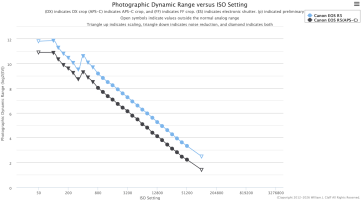
Dynamic range is primarily determined by the noise floor. If what you say is true, then an APS-C crop from the R5 sensor would have the same noise floor, and thus the same dynamic range, as the full frame image. It doesn't.

Screenshot 2026-05-25 at 12.02.43 AM.png

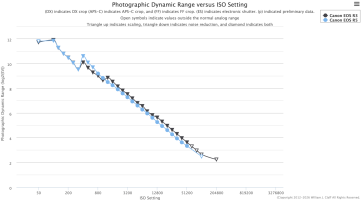
Likewise, if smaller pixels mean more noise as you suggest above, then larger pixels will have less noise, and an image from a similar-generation camera with smaller pixels and the same size sensor will have more noise and thus less dynamic range. It doesn't.

Screenshot 2026-05-25 at 12.03.07 AM.png

Same size pixels, smaller sensor area = more noise and less DR. Smaller pixels, same sensor area = same noise and same DR.

One key point for all of the above is that you actually have to compare the resulting images at the same output size. You mentioned cropping an image in Photoshop, which is conceptually similar to using crop mode on a FF camera but not identical. To actually compare, you'd need to first crop the image, then resize it to the same dimensions as the original. You don't 'lose light' in Photoshop when doing that, but if you were using a negative and an enlarger, you would get a dimmer image after enlargement. It's the same underlying basis as the circle of confusion for depth of field (which is why, for example, an APS-C sensor will actually have a slightly shallower DoF than a FF sensor at the same subject distance).
 
  • Like
Reactions: 1 users
Upvote 0
A smaller sensor will collect less light.
The exact same amount of light hits the sensor; it doesn't collect less light, it doesn't lose light. It is simply less efficient in measuring light. That's my point. Saying you lose light is incorrect because the projected image of the lens doesn't magically turn darker just cause you change the sensor size. It's a simple thing that many people fail to understand. You're just taking a smaller area from the projected image; it's the same as cropping in post.
No, pixel size is irrelevant.
You contradict yourself. In your first paragraph, you talk about bucket sizes. Then you say pixel size is irrelevant. Please pick one, you can't have both.

If what you say is true, then an APS-C crop from the R5 sensor would have the same noise floor, and thus the same dynamic range, as the full frame image. It doesn't.
Not at all what I said, I said the crop has the same noise as an APS-C camera.
Likewise, if smaller pixels mean more noise as you suggest above, then larger pixels will have less noise, and an image from a similar-generation camera with smaller pixels and the same size sensor will have more noise and thus less dynamic range. It doesn't.
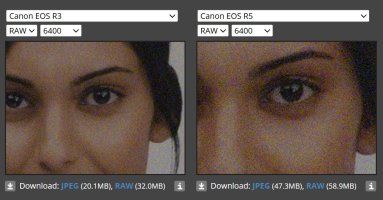
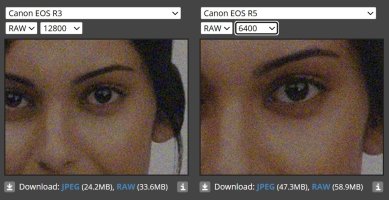
The PDR chart normalizes the data to a standard print size, so you can't really compare high-res to low-res because they basically scale it down, which merges pixels. To get a better idea of sensor-pixel performance, you might wanna look at real-world pictures, where the R3 has roughly a stop of noise advantage, if we ignore the higher resolution of the R5. Thus, proving the point that smaller pixels are less efficient in measuring light.

Screenshot 2026-05-25 170112.jpg
Screenshot 2026-05-25 171114.jpg
 
Upvote 0
The exact same amount of light hits the sensor; it doesn't collect less light, it doesn't lose light. It is simply less efficient in measuring light. That's my point. Saying you lose light is incorrect because the projected image of the lens doesn't magically turn darker just cause you change the sensor size. It's a simple thing that many people fail to understand. You're just taking a smaller area from the projected image; it's the same as cropping in post.

You contradict yourself. In your first paragraph, you talk about bucket sizes. Then you say pixel size is irrelevant. Please pick one, you can't have both.


Not at all what I said, I said the crop has the same noise as an APS-C camera.

The PDR chart normalizes the data to a standard print size, so you can't really compare high-res to low-res because they basically scale it down, which merges pixels. To get a better idea of sensor-pixel performance, you might wanna look at real-world pictures, where the R3 has roughly a stop of noise advantage, if we ignore the higher resolution of the R5. Thus, proving the point that smaller pixels are less efficient in measuring light.

View attachment 229696
View attachment 229697
@neuroanatomist is correct in stating that a smaller sensor collects less light, and he is not contradicting himself about pixel size being irrelevant for overall sensor area but being different for individual pixels. I leave it to him to explain. Basically, you are confusing photons per unit area to total photons which requires multiplying photons per unit area by the area.
 
  • Like
Reactions: 1 users
Upvote 0
The exact same amount of light hits the sensor; it doesn't collect less light, it doesn't lose light. It is simply less efficient in measuring light.


Not at all what I said, I said the crop has the same noise as an APS-C camera.
Aha ... So by your logic, the crop suddenly becomes less efficient in measuring light, but the same amount of photons hit the cropped area of the sensor as the entire sensor ... Brilliant. 🙄
 
  • Like
Reactions: 1 user
Upvote 0
Don't you worry!
You've got so many other bitingly sharp "things" in Australia...:p
blue ringed octopus at night are so cute… just make sure you wear a full wetsuit and gloves!

1 fatal snake bite per year, 6 fatal shark attacks per year this decade.
zero fatal spider bites since 1979
Horses is deadliest at 220/year then cows at 90/year
1200 road deaths per year!

That said, I pulled the pin and bought the rf20/1.4 new after getting 28% off RRP. Just in time before a Uluru workshop in a couple of weeks. With permission to shoot at night should be awesome!
 
  • Like
Reactions: 1 user
Upvote 0
The exact same amount of light hits the sensor; it doesn't collect less light, it doesn't lose light.
The exact same amount of light per unit area hits both the full frame and APS-C crop portion of the sensor. But the APS-C area of the sensor (whether it's a FF camera in crop mode or an APS-C sensor in a different camera) is smaller than the area of the FF sensor and the smaller area collects less total light.

There's a reason I used the analogy of rain falling on two containers, one with a larger opening than the other. It's the same analogy used by many websites that explain these concepts. Most people can easily understand that with the same rate of rain falling on the two containers, the larger container will collect more water than the smaller container. In the same way, with the same flux of light falling on two different sized sensors, the larger one will collect more light than the smaller one. You are arguing that the smaller container will collect the same amount of water as the larger container, and that's simply wrong.

It is simply less efficient in measuring light. That's my point.
Your point is incorrect. Consider the case of the R5 using the full sensor vs. in crop mode. How are the exact same pixels less efficient in measuring light? Sorry, that's ridiculous. The pixels are the same, there are just fewer of them in the smaller area used in crop mode. The smaller area collects less total light.

Saying you lose light is incorrect because the projected image of the lens doesn't magically turn darker just cause you change the sensor size. It's a simple thing that many people fail to understand. You're just taking a smaller area from the projected image; it's the same as cropping in post.
The smaller sensor area collects less light. Rain in cup vs. rain in a bucket. It's that simple.

The R5 has a pixel size of 4.4 µm. For simplicity, let's say that a full frame lens mounted on the R5 is delivering 1000 photons per 4.4 µm during a 1/60 s exposure at f/2.8. The 45 million pixels will thus collect a total of 45 billion photons. If the R5 is used in crop mode for the same scene with the same exposure setting, the 'brightness' of the image will be identical, but the image will be smaller (17.3 MP) and a total of 17.3 billion photons will be collected during the exposure. Smaller sensor area, less light collected. Period.

You contradict yourself. In your first paragraph, you talk about bucket sizes. Then you say pixel size is irrelevant. Please pick one, you can't have both.
You fail to understand. The larger container ('bucket') is the FF sensor, the smaller container ('cup') is the APS-C sensor.

You seem fixated on pixels, that's fine. To extend the analogy, imagine that you take some 0.5 cm diameter test tubes and tape them together in an array the size of a 16 cm cup, and take a smaller number of those 0.5 cm diameter test tubes and tape them together in an array the size of a smaller 10 cm cup. Now put those two arrays out in a steady rain for a few minutes. Which of those two arrays will collect more water – the set of ~920 test tubes in the larger array, or the set of ~340 test tubes in the smaller array? You are saying they will collect the same amount of water, and that's wrong.

AreaMatters.jpg

The correct answer is that the larger array of those same-sized test tubes (on the left) will collect more total light than the smaller array (on the right).

Not at all what I said, I said the crop has the same noise as an APS-C camera.
APS-C crop mode on an FF sensor will have the same noise as an APS-C sensor. In that case, the areas used to capture the image are identical. That's the whole point. Image noise is inversely proportional to sensor area. Same size sensor, same noise.

The PDR chart normalizes the data to a standard print size, so you can't really compare high-res to low-res because they basically scale it down, which merges pixels. To get a better idea of sensor-pixel performance, you might wanna look at real-world pictures, where the R3 has roughly a stop of noise advantage, if we ignore the higher resolution of the R5. Thus, proving the point that smaller pixels are less efficient in measuring light.
You can compare images however you want, for your own purposes. There is an accepted methodology in the field, which is what I follow and adhere to in my explanation of these concepts.

A single smaller pixel collects less light than a single larger pixel. If you want to compare images at the level of single pixels, you go ahead. I term those who do so measurebators. Have fun at that.

When you take a few million pixels and use them to make a picture, the size of the pixels doesn't make a meaningful difference in the noise or the amount of light collected.

Which of these two identically-sized 'bucket' arrays of test tubes will collect more water – the one with the larger test tubes (left) or the one with the smaller test tubes (right)?

PixelSizeDoesNottMatter.jpg

The correct answer is that the two arrays will collect practically the same amount of rain water. Just like a 45 MP and a 24 MP full frame sensor will collect the same amount of light and have the same image noise.

 
  • Like
Reactions: 2 users
Upvote 0
The exact same amount of light per unit area hits both the full frame and APS-C crop portion of the sensor. But the APS-C area of the sensor (whether it's a FF camera in crop mode or an APS-C sensor in a different camera) is smaller than the area of the FF sensor and the smaller area collects less total light.

There's a reason I used the analogy of rain falling on two containers, one with a larger opening than the other. It's the same analogy used by many websites that explain these concepts. Most people can easily understand that with the same rate of rain falling on the two containers, the larger container will collect more water than the smaller container. In the same way, with the same flux of light falling on two different sized sensors, the larger one will collect more light than the smaller one. You are arguing that the smaller container will collect the same amount of water as the larger container, and that's simply wrong.


Your point is incorrect. Consider the case of the R5 using the full sensor vs. in crop mode. How are the exact same pixels less efficient in measuring light? Sorry, that's ridiculous. The pixels are the same, there are just fewer of them in the smaller area used in crop mode. The smaller area collects less total light.


The smaller sensor area collects less light. Rain in cup vs. rain in a bucket. It's that simple.

The R5 has a pixel size of 4.4 µm. For simplicity, let's say that a full frame lens mounted on the R5 is delivering 1000 photons per 4.4 µm during a 1/60 s exposure at f/2.8. The 45 million pixels will thus collect a total of 45 billion photons. If the R5 is used in crop mode for the same scene with the same exposure setting, the 'brightness' of the image will be identical, but the image will be smaller (17.3 MP) and a total of 17.3 billion photons will be collected during the exposure. Smaller sensor area, less light collected. Period.


You fail to understand. The larger container ('bucket') is the FF sensor, the smaller container ('cup') is the APS-C sensor.

You seem fixated on pixels, that's fine. To extend the analogy, imagine that you take some 0.5 cm diameter test tubes and tape them together in an array the size of a 16 cm cup, and take a smaller number of those 0.5 cm diameter test tubes and tape them together in an array the size of a smaller 10 cm cup. Now put those two arrays out in a steady rain for a few minutes. Which of those two arrays will collect more water – the set of ~920 test tubes in the larger array, or the set of ~340 test tubes in the smaller array? You are saying they will collect the same amount of water, and that's wrong.

View attachment 229709

The correct answer is that the larger array of those same-sized test tubes (on the left) will collect more total light than the smaller array (on the right).


APS-C crop mode on an FF sensor will have the same noise as an APS-C sensor. In that case, the areas used to capture the image are identical. That's the whole point. Image noise is inversely proportional to sensor area. Same size sensor, same noise.


You can compare images however you want, for your own purposes. There is an accepted methodology in the field, which is what I follow and adhere to in my explanation of these concepts.

A single smaller pixel collects less light than a single larger pixel. If you want to compare images at the level of single pixels, you go ahead. I term those who do so measurebators. Have fun at that.

When you take a few million pixels and use them to make a picture, the size of the pixels doesn't make a meaningful difference in the noise or the amount of light collected.

Which of these two identically-sized 'bucket' arrays of test tubes will collect more water – the one with the larger test tubes (left) or the one with the smaller test tubes (right)?

View attachment 229710

The correct answer is that the two arrays will collect practically the same amount of rain water. Just like a 45 MP and a 24 MP full frame sensor will collect the same amount of light and have the same image noise.
And gapless microlenses collect the light that hits the 'borders' in your graphic, which used to be a big contributor to high resolution sensors being noisy.
 
Upvote 0