If Canon says they have an 8k camera on their R roadmap, it does not mean it is on the 2019 roadmap. Or even 2020. Maybe they have a 5 year roadmap, who knows.
Upvote
0
Yes, my mistake in thinking 8k was really 8k and not 7.6k
I would be interested in why you assume that a sensor that can do 8K video take better stills? I'm curious.
I never understood this kind of thinking. Ok, maybe you cannot buy an 8K monitor now but you can do it in 5 years? I agree it's a niche feature and not many computers will be able even to process it but in 5 years 8K could be like 4K now.
I can already see an usage for it: to extract 30MP stills from short video clips where fast action happens.
Sure, but it won’t be usable as video.if you expect extracted stills to be sharp, then a very high shutter speed is required. can video be captured at 1/2000s shutter speed?
===
The final Canon8K body pixel count may even be a 3:2 aspect ratio 9000 x 6000 pixel (54 megapixel) to satisfy the Phase One-in-a-Canon-Body Fans!
.
You Shall See Soon Enough!
.
REMEMBER! YOU HEARD IT HERE FIRST !!!!
.
Sure, but it won’t be usable as video.

in 2013 the average price for a 4k tv was $8,000. In 2018 it was $943.there are already 8K tvs on the market. have been for a year. they are still extremely expensive and there is almost zero content but it is coming.
exactly my point.. how one can extract stills out of fast action videos if each individual frame was captured at 1/60s shutter speed or whatever speed that might be. I am not a videographer, sorry. to capture fast action each frame has to be captured at a much faster shutter speeds unless the blur is what one intended to capture.

8K isnt about delivering in 8k, its about downsampling (and cropping and recompose if needed) to 4k.=)Really so where do I buy an 8K monitor or smart TV to watch the video from this camera. Being a 100% still shooter I wish they would make investments in better sensors than this Niche stuff.
if you expect extracted stills to be sharp, then a very high shutter speed is required. can video be captured at 1/2000s shutter speed?
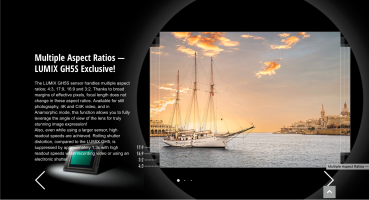
Yes, it maximizes the format possibilities as opposed to a regular m4/3 that works like all other sensors with a simple crop. The maximum area that can be covered in any aspect ratio is used, as you go narrower it goes wider. Very cool engineering solution and means the actual area used off a m4/3 sensor is close to bigger sensors that are simple crops.

You can always shoot your video at more than 30fpsIt most certainly can, the result is more of a studder look, but I've gotten by with it in interviews without anyone else noticing the issue. Typically, filmmakers choose a 180 degree shutter, meaning 30 fps with 1/60 shutter. With a 180 degree shutter, you can still get some clear and sharp photos, it just takes a little scrolling to find one without much movement.
I recently set aside the GH5 and used the 5D with RAW video for a music video with a shutter of 1/50. Even with camera movement, I was able to extract a few raw 2 megapixel photographs, nobody complained about the resolution or shutter. They were used for websites and social media, not print.

The standard M43 specifications already maximizes the format possibilities by providing 4:3, 3:2 and 16:9 formats; the 4:3 ration of the sensor chosen for this optimization. Can you elaborate on what you mean by " it maximizes the format possibilities as opposed to a regular m4/3"?
@jayphotoworks and @crazyrunner33, thanks for correcting my misunderstanding of the effects of a high shutter speed during video capture on the usability of the resulting video footage. The example was particularly helpful. The choppiness at ‘action-stopping’ shutter speeds of 1/2000 and up is noticeable, but not really all that bad – and for some action shooting might even convey a desirable ‘edginess’ to the footage.Sure, but it won’t be usable as video.

Far more than a year away. Development like this takes 5 years. A sensor that can readout 30, 60, 0r 120 fps at 8K is not trivial. They exist, but need a huge power supply to run the computer. Not for a small camera. You can, of course do 8k with a camera if you cheat and uprez from a lower resolution display. Expect to see some of that.You mean,
More like, always a year away. Goddamn canon....
8k resolution appears be the ideal intersection of video and stills sensor development. I'd like to see that as the standard going forward accross the industry. The sooner we get there the better!
Although it seems counter-intuitive. Canon might do better reading out an 8K sensor at 1:1 than they do trying to down-sample their current 6.5k sensors to 4K.
Yes. It's a tremendous amount of data to read off the sensor and write through the I/O. But, IMO, the empasis should be on the camera being a capture and recording device not a device for image processing. Processing can be down downstream on a device more suited to that job.That's a good point, just like with the 4K on their cinema cameras. It's the reason the 5D Mark III can record a variation of 3.5K RAW. There'd still be a big hurdle on the encoder they use and the sensor readout speed.