Over in FredMiranda's forums, cgarcia has done the analysis on an ISO 100 RAW from the 90D and come up with preliminary dynamic range numbers. There should be enough RAW's out there in the wild to see photonstophotos also come up with their DR analysis soon I would imagine. From FredMiranda...
www.canonnews.com
I'm really looking forward to seeing what Bill Claff comes up with.
Over in FredMiranda's forums, cgarcia has done the analysis on an ISO 100 RAW from the 90D and come up with preliminary dynamic range numbers. There should be enough RAW's out there in the wild to see photonstophotos also come up with their DR analysis soon I would imagine. From FredMiranda...
www.canonnews.com
I'm really looking forward to seeing what Bill Claff comes up with.
I am very suspicious about the analysis on the FM site. The DR at high iso with efficient modern sensors, which are of very similar efficiency, is limited mainly by the photon flux and at any given high iso is nearly the same for all the leading makes and for their different models for the same size sensor. And FF are about an ev higher than APS-C. The FM analysis has nearly an ev increase of the 90D over the 80D, putting it close to that of the 5DIV and 1DXII and leaping ahead of Nikon and Sony APS-Cs by more than you thinks the physics would allow
I am very suspicious about the analysis on the FM site. The DR at high iso with efficient modern sensors, which are of very similar efficiency, is limited mainly by the photon flux and at any given high iso is nearly the same for all the leading makes and for their different models for the same size sensor. And FF are about an ev higher than APS-C. The FM analysis has nearly an ev increase of the 90D over the 80D, putting it close to that of the 5DIV and 1DXII and leaping ahead of Nikon and Sony APS-Cs by more than you thinks the physics would allow
Maybe they have worked out a way of including the dual pixel data in such a way as to not lose it to the highlights, that alone would add nearly one full stop of DR.
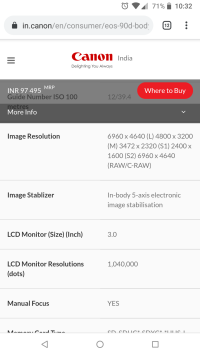
When I first looked at 90D specifications in Canon India website, I couldn't believe Canon has provided IBIS for 90D.
After looking at US site and 90D manual and no mention of IBIS anywhere else, seems to be just incorrect information on Indian website.
When I first looked at 90D specifications in Canon India website, I couldn't believe Canon has provided IBIS for 90D.
After looking at US site and 90D manual and no mention of IBIS anywhere else, seems to be just incorrect information on Indian website.
Maybe they have worked out a way of including the dual pixel data in such a way as to not lose it to the highlights, that alone would add nearly one full stop of DR.
If you have a full well size of about 32000 electrons and perfect A/D, you could get 15 stops of DR, so that is the upper limit. Of course we have read noise and imperfect conversions..... perhaps with a new on chip conversion and combining the dual pixels they MIGHT make it to 12, but I would not believe anything past that.
I am very suspicious about the analysis on the FM site. The DR at high iso with efficient modern sensors is limited by the photon flux and at any given high iso is nearly the same for all the leading makes and for their different models for the same size sensor. And FF are about an ev higher than APS-C. The FM analysis has nearly an ev increase of the 90D over the 80D, putting it close to that of the 5DIV and 1DXII and leaping ahead of Nikon and Sony APS-Cs by more than you thinks the physics would allow
Yep, I believe what we're actually going to see is closer to the Nikon D7500 in which the very noticeable 1EV dip in read noise starting from ISO 400 certainly does not transfer to 1EV improvement in high ISO performance (though it gives a ~½ stop boost at ISO 400 to 800)! Incidentally, there's a similar dip in all modern SoNikon sensors, probably indicating a dual-amp architecture of some sort. Somewhat ironically, that also makes the sensors decidedly non-ISO invariant at low ISOs. Apparently that's not in vogue anymore.
ISO invariance was always a stupid meme pushed by DPReview. At the outer edges of imaging...things like astrophotography...it can be useful to know how ISO is pushed and what the real amp stages are. But DPReview talked about it like it was some major advantage, like people were shooting without caring what the ISO was set to on their cameras. No one is shooting dim scenes at ISO 100 yielding pure black review images, even if they can push to 3200 in post back home.
Perhaps they started to imagine that a generation of cameras were coming without ISO settings without realizing themselves that then the camera would have zero clue as to how to adjust the live EVF or the images on review.
If you have a full well size of about 32000 electrons and perfect A/D, you could get 15 stops of DR, so that is the upper limit. Of course we have read noise and imperfect conversions..... perhaps with a new on chip conversion and combining the dual pixels they MIGHT make it to 12, but I would not believe anything past that.
Aren't you forgetting statistics here? If the level 1 of the DR is 1 electron in average during the exposure (0 being pure black), the variance of that is also 1 electron (assuming Poisson distribution). So the 1 electron will be covered with two stops of photon shot noise. Even with 4 electrons you have about one stop of shot noise. So, yes, maybe 12 stops could be achievable.
My 90D arrived Friday and I shot for 3 days over sat-mon. Really enjoying it. 4K footage looks great. The image sizes are surprisingly large files. Gonna switch to CRAW and see if I notice a difference.
Feels nicely built and all the buttons have a great feel. Could be placebo or my 80D just got worn in over the last 3yrs lol.
The flap for mic and headphones opens from the top now rather than the bottom. The flips screen has a lip at the top rather then the side and the Play button has moved. All of this was really annoying at first but my muscle memory is adjusting.
The setting for camera mode and video mode are entirely separate now which is kind of cool. So can have totally different ISOs ect.
The headphone level goes way louder now and the battery life lasts forever. That’s a nice upgrade. Overall really impressed.