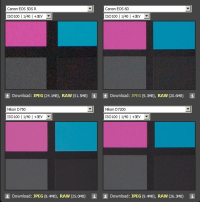
5DS-R DR test on DPReview

Hi Aglet.
Not very down with the dudes here, what is ABC for in your context please, Already Been Chewed, as in doe to death, A Better Camera?

Cheers, Graham.

Aglet said:
NOW... if I'd have made those shots with a 70D or 7d2, or even the 6D, the lack of pattern noise would have made it a LOT easier to process those images the way I want to. It looks like the new 5Ds series will also benefit from reduced pattern noise so, despite still having an absolute low iso DR disadvantage compared to ABC, at least users of these latest Canon bodies will no longer be frustrated by excessive FPN issues.

If Digic 4 had performed as well as Digic 3 I'd still be a Canon fan...now I'm just pragmatic.
 
Upvote 0
Aglet said:
My early 5d2 may have been worse for noise than some later models

My 5DII is one of the very first, bought in early 2009, serial number begins with '0', and I have no such problems, but then I never try to push zero data, and it is only zero data that causes such problems with 5DII and 5DIII. Of course it causes problems with the Exmor too but some people find the noise pattern more acceptable.

This has led to such internet myths that the 6D produces better 'IQ' than the 5DIII. In normal circumstances this just isn't true.
 
Upvote 0
ahsanford said:
Can someone tell me how applicable / useful / relevant pushing an ISO 100 shot by six stops is? I am not a sensor aficionado -- so this may be a normal sensor review sort of comparison -- but I have never needed to do that with my shots.

We Canon folk know that good photography never needs more than 10 stops of dynamic range, that is unless Canon catches up with Sonikon of course :-> ... having said this, and if you actually want a matter of fact answer and this wasn't just to give Canon fanbois an opportunity to copy/paste their opinion:

Testing how much you can push shadows is not because you're meant to do this in your photography the same way, in this case 6ev would apply to very few situations. It's about testing if you can actually use the dynamic range of the sensor on a scene that makes full use of it, i.e. you've got data left to right in the histogram. It's like testing a car in borderline situations, even though you'll probably won't encounter this in your drive to the supermarket.

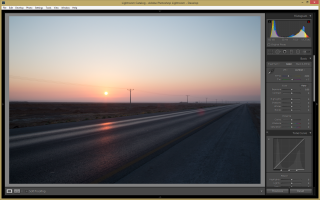
An example is shooting a sunset/sunrise like in the example on drpreview - in the raw file, you've got the sun's corona properly exposed and the rest will be nearly pitch black. You need to push that data to the right, +3ev is realistic, and then draw back some select parts for contrast. This procedure is only possible if the data on the left of the histogram doesn't drown in noise during that procedure.

Disclaimer: You could have bracketing in dpr's tulip shot, which would have resulted in a better image because of more data resolution (not 14bits, but n*14bits stacked). It would be different if something would move in the shot.
 

Attachments

  • dr.png
    dr.png
    268.5 KB · Views: 612
Upvote 0
Marsu42 said:
Testing how much you can push shadows is not because you're meant to do this in your photography the same way, in this case 6ev would apply to very few situations. It's about testing if you can actually use the dynamic range of the sensor on a scene that makes full use of it, i.e. you've got data left to right in the histogram.

No. That is another complete internet driven myth. If that was the case then Sonikon really would produce a much higher image quality in a normally exposed scene that has an EV range running through it of say 10 stops.

If dark tones are recorded on the response of the sensor in the correct place and left there, using the tonal range of the sensor this makes no difference whatsoever to the quality of the dark tones.
 
Upvote 0
Sporgon said:
If dark tones are recorded on the response of the sensor in the correct place and left there, using the tonal range of the sensor this makes no difference whatsoever to the quality of the dark tones.

I think two different things get mixed up often: 1) the higher dynamic range at low iso of Sonikon and 2) the very low noise floor because of their on-sensor exmor tech vs. Canon's higher read noise. Sure both are interconnected on a tech level, but imho it's different when it comes to actual photography usage.

My current understanding from shooting with and without Magic Lantern's dual_iso which expands dr (I'm happy to learn something unless it's pure fanboi-ism):

1. The scene has higher dr than the sensor. Obviously this means clipping in a single exposure = bad (if movement is involved).

2. The scene has lower dr than the sensor. In this case, Canon might actually be better because the data gets more evenly distributed across the 14bit range vs. compression on a 14bit sensor with higher dr. Higher dr just lets you expose lazily and sort it out in post.

3. The scene just fits into the sensor's dr like a sunset (the sun's core will always be clipped, it's just a matter of the corona). Obviously this will happen much later on a Sonikon sensor plus if you ettr you can leave any shadow noise problem out of the equation. For Canon this is ML's dual_iso enabled - the latter's files produce higher dr than Sonikon, btw.

I was talking about case 3 above, like shooting with a 11.5ev 20mp 7d2 vs. a 11.5ev 20mp 6d. You need to selectively raise and expand dark tones that are situated on the very left of the histogram even after ettr'ing. And this is where sensor noise matters as tested by dpreview. It's the same effect as enabling dual_iso even if the dr isn't maxed out - you get cleaner shadows (though with dual_iso it's also b/c you end up with a 16bit raw file).
 
Upvote 0
Marsu42 said:
Sporgon said:
If dark tones are recorded on the response of the sensor in the correct place and left there, using the tonal range of the sensor this makes no difference whatsoever to the quality of the dark tones.

I think two different things get mixed up often: 1) the higher dynamic range at low iso of Sonikon and 2) the very low noise floor because of their on-sensor exmor tech vs. Canon's higher read noise. Sure both are interconnected on a tech level, but imho it's different when it comes to actual photography usage.

My current understanding from shooting with and without Magic Lantern's dual_iso which expands dr (I'm happy to learn something unless it's pure fanboi-ism):

1. The scene has higher dr than the sensor. Obviously this means clipping in a single exposure = bad (if movement is involved).

2. The scene has lower dr than the sensor. In this case, Canon might actually be better because the data gets more evenly distributed across the 14bit range vs. compression on a 14bit sensor with higher dr. Higher dr just lets you expose lazily and sort it out in post.

3. The scene just fits into the sensor's dr like a sunset (the sun's core will always be clipped, it's just a matter of the corona). Obviously this will happen much later on a Sonikon sensor plus if you ettr you can leave any shadow noise problem out of the equation. For Canon this is ML's dual_iso enabled - the latter's files produce higher dr than Sonikon, btw.

I was talking about case 3 above, like shooting with a 11.5ev 20mp 7d2 vs. a 11.5ev 20mp 6d. You need to selectively raise and expand dark tones that are situated on the very left of the histogram even after ettr'ing. And this is where sensor noise matters as tested by dpreview. It's the same effect as enabling dual_iso even if the dr isn't maxed out - you get cleaner shadows (though with dual_iso it's also b/c you end up with a 16bit raw file).

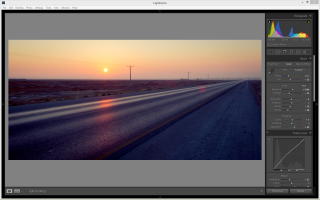
for case 3, is this shot considered to be properly exposed?
 

Attachments

  • Capture.PNG
    Capture.PNG
    2 MB · Views: 168
Upvote 0
meywd said:
for case 3, is this shot considered to be properly exposed?

That depends...was it shot on Canon or SoNikon? ;)

A shot like this is where a SoNikon sensor would be necessary if you wanted to boost the exposure of the foreground by several stops. It's sunset, a time of day when shadows look odd and out of place.
 
Upvote 0
Marsu42 said:
I was talking about case 3 above, like shooting with a 11.5ev 20mp 7d2 vs. a 11.5ev 20mp 6d. You need to selectively raise and expand dark tones that are situated on the very left of the histogram even after ettr'ing. And this is where sensor noise matters as tested by dpreview. It's the same effect as enabling dual_iso even if the dr isn't maxed out - you get cleaner shadows (though with dual_iso it's also b/c you end up with a 16bit raw file).

Even in this situation five or six stops is a joke.
 
Upvote 0
meywd said:
for case 3, is this shot considered to be properly exposed?

Look how the dark tones are well within the range of the sensor. You'd have no problem lifting those shadows by two stops, and if you did you'd end up with a daft looking picture where the foreground is brighter than the sky.

I'd say the exposure is spot on.
 
Upvote 0
meywd said:
for case 3, is this shot considered to be properly exposed?

Look at the right of the histogram for clipping (you can also enable LR to display histogram clipping). In your case, I'd say the shot is exposed just fine, the sun is clipped (of course), the shadows aren't in the noise area save some deep blacks which are nice for contrast.

You could have tried to ettr a bit more and make use of the highlight data "hidden" in the raw file and only recovered by 100% recovery though this method kills the rolloff w/o applying a tone curve.

Sporgon said:
Even in this situation five or six stops is a joke.

Sure, as written above this is a test for extreme situations, an you are free to select +ev values below 6ev. Where does dpreview write that +6ev is the standard situation and most relevant? This is just an excuse for Canon fanbois. If a car is tested for a quick turn in an emergency situation, is it considered to be a joke because you very seldom do quick turns?
 
Upvote 0
Marsu42 said:
Sporgon said:
Even in this situation five or six stops is a joke.

Sure, as written above this is a test for extreme situations, an you are free to select +ev values below 6ev. Where does dpreview write that +6ev is the standard situation and most relevant? This is just an excuse for Canon fanbois. If a car is tested for a quick turn in an emergency situation, is it considered to be a joke because you very seldom do quick turns?

I don't think that is an appropriate analogy. A six stop lift is academic. Simple.

Lets assume the sensor has a 13 stop range. You are saying that the 6 stop lift is a useful facility in an emergency when you cocked up the shot of a life time by being in M mode and forgot to twiddle one of your dials, and you underexposed horribly.

13 stop range, 6 stop lift. In practice you are going to be well into zero data. OK, so you prefer the pattern noise of the Exmor when black turns to grey. Big deal.

I don't mean 'you' personally.
 
Upvote 0
Sporgon said:
13 stop range, 6 stop lift. In practice you are going to be well into zero data. OK, so you prefer the pattern noise of the Exmor when black turns to grey. Big deal.

You're correct, the resolution when pulling very deep shadows from a 14bit file is extremely low, and you're going to post-clip it anyway for a nice contrast. But as you lift a broader range for example with LR's "shadow" slider, actual data gets moved that can become a picture. It's amazing how well this works, either with a high-dr sensor, dual_iso or after hdr merging.

I'm just arguing against the position "Oh, dpr tests +6ev, so they have to be bought by Sonikon and we can forget about this dr test no matter what". But I chose to do a +3ev screenshot above for a reason, and actually I find the 5ds does better than I'd have expected given the pixel density (though the d7200 is better).
 
Upvote 0
Marsu42 said:
"Oh, dpr tests +6ev, so they have to be bought by Sonikon and we can forget about this dr test no matter what".


I think a more plausible hypothesis is that they've tapped into a rich vein of clickbait gold. Exaggerating differences is a long-established, well-respected means of enticing people to glue their eyeballs to your advertisements.

I believe someone previously provided evidence that DxO has a business relationship with Nikon (but not Canon), which brings up questions of their neutrality.
 
Upvote 0
Orangutan said:
Marsu42 said:
"Oh, dpr tests +6ev, so they have to be bought by Sonikon and we can forget about this dr test no matter what".


I think a more plausible hypothesis is that they've tapped into a rich vein of clickbait gold. Exaggerating differences is a long-established, well-respected means of enticing people to glue their eyeballs to your advertisements.

I believe someone previously provided evidence that DxO has a business relationship with Nikon (but not Canon), which brings up questions of their neutrality.
Their lens ratings are even more silly that cameras ratings... ;D
 
Upvote 0
Orangutan said:
Marsu42 said:
"Oh, dpr tests +6ev, so they have to be bought by Sonikon and we can forget about this dr test no matter what".


I think a more plausible hypothesis is that they've tapped into a rich vein of clickbait gold. Exaggerating differences is a long-established, well-respected means of enticing people to glue their eyeballs to your advertisements.

I believe someone previously provided evidence that DxO has a business relationship with Nikon (but not Canon), which brings up questions of their neutrality.

I don't respect such method.
 
Upvote 0
meywd said:
The reason i asked is because even though my case isn't as extreme as some case might be, I didn't need to rise the shadows, and even if I did, it wouldn't have much noise.

That's because this isn't what I'd call a high dr scene - it's a lush evening/morning sun providing little contrast, and everything's lit by it. Try shooting at noon against the sun and to recover detail in the harsh shadows.

meywd said:
Orangutan said:
Marsu42 said:
"Oh, dpr tests +6ev, so they have to be bought by Sonikon and we can forget about this dr test no matter what".
I think a more plausible hypothesis is that they've tapped into a rich vein of clickbait gold. Exaggerating differences is a long-established, well-respected means of enticing people to glue their eyeballs to your advertisements.
I don't respect such method.

Ok, we're all in agreement that running a rumors or review site is about drawing attention, i.e. people talking about it and providing inbound links. We see what kind of attention any dr discussion brings over here, and for a site it's not that relevant if it's pure fanboi talk or people are trying to lean about real world relevance.

On the other hand, at what +ev value should have stopped dpreview not to draw too much hatred? 5ev? 4ev? 3ev? 2ev? 1ev? After all, it's just a synthetic test, and you could argue it doesn't matter at all unless you shoot a a color cards with plain areas, don't denoise and pixel-peep at 100% crop.
 
Upvote 0
Marsu42 said:
meywd said:
The reason i asked is because even though my case isn't as extreme as some case might be, I didn't need to rise the shadows, and even if I did, it wouldn't have much noise.

That's because this isn't what I'd call a high dr scene - it's a lush evening/morning sun providing little contrast, and everything's lit by it. Try shooting at noon against the sun and to recover detail in the harsh shadows.

I know, but isn't that why there is a rule that the best time to shoot is @ the golden hour?

Marsu42 said:
meywd said:
Orangutan said:
Marsu42 said:
"Oh, dpr tests +6ev, so they have to be bought by Sonikon and we can forget about this dr test no matter what".
I think a more plausible hypothesis is that they've tapped into a rich vein of clickbait gold. Exaggerating differences is a long-established, well-respected means of enticing people to glue their eyeballs to your advertisements.
I don't respect such method.

Ok, we're all in agreement that running a rumors or review site is about drawing attention, i.e. people talking about it and providing inbound links. We see what kind of attention any dr discussion brings over here, and for a site it's not that relevant if it's pure fanboi talk or people are trying to lean about real world relevance.

On the other hand, at what +ev value should have stopped dpreview not to draw too much hatred? 5ev? 4ev? 3ev? 2ev? 1ev? After all, it's just a synthetic test, and you could argue it doesn't matter at all unless you shoot a a color cards with plain areas, don't denoise and pixel-peep at 100% crop.

I didn't mean the DR bit it self, but the Exaggerating differences part, as for the +ev I think if they use a real world photo it would be better to evaluate the need, since they are "specialists" they should be able to replicate a real world case where they show the difference between two cameras\technologies.
 
Upvote 0
Marsu42 said:
On the other hand, at what +ev value should have stopped dpreview not to draw too much hatred? 5ev? 4ev? 3ev? 2ev? 1ev? After all, it's just a synthetic test

I confess I haven't read it; however, my take is that "data" always requires context. If they test 6ev and let it stand there then it's deceptive. If they write something like in the real world you'll rarely, if ever encounter this situation, but we just wanted to push it to the limits, then it might be reasonable. They need to make it clear which synthetic tests are applicable to the real world, and which are just for fun (like the MythBusters blowing up a cement truck.)
 
Upvote 0
meywd said:
I know, but isn't that why there is a rule that the best time to shoot is @ the golden hour?

I'm hesitant to subscribe to that legacy view, though noon shots on a high-dr system quickly run into a "hdr look" and have odd color balance when viewed in the comfort of your home.

But often you have no choice. Think of a all day beachball game, do you want the players to stop outside the golden hour? Think of animals performing some behavior only during the day, do you want them to train otherwise?

meywd said:
I didn't mean the DR bit it self, but the Exaggerating differences part, as for the +ev I think if they use a real world photo it would be better to evaluate the need, since they are "specialists" they should be able to replicate a real world case where they show the difference between two cameras\technologies.

Correct, real world scenes are missing - probably really because that everything is a wash from mobile phone to 1dx these days for regular photography.

In dpreview's defense, they don't do any as aggressive interpretation of these results as for example dxo - the latter make it appear as every sensor with a lower score is essentially crap even though some differences will never show for most folk.

Orangutan said:
like the MythBusters blowing up a cement truck.

Which proves synthetic situations can be fun, I seem to remember that distinctive *boom* sound, too :->
 
Upvote 0