6 stop push: 5DsR vs A7R vs A7RII

On would think it would be better to get a proper exposure than to count on the sensor's ability to fix that degree of underexposure.

Problem solved.

sek

Maximilian said:
[sarc mode] Yeah! Keep pushing ;) [/sarc mode]

Honestly:
Yeah! We know about these adavantages of EXMOR. Nothing new. We also know, that Canon didn't show much effort to close that gap. If this is a relevant factor to you and limiting your photography feel free to jump ship.
 
Upvote 0
Upvote 0
Can't wait for the nuclear mushroom cloud on this one!

traveller said:
neuroanatomist said:
traveller said:
Yeah whatever ... is ... the point of this thread.

Yep, that pretty much sums it up.

No, but it sums up your contribution to threads that dare to mention dynamic range. It may not matter to you, but it does impact upon a lot of people's photography. If the topic is becoming a bit of a broken record, then it's really time that Canon did something about fixing it. If it was an issue that never affected my photography, I wouldn't care less, but it often does in one form or another.

You can't blame people for making comparisons and they are going to crop up on CR Forums as they're all over the bloody internet these days.

On a side note: I look forward to Tim's promised comparison between the 5DSr with ND grads and the A7R II bare: it should answer my own usage case questions better.

You can write whatever you like now, as I've got to go to bed -it's getting late in non-America!
 
Upvote 0
It is interesting to see the extremes of a sensor's performance, but at the same time, it is also interesting to see what the practical implications are. Like most others, I want more dynamic range as long as I am getting shots which crash in one end or both of the histogram. But if it is clipping highlights as my current cameras do and only gives me shadow lift capability, to correct for significantly under exposed images ... I would not mind having it, but I'm less interested. If I did astro I might think differently.

I have gone (randomly) through my last 12 months shots, which is quite a few images, to look for the extremes and check how much exposure compensation, shadow lifting etc. have I applied. And, excluding a test case I shared with jrista a couple of threads back, I have never gone past 2.5 stops EC (trying to save an under exposed image), combined with some shadow lift (I do not know exactly how much 0-100 lifting in LR translates to EC). It might be that some would have done more, but I find that the overall quality of the images suffer if I do. If highlights stay the same, in my view, too much shadow lifting is making images look weird and unnatural.

Most of us agree that both the measurements and scoring done by DxO, both for lenses and sensors, are insufficient (and to some extend incomprehensible) to give an objective view of the total qualities of a camera or lens. At the same time too many fall in their trap by judging cameras on DR and lenses on sharpness. However, unless we include all the other elements that makes up a good image, we make unqualified decisions.

It was interesting to see the 6 stop push, but I do not see the practical implication of having that capability. After I received the 5DSR and saw what the images from this camera looked like, I cancelled my A7RII order.
 
Upvote 0
Eldar said:
It was interesting to see the 6 stop push, but I do not see the practical implication of having that capability. After I received the 5DSR and saw what the images from this camera looked like, I cancelled my A7RII order.

It's quite amazing that people can dismiss a camera based on unacceptable noise during a 6 stop push. Even though I did the opposite to you (cancelled the 5dsr for the a7rii) I think the 5dsr is an amazing camera capable of great detail and great images. It is a beast of a camera.
 
Upvote 0
I think the question and answers regarding what to do in very dim situations are interesting and, for the most part, measured. Ultimately, there will *always* be situations where you're forced to push your equipment further than is comfortable, and the results will be a compromise. Every camera has limitations.

A couple of points not mentioned - has anyone thought of video as an alternative? 1/30-1/60sec exposure time per frame allows a lot more light in, and subject motion blur is a lot less noticeable. You might be able to select frames where it was not apparent, too - although the resolution and quality will be far lower than for stills. Just a thought.

Exposing to the right is still a massively useful and important technique (for Canon users, anyway). Once I realised I could go a couple of stops higher in ISO than I was previously comfortable with, my photography benefitted a great deal. IMHO, a bright ISO 6400 shot darkened in post is better than a dark ISO 1600 brightened to the same level. Noise in the shadows in particular.

What about selective noise reduction? For instance, select the darkest parts of the image, and apply stronger (especially colour) noise reduction. The darkest areas can usually take more heavy-handed processing, as they are rarely the focus of an image. The same goes for out of focus areas.

As for pattern noise, would the astrophotographic technique of subtracting dark/bias frames be of any use?
 
Upvote 0
scyrene said:
The darkest areas can usually take more heavy-handed processing, as they are rarely the focus of an image.

Reading CR, one might come to the conclusion that those dark/shadow areas are where all the most interesting and important detail is present, which is why the ability to push an image 6-stops to obliterate shadows is so critical to camera performance.
 
Upvote 0
rs said:
krisbell said:
kraats said:
Who is going to lift shadows 6 stops in real life.

I do, regularly.

OK, I'm intrigued. Could you post some examples?

+1

I do a great deal of landscape type photography, in fact my monument pictures are really landscapes much of the time. I'm only ever looking at a two stop push and that would be extreme. Normally I'm in the region of one stop pull, one stop push.

Perhaps this is why I don't see any difference between the 5DII and the 6D at low ISO. ;)
 
Upvote 0
rs said:
krisbell said:
kraats said:
Who is going to lift shadows 6 stops in real life.

I do, regularly.

OK, I'm intrigued. Could you post some examples?
You should check out Kristian's work, really striking images. I particularly like the (predominantly tan) desert shots, not that those require 6-stop shadow lifting.
 
Upvote 0
A while back all the talk was about 4-5 stop pushes. So to mock this, I made a sarcastic comment about 6-7 stop pushes. Well...here they are!!! ;D

In years from now, we'll be hearing the same nonsense, only the numbers will go up.

Exmorite: "Ha ha, Canon sux, my A7R5 has 18 stops of DR at ISO 100, and I can do a 12 stop push, while loser Canon can only do 9"


At this point, a new realm of photography has emerged thanks to the SoNikon Alliance. They have redefined M mode.

No longer do you have to know what you're doing to use Manual. After all, the entire blogger and vloggerspheres says that you're a newbie, no good, rotten, know-nothing loser if you don't have your camera on "M" 110% of the time.

The Modern technique is simple. Use a nice middle of the road ISO 200. By doing that, one can tap into the power of the Exmor's dynamic range and never worry about anything ever again. Using 7-stop push technology, you have an effective range of 200 - 25,600 ISO. Like the infomercials say, "set it and forget it"

Simply set the camera to ISO 200, set the aperture as wide as it can go. Remember, you're a newbie if you don't always shoot wide open 110% of the time. Then just control the shutter as you see fit. Simple as that.

No matter what you get, do not worry. All of it can be fixed in post processing. Just move the exposure slider to get the desired exposure in each photo in post. Exmor gives you that flexibility. With Exmor, you have freedom.

*****

The irony in this is, the Exmor allows a camera and "modern Sonikon technique user" to operate like the old one-use disposable film cameras. ISO was a constant, and the 1-hour photo lab machine did all the over and under exposure adjustments. The difference is, the photographer armed with lightroom and the exposure slider is now the 1-hour photo machine.


But like those crappy 1-hour photo prints made from disposable cameras - the end result is washed out, inferior image quality.


Congrats on your devolution!
 
Upvote 0
StudentOfLight said:
rs said:
krisbell said:
kraats said:
Who is going to lift shadows 6 stops in real life.

I do, regularly.

OK, I'm intrigued. Could you post some examples?
You should check out Kristian's work, really striking images. I particularly like the (predominantly tan) desert shots, not that those require 6-stop shadow lifting.

I agree that Kris's work is impressive, but I'd be interested to know which have been lifted by 6 stops in his portfolio.
 
Upvote 0
StudentOfLight said:
rs said:
krisbell said:
kraats said:
Who is going to lift shadows 6 stops in real life.

I do, regularly.

OK, I'm intrigued. Could you post some examples?
You should check out Kristian's work, really striking images. I particularly like the (predominantly tan) desert shots, not that those require 6-stop shadow lifting.
I agree, lots of great images there. Some are a bit over processed for my liking, but a very good portfolio.

I did not go through everything, but I did not find any images there that seemed to have required a 6 stop lift. However, not knowing anything about the ambient light makes that difficult. It would certainly be interesting if you could post some examples, especially since you say you do it regularly.
 
Upvote 0
Sporgon said:
..I'd be interested to know which have been lifted by 6 stops in his portfolio.

On a terrible work computer at present so cant link properly but both the below contain 6 stop lifts in places. Also, many of my night-time macro shots contain similar - those are all shot with a Canon so I am doing these lifts with both Sony and Canon.

https://www.flickr.com/photos/kristianbell/16946600384
https://www.flickr.com/photos/kristianbell/17184708029

Its one small bugbear I have against some of these "only need to push 6+ stops if you're drunk or useless" comments is that they seem to imply the only use for such a lift is to lighten the entire image - for me it usually means one small patch that for whatever reason I find really distracting.
 
Upvote 0
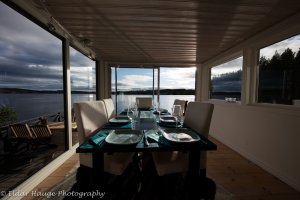
It might be that people don´t think to much about how much a stop or two is. So here is an example.

To me this is at the extreme end of what I do. I have done more extremes than this, but I believe it is a good example.

First the straight RAW-file, just levelled, then the finished image, then two crops from each. If this was a more important picture, I would have worked more on the noise reduction, but that is a bit beside the point here.

The finished picture is Exposure: +1.5, Highlights: -100, Shadows: +100, Whites: +55. Colour luminance (blue): -34 and some rudimentary noise reduction. There´s a Looong way to 6 stop.
 

Attachments

  • _23A0758-6.jpg
    _23A0758-6.jpg
    370.6 KB · Views: 228
  • _23A0758.jpg
    _23A0758.jpg
    492.4 KB · Views: 214
  • _23A0758-4.jpg
    _23A0758-4.jpg
    392.6 KB · Views: 185
  • _23A0758-3.jpg
    _23A0758-3.jpg
    667.3 KB · Views: 209
Upvote 0
I have never seen how much compensation +100 shadow lift represents. So I played around with a couple of images. It seems to me that it represent around 2.0 to 2.5 stops. Does anyone have more presise info to share?

If what I found is correct, the shadows in the image above is lifted 4-4.5 stops (which was more than I thought).
 
Upvote 0