60D over exposed in sunlight - how do I control?

Status
Not open for further replies.
May 1, 2013
114
0
5,981
I have a Canon 60D + 50mm F1.8 lens

It's on shutter speed of 50, FPS of 24 and aperture of 1.8 (what I want) - I have on manual exposure
I tested yesterday. All fine

I shoot today. Damn!!
Over exposed!!
There wasn't a control for the exposure - or at least I couldn't find it

I put on auto exposure - all fine now and beautiful video
BUT I wanted the blurred background look
The aperture was pushed up to a higher value and no longer changeable

What am I doing wrong?
(This was actually my first attempt to do video outside!!)

Thanks


Omar
 
tpatana said:
Turn down the light intensity. Do you have a dimmer?
how do i turn down?
what control?

i couldn't dim the sun - it's powers where too great for me. (joke)
i take it u r talking about something else
let me know what it is

still a relative complete newbie - so ur advice is greatly appreciated

thanks
 
Upvote 0
omar said:
tpatana said:
Turn down the light intensity. Do you have a dimmer?
how do i turn down?
what control?

i couldn't dim the sun - it's powers where too great for me. (joke)
i take it u r talking about something else
let me know what it is

still a relative complete newbie - so ur advice is greatly appreciated

thanks

"Dim the sun" = use a neutral density filter. If you're already at 100 ISO and like your other settings, that's your easiest option that I know of. Moving to (or creating) shade, or shooting when there is less sun are other options, but it sounds like that's not what you're looking for.
 
Upvote 0
If you are going to shoot at f/1.8... you have to know that is going to let in a ton of light through the aperture and into the sensor.

Last year when I shot football with my 60D, I was shooting at f/2.8 (which is about 2.3x less light than at f/1.8) I was getting shutter speeds of about 1/6000 and some at 1/8000 of a second.

So I don't know if yesterday was cloudy and today was sunny, but that what you are looking at.

Since you are in the early phases of having the camera, I'd suggest shooting in aperture priority, setting the exposure compensation in the middle and allow the camera to choose the shutter speed. If it was sunny, I'd probably set the iso to 100.... Then half press your shutter and look and see what your shutter speed is. It should be at least 1/(focal length), so if you shooting at 100mm, then you should at least have 1/100 of a second.
 
Upvote 0
Oh... and if it is still too bright, and you are at 1/8000 of a second with iso 100, then get a neutral density filter. It won't change the colors but it will limit the amount of light that goes through the sensor.

They really come in handy during the day when you want to take long exposures of rushing water and it is crazy sunny... but for a shot like that, I'd close the aperture.
 
Upvote 0
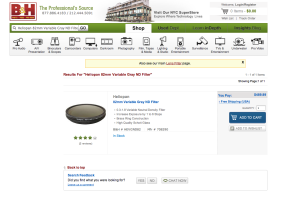
Hi Omar, get yourself one of these, there are a few Brands around it doesn't need to be this Brand, B+W make them as do others, I use this one on my 24-70 to control light/movement.

Lee Filters also make something similar but in a Rectangular design that fits into a Filter Holder, but for Video the Circular ND Filter will work better, I think, I'm not much into Video.
 

Attachments

  • Screen Shot 2013-05-19 at 8.17.53 AM.png
    Screen Shot 2013-05-19 at 8.17.53 AM.png
    194 KB · Views: 1,452
Upvote 0
eml58 said:
Hi Omar, get yourself one of these, there are a few Brands around it doesn't need to be this Brand, B+W make them as do others, I use this one on my 24-70 to control light/movement.

Lee Filters also make something similar but in a Rectangular design that fits into a Filter Holder, but for Video the Circular ND Filter will work better, I think, I'm not much into Video.


Wow, look at that price, haha. But yeah, ND is the only way you'll be able to get wider open on the aperture. I do understand that the shutter speed needs to be at 1/50th sec for 24p ;) You probably won't get the aperture to 1.8 though outside in broad daylight. I'd use it on a different time of day where the sun is at an angle for better control.
 
Upvote 0
eml58 said:
Hi Omar, get yourself one of these, there are a few Brands around it doesn't need to be this Brand, B+W make them as do others, I use this one on my 24-70 to control light/movement.

Lee Filters also make something similar but in a Rectangular design that fits into a Filter Holder, but for Video the Circular ND Filter will work better, I think, I'm not much into Video.

Or get a regular (non-variable) ND filter and use ISO and shutter speed to adjust.
 
Upvote 0
Just this morning I was shooting video outside with the 60D. Generally speaking, 1/50 is the shutter speed you need to stick with which only leaves ISO and aperture that can be adjusted. Since even at ISO 100 your f/stop is going to be really high that means the only way to get down as low as you want is with ND filters. In a nutshell they are like putting sunglasses on a lens.

So the settings I used were:

1/50 shutter
ISO 160 (I only use multiples of 160, or "native ISOs", but that is a different topic)
ND .9 filter
f/5.6

Like I said, to get down to f/1.8 in broad daylight without drastically increasing the shutter speed is going to take a crap ton of ND.
 
Upvote 0
dmosier said:
Just this morning I was shooting video outside with the 60D. Generally speaking, 1/50 is the shutter speed you need to stick with which only leaves ISO and aperture that can be adjusted. Since even at ISO 100 your f/stop is going to be really high that means the only way to get down as low as you want is with ND filters. In a nutshell they are like putting sunglasses on a lens.

So the settings I used were:

1/50 shutter
ISO 160 (I only use multiples of 160, or "native ISOs", but that is a different topic)
ND .9 filter
f/5.6

Like I said, to get down to f/1.8 in broad daylight without drastically increasing the shutter speed is going to take a crap ton of ND.

+1 stacking filters can get a bit pricy and might lose a bit of image quality too. If you really want good background blur I'd highly suggest a longer focal length.... There's plenty out there for cheap but for better IQ and background blur for a budget there's the 200mm f/2.8L or 70-200 F/4L with an ND filter might get the look you want and they're some of the lowest priced L lenses.
 
Upvote 0
dmosier said:
ISO 160 (I only use multiples of 160, or "native ISOs", but that is a different topic)

Do you have a source for this? I've seen people arguing for and against "native ISOs" aka "multiples of 160". It would seem really weird that ISO noise would be consistent across different sensors. I can believe that this might be true for some cameras... but for ALL digital cameras? :o
 
Upvote 0
dirtcastle said:
dmosier said:
ISO 160 (I only use multiples of 160, or "native ISOs", but that is a different topic)

Do you have a source for this? I've seen people arguing for and against "native ISOs" aka "multiples of 160". It would seem really weird that ISO noise would be consistent across different sensors. I can believe that this might be true for some cameras... but for ALL digital cameras? :o

With the 5DII people were advising to shoot at multiple of 160 for the best in noise performance, as 125 is digitally gained from 100 while 160 is brought down from 200 in-camera. So (theoretically) multiples of 160 are cleaner for when higher ISO is needed. I assume the 60D will be similar, as the sensor isn't any better in performance.
 
Upvote 0
Nishi Drew said:
dirtcastle said:
dmosier said:
ISO 160 (I only use multiples of 160, or "native ISOs", but that is a different topic)

Do you have a source for this? I've seen people arguing for and against "native ISOs" aka "multiples of 160". It would seem really weird that ISO noise would be consistent across different sensors. I can believe that this might be true for some cameras... but for ALL digital cameras? :o

With the 5DII people were advising to shoot at multiple of 160 for the best in noise performance, as 125 is digitally gained from 100 while 160 is brought down from 200 in-camera. So (theoretically) multiples of 160 are cleaner for when higher ISO is needed. I assume the 60D will be similar, as the sensor isn't any better in performance.

Exactly. So 160 is over-exposed by 1/3, and then SW tunes it down by 1/3. One way to reduce noise, but I prefer shooting with the real native ISOs (multiple of 100), and then decide myself how to tune the exposure for the shot.
 
Upvote 0
You don't HAVE to shoot at 1/50. If you don't have an ND filter and want to shoot at 1.8 or 2.8 outside, just crank the shutter speed up. Yes, it will change the look of your video, but you just have to decide if you'd rather have the shallow DOF or not. You don't always have to follow the rules. ND filter is a great solution, but not the only one. I'd also recommend stopping down to f/2.8 or 4, which will still give a great blurred out background on the 50 1.8.
 
Upvote 0
sjschall said:
...just crank the shutter speed up...
This is poor advice for someone wanting to create smooth, shallow depth of field video. It will take at least 1/250 - 1/500 shutter to shoot in mid day sun at f/1.8. That will strobe unbearably in your final output.

I need to use two Hoya NDx4 filters to get f/2.8, Iso 160 and 1/50th shutter. To get to f/1.8 you will most likely need one NDx8 and another NDx4 depending on the back ground. Sand, concrete and snow can increase the requirement for ND's considerably. Also if you use inexpensive ND's and/or inexpensive variable ND filters, they tend to create a very red or rust hue to all your video that is hard to remove. I've found it better to buy one really good filter as I can afford them, rather than inexpensive ones that tend to degrade your image significantly.

On a side note, f/1.8 is nearly impossible to keep in focus unless the subject is close to infinity on that lens. As others have suggested f/2.8 is about the minimum I'll even try if there is any movement in the scene.

http://www.hoyafilter.com/hoya/products/pro1digitalfilterseries/pro1dnd8/

Cheers,
Pete
 
Upvote 0
omar said:
I have a Canon 60D + 50mm F1.8 lens

I shoot today. Damn!! Over exposed!!...I wanted the blurred background look
The aperture was pushed up to a higher value and no longer changeable...What am I doing wrong?

This is a very common problem, especially for new DSLR videographers. It can be especially confusing if you're used to a camcorder. On a consumer camcorder the depth of field is deep, so you don't lose much by stopping down, some have built-in ND filters, and more adjustable video gain.

A flexible solution for DLSRs is using a variable ND filter. On this variable ND shootout, the Tiffen was well rated. I use it on my 5D3 and it's very good: http://www.learningdslrvideo.com/variable-nd-filter-shootout/

The other solution is stopping down but using a longer focal length. I sometimes shoot interviews at 280mm @ f/4 on my 5D3 which is equal to 175mm on your 60D. If you had a 70-200 f/4, at 175mm you could stop down to f/8 at a 20 ft camera-to-subject distance and have about the same depth of field as 50mm @ f/1.8 at 10 ft: http://www.dofmaster.com/dofjs.html

F/8 is 4 1/3 stops darker than f/1.8 so that might be enough to maintain your shutter speed -- on a cloudy day, but not in bright sun.

As a last resort you can increase shutter speed and sometimes on an interview or static subject you can get away with it, but it's risky. It can cause strobing, especially if anything is moving -- even out-of-focus tree leaves in the background.

The problem is a sun-lit subject is incredibly bright. You don't notice this because your eyes are so adjustable. They can handle starlight at 0.0001 lux to a sun-lit beach at 100,000 lux -- a billion-to-one range. Without aids like a ND filter, a video camera cannot handle this.

At a fixed shutter speed and ISO 100, a sun-lit subject will need either 1/8000th sec or f/22 or some combination to balance the exposure. If you want f/1.8, your 60D might over-expose even at 1/8000th, it's maximum shutter speed: http://www.calculator.org/calculate-online/photography/exposure.aspx

I'd suggest something like a 70-200 f/4 lens, coupled with a variable ND filter. That gives you (a) More flexibility at subject-to-camera distance, (b) Ability to stop down and maintain shallow DOF, (c) Variable ND to dial down light and maintain a wider aperture.

 
Upvote 0
Status
Not open for further replies.