Canon Announces the Canon RF 14mm f/1.4L VCM

The uses are different. For a short trip, I usually take the 15-35 + 70-200, and get a very good coverage.
But with a larger backpack, on longer trips or hikes, I could replace the WA zoom with the 14mm + 24mm + 35mm, for higher optical quality.
I will never sell my WA zoom, optically sharp, and much more versatile and easier to use than 3 primes needed to replace it, in cities for instance.
Ergo: I need both, WA zoom + 14mm.:giggle:
I have the 24-70, so 24-35 range is already covered. Which leaves the 15-23 uncovered. I do like the versatility of a zoom, but the wider aperture, and I assume lightness and sharpness of a prime are also appealing to me.

I suppose I'll wait a bit to read reviews and see more varied sample pictures. Not sure it makes sense for me to own both.
 
Upvote 0
I have the 24-70, so 24-35 range is already covered. Which leaves the 15-23 uncovered. I do like the versatility of a zoom, but the wider aperture, and I assume lightness and sharpness of a prime are also appealing to me.

I suppose I'll wait a bit to read reviews and see more varied sample pictures. Not sure it makes sense for me to own both.
I see it just like you, but I am still waiting for a 24-70 II. Then, I could sell the 15-35 and add the 14mm to the 24-70 and 70-200 for short trips. The gap between 14 and 24 wouldn't bother me much. One additional (lightweight) lens wouldn't matter much.
Also, I am absolutely convinced that the 14mm will be extremely good! Stlll 3 weeks of waiting and waiting...🥲
 
Upvote 0
Astro imaging though, is one photographic realm where you do have to do alot of post processing. The corrections for removing distortion aren't going to affect star fields that significantly, since trailing and coma are the worst offenders.

The coma that I see on the TDP is about what I thought it would be, not perfect (we can tell that on the MTF), but really good.

Going to add that into the review now actually.
Concerning distortion: I get ugly moire patterns when blending distortion corrected images together for startrails. So I worry that this is getting worse for VCM lenses with the heavy correction.

And yipp, I also spotted the difference between sagittal and meridional resolution in the MTF charts at the outer part of the image circle. That is usually a sign for coma.
 
Upvote 0
I see around half a stop in the worse regions of the frame, never reaching a stop. But the point stands, this is a hard trade off due to size and isn’t saved by excellent engineering elsewhere.
The difference might come from my comparison against the old Sigma 14/1.8, but what counts is the absolute shading of around 4 EV at f/1.4 and still 3 EV at f/2.0 (which would be an acceptable shading for my work). The coma is looking good at f/1.4. So a good 14mm 'astro' lens at f/2.0 is not bad! The low weight can be nice when hiking and the price ... well, nothing is perfect!
 
  • Like
Reactions: 1 user
Upvote 0
I see it just like you, but I am still waiting for a 24-70 II. Then, I could sell the 15-35 and add the 14mm to the 24-70 and 70-200 for short trips. The gap between 14 and 24 wouldn't bother me much. One additional (lightweight) lens wouldn't matter much.
Also, I am absolutely convinced that the 14mm will be extremely good! Stlll 3 weeks of waiting and waiting...🥲
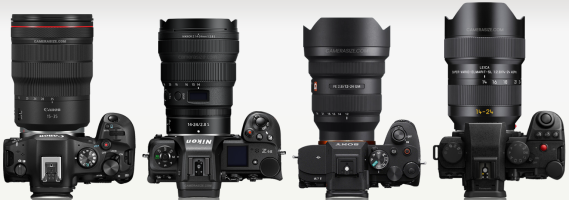
Am I the only one wishing for a 12-24 or 14-24 F2.8 ? I am also bothered by the 24-35 overlap and the 10-20 is almost too extreme and F4.
 
  • Like
Reactions: 2 users
Upvote 0
They have 7, 10, 14, 15, 15, 16, 16, 20 at various price points.. so if you're speaking of overlap....
Well, many of those are not f/2.8 and don't work as well as the 15-35 for astro. The 15-35 is excellent but harder to justify if already owning the 24-70 (to each their own). Each manufacturer (even Leica!!) has at least one bright UWA without too much overlap with the 24-70. Looking at the widest f/2.8 zooms in the industry (there is also the Sigma 14-24 for E and L mounts):

1770302426576.png

I would have expected a higher priority lens than the 10-20 f/4.
 
Upvote 0
Well, many of those are not f/2.8 and don't work as well as the 15-35 for astro. The 15-35 is excellent but harder to justify if already owning the 24-70 (to each their own). Each manufacturer (even Leica!!) has at least one bright UWA without too much overlap with the 24-70. Looking at the widest f/2.8 zooms in the industry (there is also the Sigma 14-24 for E and L mounts):

View attachment 227872

I would have expected a higher priority lens than the 10-20 f/4.

12-15mm.. doesn't matter whatsoever for astro. All 12 would do is add size and cost. The 15-35 is brilliant at 15, barely distortion. You can get them cheap, it's light. Who cares about an overlap between 24 to 35? That's strange.
 
  • Like
Reactions: 1 users
Upvote 0
12-15mm.. doesn't matter whatsoever for astro. All 12 would do is add size and cost.
What doesn't matter exactly? Removing 24-35 and adding the 12-14 range could keep the lens around the same size. Look at the Sony 12-24, it's the same size of the RF 15-35. Stabilization would't be needed.

EDIT after your edit :) --> the 15-35 is brilliant for sure, it's on my list since a long time but looking at what the industry offers on other systems, I'm wondering at this missing piece in RF mount. Fully agree that 14 vs 15 is not a huge difference (but very noticeable), but 12mm is another realm. I could for sure ignore the 24-35mm range, but the point would be having a bright UWA (not UWA to WA) that could be as big as the 15-35 while offering more value to whom already has the 24-70.
 
Last edited:
Upvote 0
What doesn't matter exactly? Removing 24-35 and adding the 12-14 range could keep the lens around the same size. Look at the Sony 12-24, it's the same size of the RF 15-35. Stabilization would't be needed.

EDIT after your edit :) --> the 15-35 is brilliant for sure, it's on my list since a long time but looking at what the industry offers on other systems, I'm wondering at this missing piece in RF mount. Fully agree that 14 vs 15 is not a huge difference (but very noticeable), but 12mm is another realm. I could for sure ignore the 24-35mm range, but the point would be having a bright UWA (not UWA to WA) that could be as big as the 15-35 while offering more value to whom already has the 24-70.

The Sony costs twice as much (15-35 deals all the time) and you can't filter it. The Leica you mentioned is an overpriced Sigma. There are a bevy of lenses you can adapt to RF mount that would cover what you want.

I just don't get the amount of people that want something that doesn't exist and overcomplicating things. Adapt the EF sigma? You could even adapt the Nikon.

(apologies earlier for misunderstanding the overlap comment)
 
Upvote 0
The Sony costs twice as much (15-35 deals all the time) and you can't filter it. The Leica you mentioned is an overpriced Sigma. There are a bevy of lenses you can adapt to RF mount that would cover what you want.

I just don't get the amount of people that want something that doesn't exist and overcomplicating things. Adapt the EF sigma?

(apologies earlier for misunderstanding the overlap comment)
People wanting things is pretty legit, right? Especially in a closed mount :D

As I started a few years ago with the Canon R system, every purchase I make tends to be native as I don't have any EF glass I needed adapting. What would you suggest as an alternative to the Sony 12-24 2.8, taking into account adapting? Disregarding cost and prioriting weight/size and delivering good astro performance.
 
Upvote 0
People wanting things is pretty legit, right? Especially in a closed mount :D

As I started a few years ago with the Canon R system, every purchase I make tends to be native as I don't have any EF glass I needed adapting. What would you suggest as an alternative to the Sony 12-24 2.8, taking into account adapting? Disregarding cost and prioriting weight/size and delivering good astro performance.

Start here: https://www.laanscapes.com/blog/best-lens-for-astrophotography-nightscapes
 
  • Like
Reactions: 1 user
Upvote 0
Only 2 other RF lenses have flourite, 400-600.. lots of EF and those are pretty much EF designed. Wild to see fluorite back in a lens.
Correction...there were 5 others and thus now 6 RF lenses with fluorite elements, including the new 14/1.4. The 400/2.8 and 600/4, as you state...and also the 800/5.6 and 1200/8 but of course those are really just the 400 and 600 with a built-in 2x. However, the RF 100-300/2.8 also has a fluorite element (and so was the first 'designed-for-RF' lens to include one).
 
Last edited:
  • Like
Reactions: 2 users
Upvote 0
Correction...there were 5 others and thus now 6 RF lenses with fluorite elements, including the new 14/1.4. The 400/2.8 and 600/4, as you state...and also the 800/5.6 and 1200/8 but of course those are really just the 400 and 600 with a built-in 2x. However, the RF 100-300/2.8 also has a fluorite element (and so was the first 'designed-for-RF' lens to include one).

Ah ok, Canon doesn't list those. Thanks. (duh on the 8 and 12)
 
  • Like
Reactions: 1 user
Upvote 0